Crisis Communications Plans
Protect Your Brand With A Professional Crisis Communications Plan from TrizCom PR
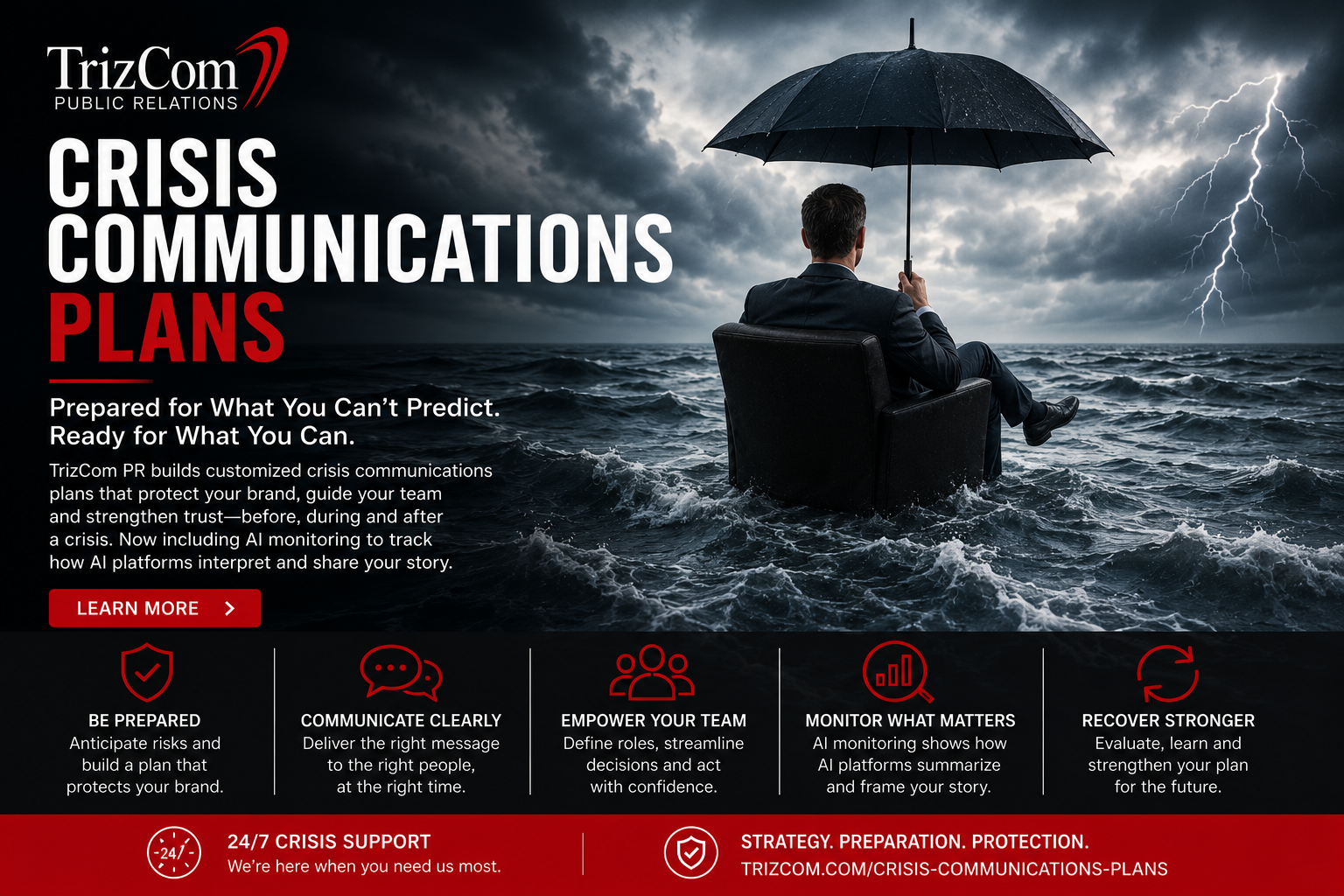
No matter how much you prepare, unplanned crises can still come out of nowhere. That's why TrizCom PR offers professional crisis communications plans. We provide detailed reviews and updates to ensure your process for reporting, decision making and executing a crisis plan is the best. In addition, our crisis communications plans are customized according to each brand's needs, and they include media training and potential simulations, so you're ready.
Today, preparation must account for more than traditional media and social channels. AI-powered search and AI-generated answers increasingly shape perception before organizations have time to respond. TrizCom PR incorporates AI monitoring into crisis communications planning so brands understand how AI platforms may summarize, frame, and reuse information during a crisis.
With our help, you can rest easy knowing that if an unexpected situation arises, every step of the way has been thought through for maximum effectiveness. As a result, you will be able to manage most crisis incidents with confidence that every detail has been accounted for and prepared.
Crisis Communications Plans - Customized Solutions
Our crisis communications plans are customized according to each brand's needs. We understand that every brand has different goals and objectives, and we will work with you to create a plan that works for you. Likewise, our plans are tailored to fit your brand's unique needs, so you can rest assured that every detail has been noticed.

An Integrated and Comprehensive Plan for Any Crisis
Crisis Communications Plan
A well-designed crisis communications plan is a critical component of any comprehensive crisis management strategy. The key elements of an effective crisis communications plan include:
Establishing Groundwork for Transparent Culture
Ensuring all employees are aware of crisis communication expectations and guidelines is foundational. This includes clearly defining communication standards, protocols, and responsibilities. Employees should know who is responsible for providing information, when and how to disseminate it, and what type of language is appropriate in crisis response.
Developing a Crisis Reporting Process
Creating dedicated channels and personnel for handling crisis-related inquiries and information sharing is crucial. This allows both internal and external stakeholders to stay informed about developing situations. A streamlined, transparent reporting process is essential for maintaining control of the narrative during a crisis.
In addition to internal and external reporting channels, TrizCom PR incorporates AI monitoring into the crisis reporting process. This includes tracking AI-generated summaries, answers, and recommendations related to the issue so leadership understands how the situation is being interpreted beyond traditional media coverage.
Assembling an Approved Crisis Team
Identifying the team that will manage communications throughout the entire crisis lifecycle is a vital step. This team should include knowledgeable experts who can make sound, timely decisions under high-stress conditions. Clearly defining each team member's responsibilities ensures a coordinated, effective response.
Incorporating these crisis communications plan elements into the overall crisis management strategy ensures the organization is prepared to proactively and transparently address crises as they emerge. By establishing the groundwork, reporting processes, and crisis communications team in advance, the organization can respond quickly and effectively to protect its reputation and stakeholders.
A modern crisis communications plan also considers how AI systems interpret and amplify information. TrizCom PR integrates AI monitoring into crisis planning to anticipate how AI platforms may surface coverage, prioritize sources, or repeat early narratives. This visibility allows organizations to correct inaccuracies and reinforce accurate messaging before AI-driven summaries become embedded.
How a Crisis Communications Plan Works in Practice
A crisis does not unfold in a single moment. It moves through phases, often faster than expected, and now across both traditional channels and AI-driven discovery environments.
TrizCom PR designs crisis communications plans that guide organizations through every stage of an incident. This ensures leadership, teams, and stakeholders remain aligned while reputation, trust, and accuracy are protected.
Crisis Communications Planning by Phase
| Crisis Phase | What Happens | How TrizCom PR Supports You |
|---|---|---|
| Preparation | Risks exist but have not surfaced publicly | Identify vulnerabilities, establish crisis teams, define reporting and approval processes, draft holding statements and integrate AI monitoring into crisis readiness |
| Issue Escalation | Early signals appear internally, in media or through AI-generated summaries | Activate reporting procedures, assess severity, confirm facts and monitor how AI platforms begin framing the issue |
| Active Crisis | Media attention increases and stakeholder scrutiny intensifies | Execute approved messaging, deploy trained spokespeople, manage media relations and use AI monitoring to identify inaccuracies or narrative drift |
| Stabilization | Attention begins to slow but interpretation continues | Maintain consistent updates, reinforce verified information and ensure AI-generated answers reflect accurate context |
| Post-Crisis Review | Long-term perception and trust take shape | Conduct debriefs, evaluate response effectiveness, update the crisis plan and assess how AI platforms continue referencing the event |

Crisis Communications Plans - Process Development
When a crisis occurs, how is it reported? Who hears about it? Who is the top-tiered decision maker? Who is responsible for carrying out the plan? Best practices from our experience involve a crisis team for each issue, consisting of a consistent corporate team (e.g., legal, communications, risk, safety and operations) and local market company leaders. This process now includes AI monitoring insights to ensure crisis teams understand how AI-powered platforms may be shaping narratives alongside media and stakeholder communications. This helps give corporate and local perspectives a voice while bringing support services' expertise to bear on the problem. (e.g., dealing with the media, legal exposure or insurance issues.)
Possible Crisis Communications Plans Tactics:
Define the crisis team composition
Regional reporting call center
Appointing a decision maker
Design an approval process.
Designate accountability
Develop technology tools – an online war room, for example, that works to keep the corporate and local teams on the same track.

Written Crisis Communications Plans
In the throes of a crisis, the team will be under stress and will have to move fast. The more planning we can do beforehand – in anticipation of a crisis – the easier it will be to make and execute decisions when a crisis occurs.
Possible plan elements:
Preparing for a crisis
First-hour response
Catastrophic incidents/fatality procedures
Step-by-step scenario response
Incident investigation/interviews
Dealing with regulators and local authorities
Crisis media/key messages
Correction procedures
AI monitoring protocols to track how AI platforms summarize crisis-related information and identify emerging narrative risks
Checklists
Telephone lists
Action flow charts
Tools and resources needed.
Crisis simulation and annual review procedures

Communication
The channels on which a brand communicates consistent, credible and authentic messages should be a priority 24/7. Whether through the media, over email, in person, in a newsletter, on the phone or over social media, a company usually has established ways to communicate with its targeted audiences, including employees. When audiences are used to receiving company communications, it strengthens relationships and makes it easier to deliver bad news, as needed, during a crisis.
Established channels for social media and the news media are especially important during a crisis. When a company has established credibly proactively, there is a history and pattern of positive news against which negative news can be shared. However, communication with reporters during a crisis can be complex.
AI-generated answers now act as an additional communication layer. During a crisis, AI platforms may surface summaries that influence stakeholder perception without direct engagement. TrizCom PR monitors these environments to ensure AI-driven narratives align with verified information and approved messaging.
Possible Tactics:
Review communication channels
Review key messages.
Media training
Media protocol
Media and social media policies signed by every employee

Media Management During a Crisis
Proactive PR
Ensure you have an active, positive PR program before a crisis occurs to build relationships with local reporters, maintain a robust website newsroom and make working with journalists part of business as usual. Also, all employees must sign a media and social media policy to understand who can talk to the press.
Media protocol
Especially in the event of a catastrophic event where the media converges at your disaster site, the media plan needs to outline how you will accommodate them. For example, identify a building near the site where they can go, and you can brief them regularly.
Media spokesperson training
The media needs to get the story whenever the crisis happens. If you don't talk to reporters, they will find someone who will speak– and you lose control of your message. Training will help spokespeople understand who is authorized to speak, how the media operates, what messages go out at different points during a crisis and how to control your message.
Third-party strategy
You can say your priority is safety and quality, but a third party can say it more credibly. Once you have your list of crisis scenarios, compiling a list of who might speak for you during a crisis may strengthen your position.
Especially in the event of a catastrophic event where the media converges at your disaster site, the media plan needs to outline how you will accommodate them. For example, identify a building near the site where they can go, and you can brief them regularly.
AI Monitoring to Media Management During a Crisis
Media management now extends beyond journalists and publishers. AI platforms often synthesize coverage and expert commentary into single answers. TrizCom PR uses AI monitoring to evaluate how those summaries are forming and which sources are influencing them, allowing corrective action through earned media and authoritative channels when needed.
Crisis Communications Plans Simulations
Organizations use TrizCom PR's crisis communications simulations to evaluate how they respond to a potential real-world crisis. The simulations are designed to replicate the real-world environment, people, and complexity of crises, and to test organizational readiness during emergencies or disruptions.
During a crisis communications simulation, organizations can practice their crisis management strategies under realistic conditions. Participants may be expected to work together to make decisions and develop a cohesive response plan that addresses critical elements, including legal issues, media relations, internal and external stakeholder engagement, regulators, customer service, and product/service operations.
Simulations can also include AI-driven discovery scenarios. TrizCom PR incorporates AI monitoring insights into simulations so teams can practice responding not only to media pressure, but also to how AI platforms might summarize events, prioritize sources, or surface outdated information during a crisis.
These simulations provide invaluable insight into how an organization can best prepare for any eventuality, allowing them to take proactive steps that could prevent costly damage-control efforts down the line. By mitigating risk before it happens, organizations can confidently face any challenge while maintaining their brand's integrity.


Crisis Communications Media Training
TrizCom PR has designed our Crisis Media Training to help prepare executives, spokespeople, and key stakeholders for interactions with media that may arise during a critical incident or newsworthy event. The training teaches proven techniques for developing effective messages and understanding what questions will likely be asked during interviews.
The goal is two-fold: respond confidently when interviewed; and convey accurate, consistent messages that help protect the organization's brand or reputation. In addition, crisis communications training ensures all stakeholders understand proper practices for managing communication before, during and after a crisis develops—with proven methods for controlling damage.
Professional Reviews and Updates of your Crisis Communications Plan
The final part of the crisis management process is collecting data, reviewing how the process has worked and tweaking the plan. Simple questions like, how did it go? What could we have done better? Or what resources would it have been helpful to have? Answering these questions makes a good plan great. All companies learn by doing, but capturing lessons is important.
It's also important to track crisis events monthly, quarterly and annually with a risk assessment tool. This report should be streamlined and high-level to give senior management a view of each crisis by type of event (safety, HR, reputational), the level of risk (watch, increased intensity, near crisis or at crisis level), revenue exposure, project name and crisis team/office.
This review process increasingly includes AI monitoring insights. TrizCom PR evaluates how AI platforms reference past crisis events over time, helping organizations understand whether outdated or inaccurate narratives persist and where proactive corrections are needed to protect long-term reputation.
Possible Tactics:
Risk monitoring process
Crisis simulation
Analysis of resource needs
Method for modifying/improving the plan.
Tracking


Are you prepared for potential crises?
Nothing is more important than having a solid crisis plan regarding your brand's reputation. At TrizCom PR, we understand the importance of being well-prepared. We offer detailed strategies and plans so your team can stay one step ahead when facing unexpected challenges.
As an established provider of public relations services, our approach combines both knowledge and experience to help create an effective crisis plan tailored specifically to what works best for your organization. With our process and manual in place, you will feel confident that your team knows how to respond quickly and appropriately in times of need without damaging the brand's image.
214-242-9282
Crisis Communications Plans FAQ
What is a crisis communications plan?
A crisis communications plan is a documented process and playbook that defines who does what, when, and how your organization communicates during a crisis. TrizCom PR builds plans that include reporting protocols, decision-making structure, approved messaging tools, and clear steps for the first hour through recovery.
Why does my organization need a crisis communications plan?
A plan reduces confusion when time is tight. It helps teams move faster with fewer missteps by clarifying roles, approval processes, stakeholder communications, and spokesperson responsibilities. TrizCom PR creates plans that protect trust by keeping messages consistent, credible, and aligned with your organization’s values.
What should be included in a crisis communications plan?
A strong plan typically includes a crisis team roster, escalation and reporting procedures, first-hour response steps, holding statements, key messages, stakeholder lists, media protocols, internal communications guidelines, and scenario-based checklists. TrizCom PR also builds review and update processes so the plan stays usable.
Who should be on a crisis communications team?
Most organizations need a core team that includes communications, legal, operations, risk, and leadership, with local market leaders added when relevant. TrizCom PR helps define roles and accountability so the team can make timely decisions without duplication or delays.
Why should AI monitoring be included in a crisis communications plan?
AI platforms often summarize crisis events long after initial coverage appears. If early narratives are inaccurate or incomplete, those summaries can persist and influence trust. TrizCom PR includes AI monitoring in crisis communications plans to help organizations identify how AI systems interpret events and take corrective action before reputational issues escalate.
How do we decide who approves messages during a crisis?
Approval should be pre-defined so teams do not debate process while the situation escalates. TrizCom PR designs an approval workflow that balances speed with oversight, including who approves holding statements, media responses, employee messages, and stakeholder updates.
What is a holding statement and when should it be used?
A holding statement is a short, verified message used early in a crisis to acknowledge the situation and set expectations for updates. TrizCom PR drafts holding statements in advance for likely scenarios so your organization can respond quickly without guessing or overexplaining.
How should we communicate with employees during a crisis?
Employees need timely, clear guidance to reduce confusion and prevent misinformation. TrizCom PR includes internal communications procedures that define what employees should know, when they will receive updates, and how questions are handled so teams stay aligned.
How does media training support a crisis communications plan?
A plan is only as effective as the people delivering it. TrizCom PR provides crisis media training so designated spokespeople understand how interviews work, how to stay on message, and how to communicate accurately under pressure.
Should crisis simulations be part of our plan?
Yes. Simulations help teams practice decision-making, coordination, and messaging before a real crisis occurs. TrizCom PR runs realistic simulations that test reporting channels, approval flow, stakeholder response, and media readiness so gaps are identified early.
How often should we review and update our crisis communications plan?
Plans should be reviewed at least twice a year and updated after organizational changes or major events. TrizCom PR also recommends post-incident reviews to capture lessons learned and refine procedures so the plan improves over time.
This page was reviewed by Jo Trizila, founder and CEO of TrizCom Public Relations, to ensure accuracy, clarity and alignment with current digital PR practices.
Updated July 28, 2026