Generative Search Optimization Agency
Help AI search engines find you, trust you and cite you
If your prospects are asking ChatGPT, Google’s AI Overviews, Perplexity, Gemini or Copilot who to hire, buy from or believe, you want your brand to show up with clear answers and credible sources. Generative Search Optimization (GSO) is how we make that happen.
TrizCom PR builds the content, credibility and distribution that AI systems reward.
Quick Takeaways
GSO is not traditional SEO. It is visibility inside generative answers, not just blue links.
Citations are the new rankings. We structure content so AI can quote it and link to it.
Authority wins. PR placements, expert bios, reviews and consistent brand signals drive trust.
You need a system, not a blog post. We build a repeatable pipeline for AI-ready content.
What is Generative Search Optimization
Generative Search Optimization (GEO) is the strategy and execution that increases how often your brand appears in AI-generated answers and how accurately you are represented when you do.
That means:
Your brand is included in “best of” lists inside AI answers
Your services are described correctly
Your content is used as a source, not rewritten from someone else’s website
You have AI formatted Truth Hub pages on your website
Why GSO matters right now
AI search is changing how buyers research. Many people are skipping page one results and going straight to a summarized answer. When that happens, the brands that win are the ones that are easiest to verify.
AI systems look for patterns like:
Clear, direct answers
Consistent naming, offers and proof points across the web
Reputable third-party coverage
Content written with expertise and specificity
Pages that are easy to extract and cite
If your brand is not being mentioned, it is often not because you are “worse.” It is because you are harder to confirm.
Why Most Companies Struggle to Appear in AI Search Results
Many organizations assume that publishing more content automatically improves AI visibility.
In reality, generative AI platforms are not looking for the most content. They are looking for the clearest, most credible signals.
The most common reasons brands fail to appear in AI-generated answers include:
Weak Authority Signals
AI systems rely heavily on trusted third-party validation. Brands with limited media coverage, industry recognition or expert citations often struggle to gain visibility.
Generic Website Content
Many websites describe services but fail to answer the actual questions buyers ask. AI platforms favor content that provides direct, specific and useful answers.
Inconsistent Brand Messaging
If your website, social profiles, executive bios and media coverage describe your company differently, AI systems may have difficulty understanding your expertise.
Limited Topic Authority
Companies that publish infrequently or cover too many unrelated topics often fail to establish the expertise signals AI platforms seek.
Lack of Citation-Worthy Assets
AI systems prefer content that is easy to extract, summarize and reference. Unstructured pages, weak FAQs and vague messaging reduce citation opportunities.
Poor Digital Reputation Signals
Reviews, media mentions, awards, speaking engagements and expert commentary all contribute to AI trust. Missing or inconsistent signals can weaken visibility.
The brands that perform best in AI search are not necessarily the largest. They are often the easiest to verify, the most consistent and the most authoritative across multiple trusted sources.
What we do for Generative Search Optimization
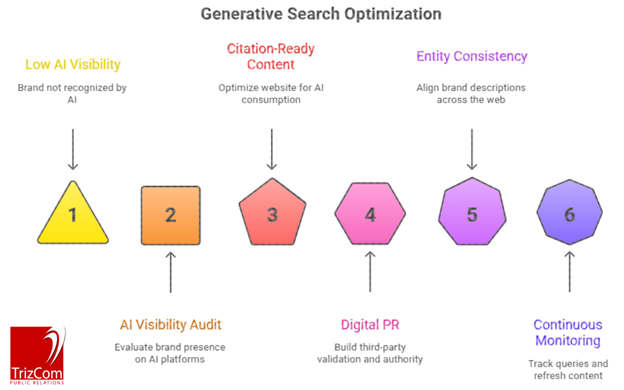
AI PR services are quickly becoming a core part of modern public relations strategy. As artificial intelligence reshapes how content is discovered, summarized and cited, brands can no longer rely on traditional media outreach alone. AI PR services focus on optimizing content for AI-driven search, monitoring how your brand appears in generative answers and ensuring your expertise is accurately represented across digital platforms. In short, it is PR built for how information is actually consumed today.
1) AI visibility audit
We evaluate how your brand appears across major generative platforms and why.
You get:
Current AI visibility snapshot for priority queries
Messaging gaps and misattributions
Competitive comparison
High-impact recommendations list
2) Citation-ready website content
We create and optimize pages that AI can lift cleanly into answers.
Includes:
Service pages with question-based headings
FAQ hubs with concise, quotable answers
Comparison pages and “best fit” guidance
Updated About pages with expert credentials
Schema markup (FAQPage, Organization, Article where relevant)
3) Digital PR for authority signals
Generative systems lean heavily on third-party validation. We build it.
Includes:
Thought leadership placements
Contributor bylines and expert commentary
Podcast and speaking visibility
Partnership announcements
Review and reputation support
4) Entity and brand consistency
We align how your company is described across the web so AI stops guessing.
Includes:
Brand narrative and proof points
Consistent descriptions across bios and profiles
Internal linking and topical hubs
Light technical guidance for crawlability
5) Monitoring and continuous improvement
GSO is not set-it-and-forget-it.
Includes:
Content refresh roadmap
New content opportunities based on what AI is citing
Who this is for
B2B service firms that sell trust, not widgets
Founder-led brands that need credibility fast
Multi-location businesses and franchises
Brands in competitive categories where “best” lists drive leads
Companies seeing traffic flatten while sales cycles get harder
What success looks like
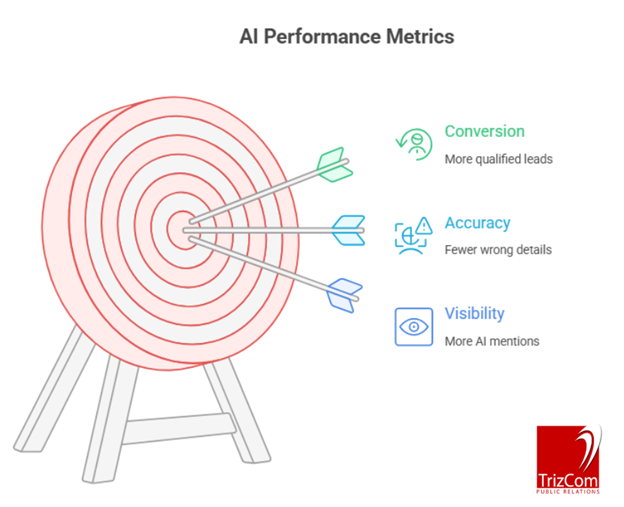
You should expect measurable movement in three areas:
Visibility: more AI mentions for target queries
Accuracy: fewer wrong details in AI summaries
Conversion: more qualified inbound leads from higher-intent searches
We will set baseline metrics before work starts so you are not guessing.
How Is Generative Search Optimization Different From Traditional SEO?
Generative Search Optimization looks beyond rankings to understand how AI interprets and presents your brand.
Traditional SEO shows where you rank.
GSO shows how you are described inside AI-generated answers.
As TrizCom PR implements GSO strategies, the focus shifts from traffic alone to influence, narrative control and citation authority.
| Dimension | Traditional SEO | Generative Search Optimization (GSO) |
|---|---|---|
| Primary Focus | Rankings and blue links | AI-generated answers and citations |
| What Is Measured | Traffic, impressions, click-through rate | Mentions, narrative accuracy, citation frequency |
| Visibility Format | Individual web pages | Synthesized multi-source AI summaries |
| Authority Signal | Backlinks and on-page optimization | Third-party validation and entity consistency |
| Timing | After indexing and ranking updates | As AI responses evolve in real time |
| Strategic Value | Traffic acquisition | Reputation influence and decision impact |
Why TrizCom PR for GSO
Most “GSO” providers start with prompts and end with blog posts. We start with authority, because that is what AI trusts.
As one of the best digital public relations agencies in the U.S., TrizCom PR brings:
Deep PR strategy that builds third-party validation
Content structure designed for extraction and citation
A practical approach that serves both SEO and AI discovery
Messaging discipline so your brand stays consistent everywhere it appears
How to get started
Option A: Free AI Visibility Snapshot
We run a quick diagnostic on your top services and the prompts your buyers actually use.
Option B: Full GSO Build
We audit, fix, build and distribute with a six-month roadmap and monthly monitoring.
Ready to Lead in AI Search Instead of Chasing It?
If your prospects are asking AI who to trust, who to hire and who delivers results, your brand needs to be part of that answer.
TrizCom PR helps companies move from invisible to cited. From overlooked to recommended. From generic to authoritative.
Generative Search Optimization is not about chasing algorithms. It is about building credibility, structuring your expertise clearly and earning the third-party validation AI systems rely on.
What happens next?
When you book a strategy call with TrizCom PR, we will:
Review how your brand currently appears across major AI platforms
Identify gaps in authority, content structure and consistency
Outline a focused 90-day action plan
Prioritize quick wins without overwhelming your team
You will leave with clarity. Not theory. Not jargon. A practical roadmap built around your business goals.
Book Your Generative Search Optimization Strategy Call
FAQs about Generative Search Optimization
What is the difference between SEO and GSO?
SEO focuses on helping pages rank in traditional search results, while Generative Search Optimization focuses on helping a brand get included and cited inside AI-generated answers. The difference is not just where visibility happens, but how success is measured.
Traditional SEO is tied closely to rankings, clicks and traffic from search engines. GSO is tied more closely to mentions, citations, narrative accuracy and whether AI systems treat your brand as a trusted source. At TrizCom PR, the simplest way to explain it is this: SEO is about blue links. GSO is about being the source AI trusts.
SEO emphasizes rankings and traffic
GSO emphasizes mentions and citations
SEO is largely page-based
GSO depends on pages plus authority signals across the web
The most effective strategy often connects both so your brand is easy to find and easy for AI systems to trust.
Which AI platforms does GSO impact?
GSO can influence visibility across major generative platforms, including ChatGPT, Google’s AI Overviews, Perplexity, Gemini and Microsoft Copilot. These systems do not work the same way, but they all respond to strong content structure, consistent brand signals and credible outside sources.
That means GSO is not about optimizing for one platform alone. It is about improving the clarity and authority signals that multiple AI systems may use when generating answers. TrizCom PR builds strategies that support broader visibility across this changing landscape rather than treating each platform as a completely separate channel.
A practical takeaway is to focus on the quality of your signals across the web, because that gives your brand a better chance of appearing across several AI environments, not just one.
How long does GSO take to work?
GSO can show early improvements once foundational content is strengthened and authority signals begin to improve, but stronger results usually build over time. Initial shifts may happen after high-intent pages are rebuilt and credible external signals start supporting them more clearly.
The timeline depends on your starting point. Brands with strong existing authority and clear site structure may see movement sooner. Brands with thin content, weak proof or inconsistent positioning often need more time. At TrizCom PR, early progress often begins after foundational content and PR support are improved, while broader gains come as the content footprint and third-party validation expand.
The practical takeaway is to treat GSO as a staged visibility effort, with early traction followed by stronger long-term gains.
Do I need to rebuild my entire website?
Usually, no. Most companies do not need a full website rebuild to improve generative search visibility. In many cases, the best approach is to strengthen the pages that matter most first.
That often means improving high-intent service pages, building a structured FAQ hub, tightening proof points and creating stronger internal linking. Rather than rewriting everything, TrizCom PR prioritizes the assets most likely to influence AI citations and search interpretation. This keeps the work more efficient and more closely tied to visibility goals.
Common priorities often include:
core service pages
FAQ or definitions content
executive and company proof points
internal linking between priority pages
clearer headings and direct answers
A useful next step is to identify which pages already have strong intent value and which ones need the most clarity or authority support.
Does PR really affect AI search visibility?
Yes. PR can directly affect AI search visibility because it helps create the trusted third-party references AI systems use when forming answers. Media coverage, expert commentary and other external mentions can strengthen the signals that make a brand more credible.
This matters because generative systems often rely on more than brand-owned content. They look at what respected outside sources say and how consistently the brand is represented across the web. That is where PR becomes especially valuable. TrizCom PR uses digital PR placements to strengthen the authority signals AI platforms often rely on when deciding what to summarize or cite.
The key takeaway is that PR does not just support awareness. It can also improve the external trust signals that shape AI-generated visibility.
What content performs best for AI citations?
Content performs best for AI citations when it gives clear answers, uses strong headings, includes specific proof and is easy for AI systems to extract. Pages that are structured clearly and written with topic focus tend to be more useful than broad, vague or overly promotional pages.
That usually means direct explanations, expert attribution, FAQ sections, scannable formatting and proof points that support the claim being made. TrizCom PR builds citation-ready pages so the content is easier for AI systems to interpret cleanly. Generic content often struggles because it does not provide enough specificity or structure to stand out.
Content elements that often perform well include:
direct answers near the top
descriptive headings
structured FAQ sections
named expertise or attribution
examples, stats or case proof
clear internal links to related pages
The practical takeaway is that clarity and proof matter more than volume.
How do you choose the prompts to optimize for?
The best prompts to optimize for are the ones your prospects are most likely to ask when they are close to making a decision. These often include pain-point questions, comparison queries, best-fit searches and other decision-stage prompts tied to real buyer intent.
At TrizCom PR, prompt selection starts with how your audience actually searches, not just which keywords have volume. From there, those questions are mapped to pages designed to answer them clearly and credibly in a format that supports AI citation. This helps connect visibility work to the buyer journey rather than treating prompt selection as a technical exercise alone.
A useful next step is to identify the questions your team hears most often from prospects, because those questions often point to the prompts that deserve the most attention.
Can you fix incorrect information AI is showing about my brand?
Often, yes. Incorrect AI outputs can often be improved by fixing the source signals that AI systems rely on. When the inputs become clearer, more consistent and better supported, the outputs often improve as well.
That usually involves tightening on-site language, strengthening trusted third-party references and aligning brand data across profiles, publications and key digital assets. TrizCom PR focuses on addressing those root causes rather than treating the symptom alone. If AI tools are seeing mixed messages or weak proof, the response quality can suffer. Better inputs create better conditions for more accurate summaries.
The practical takeaway is that inaccurate AI answers are often a visibility and content alignment problem, not just a platform problem.
Do you offer ongoing monitoring?
Yes. Ongoing monitoring is important because AI results can change frequently. A brand that appears today may disappear or shift in wording later if competitors strengthen their signals or if the platform changes what it prioritizes.
TrizCom PR provides monitoring to track priority prompts, protect visibility and identify new citation opportunities over time. This helps brands see whether they are being mentioned, how they are being described and where new gaps or risks may be emerging. Without monitoring, it becomes harder to know whether the visibility strategy is holding up.
A practical next step is to decide which prompts, platforms and competitor comparisons matter most so monitoring stays focused and useful.
What do you need from us to start?
To get started, TrizCom PR typically needs access to your analytics, Google Search Console, your core services and your strongest proof points. That gives the team a clear picture of your priorities, your current visibility, and the evidence that supports your positioning.
From there, TrizCom PR handles the strategy, content structure, authority-building direction and monitoring framework. The goal is to keep requests focused so your internal team can contribute what matters most without getting pulled into unnecessary complexity.
Helpful inputs often include:
website analytics
top revenue-driving services
key differentiators
testimonials or case studies
executive bios or credentials
existing media coverage or awards
The takeaway is that strong input helps the strategy move faster, but the process should still stay manageable for your team.
Updated June 1, 2026