Why Your Audience Matters More Than the Reporter’s Questions
Media interviews can shape reputation, influence stakeholders and affect enterprise value within minutes. This article outlines a practical framework for executive media training and media interview preparation designed for C-suite leaders and spokespersons. It explains how audience-based messaging strengthens spokesperson strategy, improves crisis communication interviews and builds confidence under pressure.
If you are responsible for corporate communications, investor relations or brand reputation, this guide clarifies how media coaching for executives shifts preparation from reactive answers to proactive message control. The focus is simple: define the audience, refine core messages and align delivery with business objectives. When leaders prepare this way, interviews become strategic opportunities rather than unpredictable risks.
Why Executives Prepare for the Wrong Thing in Media Interviews
The biggest trap executives fall into while preparing for a media interview is focusing on the reporter’s questions instead of the audience’s needs.
As a media trainer for executives, I consistently hear the same concern from executive spokespeople: “What if I can’t answer a question?” They want perfect facts. Perfect numbers. A flawless interview.
That is not how media works.
Media interviews are not about delivering perfect answers to a reporter. They are about delivering clear messages to the people watching, reading or listening. The reporter is the conduit. The audience is the priority.
According to the 2024 Edelman Trust Barometer, earned media and expert voices are among the most trusted sources of information, ranking higher than brand advertising. That means what a spokesperson says in an interview often carries more credibility than any paid campaign.
Media Interviews in the Age of AI Search
Media interviews no longer influence only the immediate audience. In the age of AI search, large language models (LLM) often pull summaries and responses from earned media coverage, executive quotes and authoritative news sources.
When an executive appears in a respected publication or broadcast, that language can be indexed, summarized and surfaced in AI-generated answers long after the original interview airs.
This changes the stakes.
A spokesperson is not only speaking to viewers in the moment. They are shaping how their organization may be described in future AI search responses, executive summaries and digital research queries.
Clear, audience-centered messaging improves:
How leadership is characterized
How company strategy is summarized
How crisis responses are interpreted
How investor positioning is reflected in AI-generated overviews
Earned media now influences both public perception and algorithmic interpretation. Message discipline protects reputation in both environments.
When executives shift that mindset, everything changes.
What Is the Most Common Media Interview Mistake?
Mistake: Preparing for Questions Instead of Preparing Messages
Executives often prepare like this:
What questions will they ask?
What statistics might come up?
What if they challenge me?
A stronger approach starts here:
Who is the audience?
What does this audience care about?
What do they need to understand, believe or feel after this interview?
Reporters ask questions. Leaders deliver messages.
Traditional Media Preparation vs Audience-Based Media Preparation
Media Interview Preparation Approach Comparison
| Traditional Media Prep | Audience-Based Media Prep |
|---|---|
| Anticipates questions | Defines stakeholder needs |
| Defensive posture | Strategic messaging |
| Focuses on the reporter | Focuses on the audience |
Who Is the Real Audience in a Media Interview?
The audience depends on the outlet and the topic. It may include:
Customers
Investors
Employees
Community members
Regulators
Policymakers
Industry peers
The reporter is never the end audience. You speak through the reporter to reach others.
Next time your PR team says a reporter wants an interview, try asking:
“What are we trying to say, and who are we trying to reach?”
That single question reshapes your preparation.
Strengthen Your Spokesperson Strategy - https://www.trizcom.com/contact
How to Build Audience-Centered Media Messages
Step 1: Define the Target Audience
Before drafting talking points, clarify:
What does this audience value?
What concerns them?
What language resonates with them?
What words may trigger anxiety or confusion?
Words land differently depending on who hears them.
Example
“Corporate boards may view cost reduction as fiscal discipline”
Employees may hear layoffs.
“Medical professionals may discuss low morbidity rates.”
Patients and families may hear death rates.
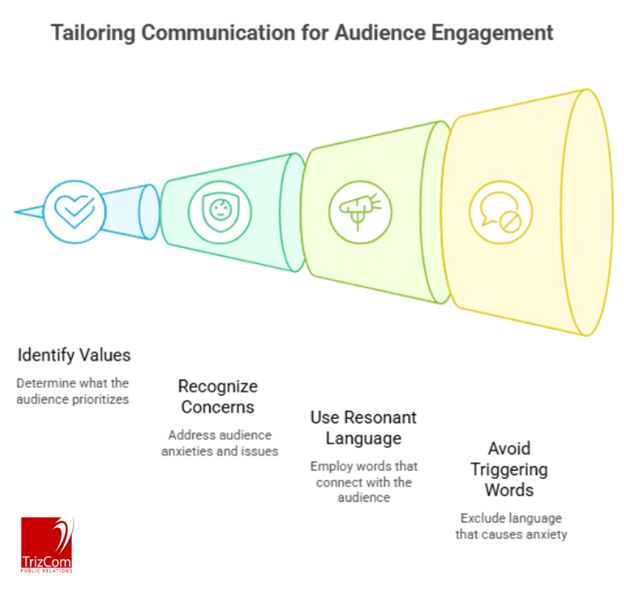
Audience awareness shapes effective messaging.
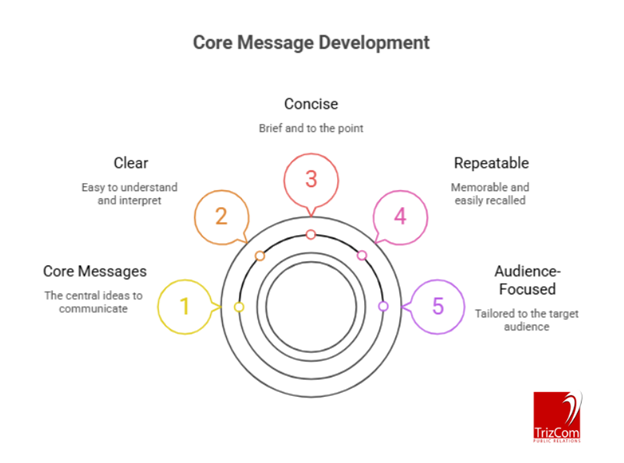
Step 2: Develop 3 to 5 Core Messages
Strong media messages should be:
Clear
Concise
Repeatable
Audience-focused
Supported with brief examples or stories
Do not overload interviews with data. Anchor your points to what matters most to the audience.
Research on digital media consumption shows audiences process information quickly and move on just as fast. Concise, repeatable messages increase retention and reduce the risk of misinterpretation.
Step 3: Use Verbal Cues to Signal Who You Are Speaking To
Direct audience references build connection:
“Our customers deserve…”
“Our employees can expect…”
“Investors should know…”
When you name the audience, you speak directly to them.
Add a short story or example to increase credibility and clarity.
Case Example: Crisis Communication for a Restaurant Brand
Weber Shandwick research has found that reputation can account for more than half of a company’s market value. In moments like this, message clarity directly affects enterprise value.
Imagine a national restaurant chain facing a contamination outbreak. The CEO appears on national television.
Interview #1: Audience Is Customers
What Customers Need to Hear
Safety
Transparency
Accountability
Action
Reassurance
Sample Messages
Food safety is our top priority. We are rebuilding customer trust by implementing additional inspections and supplier reviews.
We are working closely with regulators and independent experts to ensure this does not happen again.
Our promise remains the same: fresh, safe and high-quality food.
Each point focuses on restoring trust.
Interview #2: Audience Is Investors
Now imagine the interview is with a financial publication.
What Investors Need to Hear
Risk management
Leadership accountability
Operational recovery
Long-term stability
Sample Messages
We have implemented a corrective action plan to safeguard operations.
Leadership is addressing the issue quickly and transparently.
Our reopening strategy prioritizes safety while protecting long-term shareholder value.
Certain words, such as 'safe' and 'compliant,' still matter. The framing shifts.
Media Interview Preparation Framework
Audience-Based Messaging vs Question-Based Preparation
| Preparation Approach | Question-Focused Strategy | Audience-Focused Strategy |
|---|---|---|
| Primary Concern | What will they ask? | Who are we trying to reach? |
| Emotional Focus | Fear of tough questions | Clarity of purpose |
| Message Control | Reactive | Proactive |
| Risk Level | Higher chance of going off-message | Greater message discipline |
| Outcome | Defensive tone | Strategic, confident presence |
What Is Audience-Based Messaging in Media Training
Audience-based messaging is a strategic approach to media interview preparation that prioritizes stakeholder needs over anticipated reporter questions.
Key Takeaways for Executive Media Training
Your message matters more than the reporter’s questions.
Questions are opportunities to deliver prepared messages.
The reporter is not your audience.
Words affect audiences differently depending on their role and perspective.
Stories and examples strengthen credibility.
Confidence does not come from memorizing answers. It comes from clarity about who you are speaking to and what they need to hear.
When Audience-Based Messaging Is Misapplied
Audience-based messaging strengthens interviews when applied thoughtfully. When used incorrectly, it can weaken credibility.
It fails in three common situations.
When messages are overly scripted
If executives memorize language word-for-word, their delivery becomes rigid. Audiences detect rehearsed responses quickly. Message discipline should create clarity, not robotic tone. Leaders should internalize key points, not recite them.
When data is ignored
Audience focus does not replace factual accuracy. Stakeholders still expect evidence. Clear messaging must be supported by verified information. Omitting relevant data can create skepticism, especially in financial or regulatory interviews.
When stakeholder analysis is incomplete
If the wrong audience is prioritized, messaging misses the mark. A CEO speaking to investors uses different framing than one addressing customers or employees. Misidentifying the primary audience creates confusion rather than clarity.
Audience-based preparation works best when strategy and substance align. Message control requires both insight and accuracy.
Why Professional Media Training Makes a Difference
Executives who appear calm and composed are rarely naturals. They are prepared.
The Institute for Crisis Management reports that many corporate crises escalate within the first 24 hours. When media calls come quickly, there is no time to build messaging from scratch.
Effective media training helps leaders:
Stay on message under pressure
Bridge difficult questions back to key points and rehearse using validating phrases that signal you heard the question and allow you to transition into your messaging
Deliver concise, quotable responses
Maintain credibility in high-stakes interviews
Align messaging with broader business strategy
At TrizCom PR, we media train executive teams to approach interviews strategically, not reactively. Preparation protects reputation.
Executive Media Interview Checklist
Identify the audience
Define 3–5 core messages
Align language with stakeholder expectations
Prepare bridging statements
Practice delivery under pressure
Ready For Your Next Media Interview?
Executive interviews influence investor confidence, customer trust and internal morale. In high-visibility moments, leadership language carries financial and reputational weight.
Strategic preparation protects reputation. It aligns messaging with business objectives, strengthens stakeholder confidence and reduces unnecessary risk.
When interviews are handled with discipline and clarity, they become opportunities to reinforce leadership credibility rather than moments to manage defensively.
If your executive team is preparing for a major announcement, media scrutiny or a complex issue, now is the time to ensure your messaging reflects the strength of your organization.
Contact TrizCom PR to schedule executive media training and strengthen your spokesperson strategy.
FAQ
What is the biggest mistake executives make in media interviews?
The biggest mistake executives make before a media interview is focusing on the reporter’s questions instead of the audience they are trying to reach. Many leaders prepare defensively, anticipating difficult questions rather than defining the three to five messages stakeholders need to hear. Media interviews are not about pleasing a reporter. They are about communicating clearly to customers, investors, employees or regulators. At TrizCom PR, we media train executives to shift from question-based preparation to audience-based messaging, which results in stronger, more controlled interviews.
Who is the real audience during a media interview?
The reporter is not the audience. The real audience is the group consuming the coverage. Depending on the outlet, that may include customers, shareholders, employees or policymakers. Effective spokesperson strategy starts with identifying who needs clarity, reassurance or direction. TrizCom PR helps leadership teams identify those audiences before any interview, so messages are intentional and aligned with business goals.
How should executives prepare for a media interview?
Preparation should begin with defining the target audience and outlining three to five core messages. Those messages should be clear, repeatable and supported with brief examples. Executives should also practice delivering those messages in a conversational way. Through structured media training sessions, TrizCom PR helps leaders rehearse real-world scenarios so they feel composed and confident when interviews begin.
How many key messages should a spokesperson prepare?
Most interviews require three to five core messages. Fewer than three may feel incomplete, while more than five can dilute focus. The goal is to consistently reinforce a small set of strategic points that align with company priorities. TrizCom PR works with executive teams to refine messaging so it is concise, relevant and adaptable across multiple interviews.
What is audience-based messaging in media training?
Audience-based messaging is a preparation strategy that prioritizes stakeholder needs over anticipated reporter questions. It focuses on what a specific audience needs to understand or believe after the interview. This approach reduces defensiveness and increases clarity. At TrizCom PR, audience-first preparation is a core principle of executive media training.
How do you stay on message when asked a difficult question?
Staying on message requires discipline and preparation. A spokesperson should acknowledge the question, provide a direct response and then bridge back to a core message. This keeps the interview focused while maintaining credibility. TrizCom PR coaches executives on how to transition smoothly without appearing evasive or scripted.
Why does language matter so much in crisis communication?
Language shapes perception. Certain terms may reassure one audience while creating concern for another. In crisis communication, word choice should reflect accountability, empathy and action. TrizCom PR guides leadership teams in selecting language that aligns with stakeholder expectations while protecting long-term reputation.
How does media training improve executive confidence?
Confidence comes from clarity and repetition. When executives know their key messages and understand their audience, they are less reactive and more composed. Through structured rehearsal and real-time feedback, TrizCom PR helps leaders strengthen delivery and maintain control in high-stakes interviews.
Should executives memorize answers before interviews?
Memorizing scripted responses often leads to rigid delivery. Instead, executives should internalize core messages and supporting examples. This allows flexibility while maintaining consistency. TrizCom PR trains spokespeople to sound natural and authentic while staying aligned with strategic objectives.
When should a company invest in executive media training?
Organizations benefit from media training before major announcements, leadership transitions, product launches or crisis situations. Proactive preparation also strengthens emerging leaders who may serve as future spokespersons. TrizCom PR partners with companies to ensure their leadership teams are prepared long before a critical interview takes place.
How to prepare for a television interview
Television interviews require preparation beyond talking points. Visual delivery, tone and message discipline matter just as much as content.
Start by defining your audience. Who is watching and what do they need to understand after the segment ends? Then develop three to five core messages that support your business objectives.
Next:
Practice answering likely questions out loud
Refine concise responses under 20 seconds
Prepare one short example or story per message
Anticipate difficult questions and rehearse bridging techniques
Choose attire that reflects your brand and industry
Television magnifies hesitation and rambling. Clear structure builds confidence. Strong preparation lets you focus on delivery rather than scrambling for answers.
Media interview tips for CEOs
CEO interviews carry higher stakes because they influence investors, employees, customers and regulators at once.
An effective CEO media strategy includes:
Clarifying the business objective before accepting the interview
Aligning messaging with enterprise priorities
Preparing financial or operational context in plain language
Avoiding jargon that may confuse general audiences
Staying calm when challenged
CEOs should speak in strategic language, not technical detail. Precision builds credibility. Overexplaining weakens authority.
Most importantly, CEOs must remember that every answer reinforces leadership perception. Clarity signals control.
Spokesperson training best practices
Effective spokesperson training focuses on preparation under pressure, not memorization.
Best practices include:
Audience-based messaging development
Identifying three to five repeatable core messages
On-camera rehearsal with real-time feedback
Practicing bridging techniques for difficult questions
Stress-testing responses in mock crisis scenarios
Reviewing body language, tone and pacing
Training should simulate real conditions. Recorded practice sessions allow leaders to see and correct habits such as filler words, defensive posture or overlong responses.
Confidence comes from repetition and structure.
Crisis interview preparation
Crisis interviews demand clarity, accountability and empathy.
Preparation should include:
A confirmed fact sheet
Clear acknowledgment language
Defined corrective actions
A timeline for updates
Alignment with legal and operational teams
During crises, leaders should:
Avoid speculation
Avoid assigning blame
Speak directly to affected stakeholders
Reinforce commitment to resolution
Preparation before a crisis occurs is critical. When media calls arrive, there is no time to build messaging from scratch.
How to stay on message in interviews
Staying on message requires discipline, not deflection.
Use this structure:
Acknowledge the question
Provide a brief response
Bridge to a core message
Example:
“That is an important issue. What matters most right now is…”
Repeat your key messages throughout the interview using slightly varied language. Repetition increases retention without sounding scripted.
Stay calm. Pause before answering. Avoid overtalking.
Message discipline signals leadership control.
About the Author
Karen Carrera, APR
Karen Carrera, APR, is a senior communications counselor with more than 30 years of experience advising executives on strategic communications, brand positioning and reputation management across healthcare, construction, education, energy, finance, insurance, government and utilities.
She has media-trained hundreds of corporate spokespeople and developed integrated communications campaigns that strengthen visibility and support long-term business goals. Her work includes national brand evolutions, crisis planning initiatives and executive positioning strategies across multiple industries.
Karen holds the Accreditation in Public Relations credential, reflecting her commitment to ethics and strategic communications excellence.