11 Public Relations Tools Every Business Should Absolutely Use

What Is a Digital PR Agency and Why Your Brand Needs One in the Age of AI

A brand’s reputation is no longer shaped only by what it says about itself. It is defined by what others say online, what search engines rank and now what AI platforms summarize and recommend.
This is where a modern digital PR agency plays a critical role.
By combining traditional public relations strategy with digital marketing, SEO and artificial intelligence insights, digital PR agencies help brands build credibility, secure authoritative media coverage, improve visibility in search engines and increasingly influence how AI tools such as ChatGPT, Google’s AI Overviews and other generative search platforms surface information.
So, what is a digital PR agency today?
Unlike traditional PR, which focused on print, television and radio, digital PR operates in an online ecosystem driven by search engines, algorithms and AI systems. It secures media mentions on high-authority websites, earns high-quality backlinks that boost SEO rankings and develops data-driven campaigns that position brands as trusted sources for both humans and machines.
In an AI-influenced world, digital PR is no longer just about being seen. It is about being cited.
As businesses compete for attention in a crowded digital space, understanding what a digital PR agency does and how AI is reshaping visibility can determine whether your brand becomes a recognized authority or disappears into digital noise.
What Does a Digital PR Agency Do? More Than Just Media Coverage
A digital PR agency helps brands gain online authority through strategic storytelling, media placements, SEO integration and AI-informed content strategies. While securing media coverage remains essential, modern digital PR extends far beyond traditional press.
Generating High-Impact Media Features
Being featured in publications such as Forbes, Entrepreneur or respected niche outlets does more than increase awareness. It establishes trust signals that influence consumers, search engines and AI systems.
Generative AI models pull information from authoritative sources. When your brand is cited in credible media, those references increase the likelihood that AI tools recognize your company as a legitimate authority in its field.
Digital PR agencies:
Pitch tailored stories to journalists
Position executives as expert sources
Align messaging with current media trends
Monitor how media coverage influences search and AI visibility
Earned media is no longer just brand validation. It is structured digital credibility.
Building High-Quality Backlinks to Strengthen SEO and AI Visibility
Backlinks remain one of the strongest ranking signals for search engines. But they also influence how AI systems evaluate authority.
When trusted websites link to your content, it signals expertise, experience, authority and trustworthiness. These are core signals that search engines and AI summarization tools evaluate.
Digital PR agencies secure:
Editorial backlinks from high-authority media
Contextual links within relevant industry stories
Expert commentary placements
Guest articles that reinforce keyword authority
The result is improved domain authority, stronger search engine results page rankings and increased likelihood of being referenced in AI-generated summaries.
Using AI to Inform Strategy, Targeting and Measurement
AI is not replacing PR strategy. It is enhancing it.
Digital PR agencies now use AI tools to:
Identify trending media topics before they peak
Analyze journalist coverage patterns
Predict headline performance
Monitor brand mentions across digital ecosystems
AI-driven insights allow campaigns to be more precise, more proactive and more measurable.
Crafting a Digital PR Strategy That Delivers Measurable Results
A modern digital PR strategy includes more than press releases and pitching. It integrates content, SEO and AI visibility.
Key components include:
Strategic content creation
Developing expert articles, research reports and insights structured for both search engines and AI summarization.
Proactive media pitching
Securing coverage in digital publications that reach the right audience and influence AI indexing.
AI Search optimization
Ensuring content is formatted clearly with structured headings, FAQ sections and authoritative citations so AI systems can extract accurate information.
Influencer and expert partnerships
Collaborating with trusted voices who expand reach and strengthen digital credibility.
Issues management and crisis communication
Monitoring online conversations and AI summaries in real time to correct misinformation quickly.
Digital PR agencies do not simply secure attention. They manage how your brand is interpreted across digital and AI platforms.
How a Strong Digital PR Strategy Elevates Brand Authority
Having an online presence is no longer enough. Brands must shape conversations, influence perception and ensure their narrative is reflected accurately in AI-driven environments.
When customers search today, they often see:
AI-generated summaries
Featured snippets
Knowledge panels
Media citations
A well-executed digital PR strategy ensures those summaries reflect credible, positive and authoritative information.
The Connection Between Digital PR, SEO and AI Search
Digital PR, SEO and AI search are now inseparable.
Traditional PR might generate awareness. Digital PR generates indexed, searchable authority. AI then synthesizes that authority into summarized recommendations.
When a brand is featured in authoritative media with contextual backlinks, search engines interpret those mentions as endorsements. AI systems interpret them as validation.
A strong digital PR strategy:
Enhances brand credibility
Drives targeted referral traffic
Reinforces expertise signals
The brands that show up consistently across media, search results and AI summaries are the brands that win attention.
Press Releases in the AI-Driven Digital Landscape
Press releases remain valuable, but their purpose has evolved.
Modern digital press releases are optimized for:
Keyword relevance
Structured formatting
Clear expert attribution
Authoritative outbound citations
Shareability across digital channels
When properly distributed and supported by media outreach, press releases can:
Earn authoritative media coverage
Support link-building efforts
Strengthen AI discoverability
Drive referral traffic
However, no digital PR campaign should rely solely on press releases. Integration across earned media, owned media, thought leadership, SEO and paid media is essential.
The Winning Combination: Digital PR, SEO and AI Visibility
Unlike traditional PR, digital PR creates lasting digital assets.
Why this matters:
AI tools rely on indexed, authoritative sources
Search engines reward consistent expertise signals
A well-structured digital PR campaign:
Generates branded searches
The goal is not short-term buzz. It is sustained digital authority.
Traditional PR vs. Digital PR vs. AI-Driven Digital PR: What’s the Difference?
Understanding what a digital PR agency does today requires context. The discipline has evolved. Traditional PR built awareness. Digital PR built search authority. AI-driven digital PR builds citation authority across search engines and generative AI platforms.
Here is how they compare:
| Category | Traditional PR | Digital PR | AI-Driven Digital PR |
|---|---|---|---|
| Primary Focus | Media exposure | Online visibility plus SEO | Search visibility plus AI citation authority |
| Key Channels | Print, TV, radio | Online media, blogs, digital publications | Online media, search engines, AI platforms |
| Success Metrics | Impressions, reach | Backlinks, rankings, referral traffic | Rankings, backlinks, AI mentions, citation frequency |
| Content Strategy | Press releases, interviews | SEO content, thought leadership, media outreach | Structured expert content optimized for AI summarization |
| Authority Signals | Media mentions | Backlinks plus domain authority | Backlinks plus E-E-A-T signals plus AI extraction readiness |
| Longevity of Impact | Often short-term | Long-term search visibility | Long-term search plus AI discoverability |
| Risk Management | Reactive crisis PR | Digital monitoring plus SEO repair | Real-time AI narrative monitoring plus correction strategy |
The shift is significant.
Traditional PR asked, “Where did we get coverage?”
Digital PR asked, “How did coverage improve rankings?”
AI-driven digital PR now asks, “Is our brand being cited accurately when AI summarizes our industry?”
This evolution matters because consumer behavior has changed. Buyers now rely on search engines and AI-generated answers to evaluate expertise, compare providers and validate credibility before making decisions.
If your brand does not appear consistently in media, search results and AI summaries, competitors will fill that space.
A modern digital PR agency or AI PR agency understands that visibility is no longer just about placement. It is about structured authority that machines can interpret, validate and recommend.
Measuring the Success of a Digital PR Campaign
Modern digital PR is measurable.
Key performance indicators include:
Search engine ranking improvements
Brand sentiment analysis
The Role of Analytics and AI Monitoring
Agencies now use tools to track:
Referral traffic and conversions through Google Analytics
Domain authority and backlink growth via Ahrefs or Moz
Media mentions via monitoring platforms
Brand inclusion in AI-generated responses
Tracking AI visibility is an emerging metric. Businesses must understand not only how they rank in search engines but how they are represented in generative AI results.
Choosing the Right Digital PR Agency or AI PR Agency in an AI Era
Not all agencies that call themselves a digital PR agency or AI PR agency are prepared for AI-driven search environments.
When selecting a digital PR agency, look for:
1. A Proven Track Record
Documented media placements
High-authority backlinks
Recognized thought leadership placements
2. SEO and AI Integration Expertise
A modern digital PR agency or AI PR agency must understand how search engines and generative AI platforms evaluate authority.
Link-building aligned with SEO best practices
Content structured for AI summarization
Data-driven campaign development
3. Customized Brand Positioning
Deep understanding of your audience
Clear competitive differentiation
Messaging designed for digital discoverability
4. Transparent Reporting
Detailed SEO metrics
Backlink reporting
Media coverage tracking
AI visibility monitoring
A strong digital PR agency or AI PR agency does not just promise awareness. It demonstrates measurable impact across search, media and AI visibility.
Why Investing in Digital PR Is Essential for Brand Growth
A digital PR agency or AI PR agency is more than just a media relations partner. It is a strategic asset for brand growth. By combining media outreach, content marketing, SEO, AI visibility strategy and thought leadership, digital PR creates a sustainable online presence that drives long-term credibility across search engines and generative AI platforms.
For businesses looking to stand out in an increasingly digital and AI-influenced world, investing in a well-structured digital PR strategy is no longer optional. It is essential. Whether securing high-profile media placements, improving search rankings, influencing AI-generated summaries or establishing executive thought leadership, a strong digital PR campaign transforms online visibility into measurable business growth.
Take Your Brand to the Next Level with Digital PR
The digital landscape is more competitive than ever. Visibility now depends not only on search rankings but on how AI platforms interpret and surface your brand.
At TrizCom PR, we craft digital PR strategies designed for modern discovery. We secure high-impact media placements, strengthen search engine rankings and position brands for authority in both traditional search and AI-driven environments.
Do not let your brand get overlooked in search results or misrepresented in AI summaries. Partner with TrizCom PR and build a results-driven digital PR campaign tailored to your business goals. Contact us today to get started.
Everyone has a story. Let TrizCom PR tell yours!

About the Author:
Jo Trizila – Founder & CEO of TrizCom PR
Jo Trizila is the founder and CEO of TrizCom PR, a leading Dallas-based public relations firm known for delivering strategic communications that drive business growth and enhance brand reputations as well as Pitch PR, a press release distribution agency. With over 25 years of experience in PR and marketing, Jo has helped countless organizations navigate complex communication challenges, ranging from crisis management to brand storytelling. Under her leadership, TrizCom PR has earned recognition for its results-driven approach, combining traditional and integrated digital strategies to deliver impactful, measurable outcomes for clients across various industries, including healthcare, technology and nonprofit sectors. Jo is passionate about helping businesses amplify their voices and connect with audiences meaningfully. Her hands-on approach and commitment to excellence have established TrizCom PR as a trusted partner for companies seeking to elevate their brand and achieve lasting success. Contact Jo at jo@TrizCom.com.
Digital PR Q&A
What is a digital public relations agency?
A digital public relations agency helps brands build online authority through earned media, SEO strategy and thought leadership content. Unlike traditional firms focused primarily on print and broadcast placements, a digital PR agency strengthens visibility where modern buyers research: search engines, online publications and increasingly AI-driven platforms. At TrizCom PR, digital PR means securing high-authority media coverage, earning quality backlinks and structuring expert content so it ranks in search and is accurately reflected in AI-generated summaries. The objective is not simply exposure. It is sustained credibility that improves rankings, drives referral traffic and positions a company as a trusted voice in its industry.
How does a digital PR agency differ from a traditional PR firm?
Traditional PR firms focus on awareness through newspapers, television and radio. Success is often measured by impressions and audience reach. A digital PR agency expands that approach by integrating SEO, link building and measurable online performance. At TrizCom PR, campaigns are designed to influence both media coverage and search engine visibility. That means securing editorial backlinks, developing keyword-aligned thought leadership and monitoring referral traffic. In today’s AI-influenced environment, digital PR also considers how content is structured for generative platforms. Traditional PR builds reputation. Digital PR builds measurable digital authority that supports business growth.
What is an AI PR agency?
An AI PR agency is the next evolution of digital PR. It focuses on how brands appear not only in search engines but in generative AI platforms such as ChatGPT and Google AI Overviews. At TrizCom PR, AI-informed PR strategies ensure content is structured clearly, supported by authoritative media citations and aligned with expertise signals that AI systems prioritize. This includes strengthening E-E-A-T indicators, securing third-party validation and monitoring how brand narratives appear in AI-generated responses. As more consumers rely on AI for research and decision-making, AI-driven PR ensures your brand is cited accurately and positioned as a trusted authority.
Why is digital PR important for SEO?
Digital PR strengthens SEO by earning authoritative backlinks and increasing domain authority. Search engines interpret backlinks from reputable publications as endorsements. At TrizCom PR, media placements are pursued strategically to support keyword rankings and long-term search performance. Beyond backlinks, digital PR generates expert content that targets relevant search queries and increases branded search activity. These signals improve visibility on search engine results pages and drive sustained organic traffic. Unlike paid advertising, earned media remains indexed, creating long-term value. For businesses focused on measurable growth, digital PR becomes a foundational component of a strong SEO strategy.
How does digital PR influence AI search results?
Generative AI platforms rely on credible, indexed content to produce responses. When brands are cited consistently in authoritative publications, AI systems are more likely to reference them accurately. TrizCom PR structures campaigns to ensure clients earn media coverage that reinforces expertise and authority signals. This includes executive thought leadership, expert commentary and contextual backlinks. As AI tools synthesize information from trusted sources, brands with strong digital PR footprints are more likely to appear in summaries. In an AI-driven environment, visibility depends not just on ranking well but on being cited reliably.
What services does TrizCom PR provide within digital PR?
TrizCom PR offers integrated digital PR services that include media outreach, executive thought leadership, link-building strategy, press release distribution through Pitch PR and reputation management. Campaigns are designed to align earned media with SEO objectives and AI visibility goals. This includes securing authoritative placements, developing structured content and monitoring digital performance metrics. TrizCom PR also supports crisis communication and real-time brand monitoring to protect online reputation. The firm’s approach connects storytelling with measurable search impact, ensuring that every media placement contributes to broader digital authority.
How do you measure the success of a digital PR campaign?
At TrizCom PR, digital PR performance is measured through data, not assumptions. Key indicators include media coverage quality, backlinks earned, improvements in search rankings and referral traffic growth. Domain authority increases, branded search volume and lead generation metrics are also tracked. In more advanced strategies, AI search visibility is monitored to assess how often a brand appears in generative responses. This data-driven approach allows campaigns to be refined and optimized. Digital PR should demonstrate clear return on investment, not just awareness.
How long does it take to see results from digital PR?
Digital PR is a long-term investment. At TrizCom PR, clients typically begin seeing early traction within three to six months, especially in media coverage and referral traffic. Search ranking improvements and domain authority growth often compound over time as backlinks accumulate. AI visibility may also strengthen gradually as authoritative citations increase. Because earned media remains indexed online, the benefits continue long after the initial placement. Consistency is key. Brands that maintain steady thought leadership and media engagement see the strongest sustained impact.
Who should hire a digital PR or AI PR agency?
Organizations that rely on online credibility benefit most from digital PR. This includes B2B firms, healthcare providers, franchise brands, professional services and technology companies. If your customers research providers online or use AI tools to compare options, digital PR becomes essential. TrizCom PR works with organizations seeking to strengthen authority, improve search rankings and elevate executive positioning. Companies operating in competitive markets where trust influences purchasing decisions often see significant gains from a structured digital PR strategy.
Why is digital PR essential in the age of AI?
In the age of AI, buyers rely on search engines and generative summaries to evaluate brands. If your company lacks authoritative digital signals, it may not appear in those summaries. Digital PR ensures your brand is cited in trusted publications, supported by backlinks and structured for search clarity. At TrizCom PR, campaigns are designed to influence both human audiences and AI-driven platforms. The goal is consistent, credible visibility. Today, it is not enough to be known. Your brand must be referenced, validated and discoverable across search and AI environments.
11 PR Stunts That Turned Brands Into Media Sensations
The Power of PR
In the evolving world of marketing, a well-executed publicity stunt can be the spark that sets a brand apart from its competitors. The best PR stunts don’t just make headlines. They create viral moments that capture the public’s imagination and command media attention worldwide. Whether you’re launching a new product, celebrating a milestone, or simply looking to promote your brand in a crowded industry, a creative and innovative stunt can generate the kind of awareness that traditional advertising can only dream of.
What makes a publicity stunt truly powerful is its ability to break through the noise and get people talking. By blending creativity with strategic timing, brands can create experiences that not only engage audiences but also inspire journalists and influencers to share the story far and wide. The result? Massive media coverage, increased brand recognition, and a boost in sales. All from a single, unforgettable event.
As we explore the world of PR stunts, it’s clear that the most successful campaigns are those that dare to be different. They challenge expectations, push boundaries, and invite the public to join in the spectacle. For brands looking to promote themselves, drive sales, and stay ahead of the competition, embracing the power of PR stunts isn’t just an optio. It’s a must.
Public relations (PR) stunts are a powerful way for brands to break through the noise, capture public attention and generate massive media coverage. When executed correctly, they can turn an ordinary marketing campaign into a viral sensation, creating buzz that extends beyond traditional advertising. Whether it’s a world record attempt, a heartwarming publicity stunt or a viral social media moment, PR stunts can make headlines and keep brands top of mind.
In this article, we’ll explore some of our most successful PR stunts, including notable campaigns from TrizCom PR and other brands that took the media by storm. We’ll also delve into how brands can execute national PR activations effectively.
What is a PR Stunt?
A PR stunt is a carefully planned event or campaign designed to grab media attention and spark conversations. These stunts leverage creative storytelling and bold actions to generate publicity and engage audiences.
Successful PR stunts often include:
A strong emotional appeal: Whether humorous, inspiring or shocking, effective PR stunts trigger an emotional response.
A clear brand message: The stunt must align with the company’s values and overall media strategy, supporting the company's reputation management efforts.
Shareability: In today’s digital age, social media plays a key role in amplifying PR stunts, making them go viral.
Earned media potential: The ultimate goal of a PR stunt is to attract media coverage without relying on paid advertising.The best PR stunts are designed to drive earned media across multiple channels, creating conversations that reach millions.
The best PR stunts are designed to drive earned media across multiple channels, creating conversations that reach millions.
From viral social media challenges to large-scale publicity stunts, PR activations can significantly boost a brand’s visibility. Below, we’ll explore real-world example case studies of impactful PR stunts, starting with successful campaigns executed by TrizCom PR.
PR Stunts (Also Known As...)
PR stunts are sometimes referred to as publicity stunts, brand activations or earned media campaigns. No matter the name, they all share the same goal: to spark buzz and conversation that drives visibility without paid advertising. These efforts often cross into the territory of experiential marketing, social media virality and community engagement—making them some of the most versatile tools in a marketer’s toolkit. Whether playful or powerful, PR stunts are rooted in the psychology of storytelling and surprise, aiming to create a moment worth capturing and sharing.
What is Considered a PR Stunt?
A PR stunt is a carefully planned event or action designed to attract public attention and generate media coverage. These stunts can range from the bold and outrageous—like a brand attempting to break a Guinness World Record—to more subtle or socially driven efforts, such as a flash mob promoting a charitable cause or an unexpected product giveaway. The goal of a PR stunt is simple: get people talking and, ideally, generate organic media coverage and social media buzz.
But not all PR stunts have to be dramatic. Sometimes a clever twist on a traditional concept or perfect timing around a trending topic, (check out this amazing newsjacking stunt) can spark just as much attention. The key is creativity, strategy and a deep understanding of the brand's voice and audience. When done well, a PR stunt can dramatically elevate brand visibility. When done poorly, it can backfire—and fast.
How Much Do PR Stunts Cost?
Let’s bust a myth right now: just because you don’t pay for earned media coverage doesn’t mean it’s free. In fact, PR stunts can be costly—depending on the complexity, logistics and team involved. You might not pay a news outlet to run your story, but you do pay professionals to make that story newsworthy and to get it in front of the right people.
Here’s a breakdown of potential costs:
Strategic planning and ideation: Hiring a PR strategist or agency to conceptualize and plan the stunt.
Coordination and logistics: Permits, locations, talent, production crews, props, etc.
Media outreach: Building media lists, pitching reporters, following up and managing interviews or coverage.
Execution day: Staffing, equipment rentals, insurance and onsite coordination.
Post-event follow-up: Press release distribution, media monitoring and engagement with reporters or influencers.
Depending on the scope, a PR stunt can cost anywhere from a few thousand dollars to six figures or more. The investment covers not only the stunt itself but also the countless hours of coordination, creative development and media pitching required to make it successful.
In PR, the spotlight might be free—but getting there never is.
PR Stunt Examples – From TrizCom PR
TrizCom PR has executed powerful PR stunts that captured national attention. Below are some case studies:

Team Escalade Texas
Description: This PR stunt was a creative activation for Cadillac, designed to capture national attention while reinforcing the luxury SUV’s reputation.
Execution: TrizCom PR orchestrated a road-trip storytelling campaign that featured influential personalities, auto journalists and social media influencers driving the Cadillac Escalade across Texas. The campaign highlighted the vehicle’s luxury, technology and performance, generating user-generated content and extensive media coverage. TrizCom PR also ensured high-profile stops, including automotive industry events, influencer meetups and social media live streams to create real-time engagement.
Earned Media: The campaign was covered by major automotive and lifestyle media outlets, including Forbes, Car and Driver and local Texas media. It also trended across social media, generating thousands of organic posts from influencers and fans.
Key Takeaways: Leveraging influencer marketing and experiential storytelling can enhance brand engagement and credibility.
Read the full Team Escalade Texas case study here.

Dallas Fan Expo – Chewbacca Mom
Description: A joyful, authentic viral moment turned into a media phenomenon with the help of strategic PR.
Execution: TrizCom PR leveraged Candace Payne’s viral popularity to generate widespread media coverage around her appearance at Dallas Fan Expo. The team secured high-profile interviews and coordinated with national outlets to maintain momentum, landing placements on “Good Morning America,” “The Late Late Show with James Corden,” and major media platforms including CNN, Time Magazine, and The Washington Post. Our strategic media outreach extended the story well beyond the initial viral moment, positioning Payne as a relatable, feel-good personality and amplifying both her personal brand and the event’s visibility.
Key Takeaways: When PR professionals move quickly and authentically, even the most unexpected viral moment can be elevated into a full-blown cultural event. Real-time responsiveness, paired with strategic media coordination, turns online buzz into sustained media exposure.
Authenticity and real-time engagement can transform a simple moment into a full-scale PR sensation.
Read the full Dallas Fan Expo case study here.
GMC Hashtag Challenge
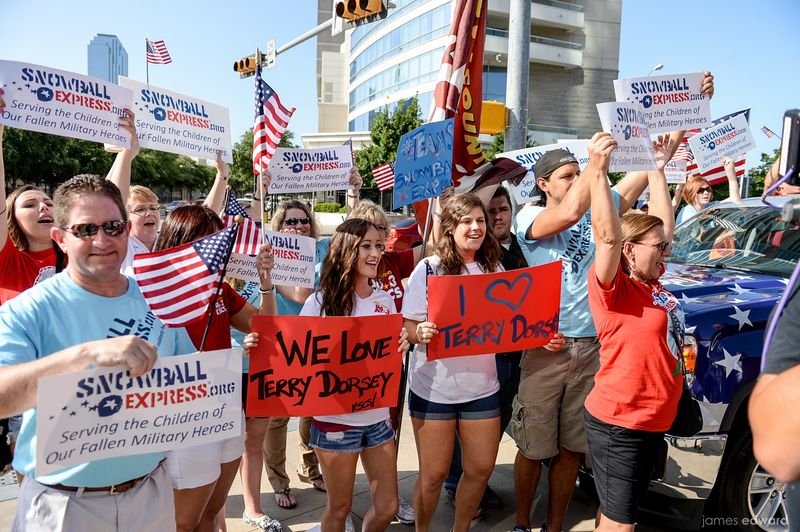
Description: A social media-driven PR stunt designed to increase brand visibility and engagement.
Execution: GMC launched a social media hashtag challenge, encouraging users to post creative content featuring their GMC vehicles. The challenge incorporated gamification by offering rewards for the most engaging posts. To amplify the campaign, TrizCom PR engaged influencers, bloggers and media partners to participate. Live activations at major auto shows and GMC dealerships allowed participants to interact with the campaign in person, further boosting engagement.
Earned Media: High levels of engagement on Instagram, Twitter and Facebook, with national media outlets covering the challenge and consumer participation driving organic reach. The campaign generated over 5 million hashtag impressions and was featured in automotive publications like Motor Trend and AutoWeek.
Key Takeaways: A combination of digital engagement and real-world participation can elevate a brand’s online presence and credibility.
Read the full GMC Charity Challenge case study here.

$50,000 Giveaway (Q Chevrolet)
Description: An experiential marketing stunt that created excitement and media buzz.
Execution: Q Chevrolet hosted a massive $50,000 giveaway event, generating significant foot traffic and local engagement. TrizCom PR developed a strategic media relations campaign to amplify the event, securing press coverage and social media exposure. They leveraged live radio broadcasts, influencer partnerships and local news channels to create hype leading up to the giveaway. Attendees participated in games and social media challenges to increase engagement.
Earned Media: National and regional news outlets covered the event, including NBC and ABC affiliates. The campaign also generated thousands of social media interactions, with viral posts showcasing excited winners and behind-the-scenes footage of the event.
Key Takeaways: High-stakes giveaways create strong consumer engagement and media interest, driving both brand loyalty and immediate sales impact. (Just be sure to consider the legal requirements and regulations around giveaways.)
Read the full $50,000 Giveaway case study here.

Hospice Wedding (Heroes for Children)
Description: A touching, socially driven PR stunt that demonstrated a brand’s ability to make a real difference.
Execution: TrizCom PR helped coordinate and promote a wedding for a terminally ill patient in hospice care, highlighting the compassionate efforts of Heroes for Children. The stunt showcased the human side of the organization, strengthening its emotional connection with the community. Media outreach included heartfelt storytelling, behind-the-scenes footage and interviews with the couple and medical staff. The event was also streamed live for those unable to attend in person.
Earned Media: Featured in national and local media outlets, including People Magazine, The Today Show and USA Today. The story went viral on social media, with millions of shares and an outpouring of positive responses.
Key Takeaways: Not all PR stunts need to be about selling a product—stunts that focus on human impact and emotion can generate powerful brand goodwill and public trust.
Read the full Hospice Wedding case study here.

The Little Black Dress Experiment
Description: A social experiment turned viral statement about simplicity, sustainability and identity.
Execution: For 31 days, a woman wore the same black dress styled differently each day to spark dialogue about fashion and self-expression. TrizCom PR amplified the story, pitching it as both a minimalist challenge and a media-friendly narrative.
Earned Media: Featured on TODAY, CNN and national morning shows, alongside millions of YouTube views and widespread blog coverage.
Key Takeaways: Personal storytelling with a cultural hook can evolve into a global PR moment.
Read the full Little Black Dress Experiment case study here.
Cadillac Cares
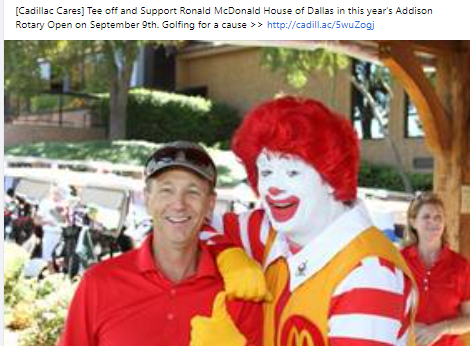
Description: A community-focused campaign that empowered local charities through digital engagement and strategic brand support.
Execution: TrizCom PR and Cadillac launched the Cadillac Cares Challenge in multiple markets including Dallas/Fort Worth and Houston. In each city, community members voted via Facebook for their favorite nonprofit organizations. Winners received $50,000 advertising campaigns that included TV spots on WFAA, CBS Radio promos and features in D Magazine. Runners-up received cash donations. The campaign helped raise awareness for the missions of charities like Heroes for Children, The Family Place, Make-A-Wish North Texas and the YMCA of Greater Houston.
Earned Media: Local TV and radio coverage, widespread social media engagement, increased Facebook fan bases for Cadillac and participating charities and significant cross-promotion between organizations.
Key Takeaways: Combining digital voting, charitable giving and strategic media placements creates a highly engaging and community-driven PR stunt.
Read the full Cadillac Cares case study here.

MrBeast Battle Royale
Description: A high-stakes, gamified experiential stunt that merged YouTube celebrity and brand sponsorship.
Execution: TrizCom PR supported media coverage for MrBeast’s $200,000 airsoft “Battle Royale,” which mimicked popular video game formats. Sponsored by Apex Legends, the event included influencer teams, dramatic visuals and livestreamed content.
Earned Media: Millions of views across YouTube and Twitch, gaming press coverage and major consumer media articles.
Key Takeaways: Fusing entertainment and brand messaging can yield multi-platform earned media.

GMC Terrain Charity Challenge
Description: A philanthropic stunt showcasing both product capability and community investment.
Execution: Teams were challenged to complete physical and service-based missions using GMC Terrains, with proceeds going to local charities. TrizCom PR framed the campaign around giving back, positioning the vehicles as versatile tools for good.
Earned Media: Covered by local stations, featured in automotive press and celebrated by nonprofits.
Key Takeaway: Cause marketing builds stronger brand loyalty when it’s active, visible and tied to community impact.
Read the GMC Terrain Charity Challenge case study here.

Chip and Adele
Description: A whimsical and heartfelt PR campaign that united animal lovers nationwide.
Execution: TrizCom PR partnered with Operation Kindness to tell the real-life story of a Chihuahua puppy named Chip and a kitten named Adele—both orphaned and rescued on the same day. The two were paired together in a foster home where they formed an inseparable bond. Rather than staging a literal wedding, the campaign creatively framed their connection as a “storybook romance,” supported by photos, foster updates and a dedicated social media presence.
Earned Media: Within a week, Chip and Adele’s Facebook page attracted over 30,000 followers and reached more than 8 million people. Their story was featured on BuzzFeed, Good Morning America, Inside Edition and numerous local TV outlets. Donations poured in from across the country.
Key Takeaways: When rooted in authentic storytelling, even the smallest subjects—like a puppy and kitten—can inspire massive community engagement, national media attention and fundraising momentum.
Read Chip and Adele’s case study here.
Best PR Stunts of All Time
Some PR stunts become etched into pop culture, studied in marketing classes, and referenced for years to come. These are attention-grabbing moments intentionally designed to capture the public's attention and generate widespread engagement. Brands use these stunts to spark conversation, drive sales, and create lasting cultural impact.
Below is a table summarizing some of the most iconic and influential PR stunts of all time:
| Brand & Year | Stunt Description | Key Outcome |
|---|---|---|
| Burger King (2018) | Whopper Detour used geofencing technology to offer Whoppers for 1 cent near McDonald’s locations. | Massive app downloads and sales through clever location-based marketing. |
| Duolingo (2025) | “The Death of Duo” viral TikTok storyline. | Over 120 million views demonstrating global social media engagement. |
| State Street Global Advisors (2017) | Fearless Girl statue installed on Wall Street. | Became an instant cultural icon with global media coverage promoting gender diversity. |
| KFC (2018) | “FCK” apology ad following a nationwide chicken shortage. | Turned a crisis into a positive brand moment and generated widespread goodwill. |
| Spotify (since 2016) | Spotify Wrapped personalized year-end listening recaps. | Highly shareable moments driving annual social media engagement surges. |
| CeraVe (2024) | Super Bowl campaign built around a Michael Cera conspiracy narrative. | High engagement, industry awards and amplified celebrity storytelling. |
| Apple TV+ (2022) | Severance glass office installation in Grand Central Terminal. | Immersive experience that drew crowds and extensive media coverage. |
| Miley Cyrus | Intimate concert at Chateau Marmont for superfans. | Created exclusivity and buzz around a single release. |
| Coors Light | Intentional typo on a Times Square billboard. | Sparked online outrage and a 400 percent surge in social conversations. |
| Canva (UK) | Waterloo billboards featuring playful “wrong-but-right” designs. | Viral engagement that resonated strongly with UK audiences. |
| Flagstone (UK) | Sleeping Giant installation made from printed pound notes. | Striking visual highlighting idle money in UK accounts. |
| PUMA (UK) | 10.5-metre illuminated football floating on the Thames. | City-wide attention and domination of social media conversation. |
| Netflix | Nubbin fictional tech device created for Black Mirror. | Fueled online speculation and captured public attention. |
| Aldi | Cap-Aldi rooftop performance by Lewis Capaldi in Nottingham. | Celebrity surprise that deeply engaged fans. |
| Heineken (2024) | Boring Phone launch at Milan Design Week. | Sparked conversation around digital fatigue and modern lifestyle. |
| Oatly | Crisis management microsite addressing brand controversies. | Helped manage brand image and maintain transparency during crises. |
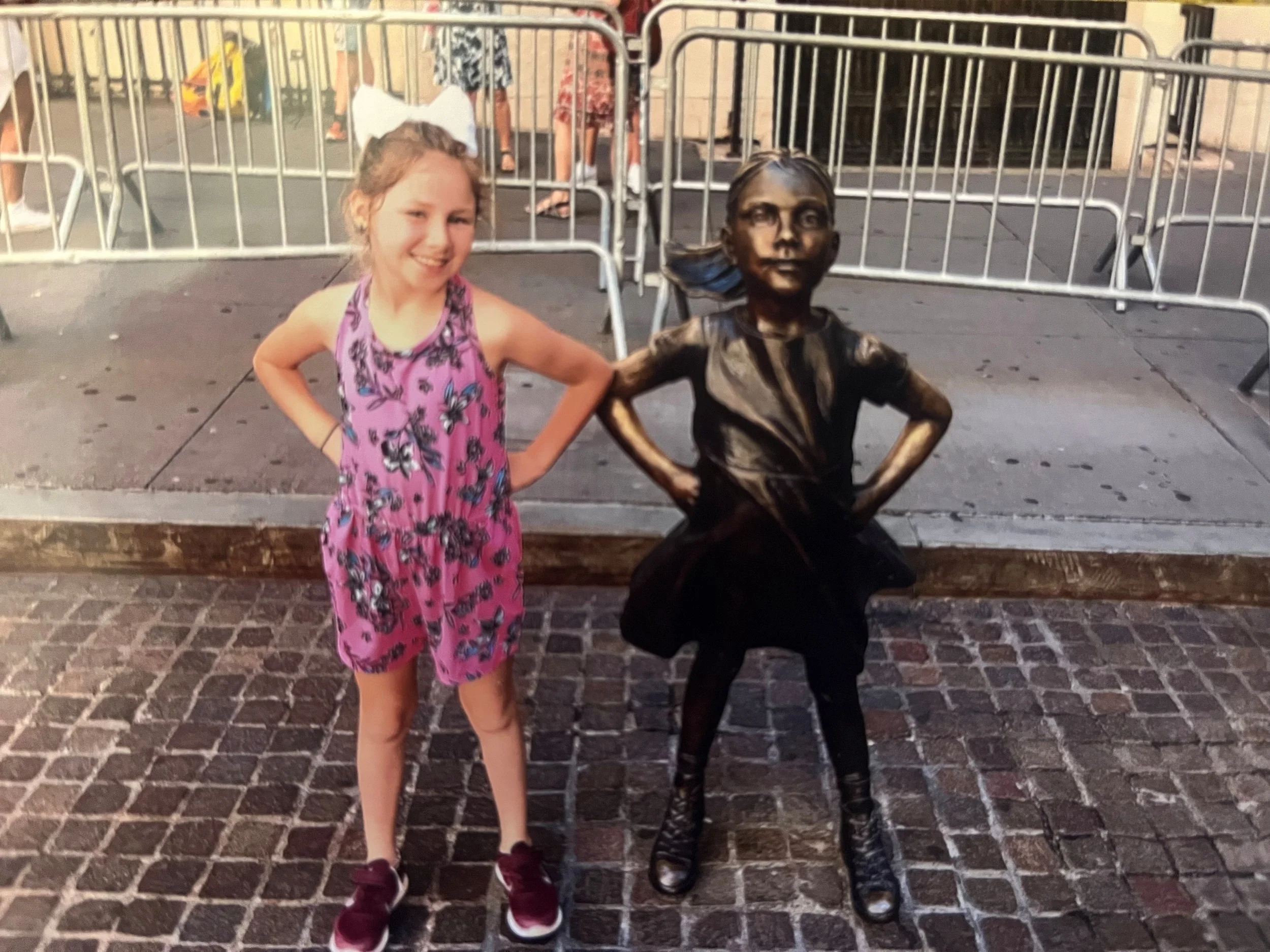
Jo Trizila’s daughter, Kate, with the Fearless Girl Statue in NYC
More Iconic PR Stunts

Red Bull Stratos Space Jump
Description: In 2012, Red Bull sponsored Felix Baumgartner’s record-breaking freefall from the edge of space.
Impact: Broadcast live on YouTube with over 9.5 million concurrent viewers, this stunt reinforced Red Bull’s brand identity around pushing limits and adventure.
Why It Worked: It was a high-risk, high-reward feat that tied directly to the brand’s “gives you wings” ethos while securing massive global media coverage.

ALS Ice Bucket Challenge
Description: The ALS Ice Bucket Challenge was a viral social campaign in 2014 that encouraged participants to pour ice water over themselves and donate to ALS research.
Impact: Raised over $115 million for ALS and engaged millions across social platforms, including celebrities and world leaders.
Why It Worked: It was accessible, emotionally charged and perfectly designed for social sharing, making it a model for nonprofit publicity stunts.

Thom Carroll/PhillyVoice.com
Taco Bell Buys the Liberty Bell (Spoof)
Description: On April Fool's Day in 1996, Taco Bell ran ads claiming it had purchased and renamed the Liberty Bell.
Impact: Generated a flood of media attention and consumer conversations. Though clearly a hoax, it raised Taco Bell's visibility dramatically.
Why It Worked: It was irreverent, humorous and executed with perfect timing—proving that a great PR stunt can be built on clever satire.
How to Activate a National PR Stunt
Executing a national PR stunt across multiple markets can be both complex and rewarding. To begin the planning process for a national PR stunt, it's important to outline your objectives, identify key markets, and coordinate resources early. National activation requires detailed planning, local insights, and a scalable structure. TrizCom PR, through its membership with PRConsultants Group (PRCG), is uniquely equipped to manage this.
Nationwide Reach, Local Expertise
PRCG is a network of seasoned communications professionals in every major U.S. market. This gives TrizCom PR the capability to execute stunts that feel both globally aligned and locally relevant.
Consistency Across Markets
With a unified strategy, TrizCom PR ensures that messaging, brand voice, and outcomes remain consistent regardless of geography.
On-the-Ground Support
Local team members help coordinate logistics, manage media relations, and monitor outcomes, ensuring real-time responsiveness.
Strategic Amplification
TrizCom PR pairs local execution with national amplification, securing coverage in top-tier outlets while maintaining community-level connections.
Whether it’s launching a product, hosting a live event, building a multi-city tour, or driving targeted website traffic, TrizCom PR ensures that every touchpoint is executed with purpose and precision.
From Bold Ideas to Media Sensations
PR stunts, when done right, can turn a brand into a media sensation overnight. From heartfelt human stories to humor-filled viral moments, the power of a well-timed publicity stunt lies in its ability to resonate emotionally and culturally. TrizCom PR has proven time and again that with creativity, strategic insight, and the right network, brands of any size can create lasting impressions.
If you're ready to elevate your brand with a bold, buzz-worthy campaign, partner with TrizCom PR. Our experience in experiential marketing, media relations, and national campaign execution ensures your story isn't just heard—it's remembered.
Let us help you craft the PR stunt that turns heads and headlines.
Everyone has a story. Let TrizCom PR tell yours!
About the Author:
Jo Trizila – Founder & CEO of TrizCom PR
Jo Trizila is the founder and CEO of TrizCom PR, a leading Dallas-based public relations firm known for delivering strategic communications that drive business growth and enhance brand reputations as well as Pitch PR, a press release distribution agency. With over 25 years of experience in PR and marketing, Jo has helped countless organizations navigate complex communication challenges, ranging from crisis management to brand storytelling. Under her leadership, TrizCom PR has earned recognition for its results-driven approach, combining traditional and integrated digital strategies to deliver impactful, measurable outcomes for clients across various industries, including healthcare, technology and nonprofit sectors. Jo is passionate about helping businesses amplify their voices and connect with audiences meaningfully. Her hands-on approach and commitment to excellence have established TrizCom PR as a trusted partner for companies seeking to elevate their brand and achieve lasting success. Contact Jo at jo@TrizCom.com.
0 Likes
National PR Stunts FAQ
What is a PR stunt and why do brands use them?
A PR stunt is a planned activation designed to capture attention, spark conversation and earn media coverage. Brands use PR stunts to break through crowded media environments and create moments people want to share. TrizCom PR approaches PR stunts as strategic storytelling tools, not gimmicks, ensuring each activation supports a larger brand goal.
What separates a successful PR stunt from a failed one?
Successful PR stunts align with brand values, feel authentic to the audience and are supported by strong media outreach. Failed stunts often chase shock value without strategy. TrizCom PR emphasizes planning, audience insight and message clarity so stunts generate positive attention rather than backlash.
Do PR stunts still work in a social media–driven world?
Yes, PR stunts work even better today when designed with shareability in mind. Social platforms amplify moments instantly, turning local activations into national conversations. TrizCom PR builds stunts that are visually compelling, emotionally engaging and optimized for both social sharing and earned media.
How do emotional PR stunts drive stronger media coverage?
Emotion is one of the strongest drivers of engagement. Campaigns like the Hospice Wedding or Chip and Adele resonated because they highlighted genuine human connection. TrizCom PR uses emotional storytelling to help media outlets and audiences connect with brands on a deeper level.
Can PR stunts support nonprofit and cause-driven campaigns?
Absolutely. Cause-driven PR stunts often generate stronger goodwill and longer-lasting impact than product-focused campaigns. TrizCom PR has executed nonprofit stunts that raised awareness, donations and national media attention by centering stories on real people and real impact.
How much planning goes into a PR stunt behind the scenes?
A lot more than most people realize. From ideation and logistics to media pitching and post-event follow-up, PR stunts require careful coordination. TrizCom PR invests significant time in planning to ensure stunts are newsworthy, legally sound and scalable across markets.
What role does earned media play in PR stunts?
Earned media is the end goal of most PR stunts. The objective is to create a moment compelling enough that journalists choose to cover it organically. TrizCom PR leverages long-standing media relationships to turn stunts into national headlines rather than one-day events.
How do influencer partnerships enhance PR stunts?
Influencers add reach, credibility and real-time amplification. Campaigns like Team Escalade Texas succeeded because influencers helped tell the story as participants, not just promoters. TrizCom PR carefully selects influencers whose audiences align with the brand and the stunt’s message.
Are PR stunts only for large national brands?
No. While some stunts scale nationally, smaller brands can achieve big results with creative thinking and smart execution. TrizCom PR has proven that well-timed, well-told stories can generate national attention regardless of company size.
What should brands consider before launching a PR stunt?
Brands should consider their audience, risk tolerance, message alignment and long-term reputation. A PR stunt should support the brand story, not distract from it. TrizCom PR helps clients evaluate whether a stunt makes sense strategically and how to execute it responsibly.
The Best Crisis Communication Examples for 2025

Every year, brands make public relations mistakes that turn into case studies. These crisis communication examples show how fast trust can drop when leadership treats an emotional moment like a routine update, waits too long to speak or talks like a legal memo while stakeholders feel the impact in real time.
The pattern is simple. A crisis creates an information vacuum. If you do not fill it with clear facts, human tone and practical next steps, someone else will. Social media will. Reddit will. A competing narrative will. Once that version takes hold, even a good response can look late.
TL;DR
A crisis is a fast-moving event that can harm people, operations, finances or trust
The first goal is stability, not a perfect explanation
Publish one source of truth with timestamped updates
Pick one spokesperson, limit mixed messages
Lead with care, then facts, then next steps
Keep promises about when the next update is coming
What is considered a crisis
A situation is considered a crisis when it creates real stakes and real urgency. Stakes can include safety risk, service disruption, legal exposure, financial impact or reputation damage that threatens future business. Urgency shows up when facts are incomplete, pressure is rising and decisions must be made quickly. If the event pulls in multiple audiences at once, employees, customers, partners, regulators, media and requires a cross-functional response, it has crossed into crisis territory.
What is crisis communications
Crisis communications is the coordinated work of sharing accurate, timely information during a high-stakes event while protecting people, operations and long-term trust. It covers what you say, when you say it, who says it and where it is published. The goal is not to “spin” a situation. The goal is to reduce confusion, prevent harm, support affected people and keep stakeholders informed as facts evolve. Strong crisis communications pairs empathy with clarity and uses one consistent update hub.
Top 11 Crisis Communications Events of 2025
Below is my list of 10 2025 crisis PR examples followed by past examples that still hold up. Each one includes what went wrong, what a stronger crisis response could have looked like and the takeaway you can steal for your own crisis management plan.
1) Dallas Mavericks trade Luka Dončić
The Dallas Mavericks traded Luka Dončić and announced it overnight on February 2, 2025. Fans woke up to a decision that felt abrupt and personal, not just strategic. The backlash moved from social posts to protests outside the arena, including a mock funeral. Local coverage stayed on the story for weeks because the team did not control the conversation early.
What went wrong
They treated a high-emotion moment like a routine transaction. The first wave of communication did not acknowledge what fans were losing. Leadership appeared reactive, then defensive, which kept the story alive.
What they should have done
They needed a planned rollout that treated fans as stakeholders, not an audience. That starts with a clear statement from leadership explaining the reasoning in plain language paired with a visible tribute to Luka’s legacy.
They also needed a listening phase. Hold a structured media availability with one spokesperson, share what the team can say and what it cannot, then commit to a second update within 24 to 48 hours. Most importantly, stop escalating tension in the arena. If fans show up upset, the organization’s job is to lower the temperature, not raise it.
What we learned
You can make a smart business move and still create a trust problem. Timing and tone decide whether stakeholders feel respected or dismissed. If your most loyal supporters feel blindsided, they will tell the story for you.
2) Astronomer Coldplay kiss cam scandal
Astronomer went from niche tech company to household name in a single weekend, but not because of its product. A kiss cam clip at a Coldplay concert showed two senior leaders, which turned into instant scrutiny around workplace ethics and leadership conduct. Internet sleuths identified the individuals within hours and the story shifted from gossip to governance. The company placed the executives on leave, opened an investigation and both leaders later exited. Astronomer then tried to redirect attention with a humorous, celebrity-led creative spot.
What went wrong
The real crisis was not the brand awareness spike. The crisis was executive behavior and the power dynamics implied by two leaders at the top. The company also lost the first day to silence, which gave the internet time to write its own version of events. The humor pivot created mixed reactions because many stakeholders wanted clarity and accountability first.
What they should have done
They needed a same-day holding statement that did three things: acknowledge awareness, confirm an independent investigation process and reaffirm leadership standards. Keep it short. Keep it human. Save humor for later, if it fits at all.
Next, run a disciplined update cadence tied to decision points: who is leading interim operations, when the investigation concludes, what changes will follow. If the company still wanted creative reframing, it needed to come after visible accountability and internal culture actions so the tone matched the substance.
What we learned
Virality can turn a company into a household name overnight, but that is not a win if the story is executive conduct. The first day matters. Silence invites speculation that is hard to unwind.
3) American Eagle Great Jeans campaign
In the Fall of 2025, a denim campaign sparked controversy because the messaging was read by some audiences as echoing sensitive themes around genetics. The conversation spread quickly across social platforms and traditional media. What the brand intended as playful wordplay became a broader cultural debate. The spokesperson and the brand responded later, but the story had already taken its shape.
What went wrong
The campaign was not stress-tested for interpretation risk. The response window looked slow, which let others define intent. The follow-up messaging focused on the original creative idea rather than addressing why the interpretation landed.
What they should have done
Before launch, they needed a red-team review: read the copy like a critic, then rewrite until the double meaning disappears. If the campaign is already live, the first response should validate concerns without arguing with them. Clarify intent, remove or revise the element causing harm and explain the change clearly.
Then shift to proof. Share what internal review steps are changing, how future campaigns will be tested and what representation and inclusion look like in practice. People do not need a lecture. They need clarity and action.
What we learned
If a line can be interpreted two ways, the internet will choose the one that creates friction. Cultural meaning moves faster than brand intent. Creative review needs a “how could this be read badly” step, every time.
4) Cracker Barrel logo redesign and reversal
In August of 2025, Cracker Barrel rolled out a brand refresh that included a logo change, then faced public backlash. The company reversed course and restored the old logo and brand elements. Executive changes followed as leadership tried to reset attention back to the guest experience. The episode turned a design decision into a reputational story.
What went wrong
They changed a symbol people feel protective of before explaining the reason. The explanation arrived after the reaction, so the reaction became the headline. The reversal looked reactive, which can make a brand feel unsteady even when it is trying to listen.
What they should have done
If a legacy brand wants to modernize, it needs a story that respects what people value. Explain the purpose first, show the evolution and test the rollout in smaller markets before a full switch. Treat brand change like change management, not like swapping a file.
They also needed better signal detection. Volume alone is not insight. Separate real customer feedback from coordinated amplification, then respond to the stakeholders who actually sustain the business.
What we learned
Changing a beloved symbol without a story creates a vacuum and people fill it fast. A reversal can look like listening, but it can also look like instability if the brand cannot explain the “why.” Not all outrage is customer outrage, so validation matters.
5) Camp Mystic Texas Hill Country flood
Over the July 4, 2025 holiday weekend, catastrophic flash flooding swept through Texas Hill Country, including the Guadalupe River area near Hunt, Texas where Camp Mystic operates. Camp Mystic later confirmed that 27 campers and counselors died. As search and rescue continued, families and the public looked for real-time updates, safety details and clear points of contact. Reporting also noted that Camp Mystic’s first formal website statement came after families and friends had already turned to social media for information.
What went wrong
In fast-moving disasters, information gaps become part of the crisis. Public reporting raised questions about response timing, including that evacuation began after a National Weather Service alert. Communication also appeared fragmented early on, with many people relying on unofficial channels while the situation was still unfolding.
What they should have done
First, camps in flood-prone regions need a crisis plan built around speed and redundancy. That includes hard evacuation triggers tied to weather alerts, overnight monitoring, flood gauges and multiple ways to reach every cabin and staff member if power and cell service fail. It also includes a separate family communications system that does not depend on staff posting updates in the middle of an emergency.
Second, once the crisis begins, the organization needs a single information hub and a predictable update rhythm. Set up a hotline and a dedicated webpage with time-stamped updates, what is confirmed, what is still being verified and where families can get help. Coordinate messaging with local emergency management so the public hears consistent facts and families do not feel pushed toward rumor-filled threads for answers.
What we learned
Natural disasters turn into reputation crises when stakeholders cannot get timely, trusted information. The most effective crisis communication is operational, not performative: clear triggers, redundant tools and a family-first update system. Post-crisis, the only path forward is transparency on what changed, plus visible safety upgrades that people can verify.
6) Target
In early 2025, Target said it would end its three-year DEI goals and wind down its REACH initiative, citing an “evolving external landscape.” The decision drew immediate public scrutiny because many people associate Target with values-led branding. Some community leaders and shoppers called for boycotts and sustained pressure campaigns, keeping the story in the news cycle well beyond a typical corporate announcement.
What went wrong
Target framed the change as a planning or positioning update, but many audiences experienced it as a reversal. The public messaging left space for others to assign motives, which widened the perception gap. The response also lacked a clear explanation of what would stay the same and what would change in day-to-day practices.
What they should have done
They needed to communicate in concrete terms, not umbrella language. A stronger approach would have spelled out what commitments were continuing, what programs were evolving and what metrics would still be tracked. Share a short FAQ that answers the questions people actually ask in these moments: what changes for employees, what changes for suppliers, what changes for community investment and what is non-negotiable.
They also needed a listening plan that matched the intensity of the reaction. That can include pre-briefs with key stakeholder groups, then a clear cadence of updates with one consistent spokesperson. If the company wanted to reposition language, it still needed to show continuity through visible actions and reporting that people can verify over time.
What we learned
Policy statements land as identity and trust, not corporate process. If you change something tied to values, you have to communicate what stays true, not only what is ending. Vagueness invites other people to define intent.
7) OpenAI ChatGPT mental health and safety lawsuits
In 2025, OpenAI faced a wave of public scrutiny tied to how ChatGPT responds to people in emotional distress, including minors. The most high-profile coverage centered on a wrongful-death lawsuit filed by a teen’s family who alleged the chatbot contributed to harmful outcomes. The story expanded beyond one case into a broader question about whether current safeguards are strong enough for vulnerable users. OpenAI responded by outlining new mental health guardrails for teens and people in crisis, including additional controls and crisis detection improvements.
What went wrong
This was not a standard PR crisis where a statement fixes the problem. The core issue was the gap between product capability and user safety expectations, especially when the user is a teen or in distress. As lawsuits and reporting stacked up, the narrative became “platform responsibility” instead of “isolated incident.”
What they should have done
OpenAI needed to treat this like a safety event with public accountability, not a reputational flare-up. That means a clear, centralized safety hub that explains what the system does when someone signals distress, what it will not do and how escalation works. It also means publishing measurable safety commitments, then reporting progress on a predictable schedule so the conversation is grounded in proof, not promises.
They also needed stronger guardrails that are easy to understand and hard to bypass for minors. Parental linking, teen-specific defaults, clearer warnings and better crisis routing all help, but credibility increases when safeguards are validated by independent experts and user research, then shared in plain language. When the topic is mental health, tone matters. The company has to lead with care for affected families, not corporate defensiveness.
What we learned
When a product touches mental health, trust is built through safety design and transparent follow-through. In these moments, “we take this seriously” is not enough because stakeholders want to see what changed. The brands that hold up best treat safety as a product feature that ships, gets measured and gets updated in public.
8) Hertz
Hertz disclosed that customer information was accessed after a threat actor exploited vulnerabilities in Cleo file transfer software used by a vendor. Hertz said it confirmed on February 10, 2025 that data had been acquired by an unauthorized party connected to attacks that occurred in late 2024. The notice described the types of information that may have been involved, including identification and contact details, with some individuals potentially affected more severely depending on the records involved.
What went wrong
The company faced the classic “it was a vendor” problem. Most customers do not separate vendor responsibility from brand responsibility, especially when identity risk is involved. The delay between the underlying intrusion window and consumer notification also creates frustration because people feel they lost time to protect themselves.
What they should have done
They needed to lead with customer protection, then explain the vendor chain. That means a breach hub that is easy to find, plain-language updates and a checklist of immediate steps people can take, even while forensic work continues. Put the highest-risk groups first and communicate directly with those individuals as early as possible.
They also should have tightened the tone around accountability. “Third-party incident” can sound like finger-pointing if it is not paired with clear ownership: what Hertz is doing now, what controls will change and how the company will validate improvements. A post-incident report, written for non-technical readers, would help restore confidence.
What we learned
In a breach, customers judge outcomes, not root causes. Vendor incidents still belong to the brand in the public’s mind. Speed, clarity and practical guidance reduce long-tail distrust.
9) Tesla and Elon Musk DOGE role backlash
Elon Musk became the public face of the White House’s Department of Government Efficiency known as DOGE even as the White House said in court filings that Musk was not a DOGE employee and had no formal decision authority. The visibility of the role triggered a consumer backlash that moved into the real world through #TeslaTakedown protests at Tesla locations. The situation blurred Tesla’s brand with Washington politics and created negative attention across key markets. The White House later publicly showcased support for Tesla, which kept the story connected to politics rather than products.
What went wrong
The core issue was brand entanglement. Tesla became a proxy target for opinions about Musk’s government role and federal cuts, even though the company is a separate entity. Messaging also struggled to clarify the difference between Musk’s public persona, Musk’s advisory role and Tesla’s operations, leaving a perception gap that others filled quickly.
What they should have done
This required a clear firewall narrative, repeated consistently. Tesla could have separated “Musk the adviser” from “Tesla the company” with a short, plain-language statement that explained governance, decision-making and who speaks for Tesla on operational matters. Then reinforce it with actions: elevate additional executive spokespeople, increase visibility for product and safety leadership, publish a predictable cadence of customer-first updates that do not touch politics.
They also could have planned for stakeholder reaction the way they plan for product launches. That means scenario planning for boycotts and protests, employee communications that prepare store teams, retailer guidance for handling in-person demonstrations and a monitoring plan that tracks reputation by region. The goal is not to argue with critics. The goal is to reduce ambiguity so customers, employees and investors know what Tesla is accountable for and what it is not.
What we learned
When a founder becomes a political symbol, the brand can inherit political heat whether it wants it or not. “Clarifying later” rarely works because public narratives move faster than corporate explanations. A visible firewall and steady spokesperson strategy can reduce long-tail damage, especially when protests and boycotts move offline.
10) American Airlines Flight 5342 midair collision near Washington DC
On January 29, 2025, an American Eagle regional jet operating as American Airlines Flight 5342 collided midair with a US Army Black Hawk helicopter near Ronald Reagan Washington National Airport. All 67 people on both aircraft died including 28 members of US Figure Skating Association’s figure skating community, making it one of the deadliest US aviation disasters in decades. The story dominated national news immediately and families, regulators, elected leaders and the public looked for clear information fast. American Airlines’ CEO issued video statements and the company used its newsroom updates as the incident investigation unfolded.
This one hit hard for me on a personal level because my daughter is a figure skater and seeing the skating community connected to the coverage made it feel close to home.
What went wrong
In tragedies of this scale, “wrong” is not only about what caused the event. It is also about how quickly misinformation spreads when facts are incomplete. The pressure point is the first two to six hours, when people search for answers and every gap gets filled by speculation.
What they should have done
Treat the first statement as a stabilizer, not a full explanation. Confirm what is known, state what is not yet known, explain what the company is doing next and point everyone to one source of updates that stays current. Repeat that cadence on a predictable schedule, even if the update is short.
Then separate audiences. Families need a dedicated channel and support resources that do not compete with media updates. Customers and the public need operational clarity, travel guidance and a clear commitment to cooperate with investigators. Regulators and elected officials need direct lines and consistent facts. This is one of the clearest moments where a single, disciplined message map reduces confusion and protects credibility while investigations run their course.
What we learned
In a mass-casualty crisis, speed and clarity matter, but discipline matters more. One trusted update hub, one spokesperson plan and a predictable rhythm can prevent speculation from becoming the narrative. When facts are limited, the company that communicates what it knows and what it is doing next earns more trust than the company that waits for perfect information.
Older crisis communication examples that still hold up
The 2025 examples show how crises move now: faster, louder, and shaped by emotion before facts are complete. The older examples are worth revisiting because the mechanics never changed. Leaders still wait too long, talk in corporate language when people want plain truth, and underestimate how quickly a vacuum gets filled. These cases may be years old, but the failures are current. Read them as pattern recognition. If you can spot the same missteps early in your own organization, you can correct course before the headline hardens.
1. Bud Light’s Marketing Misfire: Alienating Core Customers
Bud Light, one of the biggest beer brands in America, attempted to expand its audience by partnering with transgender influencer Dylan Mulvaney. However, the campaign sparked backlash from conservative customers, leading to widespread boycotts. Sales plummeted by 24%, and the company lost its position as America’s top-selling beer.
What Went Wrong?
Bud Light failed to anticipate the potential backlash from its existing customer base. The brand launched the campaign without a clear messaging strategy and, when faced with criticism, offered no decisive response—leaving both supporters and detractors confused.
Crisis Communication Examples: What They Should Have Done
Bud Light needed a cohesive crisis PR strategy from the start. First, they should have prepared for pushback and preemptively crafted messaging that reinforced their commitment to inclusivity while also addressing the concerns of longtime consumers. Instead of a vague and inconsistent response, a clear and unified crisis communication strategy would have helped manage public sentiment.
Additionally, an effective crisis communication plan should have included internal and external communication strategies to align all team members and ensure a consistent message across social media channels and press statements.
2. Twitter (X) and Elon Musk’s PR Nightmare
Elon Musk’s takeover of Twitter, now rebranded as X, quickly became a PR disaster. Sudden mass layoffs, erratic policy changes, and the reinstatement of controversial accounts led to a massive exodus of major advertisers and a sharp decline in user trust.
What Went Wrong?
The chaos stemmed from a lack of transparency in Musk’s leadership. His approach was abrupt, often relayed through spur-of-the-moment tweets instead of structured crisis response statements. This mismanagement led to significant damage to public trust and loss of key business partnerships.
Crisis Communication Examples: What They Should Have Done
Musk needed a phased crisis management strategy that reassured advertisers and users during the transition. Hosting industry roundtables, offering transparency into upcoming changes, and rolling out new policies gradually rather than all at once could have maintained stability and trust. A well-developed crisis communications plan with structured messaging and team members trained in effective crisis communication could have helped mitigate long-term reputational damage.
3. OceanGate’s Titan Tragedy: A PR Catastrophe
The OceanGate Titan submersible disaster made global headlines when the vessel imploded during a deep-sea expedition to the Titanic wreckage. The company had ignored previous safety warnings, and its dismissive PR response only worsened the crisis.
What Went Wrong?
Instead of addressing valid safety concerns, OceanGate downplayed risks and even mocked experts who raised warnings. Their initial response lacked empathy, further eroding public trust and intensifying media scrutiny.
Crisis Communication Examples: What They Should Have Done
The company should have implemented a real-time crisis response strategy that prioritized transparency and public reassurance. Acknowledging concerns early, outlining clear safety protocols, and committing to an independent investigation would have demonstrated effective crisis management. OceanGate also needed an internal and external communication framework to align messaging across all platforms, including social media channels and press releases.
4. Balenciaga’s Disturbing Ad Campaign
Luxury brand Balenciaga faced global outrage after releasing an ad campaign featuring children holding teddy bears dressed in BDSM-style harnesses. The disturbing imagery led to accusations of child exploitation, causing celebrities and customers to sever ties with the brand.
What Went Wrong?
Balenciaga’s lack of internal review processes resulted in a damaging public relations crisis. Their delayed response and attempts to shift blame onto external creatives only worsened public sentiment.
Crisis Communication Examples: What They Should Have Done
A strong crisis management plan would have included thorough content review processes and real-time response protocols. Balenciaga needed effective crisis communication—an immediate, unequivocal apology combined with proactive corrective measures such as partnerships with child advocacy organizations to restore public trust.
5. Southwest Airlines’ Holiday Meltdown
During the 2022 holiday season, Southwest Airlines faced a PR nightmare when an outdated scheduling system caused thousands of flight cancellations, stranding passengers for days.
What Went Wrong?
Instead of communicating early and transparently, Southwest provided limited updates, leading to confusion and frustration among travelers. The lack of real-time crisis response made the situation worse.
Crisis Communication Examples: What They Should Have Done
Southwest needed a crisis communication strategy that included frequent and transparent updates, clear refund policies, and a long-term plan for system upgrades. An effective crisis management approach would have prioritized internal and external communication, ensuring that customers and employees received consistent messaging.
6. Pepsi’s Kendall Jenner Ad Backlash
Pepsi’s 2017 commercial featuring Kendall Jenner attempting to diffuse a protest by offering a police officer a can of soda was widely condemned for trivializing social justice movements.
What Went Wrong?
Pepsi failed to recognize the sensitivity of the topic and did not anticipate the backlash from audiences who viewed the ad as tone-deaf. The company’s attempt to appear socially aware backfired, leading to accusations of exploiting serious issues for commercial gain.
Crisis Communication Examples: What They Should Have Done
Pepsi should have employed a diverse crisis communication team to assess the potential impact of the advertisement before its release. A stronger internal review process and direct engagement with activists could have helped prevent the crisis. Additionally, a more heartfelt and direct apology, rather than pulling the ad without explanation, would have been a better crisis response.
7. Boeing’s 737 MAX Crisis
Boeing faced an unprecedented PR disaster when two 737 MAX aircraft crashed, killing 346 people due to faulty software.
What Went Wrong?
Boeing initially attempted to downplay the issues and delayed grounding the aircraft, leading to erosion of public trust. Regulatory agencies and passengers lost confidence in the company.
Crisis Communication Examples: What They Should Have Done
Boeing needed to take immediate accountability and prioritize passenger safety by proactively grounding the aircraft. A transparent and remorseful approach, combined with a clearly outlined corrective action plan, would have improved crisis communication and restored confidence in the brand.
8. United Airlines Passenger Removal Incident
In 2017, a United Airlines passenger was forcibly removed from an overbooked flight, and disturbing footage of the incident went viral. The passenger, a doctor, was dragged off the plane by law enforcement after refusing to give up his seat. The public outrage was immediate, with calls to boycott United Airlines.
What Went Wrong?
United Airlines’ initial response was defensive, stating that the passenger was "re-accommodated" instead of addressing the excessive force used. The airline’s CEO then issued a half-hearted apology, failing to acknowledge the harm caused. This lack of transparency and poor crisis response fueled further backlash.
Crisis Communication Examples: What They Should Have Done
United Airlines should have immediately acknowledged the situation and taken responsibility. A sincere apology, coupled with a pledge to review and change its overbooking policy, could have helped ease public anger. Additionally, real-time crisis communication via social media would have allowed the company to control the narrative instead of letting the viral video dominate public perception.
9. Facebook’s Cambridge Analytica Scandal
In 2018, it was revealed that Cambridge Analytica had improperly harvested data from 87 million Facebook users without their consent and used it for political advertising. The scandal raised major concerns about data privacy and misuse of personal information.
What Went Wrong?
Facebook delayed acknowledging the breach, allowing negative media coverage to spread unchecked. The company's CEO, Mark Zuckerberg, waited too long before publicly addressing the issue. The platform’s lack of transparency and poor internal crisis management led to regulatory scrutiny and a major loss of trust among users.
Crisis Communication Examples: What They Should Have Done
Facebook needed a proactive crisis management strategy, ensuring that users were informed as soon as the data breach was uncovered. Immediate action, such as implementing new privacy policies and issuing a clear, apologetic statement from leadership, would have helped restore public trust. Partnering with independent auditors to verify changes in data security could have further demonstrated commitment to change.
10. Chipotle’s Food Safety Scandal
Between 2015 and 2018, Chipotle faced multiple foodborne illness outbreaks, including E. coli, norovirus, and salmonella, which sickened hundreds of customers. The outbreaks raised concerns about the company’s food safety practices.
What Went Wrong?
Chipotle's slow crisis response and lack of transparency exacerbated the damage. The company failed to immediately identify the sources of contamination and did not reassure customers with a clear action plan. Sales plummeted, and Chipotle's reputation suffered long-term damage.
Crisis Communication Examples: What They Should Have Done
Chipotle needed to implement a robust crisis communication strategy, immediately acknowledging the issue and outlining the corrective steps being taken. A strong internal and external communication plan would have reassured the public and prevented further speculation. Investing in more rigorous food safety procedures and publicly committing to enhanced quality control measures would have helped rebuild consumer confidence.
Crisis Communications FAQ
How do we know if something is a crisis or just a tough day?
A crisis is any event that threatens people’s safety, your ability to operate, your financial stability or trust with key stakeholders. The quick test is consequence plus speed: facts are incomplete, the situation is moving fast and choices made in hours can change outcomes. A service outage is a tough day until it creates safety risk, major customer loss, regulatory exposure or viral attention. If you need a cross functional war room and a single source of truth, treat it as a crisis.
What should happen in the first hour of a crisis?
In the first hour, aim to stabilize, not to explain everything. Confirm what is known, flag what is not confirmed, assign a decision lead and pick one spokesperson. Create one update hub, even if it is a simple newsroom post. Draft a holding statement that acknowledges the situation, shows care for affected people and commits to the next update time. Brief employees so they do not learn the story from social media. Start monitoring for misinformation and urgent customer impacts.
What is a holding statement and why does it matter?
A holding statement is a short first message used when events are unfolding and you do not yet have full facts. It buys time without sounding evasive. A strong holding statement acknowledges awareness, expresses care for affected people and explains what you are doing next. It points everyone to one place for updates and includes a time for the next check-in. The goal is to reduce speculation while your team verifies details, coordinates with partners and makes operational decisions.
Who should be the spokesperson during a crisis?
Choose a spokesperson who can speak credibly, calmly and consistently to the audiences that matter most in that moment. For operational disruptions, a senior operations leader often works well. For safety incidents, the CEO may be needed, supported by a subject matter expert. For legal or regulatory issues, pair leadership with clear process language, not legal jargon. Limit the number of voices. One primary spokesperson reduces contradictions. Prepare a backup and rotate when fatigue sets in.
How do we balance legal risk with human tone?
Legal review matters, but legal tone can damage trust. Balance comes from separating facts, empathy and commitments. State what is confirmed, avoid speculation and do not over-promise. At the same time, acknowledge impact in plain language and name who you are prioritizing, such as customers, employees or families. Use process language like “we are reviewing” and “we will share updates as facts are confirmed.” Keep messages short, consistent and readable by a non-lawyer. Confirm a next update time.
What is the role of internal communications in a crisis?
Internal communications keeps teams aligned, reduces rumor spread and protects culture. Employees are stakeholders and also amplifiers. If they feel blindsided, they may fill the information gap themselves, even with good intentions. A strong internal update covers what happened, what is confirmed, what is not, what to say if asked, where to route inquiries and what support is available. Repeat the message across shifts and channels. Timestamp changes so people can follow the latest guidance.
How do we respond to misinformation and viral rumors?
Start by judging harm. If a rumor creates safety risk, legal risk or reputational damage, correct it quickly with one clear fact and a link to your update hub. Avoid repeating the false claim in detail because that can spread it further. Use timestamped updates so people can see what changed and when. If a credible third party can validate the correction, that often increases trust. Also fix the conditions that fuel rumors, like silence or scattered statements.
When is an apology appropriate and what should it include?
Apologize when your organization caused harm, contributed to harm or failed to meet a reasonable standard of care. A useful apology is specific. Name what happened, acknowledge impact and take responsibility for your part. Then explain what changes next so the issue does not repeat. Avoid conditional phrasing like “if anyone was offended.” If you cannot share details yet, apologize for the experience, describe the review process and commit to a timeline for updates and next steps.
How often should we provide updates during an active crisis?
Update frequency should match stakeholder anxiety and the pace of change. In the first day, a predictable rhythm helps even if updates are brief. Many teams post hourly early on, then shift to every few hours as facts stabilize. The key is to keep promises. If you say “next update at 3 p.m.” deliver it. Use timestamps and version control so media and customers can track changes. If nothing new is confirmed, say that and restate what happens next.
What should we do after the crisis is over?
After the immediate crisis, move into recovery and proof. Hold a debrief within two weeks while details are fresh. Document what happened, what decisions were made, what worked and where delays occurred. Update the crisis plan, message map and contact lists. Share a plain-language post incident summary with stakeholders when appropriate, including what changed in operations, training or controls. Track long-tail trust signals like customer churn, employee sentiment and media framing, then adjust plans and training based on what you learn.
Need Help Navigating a Crisis?
At TrizCom PR, we specialize in crisis communication strategy and reputation management. Whether you’re dealing with a PR crisis or need a crisis management plan, we’ve got you covered.
Contact us today to safeguard your brand’s reputation.
Everyone has a story. Let TrizCom PR tell yours!
About the Author:
Jo Trizila – Founder & CEO of TrizCom PR
Jo Trizila is the founder and CEO of TrizCom PR, a leading Dallas-based public relations firm known for delivering strategic communications that drive business growth and enhance brand reputations as well as Pitch PR, a press release distribution agency. With over 25 years of experience in PR and marketing, Jo has helped countless organizations navigate complex communication challenges, ranging from crisis management to brand storytelling. Under her leadership, TrizCom PR has earned recognition for its results-driven approach, combining traditional and digital strategies to deliver impactful, measurable outcomes for clients across various industries, including healthcare, technology, and nonprofit sectors. Jo is passionate about helping businesses amplify their voices and connect with audiences meaningfully. Her hands-on approach and commitment to excellence have established TrizCom PR as a trusted partner for companies seeking to elevate their brand and achieve lasting success. Contact Jo at jo@TrizCom.com.
Crisis Communication Examples Frequently Asked Questions (FAQ)
What is crisis communication in PR?
Crisis communication in PR refers to strategies companies use to manage and respond to crises that threaten their reputation. It involves proactive planning, clear messaging, and timely responses to control the narrative and minimize public backlash. Effective crisis communication helps maintain trust, engage stakeholders, and implement corrective actions to restore credibility.
Why do companies need a crisis communication plan?
A crisis communication plan helps companies respond effectively to PR disasters by outlining clear protocols, designated spokespeople, and communication strategies. This minimizes confusion and ensures a swift, unified response to protect the brand’s reputation. It also prepares teams to handle media inquiries, mitigate misinformation, and restore public trust through proactive engagement and strategic messaging.
What are some key elements of an effective crisis management strategy?
An effective crisis management strategy includes:
Preparation: Identifying potential crises and having response plans in place.
Transparency: Providing honest and timely updates to maintain credibility.
Consistency: Ensuring all messaging aligns across media channels.
Accountability: Taking responsibility and outlining corrective actions.
Engagement: Communicating directly with stakeholders and the public.
Adaptability: Adjusting crisis responses as situations evolve.
Monitoring: Using media tracking tools to assess impact and adjust strategies accordingly.
How did Bud Light’s crisis PR mistake affect its brand?
Bud Light’s partnership with a transgender influencer led to backlash from conservative consumers, causing a significant drop in sales. The brand’s failure to anticipate and address the controversy resulted in widespread boycotts, negative media coverage, and a loss of brand trust among its core audience. The company struggled to regain consumer confidence and market stability.
What could Twitter (X) have done differently during Elon Musk’s takeover?
Twitter (X) should have implemented a phased crisis management strategy that reassured advertisers and users during the transition. Hosting industry roundtables, providing transparency into policy changes, maintaining stability, and strengthening internal communication could have prevented mass advertiser pullouts, reduced user distrust, and ensured a smoother transition with minimal reputational damage.
What lessons can brands learn from OceanGate’s Titan disaster?
OceanGate’s dismissive response to safety concerns worsened the crisis. Brands must prioritize transparency and public reassurance during emergencies. A commitment to safety, independent investigations, and immediate acknowledgment of concerns could have mitigated the backlash. Establishing clear crisis communication plans, engaging experts for risk assessments, and maintaining open dialogue with stakeholders can strengthen credibility and prevent long-term reputational damage.
How did Balenciaga mishandle its PR crisis?
Balenciaga failed to properly vet an ad campaign that led to accusations of child exploitation. Their delayed response and attempt to shift blame only intensified the controversy. The company needed an immediate, unequivocal apology and stronger content review processes. Implementing stricter internal approval procedures, engaging crisis management experts, and swiftly addressing concerns with corrective action could have helped restore public trust.
What was Pepsi’s biggest mistake with the Kendall Jenner ad?
Pepsi’s ad was criticized for trivializing social justice movements. The company failed to conduct proper cultural sensitivity reviews before releasing the campaign. Involving diverse perspectives and engaging with activists before the ad launch could have prevented backlash. Additionally, Pepsi should have issued a more immediate and genuine apology, while committing to initiatives that support the communities affected by the campaign’s missteps.
How did Boeing’s response to the 737 MAX crisis damage its reputation?
Boeing initially downplayed the seriousness of the two crashes and delayed grounding the aircraft, which led to loss of public trust and regulatory scrutiny. Immediate accountability, proactive grounding of planes, and transparent communication with safety agencies could have minimized the fallout. Additionally, a commitment to enhanced safety measures, improved pilot training, and a clear plan for rebuilding confidence among passengers and airlines would have mitigated long-term reputational damage.
What are the most important steps for effective crisis communication?
Acknowledge the crisis early.
Communicate transparently and frequently.
Take responsibility and provide solutions.
Use all media channels to reach stakeholders.
Continuously update the public on corrective actions.
Train spokespersons to deliver consistent messaging.
Monitor public sentiment and adjust strategy as needed.
Engage with key stakeholders for direct feedback.
Ensure internal teams are aligned on crisis response.
Follow up post-crisis to rebuild trust and credibility..
How can companies restore public trust after a PR crisis?
To rebuild public trust, companies should:
Issue sincere apologies.
Take concrete steps to prevent future mistakes.
Engage in community outreach or corporate responsibility initiatives.
Maintain open and honest communication with consumers and stakeholders.
Demonstrate long-term commitment to ethical business practices.
Implement transparency measures such as third-party audits and reports.
Foster direct engagement with affected customers and communities.
Showcase corrective actions through media and social channels.
What role does social media play in crisis communication?
Social media allows companies to respond in real-time, manage narratives, and engage with audiences directly. However, it also amplifies negative publicity if mishandled. A well-planned social media crisis response strategy is essential for damage control. Companies should monitor conversations, address misinformation promptly, and ensure messaging is consistent across platforms. Engaging proactively with stakeholders can help rebuild trust and minimize reputational harm.
How do internal teams play a role in crisis PR management?
Internal teams should be well-prepared through crisis simulation training, clear communication roles, and established escalation procedures. Effective internal communication ensures that all employees understand messaging strategies and their role in crisis response. Cross-department collaboration, regular crisis drills, and designated response teams enhance readiness. Keeping employees informed fosters unity and ensures a coordinated approach during crises.
What industries are most vulnerable to PR crises?
Industries most susceptible to PR crises include:
Airlines and transportation (flight delays, safety concerns)
Tech companies (data breaches, regulatory issues)
Food and beverage (contamination, misleading advertising)
Fashion and retail (controversial ads, ethical concerns)
Pharmaceutical and healthcare (product recalls, lawsuits)
How can brands prepare for potential PR disasters?
Brands can prepare by:
Developing a crisis communication plan.
Training spokespersons for media interactions.
Monitoring public sentiment through social listening.
Establishing transparent relationships with media outlets.
Conducting regular risk assessments.
Creating scenario-based crisis simulations to test response strategies.
Ensuring internal teams understand crisis protocols and their roles.
What Is PR, SEO and AI Search Integration?

PR Metrics That Matter
Last quarter I sat with a CEO who proudly told me their team earned 35 million impressions on a product launch. Big number. I asked a simple follow up. What did those impressions do for the business? Silence.
That is the trap with vanity. Numbers that look impressive on a slide can disconnect from outcomes. In public relations, where numbers can be dazzling and deceptive, it is easy to get lost in the sparkle. Strong leaders do not.
What are vanity PR metrics?
Vanity metrics are the stats that look good without proving success. Impressions. Raw follower counts. Likes. These inflate visibility but rarely show if anyone cared, trusted or acted.
They are not meaningless, but they are not enough. You would not judge your sales team only on doors knocked. You would ask how many opened, how many conversations happened and how many deals closed. PR deserves the same rigor.
Case in point. Your team lands a story on Forbes.com. Cision lists Forbes with an audience of 16,273,661. That is a platform number, not your readership. Treating 16,273,661 as reads is misleading, yet many reports still drop that number into reach. Big numbers can start a conversation. Actionable numbers close it.
What are actionable PR metrics?
Actionable PR metrics show whether communications move people toward a decision that matters to the business. A few to anchor your dashboard:
Share of voice vs named competitors
Quality and relevance of backlinks from earned coverage
Referral traffic from specific placements
Engagement that signals intent, such as saves, comments, shares, replies
Conversions tied to PR touchpoints, such as demo requests, email signups, store visits
Growth in branded and category search
Presence in AI search results for priority queries
Message pull through in coverage and interviews
Sentiment shifts among priority audiences
Cost per outcome, such as cost per qualified media mention or cost per referral lead
These are the numbers that help a CMO decide where to place the next dollar. They help a CEO see how communications contribute to revenue and reputation.
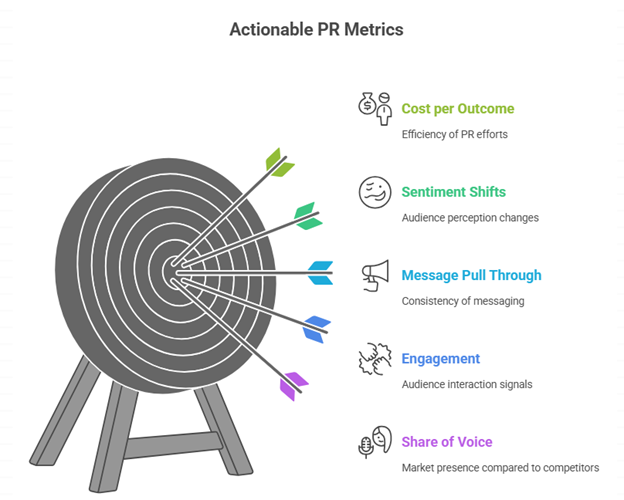
Map PR metrics to the customer journey
PR works across the full funnel. Your metrics should too.
Awareness
Share of voice, unique reach of earned coverage, category search lift, branded search lift, new users from referral traffic
Consideration
Time on PR landing pages, return visits from placements, content downloads, email growth from PR content, analyst briefing requests
Decision
Sales-qualified leads with PR as first or assist touch, coupon redemptions tied to PR codes, foot traffic tied to local coverage, store locator starts
Loyalty and advocacy
Repeat purchase tied to customers sourced from PR, reviews volume and rating after PR bursts, UGC volume, owned community growth
This is how PR Metrics stop being a scoreboard and start being a steering wheel.

Tie metrics to the PESO model
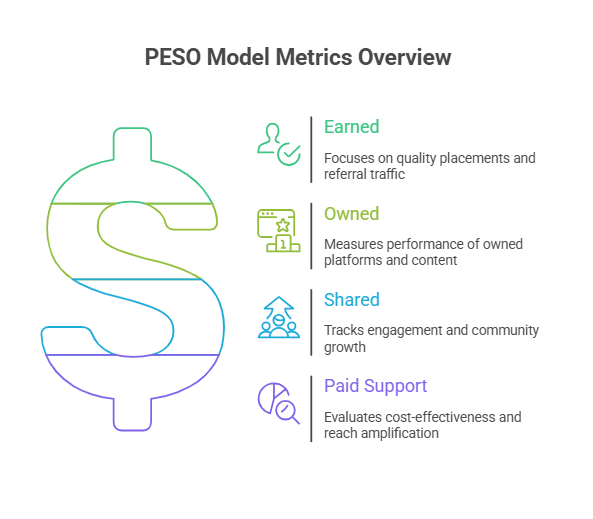
Your plan likely blends paid, earned, shared and owned. Measure each channel on what it does best, then show how the pieces reinforce each other.
Earned
Placement quality, domain authority of outlets, backlink quality, message pull through, referral traffic, conversions from earned pages
Owned
PR hub performance, newsroom traffic, average time on page, scroll depth, conversions from bylines and explainers
Shared
Saves, shares, comments, click-through to owned content, community growth tied to PR moments
Paid support
Cost to amplify earned hits, incremental reach on target, lift in branded search when you boost coverage, assisted conversions
When you connect the dots across a fully integrated program, executives see how communications compounds.
Why the difference matters in the boardroom
Quick story from my desk. A franchise brand was spending heavily on influencers. The vanity report sparkled. Big reach. Pretty content. Many likes. We traced referral traffic and coupon redemptions. Almost no conversion. We shifted to fewer creators with buyer overlap and tighter briefs. Reach dropped by half. Sales inquiries quadrupled.
Boards do not need to see every click. They need clarity. Is PR driving outcomes that matter to this business? Actionable PR Metrics earn their place in that answer.
Why asking for tactics first misses the point
Too many new business calls start the same way. A brand leads with tactics. We want a press release. We want The New York Times. A press release and one media hit rarely make a significant impact.
When selecting a PR agency, start with your business goals, not a wish list of outlets. Lead with a real outcome. We need to grow holiday sales 15 percent year over year. Can you help? Now you will get strategy. That is why you hire a firm.
Think of it this way. You would not tell a cardiologist how to perform heart surgery. You would not instruct an attorney on contract law. You hire experts because they know how to solve the problem.
And when the CEO and board review the sales impact and PR is not present, the shiny headline loses its appeal.
Build a PR metrics framework you can defend
Here is a simple framework we use with executives who want confidence, not clutter.
Start with one business objective
State it in plain language with a number and a deadline. Example: Increase qualified pipeline from healthcare prospects by 20 percent this quarter.
Then we define two or three PR outcomes that influence that objective
Examples: Double meetings with healthcare trade media. Secure three analyst briefings that cite our product category. Earn ten backlinks from healthcare domains with domain authority over 60.
We pick a short set of leading and lagging indicators
Leading: analyst inquiries, inbound media requests, PR-driven traffic to healthcare landing pages
Lagging: demo requests from healthcare domains, proposal volume, closed-won with PR as first or assist touchWe instrument the journey
Use UTM links, dedicated landing pages, unique discount or RSVP codes, call tracking, QR codes at events, click-to-call in local listings. Remove guesswork.
Then we set thresholds for action
Decide what triggers a change. If the message pull-through drops below 60 percent, revise the brief. If referral traffic from earned is below 10 percent of total traffic, revisit the outlet mix.
We report with context
Replace wall-of-numbers reports with a one-page narrative. What we tried. What happened. What we are changing. One chart per stage is plenty.
Finally, we close the loop with sales and service
Confirm that PR-sourced leads progress faster or close at higher rates. Capture feedback on objections PR can address with content or executive visibility.
That is a framework a board can respect.
Practical examples of replacing vanity with value
A few common swaps you can make this quarter.
Instead of total impressions
Track unique reach to priority audiences and the percent of coverage with message pull-throughInstead of follower counts
Track saves, replies and shares on posts tied to PR stories, plus click-through to owned contentInstead of raw clip counts
Track outlet quality, domain authority, backlink presence and referral traffic from those clipsInstead of made-up AEV (advertising value equivalency)
Track cost to replicate outcomes with paid media, plus cost per qualified outcome, such as cost per referral leadInstead of a single viral moment
Track compounding effects such as search lift, brand mentions and secondary pickups two to four weeks after the hit
The role of AI and PR metrics
Executives ask about AI search. It belongs in your PR Metrics mix. Treat it like a new channel of discovery.
Track presence in AI overviews for your priority queries
Log cited sources when your brand appears
Expand your media plan to include credible sources AI often cites in your niche
Compare shifts in branded search and direct traffic after AI mentions
Watch your owned content quality. Clear headlines, strong subheads, schema, expert bios, citations
AI does not replace PR. It rewards credible coverage and clear content.
Avoid the most common measurement mistakes
A short list we often see.
Counting potential audience as readership
Platform audience is not people who read your story.
Cherry picking only the good clips
Executives want the full picture. Include neutral or negative coverage with a plan to address it.
Treating AEV as a monetary north star
AEV is a flawed metric and ignores quality, message pull-through and behavior. Please retire this metric.
Reporting everything, learning nothing
Ten pages of charts do not equal insight. Pick a few numbers that will change what you do next month.
Never connecting to sales
If your CRM does not see PR, your board will not either. Build UTM discipline with sales and marketing ops.
Skipping baselines
Start every program with a baseline for share of voice, search, sentiment and referral traffic.
A five-part PR metrics dashboard that executives will read
Keep it to one page. No fluff.
Objective
One sentence with a number and a date
What we did
Three bullet points on actions that matter
What happened
Five to seven metrics split across awareness, consideration, decision, loyalty
What we learned
Two or three short insights tied to outcomes
What we are changing
One to three concrete changes for the next cycle
That is how PR Metrics earn trust. Not through volume, but through clarity and decisions.
What to ask your PR team
If you are reviewing reports this month, try these questions.
Which of these metrics tie directly to our business goals
Can you show me the pathway from this media placement to engagement or sales
What did we learn this quarter that changes how we approach the next one
How are we instrumenting PR, so attribution is not guesswork
What will you stop doing based on these results
If the answers circle back to look at how big the number is, you are in vanity land.
A short buyer’s guide to PR measurement
Choosing a new firm or evaluating the one you have
Ask for a sample dashboard that hides the client’s name but shows structure and clarity.
Request one case where the team cut a tactic based on data and what happened next.
Confirm the tool stack and how they combine data across tools to avoid double-counting.
Ask how they measure message pull-through and sentiment?
Push on sales alignment. How will they get PR data into your CRM or analytics?
Ask for definitions up front. What do they mean by reach, reads, engagement and conversion?
You will learn more from how a firm measures than from any reel of highlights.
So, what does this mean
PR is not about inflating numbers. It is about influence, credibility and outcomes. Impressions have their place, but executives should press for metrics that inform decisions and drive growth. Otherwise, you end up buying bigger fireworks with no light after they fade.
Trade vanity for value
At TrizCom PR, we cut through the fluff. Our reporting is not designed to pad a deck. It is built to answer the question every executive asks. What did this campaign do for the business? If you are tired of vanity and want clarity, accountability and outcomes you can take to the boardroom, let's talk.
The Ultimate Guide to Giving Tuesday Strategies: Maximizing Your Impact in 2024

The Ultimate Guide to Giving Tuesday Strategies: Maximizing Your Impact in 2024
As we approach another giving season, nonprofits across the globe are finalizing their Giving Tuesday strategies. With U.S. donors contributing an impressive $3.1 billion during Giving Tuesday 2023, the stakes are higher than ever for organizations looking to make their mark on this global day of giving. This blog will walk you through proven strategies to maximize your Giving Tuesday impact and set your organization up for long-term success.
Understanding the True Power of Giving Tuesday
Giving Tuesday CEO Asha Curran puts it perfectly: "Giving Tuesday is not just a fundraising day. It's a day when people TALK and THINK about giving back." This perspective transforms our understanding from viewing it as merely a fundraising event to recognizing it as a cultural moment that can catalyze lasting donor relationships and community engagement.
The numbers speak volumes about the day's potential: 34 million adults in the United States participate in Giving Tuesday, with organizations experiencing 12 times more donor engagement than an average day. With donors providing an average one-time gift of $175, the opportunity for meaningful fundraising is significant.
Setting Foundation: SMART Objectives
Success begins with clear, measurable objectives. Instead of vague goals like "raise more money," successful organizations employ the SMART framework. For example, a well-crafted objective might be: "To acquire 200 new donors and raise $25,000 during the week before, during, and after Giving Tuesday to fund our youth education program."
Your objectives should be:
Specific enough to guide actions
Measurable through concrete metrics
Attainable based on your resources
Relevant to your mission
Time-bound with clear deadlines
The Five Essential Phases of Giving Tuesday Success
Phase 1: Strategic Storytelling
Begin your narrative development in early November, focusing on your organization’s tangible impact. Your story should:
Connect emotionally with potential donors
Demonstrate clear impact through data and testimonials
Show the journey from donation to impact
Include diverse voices from beneficiaries, staff, and supporters
Create urgency while maintaining authenticity
Phase 2: Comprehensive Planning
Start planning at least two months before Giving Tuesday. Your planning should encompass:
Campaign Infrastructure
Detailed timeline of all activities
Multi-channel communication strategy
Marketing materials preparation
Donation platform testing and optimization
Staff and volunteer training programs
Resource Allocation
Marketing budget distribution
Staff responsibility assignments
Technology requirements assessment
Content creation calendars
Volunteer coordination plans
Phase 3: Mobilizing Key Supporters
Your supporters are your greatest asset. Empower them through:
Brand Ambassador Programs
Provide your ambassadors with:
Clear guidelines and expectations
Ready-to-share social media content
Personalized donation tracking links
Regular updates and support materials
Recognition and incentive structures
Peer-to-Peer Fundraising
Enable supporters to create personal fundraising pages with:
Customizable content options
Easy social sharing capabilities
Real-time progress tracking
Mobile-friendly interfaces
Automated thank-you messages
Phase 4: Flawless Execution
Digital Presence Optimization
Your online donation page should be:
Mobile-responsive (According to 360MatchPro, sites with mobile-friendly donation pages yield 34% more donations)
Fast-loading
Simple to navigate
Secure and trustworthy
Clear in its call to action
Multi-Channel Communication Strategy
Email Campaigns
Segment your donor lists
Personalize content
Enable one-click donations
A/B test subject lines
Track open and click-through rates
Social Media Engagement
Create platform-specific content
Maintain consistent branding
Schedule regular updates
Monitor engagement metrics
Respond to comments promptly
Text Messaging
With a 98% open rate, text messaging should include:
Clear calls to action
Short, compelling messages
Easy donation options
Regular campaign updates
Immediate thank-you responses
Phone Campaigns
Train callers effectively
Provide clear scripts
Establish follow-up protocols
Track conversion rates
Gather feedback systematically
Phase 5: Donor Retention and Stewardship
Your post-campaign strategy should focus on:
Immediate acknowledgment of donations
Personal thank-you messages
Impact updates
Ongoing engagement opportunities
Regular communication
Advanced Strategies for Enhanced Impact
Leverage User-Generated Content
With 57% of online donors making gifts after watching videos, focus on:
Beneficiary testimonials
Donor experience stories
Behind-the-scenes glimpses
Live streaming updates
Impact demonstrations
Implement Real-Time Analytics
Track and optimize your campaign using:
Website conversion rates
Social media engagement metrics
Email campaign performance
Text message response rates
Donor behavior patterns
Timeline for Maximum Impact
Early November
Launch your storytelling campaign
Begin ambassador outreach
Test all technical systems
Finalize marketing materials
Train staff and volunteers
Mid-November
Share impact stories
Activate social media campaigns
Begin email sequence
Launch peer-to-peer fundraising
Engage corporate partners
Thanksgiving Week
Express gratitude to existing donors
Share touching testimonials
Prepare final campaign elements
Activate ambassador network
Test all donation systems
Giving Tuesday
Execute primary ask strategy
Monitor real-time metrics
Engage across all channels
Share progress updates
Celebrate milestones
Post-Giving Tuesday
Thank donors promptly
Share campaign results
Begin stewardship process
Analyze campaign data
Plan follow-up engagement
Keys to Long-Term Success
Maintain Perspective
While Giving Tuesday is significant, it should be viewed as part of your broader fundraising strategy. Focus on:
Building sustainable relationships
Creating year-round engagement opportunities
Developing donor loyalty
Measuring long-term impact
Planning for future growth
Technology Integration
Ensure your technology stack supports:
Mobile giving options (text to give)
Automated thanking processes
Data analysis capabilities
Social media integration
Donor management systems
Corporate Partnerships
Develop partnerships that provide:
Matching gift programs
Employee giving initiatives
In-kind support
Marketing amplification
Volunteer opportunities
Measuring Success
Track your campaign through:
New donor acquisition
Total funds raised
Donor retention rates
Social media engagement
Email performance metrics
Text message response rates
Peer-to-peer fundraising results
Looking Forward
As Giving Tuesday continues to evolve, successful organizations will:
Embrace new technologies
Adapt to changing donor preferences
Focus on relationship building
Innovate engagement strategies
Maintain authentic connections
Case Study: Heroes for Children's Giving Tuesday Success
In 2019, Heroes for Children faced a significant challenge: donor fatigue was threatening their ability to support families with children battling cancer. The organization needed a fresh approach to their Giving Tuesday campaign that would energize existing supporters while attracting new ones. Their journey from challenge to success offers valuable insights for nonprofits facing similar obstacles.
The campaign began with a precisely defined SMART goal: to attract 350 new donors and raise $25,000 within a focused timeframe spanning the week before, during, and after Giving Tuesday. This ambitious target represented a significant increase from previous years, but the organization believed it was achievable through strategic innovation in their approach.
Understanding their target audience was crucial to the campaign's success. Heroes for Children specifically focused on millennials, recognizing that this demographic responds strongly to peer recommendations and social proof. The organization developed a multi-channel strategy that prioritized mobile-first experiences, knowing that younger donors prefer seamless digital giving options.
The campaign's backbone was a sophisticated brand ambassador program. Selected ambassadors received comprehensive support packages, including pre-crafted social media content, personalized tracking links, and regular campaign updates. Each ambassador had specific guidelines, storytelling frameworks, and calls to action that maintained consistency while allowing for authentic personal connection.
Technology played a pivotal role in the campaign's execution. Heroes for Children implemented MobileCause as their fundraising platform, ensuring a smooth donation experience across all devices. The platform's capabilities allowed for real-time tracking of donations, automated thank-you messages, and seamless social sharing options, creating a virtuous cycle of giving and engagement.
The organization developed a strategic content calendar that built momentum throughout the campaign period. They began with awareness-building content in early November, transitioned to impact stories mid-month, and culminated in direct appeals during Giving Tuesday itself. This phased approach prevented donor fatigue while maintaining engagement throughout the campaign period.
User-generated content became a powerful tool in their arsenal. The organization encouraged families they had helped, board members, and supporters to create short videos sharing their Heroes for Children stories. These authentic narratives, each concluding with a clear call to action, proved particularly effective in driving donations, aligning with research showing that 57% of online donors give after watching videos.
Post-campaign analysis revealed several key success factors. The micro-donation strategy proved effective in lowering barriers to entry for new donors. The focus on mobile optimization resulted in a 34% increase in donation completion rates compared to previous campaigns. The ambassador program significantly expanded their reach, with each ambassador averaging 15 new donor referrals.
The lessons learned from Heroes for Children's campaign underscore the importance of strategic planning, clear targeting, and technological integration in modern fundraising. Their success demonstrates that even organizations facing donor fatigue can revitalize their giving programs through innovative approaches and authentic storytelling.
The impact extended beyond Giving Tuesday itself. The campaign's success established new benchmarks for donor engagement and provided a template for future fundraising efforts. More importantly, it strengthened Heroes for Children's ability to support families facing the challenges of childhood cancer, proving that strategic innovation in fundraising directly translates to enhanced mission fulfillment.
Last-Minute Giving Tuesday Strategies: A Rapid Response Guide
Don't panic! While early planning is ideal for Giving Tuesday, you can still create an effective campaign with these rapid-deployment strategies.
Immediate Actions (Today)
1. Quick Digital Setup
Optimize your donation page for mobile devices
Set up a text-to-give system (services like MobileCause offer quick implementation)
Create a simple landing page with clear calls-to-action
2. Leverage Existing Assets
Review and repurpose previous campaign materials
Gather existing impact stories and testimonials
Pull compelling statistics from your recent work
3. Emergency Communications Plan
Create a simple schedule:
Day 1-2: Awareness messages
Day 3-4: Impact stories
Day 5: Final preparation
Giving Tuesday: Hourly posting plan
Fast-Track Strategy (Next Five Days)
1. Rapid Ambassador Activation
Email your most engaged donors and board members
Provide them with:
Pre-written social media posts
Simple sharing instructions
Basic talking points
Your organization's donation link
2. Quick-Launch Social Media Campaign
Schedule minimal but impactful posts
Focus on your best-performing platform
Use the #GivingTuesday hashtag
Share real stories from your organization
3. Essential Email Sequence
Day One: Campaign announcement
Day Three: Impact story
Day Five: Reminder
Giving Tuesday morning: Launch
Giving Tuesday afternoon: Update
Giving Tuesday evening: Final push
4. Simple But Effective Messaging
Focus on:
One compelling story
One clear ask
One specific impact goal
One easy way to give
Giving Tuesday Game Plan
Morning
Launch email campaign
Post social media announcements
Activate text message system
Begin ambassador outreach
Afternoon
Share progress updates
Post donor thank yous
Send reminder emails
Engage with social media responses
Evening
Final push communications
Last-call messaging
Thank you broadcasts
Results sharing
Post-Event Essentials
Thank donors within 24 hours
Share initial results
Plan simple follow-up engagement
Document lessons learned for next year
Key Success Factors
Keep messaging simple and direct
Focus on mobile giving
Leverage existing relationships
Maintain realistic expectations
Start planning earlier next year
Remember: Something is better than nothing. While not ideal, a simple, focused campaign can still yield results. Use this experience to build a stronger foundation for next year's campaign.
Conclusion
Effective Giving Tuesday strategies require careful planning, clear goals, and coordinated execution across multiple channels. By following these guidelines while maintaining focus on long-term donor relationships, organizations can maximize their Giving Tuesday impact while building a foundation for sustainable fundraising success.
Remember that while the day itself is important, the relationships and engagement fostered during Giving Tuesday can lead to year-round support for your organization's mission. Start planning early, engage supporters meaningfully, and maintain perspective on how this day fits into your overall fundraising strategy.
Success on Giving Tuesday isn't just about the dollars raised—it's about building a community of engaged supporters who believe in your mission and are committed to helping you achieve it. By implementing these strategies thoughtfully and focusing on long-term relationships, your organization can make the most of this powerful giving day while setting the stage for sustained growth and impact.
Transform Your Giving Tuesday Impact with TrizCom PR
Ready to maximize your nonprofit's impact this Giving Tuesday and beyond? Your mission deserves more than just publicity—it needs strategic storytelling that drives real results. TrizCom PR has helped organizations like Heroes for Children increase their donor base by hundreds while raising tens of thousands in critical funding. Our proven approach combines data-driven strategies, multi-channel campaigns, and compelling narratives that turn your cause into a movement. Don't let another giving season pass without the expert PR support you need. Contact TrizCom PR at 214-242-9282 or email Jo Trizila jo@trizcom.com today to transform your nonprofit's visibility and impact.
Everyone has a story. Let TrizCom PR tell yours!
About the Author:
Jo Trizila – Founder & CEO of TrizCom PR
Jo Trizila is the founder and CEO of TrizCom PR, a leading Dallas-based public relations firm known for delivering strategic communications that drive business growth and enhance brand reputations. With over 25 years of experience in PR and marketing, Jo has helped countless organizations navigate complex communication challenges, ranging from crisis management to brand storytelling. Under her leadership, TrizCom PR has earned recognition for its results-driven approach, combining traditional and digital strategies to deliver impactful, measurable outcomes for clients across various industries, including healthcare, technology, and nonprofit sectors. Jo is passionate about helping businesses amplify their voices and connect with audiences meaningfully. Her hands-on approach and commitment to excellence have established TrizCom PR as a trusted partner for companies seeking to elevate their brand and achieve lasting success. Contact Jo at jo@TrizCom.com.
Hiring a PR Agency to Boost Sales? Key Insights You Need To Know

Law Firm PR: Strategies for Small and Mid-Sized Practices

This guide offers key PR strategies for small and mid-sized law firms to enhance their visibility and credibility in a competitive landscape. It covers essential tactics including crafting a compelling narrative, engaging with local media, utilizing social media effectively, developing thought leadership, and community involvement. The guide also includes expert Q&As addressing crucial aspects of law firm PR, from content marketing and crisis communication to ethical considerations and measuring PR success.