
How Does Public Relations Help Sales?

What Is PR's Role In Sales?
Public relations supports sales by increasing visibility, building trust, establishing authority and providing third-party validation that reduces buyer hesitation. Strong PR programs help prospects discover your company, evaluate your credibility and move closer to a purchase decision before engaging with a salesperson.
Executive Summary
Public relations helps sales by building trust before a prospect ever speaks to your team. Media coverage, thought leadership, industry recognition, AI-search visibility and expert positioning create credibility that shortens sales cycles, improves conversion rates and generates qualified leads.
In today's buying environment, PR is often the first sales conversation a prospect has with your company, whether through media coverage, search results or AI-generated answers.
How Does PR Help Sales? Five Direct Ways
Builds trust before the first sales call.
Generates qualified leads.
Shortens sales cycles by reducing buyer uncertainty.
Increases visibility in AI-generated answers and search results.
What Happens Before A Prospect Contacts Sales?
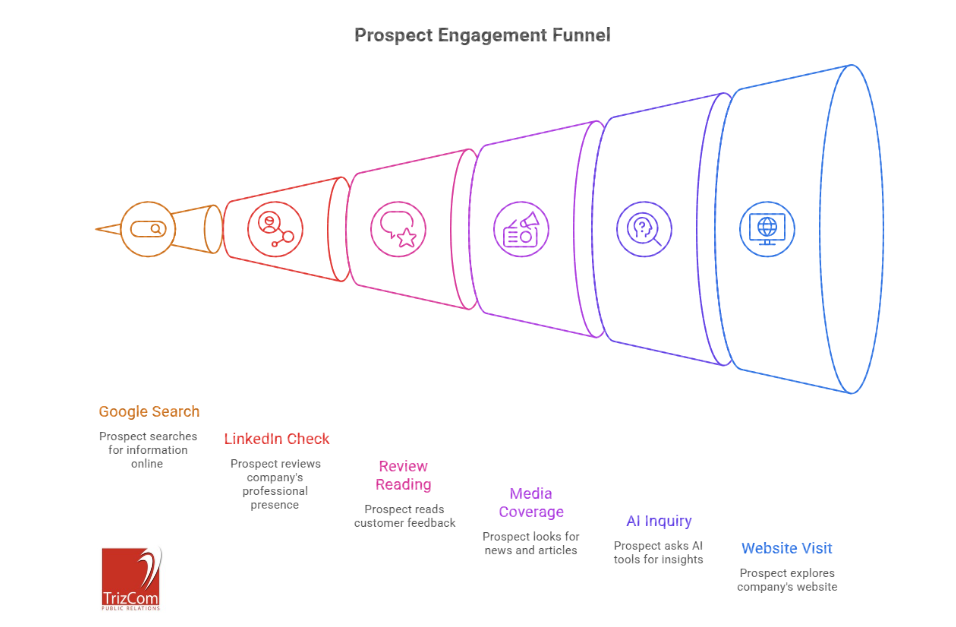
The average prospect rarely moves directly from awareness to a sales call.
Today's journey often looks like this:
Hears about your company.
Searches Google.
Checks LinkedIn.
Reads reviews.
Looks for media coverage.
Asks ChatGPT or another AI tool.
Visits your website.
Contacts your company.
By the time a prospect reaches sales, much of the buying decision has already been influenced.
Key Takeaways
PR builds credibility before prospects contact your company.
Media coverage serves as independent validation buyers trust.
Thought leadership positions executives as industry experts.
PR content supports every stage of the buyer journey.
AI search is making PR more important to sales than ever before.
Organizations that align PR and sales often experience higher conversion rates and shorter sales cycles.
Why Do So Many People Separate PR And Sales?
A few years ago, I sat in a boardroom listening to a CEO explain why he was cutting his public relations budget.
His reasoning sounded logical.
"Sales brings in revenue. PR builds awareness."
I hear some version of that statement every year.
The problem is that buyers don't make decisions the way they used to.
Today's customer doesn't wait for a salesperson to educate them. They research online. They ask AI tools for recommendations. They read reviews. They check media coverage. They look up executives on LinkedIn. They evaluate your reputation long before your sales team gets a chance to make a pitch.
By the time a prospect schedules a meeting, they've already formed an opinion.
Public relations helps shape that opinion.
That is why PR is often the first sales call your company never knows happened.
If your leadership team still views PR as a publicity function rather than a business function, read our article: https://www.trizcom.com/blog/what-every-ceo-needs-to-understand-about-pr
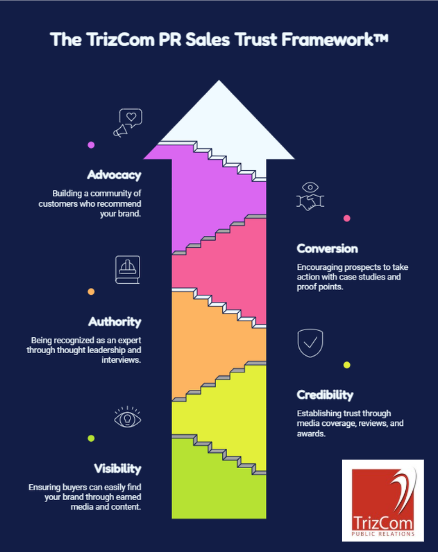
The TrizCom PR Sales Trust Framework™
Over more than three decades in public relations, I've noticed that successful companies consistently build trust in five stages.
| Stage | Key Question | PR's Role |
|---|---|---|
| Visibility | Can buyers find you? | Earned media, content and AI visibility |
| Credibility | Can buyers trust you? | Media coverage, reviews and awards |
| Authority | Are you recognized as an expert? | Thought leadership, speaking and interviews |
| Conversion | Will prospects take action? | Case studies, proof points and FAQs |
| Advocacy | Will customers recommend you? | Reputation management and community engagement |
Strong PR programs support all five stages simultaneously.
The 80/20 Trust Principle
In many industries, buyers complete roughly 80 percent of their evaluation process before they ever speak with a salesperson. They read articles, review websites, compare competitors, search social media, check reviews and increasingly ask AI platforms for recommendations and background information.
The remaining 20 percent happens during direct interactions with your sales team.
While the exact percentages vary by industry and purchase size, the principle remains the same: trust is built long before the first meeting.
Media coverage, thought leadership, online reviews, executive visibility and AI-generated answers all influence how prospects perceive your company during that first 80 percent. By the time sales enters the conversation, many buyers have already decided whether your organization is credible, qualified and worth considering.
Companies that invest in public relations enter sales conversations with a significant advantage because much of the trust-building work has already been done.
How Does PR Build Trust Before The First Sales Conversation?
Think about your own buying habits.
If you're considering a software platform, financial advisor, healthcare provider, law firm or professional services company, what do you do first?
You research.
You look for proof.
You look for evidence that the company can deliver what it promises.
That proof often comes from public relations.
When prospects find:
Industry articles
Executive commentary
Speaking engagements
Analyst mentions
They see validation from sources other than the company itself.
Anyone can claim expertise.
Independent validation carries more weight.
When a respected publication says you're an expert, buyers pay attention.
Why Does Media Coverage Influence Buying Decisions?
Media coverage influences buying decisions because it provides independent validation that reduces perceived risk.
Imagine two companies offering nearly identical services.
Company A runs advertising that says they're the best.
Company B appears in Forbes, The Wall Street Journal, trade publications and industry podcasts.
Which company feels more trustworthy?
Most buyers choose Company B.
The reason is simple.
Advertising tells.
Media coverage signals that journalists, editors and industry experts considered the company credible enough to feature.
That validation lowers perceived risk.
And lowering risk is one of the fastest ways to improve sales performance.
| Function | Primary Goal | KPI | Impact on Revenue |
|---|---|---|---|
| Sales | Close deals | Revenue, close rate | Direct |
| Marketing | Generate demand | Leads, traffic | Direct and indirect |
| Public Relations | Build trust and authority | Share of voice, media coverage, AI visibility | Influences buying decisions |
Can PR Generate Leads Directly?
Yes. Public relations generates leads by increasing visibility, establishing credibility and creating opportunities for prospects to discover your company through media coverage, thought leadership, speaking engagements, strategic partnerships and AI-generated search results.
At TrizCom PR, we've seen leads come from:
National media placements
Trade publication coverage
Podcast appearances
Speaking engagements
Executive profiles
Award recognition
Strategic partnerships
Owned media, including blogs and landing pages
However, the times they are a-changing. The path used to look something like this:
Article → Website → Research → Contact Form → Sales Call
Today, there is often another step.
The prospect asks AI.
They may ask ChatGPT, Google AI Overviews, Gemini, Claude or Perplexity questions like:
Who are the top PR agencies for franchise companies?
Is this company credible?
What has this CEO said about this issue?
Has this company been featured in trusted media?
What should I know before hiring this firm?
This is where public relations plays a direct role in sales.
AI answers are built from signals.
Those signals often include:
Earned media coverage
Executive interviews
Expert commentary
Business profiles
Customer reviews
FAQ pages
Authoritative website content
LinkedIn Articles
AI systems are trying to determine whether your company is credible enough to mention.
Strong PR gives AI systems more trustworthy information to find, evaluate and cite.
A media placement in a respected publication, a well-structured blog article, an executive bio, a podcast interview or a detailed service page can all influence what AI says about your company.
That matters because buyers are no longer only searching your company name on Google.
They're asking AI to compare vendors, evaluate expertise and recommend companies.
If your company has weak visibility, thin content or inconsistent messaging, AI may skip you entirely.
That is not a visibility problem.
That is a sales problem.
Learn more about AI visibility check out our blog, Why Does PR Help My Brand Show Up in AI Search?
How Does PR Influence AI Search Results?
This may be the most important PR question executives face today.
For years, companies focused almost exclusively on ranking in Google.
Today, prospects increasingly ask AI tools for recommendations.
What Sources Do AI Systems Use?
AI systems frequently reference:
Trade publications
Executive interviews
Industry reports
Conference presentations
Business profiles
FAQ pages
Many of these assets originate from public relations efforts.
Why Does PR Matter For AI Citations?
AI systems look for authority, credibility and consistency.
Strong PR creates:
More expert mentions
More trusted citations
More executive visibility
More authoritative content
More evidence of expertise
In simple terms, PR gives AI systems something credible to find, evaluate and cite.
Can AI Search Generate Leads For My Business?
Yes. AI search can generate leads when your company appears in answers prospects trust and act upon. As more decision-makers use ChatGPT, Gemini, Claude and Perplexity to research vendors, visibility within AI-generated answers becomes increasingly important.
Public relations helps create the content, authority and third-party validation AI systems use when evaluating companies. The stronger your public presence, the more likely prospects are to discover your business through AI-assisted research.
Why This Matters For Business Growth
Companies are more likely to appear in AI-generated answers when they consistently earn media coverage, publish expert content, participate in industry conversations and maintain accurate information across the web. Public relations helps create and distribute many of the signals AI systems use to evaluate expertise, authority and trustworthiness.
Seven Signs Your PR Program Is Driving Revenue
If you're wondering whether PR is contributing to business growth, look for these indicators:
Increased branded search traffic
More referral traffic from earned media
Higher-quality inbound leads
More speaking and partnership opportunities
Mentions in AI-generated answers
Shorter sales cycles
Improved conversion rates
When several of these indicators improve at the same time, PR is often contributing directly to revenue generation.
Five Mistakes Companies Make When Trying To Use PR To Drive Sales
Treating PR as publicity instead of a business strategy.
Focusing only on media placements.
Not creating thought leadership content.
Ignoring AI-search visibility.
Failing to align PR and sales teams.
"Public relations is no longer just about getting coverage. It's about becoming the trusted source prospects and AI systems find before they make a buying decision."
— Jo Trizila
What Is The Biggest Reason PR Helps Sales?
The biggest reason public relations helps sales is trust.
Media coverage, thought leadership, reviews, awards, executive visibility and AI-search presence all reduce uncertainty for buyers. When prospects trust your company before the first conversation, sales becomes easier, faster and more effective.
Public relations doesn't replace sales. It helps sales start from a position of credibility rather than skepticism.
Ready To Turn Visibility Into Revenue?
The companies winning today are not necessarily the ones with the biggest sales teams or the largest advertising budgets. They're the ones prospects already trust before the first conversation happens.
Public relations helps create that trust through media coverage, thought leadership, industry recognition, valuable content and a strong presence in both traditional search and AI-generated answers. When PR and sales work together, buyers arrive more informed, more confident and more likely to take the next step.
At TrizCom PR, we help organizations use the earned, shared, owned and paid media to build credibility, increase visibility and create measurable business results. Whether your goal is generating qualified leads, shortening the sales cycle, improving AI-search visibility or strengthening your reputation, our team can help you develop a strategy that supports growth.
If you're ready to stop thinking of PR as a cost center and start using it as a revenue driver, let's talk. Contact TrizCom PR today to discuss how strategic public relations can help your organization earn trust, win attention and grow sales.
Frequently Asked Questions About How Public Relations Helps Sales
How does public relations help generate qualified sales leads for B2B companies?
Public relations helps generate qualified sales leads by increasing visibility among decision-makers before they enter the buying process. Through media coverage, thought leadership, podcast interviews, speaking engagements and AI-search visibility, PR creates opportunities for prospects to discover and evaluate your company. When prospects contact your sales team after consuming PR content, they often arrive with greater trust and a clearer understanding of your expertise.
Can public relations shorten the sales cycle for professional services firms?
Yes. Public relations shortens sales cycles by answering common buyer concerns before the first sales conversation. Media coverage, executive interviews, case studies and thought leadership content provide third-party validation that reduces uncertainty. Prospects who already trust your expertise typically require fewer meetings and less education before making a decision.
Why are buyers using AI tools before speaking with a salesperson?
Buyers increasingly use AI tools such as ChatGPT, Gemini, Claude and Perplexity to research vendors, compare companies and evaluate expertise before reaching out. AI allows decision-makers to gather information quickly and privately. Companies with strong public relations programs often have more credible content available for AI systems to reference and recommend.
How does media coverage influence purchasing decisions in competitive industries?
Media coverage acts as independent validation. When a company is featured in respected publications, buyers often perceive it as more credible, trustworthy and established than competitors with little public visibility. This third-party endorsement can influence vendor selection, especially when buyers are comparing similar solutions.
What role does thought leadership play in generating new business opportunities?
Thought leadership positions executives and organizations as experts in their field. By publishing articles, speaking at events, participating in podcasts and contributing industry insights, companies demonstrate expertise before prospects enter the sales funnel. This familiarity often leads to stronger inbound inquiries and higher-quality sales conversations.
How can public relations improve a company's visibility in AI-generated search results?
Public relations creates many of the signals AI systems use to evaluate authority and trustworthiness. Earned media coverage, executive commentary, awards, interviews, business profiles and expert content help AI platforms understand who your company is and what expertise it offers. The stronger your public presence, the greater the likelihood of appearing in AI-generated answers.
What types of PR content are most likely to be cited by AI search platforms?
AI systems frequently reference authoritative content such as news articles, trade publication coverage, executive interviews, FAQ pages, industry reports, case studies, thought leadership articles and well-structured service pages. Content that clearly demonstrates expertise and provides direct answers to common questions tends to perform best.
Is public relations more effective than advertising for building trust with prospects?
Advertising and public relations serve different purposes. Advertising provides control and reach, while PR provides credibility through third-party validation. Studies consistently show that consumers and business buyers trust earned media more than promotional messages because it comes from independent sources. The strongest growth strategies use both PR and advertising together.
How can executives measure whether public relations is contributing to sales growth?
Organizations can measure PR's impact on sales by tracking metrics such as qualified inbound leads, branded search growth, referral traffic from media placements, AI-search visibility, sales cycle length, conversion rates and revenue influenced by earned media. The key is connecting PR activities to business outcomes rather than measuring publicity alone.
Why is public relations becoming more important as AI search adoption grows?
As more buyers use AI tools to research companies, public relations has become a critical source of information feeding those systems. AI platforms often rely on media coverage, expert commentary, thought leadership and authoritative content when generating responses. Companies with strong PR programs are better positioned to influence what prospects see, read and trust during the research process.

About the Author
Jo Trizila
Jo Trizila – Founder & CEO of TrizCom PR
Jo Trizila is the founder and CEO of TrizCom PR, a leading Dallas-based public relations firm known for delivering strategic communications that drive business growth and enhance brand reputations as well as Pitch PR, a press release distribution agency. With over 25 years of experience in PR and marketing, Jo has helped countless organizations navigate complex communication challenges, ranging from crisis management to brand storytelling. Under her leadership, TrizCom PR has earned recognition for its results-driven approach, combining traditional and integrated digital strategies to deliver impactful, measurable outcomes for clients across various industries, including healthcare, technology and nonprofit sectors. Jo is passionate about helping businesses amplify their voices and connect with audiences meaningfully. Her hands-on approach and commitment to excellence have established TrizCom PR as a trusted partner for companies seeking to elevate their brand and achieve lasting success. Contact Jo at jo@TrizCom.com.
What is the Difference between sales promotions, public relations and advertising?

Executives ask this when money is on the line. You need to know which tactic moves buyers now, which one builds trust that lowers costs later and how to run both without wasting a dollar. The short version is simple. Ads buy reach. Promotions trigger action. PR earns credibility people believe.
The useful version is bigger. None of these tools should live alone they are integrated. At TrizCom PR we plan with The PESO Model©, developed by Gini Dietrich, so paid, earned, shared and owned work as one system. That helps you decide what to run, when to run it and how to measure each one without mixing signals.
This paper is your field guide. We start with plain definitions so your team speaks the same language. Then we break down where each tactic wins, how to set separate goals and what to track. You will see practical calls on direct mail, BOGO offers, loyalty programs and sponsorships. We close with a TrizCom PR case built on The PESO Model and a quick FAQ you can use in your next meeting.
What you will get from this guide:
Clear differences between ads, promotions and PR so you pick the right tool
Simple rules for when to use each one, alone or together
A monthly mix any small team can run
Metrics that prove value without overlap
A real example that shows how PESO turns a plan into results
If you want fewer debates and better outcomes, keep reading. This will help you choose the right move, spend with intent and show the board exactly what you got for the money.
Definitions And Basics
What is advertising?
Advertising is paid placement. You buy space or time and control the message, audience and frequency. Formats include, for example, search, social, display, print, radio, TV, streaming and sponsored content. The job is to put a clear offer or idea in front of the right people at the right time.
What is sales promotion?
Sales promotion is a short-term incentive that compresses action into a window. Examples include a limited time code, BOGO, bundle, gift with purchase, referral credit or contest. You can run a promotion inside any channel. The job is to move products fast, collect leads or tip fence sitters.
What is public relations in a PESO world?
Public relations is not a single tactic. In the PESO Model it is how the four media types work together.
Paid amplifies the best messages and fills reach gaps
Earned includes media relations plus analyst relations, reviews and third-party endorsements
Shared covers social channels, community engagement and partnerships
Owned is your content hub with articles, videos, guides, data and FAQs
Used together, PESO builds reputation, authority and measurable outcomes for the business.
What’s The Difference Between Sales Promotion, Public Relations And Advertising?
Control vs credibility: advertising gives full control; promotions add an incentive; PR trades control for credibility by earning space in trusted places
Time horizon: promotions are sprints; ads run as long as you fund them; PR compounds over time
Primary job: promotions push immediate action; ads build reach and demand; PR builds belief and access that lowers future costs
Cost model: ads cost media dollars; promotions cost margin; PR costs senior time, content and relationships
Is PR Two-Way Communication While Advertising Is One Way?
PR works best as a conversation. You listen, adjust, respond and earn the right to be heard. Media interviews, analyst briefings, employee forums and community work all bring feedback. Advertising is usually one way. You send a paid message and measure response. Both have a place. The difference is how feedback flows.
Does PR Always Mean “No Direct Sale,” Or Can It Drive Purchases Too?
PR can (and does) drive purchases when you connect the story to a path to buy. A credible article or expert feature lowers risk in a buyer’s mind. Add clear next steps on your site and you will see traffic, inquiries and sales. The bigger value of PR is its compounding effect. It shortens sales cycles, raises close rates and protects price because trust is higher.
What Counts As Ads, Promotions Or PR?
Is direct mail considered advertising or sales promotion?
It depends on the content. A postcard with a brand message and no offer is advertising sent by mail. A catalog with a code or coupon is a promotion using the mail channel. The channel does not define the tactic. The presence of an incentive does.
Is a BOGO offer a sales promotion or part of pricing strategy?
Both can be true. A one month BOGO to load trial is a promotion. A permanent BOGO structure is pricing and merchandising. If it is temporary with a hard end date, treat it as a promotion and track lift vs baseline. If it is always on, treat it as pricing and track mix and margin.
Is a customer loyalty program a sales promotion or CRM?
A loyalty program is CRM with promotional tools inside it. The system, data and lifecycle design are CRM. The points and perks are promotions. Measure it as a relationship engine first. Use promotions to shape behavior you want, such as repeat visits or trials of new items.
Does sponsoring a local charity or youth team count as PR?
Yes. Sponsorship is part of community relations inside PR. It can include paid components if you buy signage or naming and promotional elements if you add a code or event. Treat it as PR led with a clear community goal, then decide if you need paid or promotional layers to extend reach.
When I donate to a cause, how do I talk about it without it sounding like an ad?
Lead with the need, not your logo. Share the commitment in plain numbers. Put the nonprofit’s voice first with a quote. Show proof of delivery with photos or receipts. Invite others to help in ways that do not require a purchase. Keep the focus on impact and let others give you credit. (Read more here: Purpose Driven Brands)
Choosing The Right Mix
For a new product, when should I use advertising vs a sales promotion vs PR
Phase 1: Build the story with PR focusing on earned and owned media
Publish a clear problem-solution article, FAQs and a data point on your site
Brief a short list of reporters and analysts with proof and demos
Line up community or category partners who add trust
Phase 2: Add paid media to scale what works
Test two messages in search and social tied to one landing page
Use small budgets to see which proof points pull the best
Retarget people who engaged with earned and owned content
Phase 3: Pulse a promotion to spark trial
Time a code or bundle for the first two weeks after launch
Keep the window tight with a hard end date
Use unique codes by channel so you can see what pulled
Phase 4: Sustain with shared and earned media
Publish early user stories
Pitch bylines and podcasts that reach buyers
Keep issues responses and reviews active to protect momentum

How do I plan a simple monthly mix of ads, promotions and PR for a small business?
Use a four week rhythm that a small team can run.
Week 1: Earned push. Pitch one timely story or expert quote. Update the newsroom on your site
Week 2: Paid test. Run two creative variants to one audience. Keep the budget tight and learn
Week 3: Promotion pulse. Offer a short incentive tied to a real event, not a random discount
Week 4: Review. Check traffic, inquiries, footfall, calls and sentiment. Keep what worked. Drop what did not

If my market is niche with low traffic, should I prioritize trade PR or paid ads?
Start with trade PR plus pinpoint paid. A credible article in the right trade outlet reaches decision makers in one move. Pair that with account based ads and sponsored placements where your buyers already read. Skip broad awareness until you have proof that a wider net returns value.
Measurement And Goals
How do I set goals for PR vs advertising vs promotions that aren’t overlapping?
Give each tool a job with a metric native to that job.
PR: share of voice, message pull through, quality backlinks, qualified inbound, analyst or trade mentions, lift in branded search, organic traffic lift, referral traffic tracked with UTMs and AI search citations
Advertising: reach, frequency, CTR, cost per lead, cost per order, new file rate
Promotion: redemptions, incremental revenue, lift vs baseline, new buyers acquired, repeat rate after the offer ends
Judge each tool by what it is built to do. Then look at how the set performs together.
What’s the best way to measure a charity sponsorship’s impact?
Use three views.
Exposure: audience at the event, estimated impressions from signage, partner social reach
Engagement: QR scans, email or volunteer signups, traffic to a dedicated page, partner referrals
Reputation: sentiment in local media, message recall in a short survey, lift in branded search during the period
If you add a small promotion to the sponsorship, track a unique code so you can tie revenue to the activation. If it stays pure PR, focus on exposure, engagement and reputation.
How do I tell if a loyalty program is working vs just discounting away margin?
Watch four signals.
Earn vs burn: healthy programs have points earned and used in balance. If burn only spikes when you discount, you trained people to wait
Frequency: members should buy more often than non members
Average order value: if AOV drops after a perk, you may be discounting items people would buy anyway
Incremental margin: test vs control by cohort. If members do not produce more gross margin after perks, adjust the offer mix
Reward behaviors that matter: visits, full price trials of new items, referrals, reviews. Do not reward pure discount hunting.
What metrics prove PR value if I’m not running ads at the same time?
Track lifts you earn, not buy.
Month over month branded search
Referral traffic from earned articles and podcasts
Quality backlinks and the change in domain authority
Inbound speaking and partnership requests
Analyst and trade mentions tied to your messages
Win rate and cycle time if PR content is in the sales process
AI search presence: citations in LLM answers and referral traffic from AI assistants
Ask sales which objections shrink after coverage lands. If friction drops, PR is working.
Ethics And Expectations
When does a “PR” activity become advertising and need disclosure?
If money changes hands for coverage, it is paid. Sponsored content, paid influencer posts, native ads and advertorials need clear, near-the-message disclosure. If you provide a material benefit to a creator and expect coverage, they should disclose. Earned media that happens with no exchange does not require a paid label.
How do I talk about community donations in PR without looking performative?
Keep the spotlight on the cause and the community.
Name the need first
State your commitment with numbers
Let the nonprofit speak with a quote and link
Share proof of delivery, not staged scenes
Offer ways to join that do not require a purchase
Report back later with results, not self praise
Tone matters. Let others say thank you while you stay at work.
Budget And Execution
With a small budget, should I spend on local PR, run a BOGO or buy direct mail?
Match the tool to the problem.
Need fast cash flow: run a tight promotion to convert fence sitters. Protect margin with limits
Need to open doors: invest in local PR and community ties so future ads work cheaper
Need targeted reach in a radius: consider direct mail with a clear offer and a code, then retarget digital to households that respond
If you have zero ad history, start with a small digital test before a big mail drop. If you have zero story in market, run PR first so ads do not work alone.
What’s a starter checklist for running each: an ad, a sales promotion and a PR activity?
Ad checklist
One page plan with goal, audience, budget and timeline
One message, one call to action, one landing page
Two creative variants to test
Tracking in place: UTM, pixel or call tracking
Daily checks the first week, then twice a week
Follow up plan for leads you earn
Sales promotion checklist
Clear objective: trial, load-up, referral or win-back
Offer rules with caps and end date
Unique code or QR for tracking
Margin and inventory plan
Simple terms in plain language
Post promo plan to retain new buyers at full price
PR activity checklist using PESO
Core story with proof and a newsroom post ready to publish
Earned targets and angles mapped to outlets and stakeholders
Shared plan for social cutdowns and partner posts
Paid plan to boost the best performing owned or earned content
Spokespeople trained with key messages and FAQs
Measurement plan for share of voice, sentiment and inbound signals
How do I avoid mixing tactics in one message so people don’t get confused?
Pick one lead. If the goal is to tell a story, lead with PR and keep the offer in the background or on a different channel. If the goal is to move inventory this weekend, lead with the promotion and keep the story off the ad. Build a simple message map:
Lead idea: the first line and visual
Support: proof or detail
Action: the next step
Run that map across PESO and keep the order the same, then adjust weight by channel.
A TrizCom PR PESO Example: Total Eclipse DFW
A regional eclipse became a business and public safety moment. TrizCom PR created and led Total Eclipse DFW, a spinoff we owned and operated. We built the plan on the PESO Model from Spin Sucks and set three goals: make DFW the go-to viewing market, educate on ISO-compliant safety and win measurable search and traffic. The work earned PRSA Dallas’ Pegasus Award for Events and Observances.
Owned Media
We built TotalEclipseDFW.com as the hub. In just four months, it drew 60,300 users and 74,325 sessions, with 70.56 percent of traffic from organic search. The site ranked for 3,800 keywords against a goal of 500 and captured top clicks on “total eclipse dfw” and county pages that helped residents plan the day.
Earned Media
Media lifted credibility and fed search. We secured 374 placements against a 250 goal, many with backlinks. Coverage included The Dallas Morning News, CBS News, CW, Forbes and Univision. Referral traffic converted: DallasNews.com visitors produced $9,529 in sales and eclipse.aas.org added $1,000.
Shared Media
Social gave quick reach and useful signals. Facebook drove volume but light engagement, while LinkedIn and YouTube audiences stayed longer and interacted more. Real-time updates beat general content, which shaped what we posted in the final weeks.
Paid Media
We kept spend small and precise. With less than a thousand dollars, on Facebook, we generated 173,895 impressions and a 5.68 percent CTR. Email carried the heavier lift with high open rates and clear calls to action. The pairing built awareness and converted existing relationships.
Promotion
Free glasses from museums and retailers changed buyer behavior. We repositioned ours as premium collectibles, guaranteed ISO-compliant and offered early purchase incentives to lock orders before free distribution ramped up.
Measurement
We tracked traffic, search, referrals and sales by source. Google organic drove 29,523 users and $18,495.16 in sales. Timed coverage moved revenue: Feb 2 stories in The Dallas Morning News and eclipse.aas.org drove 94 sales and $3,345.35. Feb 6 coverage contributed 145 sales and $5,553.91.
What this shows
One plan. Separate jobs. Each PESO lane carried different weight at different times. Owned search kept the lights on, earned spiked momentum, shared tuned the message and paid scaled what worked. The mix produced authority, sales and community impact without wasting budget.
How Does PESO Change How You See PR vs Advertising vs Promotions?
The biggest shift is mental. Instead of choosing one tool in a vacuum, you decide how the four media types support the same goal. Advertising stops competing with PR. Promotions stop undercutting brand work. Owned content stops sitting idle. The plan becomes one system that moves buyers now and builds trust for later. That is what the PESO Model was built to do.
FAQ for leaders who want clarity fast
Is PR just media relations?
No. Media relations is one earned tactic. Public relations uses the full PESO Model across paid, earned, shared and owned. That means media outreach, expert content, social community, owned content and smart amplification work together. The goal is reputation, authority and outcomes tied to real business metrics, not headlines alone.
Can PR drive direct sales?
Yes. Credible coverage reduces risk for buyers and nudges action. Link every earned or owned piece to a clear next step. Use landing pages, CTAs and simple tracking. Let sales teams share articles and clips in follow-ups. Add light paid support to reach lookalike audiences and move qualified traffic.
Do I need ads if PR is strong?
Yes, if you want predictable reach and control. PR opens doors and lowers costs over time. Advertising lets you decide who sees your message, when and how often. The best plans pair both. Use PR to build trust. Use ads to scale what resonates and fill gaps in coverage.
Will promotions hurt my brand?
They can if you train buyers to wait for deals (Think Bed Bath & Beyond). Keep offers short, tied to real events, with clear rules and caps. Reward behaviors you want, like trial of new items or referrals. Measure lift versus baseline, not just redemptions. Protect price, then use promotions as precise tools.
Is direct mail advertising or promotion?
It depends on the content. A postcard that builds awareness with no incentive is advertising delivered by mail. A mailer with a coupon or deadline is a sales promotion. Track with unique codes or QR. Start small, test offers and creative, then scale the version that earns profitable response.
Does sponsorship count as PR?
Yes. Sponsorship lives in community relations. Start with a cause that fits your audience and values. Set goals for exposure, engagement and reputation. Let the nonprofit’s voice lead. Share clear numbers on support and impact. If you need extra reach or trial, add paid boosts or a short offer.
Put seniors on the work that matters
At TrizCom PR you work with senior professionals from pitch to results. We plan with the PESO Model so every dollar funds the right job. We build the team by market and specialty, keep one owner on your work and measure the outcomes your C-suite tracks.
If you want a plan your leadership can trust, email Jo@TrizCom.com or call 972 247 1369.
Author: Jo Trizila, founder and CEO of TrizCom PR. Three decades in earned media, issues management and brand storytelling for leaders who expect results.

Frequently Asked Questions About Sales Promotions, Public Relations and Advertising
Which is more cost-effective: public relations, advertising or sales promotions?
The answer depends on your goal. Advertising delivers immediate reach but requires ongoing media spending. Sales promotions can generate quick revenue but often reduce margins. Public relations typically takes longer to build momentum, but earned credibility can continue generating value long after a campaign ends. The most cost-effective approach is usually a combination of all three, with each tactic assigned a specific role.
How do advertising, public relations and sales promotions work together?
The strongest marketing programs use all three. Public relations builds trust and awareness. Advertising expands reach and reinforces key messages. Sales promotions create urgency and encourage action. When coordinated through a framework like the PESO Model, these tactics support one another rather than compete for budget.
Which tactic should a startup prioritize first?
Most startups benefit from starting with public relations and owned content. Credible media coverage, thought leadership and educational content help establish trust before significant advertising dollars are spent. Once messaging and audience response are validated, paid advertising and targeted promotions can accelerate growth.
Can a business succeed using advertising alone?
Advertising can generate awareness and leads, but without credibility from earned media, customer reviews and reputation-building activities, advertising often becomes more expensive over time. Buyers increasingly seek third-party validation before making purchasing decisions.
How often should a company run sales promotions?
Sales promotions should be used strategically, not continuously. Frequent discounts can train customers to wait for offers rather than buy at full price. Most businesses see stronger results when promotions are tied to specific events, seasons, product launches or customer milestones.
What is the biggest mistake companies make when using promotions?
Many companies focus only on redemption rates instead of profitability. A promotion that generates sales but destroys margin may not be successful. Businesses should measure incremental revenue, customer acquisition costs and post-promotion purchasing behavior to determine true effectiveness.
How does PR help during an economic downturn?
During periods of economic uncertainty, PR helps organizations maintain visibility and credibility when advertising budgets may be reduced. Consistent media coverage, executive thought leadership and expert commentary can keep brands top of mind while preserving marketing resources.
Should B2B companies invest more in PR or advertising?
Most B2B companies benefit from prioritizing PR, trade media coverage, analyst relations and thought leadership. Business buyers often conduct extensive research before making decisions. Credible third-party validation frequently has greater influence than traditional advertising alone.
How do AI search engines affect PR, advertising and promotions?
AI-powered search tools increasingly cite earned media, expert content and authoritative websites when answering user questions. Public relations and owned content now play a larger role in online visibility because AI systems often reference trusted sources rather than advertisements. Businesses should ensure their PR, content and SEO strategies work together to improve AI-search visibility.
What is the best way to allocate a marketing budget between PR, advertising and promotions?
There is no universal formula, but many organizations dedicate resources across all three areas. PR builds long-term authority, advertising drives predictable reach and promotions generate short-term action. Budget allocation should reflect business objectives, competitive conditions and growth stage rather than a fixed percentage.
SEO and PR - How Public Relations Improves Search Visibility and AI Discovery

Key Takeaways
Public relations improves SEO by generating credible third-party mentions.
Earned media coverage creates authority signals search engines trust.
Thought leadership and expert commentary expand brand visibility across the web.
AI search platforms often reference brands that appear in trusted media sources.
Why Search Visibility Depends on Credibility
Search engines no longer rely only on keywords and website optimization. Authority, credibility and third-party validation influence how brands appear in both traditional search results and AI-generated answers.
Public relations plays a direct role in this process.
When a brand earns coverage in credible media outlets, appears in industry publications or is quoted by journalists, those mentions create signals that search engines and AI systems recognize as trustworthy information sources.
PR builds the reputation signals that SEO alone cannot produce.
What Is the Relationship Between PR and SEO?
Public relations improves SEO by generating earned media coverage, authoritative backlinks and credible brand mentions across trusted publications. These signals help search engines and AI platforms recognize a brand as a reliable source of information, which can improve search visibility and influence AI-generated answers.
Why Public Relations Matters for SEO
Search engines evaluate credibility across the internet. They analyze how often a brand appears in trusted sources and whether those mentions connect to consistent messaging.
Public relations supports SEO by:
Generating earned media coverage through strong media relations strategies
Increasing brand mentions across credible domains
Building authority through expert commentary
Creating high-quality backlinks
Reinforcing consistent brand narratives
These signals help search engines understand that a company is a reliable source of information.
Research from Addlly AI across SEO studies shows that websites with authoritative backlinks and brand mentions often perform better in search results because these signals help search engines evaluate credibility and authority.
PR vs SEO
How the Disciplines Work Together
| SEO | Public Relations |
|---|---|
| Optimizes website structure and keywords | Builds external credibility through media coverage |
| Focuses on search engine algorithms | Focuses on audience trust and reputation |
| Improves on-site discoverability | Creates third-party validation across the web |
| Generates backlinks through digital outreach | Earns high-authority mentions in news and industry media |
The strongest visibility strategies combine both.
SEO ensures a website can be found.
PR ensures people and platforms trust what they find.
Organizations often combine search optimization with a broader SEO and digital visibility strategy that includes earned media and thought leadership.
Why PR Matters Even More in the Age of AI Search
Generative AI platforms such as ChatGPT, Google AI Overviews, Google Gemini, Claude and Perplexity gather information from many sources across the web.
These systems often rely on:
News articles
Industry publications
Expert interviews
Corporate thought leadership
Credible third-party citations
Earned media and thought leadership influence what AI systems reference when answering questions.
Brands that invest in AI search visibility strategies increase the likelihood that AI platforms recognize them as authoritative sources.
Many organizations now also track how their brand appears in AI responses through AI monitoring and brand tracking to understand how generative platforms describe their companies.
Key PR Activities That Support SEO
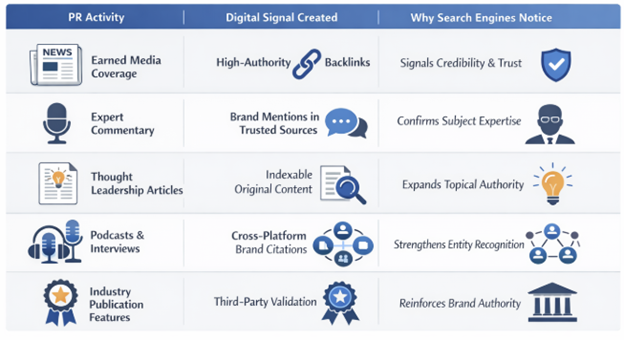
Several PR strategies directly strengthen search visibility.
Media relations
Securing coverage in respected publications increases authority signals. A strong media relations strategy expands brand credibility across trusted news sources.
Thought leadership
Executive commentary in articles, podcasts and conferences expands brand expertise and supports strategic content creation efforts that search engines can index.
Content creation
Blogs, reports and commentary create original information sources that support both search visibility and media outreach.
Digital PR campaigns
Stories designed for online media generate backlinks and brand mentions that strengthen search authority through a coordinated digital PR strategy.
Consistent messaging
Clear narratives help search engines and AI systems understand brand identity.
Together these activities expand the digital footprint that search engines and AI models analyze.
Frequently Asked Questions
What is the relationship between PR and SEO?
Public relations strengthens SEO by building authority through earned media coverage, brand mentions and credible backlinks. Search engines evaluate these signals when determining which organizations deserve greater visibility in search results.
Does media coverage improve search rankings?
Media coverage can support search performance because many news outlets have strong domain authority. When those outlets mention or link to a company, search engines treat that reference as a credibility signal.
How does PR influence AI search results?
AI systems gather information from trusted third-party sources such as news articles, industry publications and expert commentary. Organizations that appear frequently in credible media sources are more likely to be referenced in AI-generated responses.
Is PR more important than SEO?
PR and SEO serve different roles. SEO helps search engines find website content, while PR builds the credibility signals that influence how platforms rank and reference that content.
What is digital PR?
Digital PR focuses on earning online media coverage, backlinks, content and brand mentions that strengthen search visibility and online reputation.
How TrizCom PR Helps Brands Build Search Authority
At TrizCom PR, digital public relations connects storytelling with search visibility.
Our team integrates earned media, thought leadership and strategic digital PR services to expand brand authority across trusted media platforms.
When credible sources talk about your brand, search engines and AI systems are more likely to listen.
Author
Jo Trizila, Founder & CEO, TrizCom Public Relations
Jo Trizila leads Dallas‑based TrizCom PR, an award‑winning digital public relations agency she founded in 2008. She has guided integrated PR programs for startups, middle‑market companies and national brands, with deep experience in crisis communications, expert positioning and data‑driven media strategy.
Jo is also the creator of Pitch PR, a press release distribution company and a frequent speaker on earned media ROI, including sessions at the Earned Media Mastery virtual summit.
For more information contact jo@trizcom.com or 214-242-9282.
Why Does PR Help My Brand Show Up in AI Search?

Public relations helps companies appear in AI search results by creating content and building credibility through mentions in authoritative third-party sources, such as news outlets, podcasts and trade publications. AI models rely on trusted external data to generate answers. They look beyond keywords and websites, instead prioritizing earned media, consistent messaging, and structured content they can process and cite. When AI PR is done well, it establishes your brand as a reliable source AI systems feel confident referencing.
We are now in the age of AI search, where generative AI search and AI search engines like Google's AI Overviews have transformed the landscape from traditional web search and blue links to AI-generated summaries and AI overviews. Instead of relying solely on traditional SEO tactics, brands must focus on building trust signals, credibility signals, and domain authority through strategic PR and media placements to influence AI engines and AI-powered search engines. Digital marketing and digital PR are now essential for building brand visibility and online visibility in the AI era.
It also starts with great, fresh content that answers questions. PR is communication at its core, which is why PR teams are well-positioned to write content that is clear, accurate and ready to be referenced across the web. Creating content is now crucial not only for human audiences and human readers, but also for AI platforms and AI discovery, ensuring your brand is included in AI-generated summaries and search answers.
For chief marketing officers and business owners, this shift changes how visibility is earned. Being discoverable now depends on what you publish about yourself and on what credible sources say about you. PR pros, PR firms, and PR agencies play a crucial role in establishing trust signals, credibility signals, and domain authority, which directly influence AI engines and AI-powered search engines. Unlike traditional SEO, link building, and paid ads, the current focus is on earning high value media placements, authoritative mentions, and securing brand mentions in respected publications to improve search rankings and brand authority. Reputation management and brand reputation are now central to influencing AI results, AI-generated summaries, and search answers in Google's AI Overviews and AI search results. To future-proof your brand's presence and stay visible in the AI search era, leverage owned media, specific expertise, and consistent PR efforts.
Why do AI search tools rely on public relations signals?
AI systems summarize information rather than display ranked links. To do that, they pull from sources they recognize as accurate and independent.
Those sources include:
Trade publications and analyst reports
Expert bylines and quoted commentary
Media placements in respected publications
PR places your brand inside those environments, which AI models treat as trusted training data. PR pros and PR agencies are skilled at securing authoritative mentions and media placements in respected publication, which AI engines and AI platforms use for AI discovery.
How does PR build trust and authority for AI systems?
AI models learn patterns. When your company appears repeatedly in respected outlets through interviews, quotes and features, the system begins to associate your brand with credibility.
PR builds trust by:
Securing consistent earned media mentions
Positioning executives as expert sources
Reinforcing the same message across multiple publications
Building trust signals and credibility signals that AI systems recognize as indicators of authority and trustworthiness
Over time, this teaches AI tools that your brand is a dependable authority within its category.
PR firms focus on reputation management and building domain authority and brand authority, which can improve your search rankings in AI-driven environments.
How does PR shape what AI says about your brand?
AI-generated summaries, AI Overviews, and Google's AI Overviews are influenced by the information already available across the web. If that information is inconsistent or incomplete, the output will be too.
PR shapes your brand narrative by:
Aligning messaging across earned and owned channels
Reinforcing accurate descriptions of your products and expertise
Securing brand mentions and authoritative mentions from reputable sources to ensure accurate search answers in AI outputs
Reducing the likelihood of outdated or misleading summaries
This consistency helps AI systems present your company clearly and accurately.
Why does earned media acts as training data for AI models?
Executive interviews, contributed articles, podcast appearances, and media placements in respected publications provide context AI systems value. These formats explain who you are, what you do and why it matters in plain language.
Earned content works as training data because it:
Comes from third-party AI already trusts
Includes real explanations instead of marketing copy
Offers quotable statements AI can reuse
Highlights your specific expertise in earned content, increasing its value for AI
This is one reason executive visibility outperforms brand-only content. Earning high value coverage in respected publications further increases your brand’s recognition and trustworthiness in AI-driven search.
How do press releases help with AI search visibility?
Press releases remain useful when they are written for clarity and structure rather than promotion, and can be distributed through owned media channels to ensure direct control over brand messaging.
Well-structured releases:
Follow predictable formats AI can parse
Reinforce consistent terminology
Serve as reference points for news coverage
Allow brands to create content that supports AI recognition
When press releases lead to earned coverage, they strengthen AI recognition even further. PR agencies can help maximize the impact of press releases by securing strategic placements and optimizing distribution for greater AI search visibility.
Why relevant mentions matter more than volume?
AI systems favor relevance over reach. A mention in the right trade publication often carries more weight than broad coverage in unrelated outlets.
PR drives relevant mentions by:
Targeting niche and industry-specific media
Securing analyst and expert commentary
Aligning placements with buyer search behavior
PR pros focusing on securing authoritative mentions and brand mentions in targeted outlets
This ensures your brand appears in the conversations AI prioritizes.
What PR strategies improve AI visibility most?
Focus on outlets AI models frequently reference, including major news organizations and respected industry publications. Digital PR strategies help future proof your brand in the AI search era by building a resilient digital presence that adapts to evolving AI search technologies.
Place executives in interviews and bylines that explain category challenges and solutions in clear terms.
Use consistent language, clear headlines and factual framing to support AI ingestion.
Repeat the same positioning across earned and owned content so AI systems recognize patterns.
Leverage link building and reputation management to support AI discovery and long-term visibility. Earning authoritative links and maintaining a positive reputation help AI systems identify your brand as trustworthy and relevant, increasing your chances of being surfaced in AI-driven search results.
Plan for how AI might summarize sensitive situations and have processes in place to correct inaccuracies quickly.
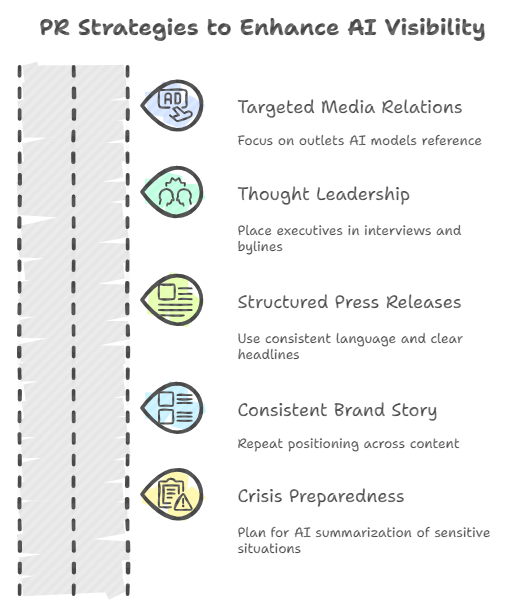
How Public Relations Drives AI Search Visibility
| PR Strategy | What It Does | Why AI Systems Value It | Impact on AI Search Visibility |
|---|---|---|---|
| Earned Media Placements | Secures coverage in national, regional and trade publications | Third-party validation signals credibility and independence | Increases likelihood of brand mentions in AI-generated summaries |
| Executive Thought Leadership | Positions executives in interviews, bylines and podcasts | Human expertise signals strengthen authority patterns | Improves brand attribution in AI answers |
| Consistent Messaging Across Channels | Aligns language across earned and owned media | AI models detect repetition and pattern consistency | Reduces vague or conflicting AI summaries |
| Structured Press Releases | Uses clear headlines, factual framing and consistent terminology | Predictable structure makes content easier for AI to parse | Strengthens recognition and terminology alignment |
| Targeted Industry Outreach | Focuses on niche and analyst-driven publications | Relevance carries more weight than volume | Improves visibility in category-specific AI searches |
| Reputation Management | Reinforces accurate positioning and corrects misinformation | AI systems adjust outputs based on updated credible sources | Helps correct or prevent misleading AI summaries |
| Owned Content Hubs | Publishes FAQs, executive bios and resource pages | Structured, well-organized content improves AI ingestion | Supports accurate AI descriptions of products and services |
| Podcast and Interview Visibility | Secures context-rich conversations and quotable insights | Natural language explanations give AI reusable context | Enhances inclusion in AI-generated responses |
How TrizCom PR supports AI search visibility
As one of the leading pr firms and pr agencies specializing in digital marketing for AI search, TrizCom PR helps middle-market companies strengthen AI discoverability through earned media strategy and executive positioning. Our approach focuses on placing brands inside trusted sources AI systems already use, reinforcing consistent narratives and producing structured content that supports accurate summaries. These strategies help strengthen your brand's presence across AI and digital platforms.
Want your brand to show up in AI answers when buyers ask the questions?
When AI systems decide which brands to mention, they rely on trust, repetition and clarity. Public relations supplies all three by placing your expertise inside the sources AI already trusts. PR also helps your brand appear in ai results and ai generated summaries, ensuring your messaging is included when AI-powered search tools and language models present information.
If your company is investing in AI, content and visibility but still is not appearing in AI-generated answers, it is time to look beyond keywords. As AI search evolves, it is crucial to stay visible by leveraging strategic PR, which helps ensure your brand becomes part of the data AI uses to explain your category.
If you want to understand how your brand is currently represented in AI search results and what it would take to improve that visibility, talk with the team at TrizCom PR. A focused conversation can help you identify gaps, opportunities and a clear path to becoming a trusted source AI systems recognize and reference.
Frequently asked questions about PR and AI search
How long does it take PR to influence AI search results?
PR can quickly influence AI search results, especially when you consistently earn coverage (the opposite of SEO, which sometimes takes months to rank). AI engines and AI powered search engines respond rapidly to new authoritative mentions and media placements, rewarding brands that are cited in reputable sources. Stronger citation patterns typically emerge after sustained placements across multiple authoritative sources, as AI systems respond to repetition in credible environments.
Can AI tools pull from press releases directly?
AI tools can (and do) pull from press releases directly, but press releases matter most when trusted outlets pick them up, reference them or use them as source material. However, owned media, such as your brand's website or newsroom, allows you to create content that AI tools can access directly, ensuring your messaging is clear and available for AI-driven search. A release that stays on your site often has less influence than a release that leads to third-party coverage.
Is PR more important than SEO for AI visibility?
PR is not more important than SEO for AI visibility because they do different jobs. PR builds trust and authority signals through third-party validation. SEO improves structure, crawlability and clarity on your owned channels. Most brands need both to show up reliably in AI answers.
However, traditional SEO tactics like keyword optimization and link building are no longer sufficient for visibility in AI-driven search results. Instead, digital PR and reputation management have become crucial. Digital PR helps earn authoritative media coverage and builds a strong digital footprint, while reputation management ensures your brand is seen as credible and trustworthy, factors that AI systems increasingly prioritize.
Do podcasts and interviews help with AI search?
Yes, podcasts and interviews help with AI search because they provide context-rich explanations and quotable expert commentary. By participating in podcasts and interviews, you are securing brand mentions and highlighting your specific expertise, which AI systems recognize and use to improve your brand's visibility in search results. AI platforms often prioritize these types of expert-driven mentions, especially when they appear in trusted trade publications or local news.
Does company size affect AI visibility?
No, company size does not affect AI visibility as much as authority signals do. In fact, brand authority and domain authority are more important than company size for AI visibility. AI systems tend to reward brands that show consistent expertise in credible sources, and reputable media coverage with high-quality backlinks can boost your domain authority, signaling credibility and trustworthiness to AI-driven search engines. Middle-market companies often compete well when their executives are visible and their messaging stays consistent.
What types of outlets matter most for AI?
The outlets that matter most for AI are national business media, respected trade publications, respected publications, and analyst-driven platforms. Strategic media placements in these respected publications are prioritized by AI systems, as they are seen as high-confidence references that enhance a brand’s credibility and visibility. These sources tend to carry more weight because AI systems treat them as higher-confidence references.
Can inconsistent messaging hurt AI summaries?
Yes. Inconsistent messaging and conflicting numbers undermine AI summaries because AI systems struggle to determine accuracy. When your company is described differently across interviews, bylines, bios and coverage, AI outputs can become vague, outdated or outright incorrect. This inconsistency can also negatively impact how your brand appears in AI-generated summaries and AI Overviews, making it less likely that your brand will be accurately or prominently featured in these AI-powered search results.
How do you correct AI misinformation about a brand?
You correct AI misinformation about a brand by publishing clearer, more consistent information in sources AI trusts. That usually means reinforcing accurate details through earned media, executive commentary, and updated owned content hubs that AI systems frequently reference. Additionally, reinforcing authoritative mentions from reputable third-party outlets and focusing on reputation management helps correct AI misinformation by building trust and credibility, which AI systems recognize and prioritize.
Should executives be visible or should brands speak alone?
Executives should be visible because AI models rely heavily on human expertise signals. When executives are quoted, interviewed or published as authors, AI systems have more context to cite, which often leads to stronger brand attribution than brand-only messaging. Executive visibility also appeals to both human audiences and human readers, ensuring that PR content resonates with real people while simultaneously providing authoritative data for AI systems to reference.
How do you measure AI search impact?
You measure AI search impact by tracking how often your brand is mentioned in AI tools and how accurately it is described. Monitor your brand's presence in ai results and across different ai search engines, such as ChatGPT and Google AI Overviews, to see how your brand is represented. Look for patterns in brand mentions across platforms, referral traffic from AI sources, and whether earned coverage lines up with what AI systems are summarizing.
Everyone has a story to tell. Let TrizCom PR tell yours.
Author
Jo Trizila, Founder & CEO, TrizCom Public Relations
Jo Trizila leads Dallas‑based TrizCom PR, an award‑winning digital public relations agency she founded in 2008. She has guided integrated PR programs for startups, middle‑market companies and national brands, with deep experience in crisis communications, expert positioning and data‑driven media strategy.
Jo is also the creator of Pitch PR, a press release distribution company and a frequent speaker on earned media ROI, including sessions at the Earned Media Mastery virtual summit.
For more information contact jo@trizcom.com or 214-242-9282.
Increase Sales with PR: How Strategic Visibility Drives Revenue
How strategic visibility drives revenue
TL;DR
Public relations increases sales by reducing buyer risk before a sales conversation begins. Earned visibility, third-party credibility, and thought leadership shorten sales cycles, improve conversion rates, and support higher deal values. When PR objectives are tied directly to business goals and measured inside revenue systems, PR becomes a sales accelerator rather than a brand exercise.
Why Sales Growth Rarely Starts with Sales
Most buying decisions are already leaning yes or no before a sales team ever engages.
Buyers research independently. They look for signals that a company is credible, established, and safe to do business with. Headlines, analyst commentary, executive bylines, and brand mentions quietly shape that perception long before outreach begins.
This is why experienced PR firms like TrizCom PR focus on shaping visibility early in the buyer journey, before sales conversations ever begin.
PR does not close deals. It creates the conditions that make deals easier, faster, and less risky to approve.
What Public Relations Really Does for Sales
Public relations operates as a trust-building and risk-reduction function.
It establishes credibility before the first conversation, creates familiarity that lowers hesitation, and positions a company as a confident choice. By the time sales enters the discussion, the buyer often feels informed and aligned.
At TrizCom PR, this philosophy is reflected in how integrated communications programs are designed to support real business outcomes rather than surface-level exposure.
How PR Influences the Buyer’s Decision Process
Buyers rarely move from discovery straight to purchase.
They research.
They validate.
They justify decisions internally.
PR supports each of these stages. Earned media and thought leadership act as proof points buyers reference when explaining their recommendation to peers, finance teams, or leadership. Consistent visibility across trusted outlets reinforces confidence that the decision is sound.
This dynamic is especially visible in national and multi-market campaigns where buyers encounter a brand repeatedly across credible sources.
Why PR Objectives Must Start with Business Goals
PR is most effective when it is designed backward from business outcomes.
Too often, PR objectives are framed around outputs like impressions or coverage volume. Those measures indicate activity, but they do not explain impact. Revenue leaders care about pipeline quality, deal velocity, retention, and growth.
When PR objectives are anchored to business goals, alignment improves across the organization. Media strategy focuses on outlets buyers trust. Messaging reflects real objections sales teams hear. Measurement tracks contribution to revenue rather than exposure alone.
This business-first approach is core to how TrizCom PR structures strategy engagements.
PR vs Advertising vs Marketing: Where PR Impacts Revenue Most
Advertising and marketing play important roles, but PR carries unique weight at the decision stage.
Advertising is paid and expected. Marketing is owned and persuasive. Public relations is earned and validated by others. That distinction matters because it lowers perceived risk.
When a third party vouches for a brand, buyers feel safer attaching their name to the purchase, especially in high-consideration categories such as financial services.
| Function | Primary Role | Buyer Perception | Revenue Impact |
|---|---|---|---|
| Advertising | Paid promotion | Expected | Awareness |
| Marketing | Brand-owned messaging | Informative | Consideration |
| Public relations | Earned validation | Credible | Decision confidence |
The Direct Ways PR Helps Increase Sales
PR influences revenue in ways sales teams feel quickly.
Earned visibility drives inbound interest from buyers who already trust the brand. Conversion rates improve because credibility is established early. Sales cycles shorten because fewer objections need to be addressed. Deal sizes increase when authority and expertise are clear.
These outcomes are common in sectors like automotive and mobility, where TrizCom PR supports complex buying journeys.
How PR Supports Sales Teams
PR becomes a sales enablement asset when it is integrated into the sales process and aligned with how buyers search and validate information.
Media placements and bylines support pitch decks, proposals, and follow-up conversations. Thought leadership content helps address common objections before they surface. Press mentions give sales teams third-party validation they can reference without overselling.
Strong PR also strengthens SEO and AI-driven discovery. Earned coverage increases authoritative backlinks, reinforces brand entities, and improves how search engines and AI platforms interpret credibility. When prospects search for a company or see it referenced in AI-generated answers, PR visibility often shapes that first impression.
Clients working with TrizCom PR often incorporate earned media directly into sales materials while also benefiting from stronger organic search presence through integrated PR and SEO strategies.
Why Thought Leadership Drives Long-Term Revenue
Thought leadership shapes both who enters the pipeline and how prepared they are.
When companies consistently share expertise, prospects arrive more informed and aligned. These buyers tend to move faster, ask better questions, and focus less on price. Over time, thought leadership builds preference and pricing power rather than short-term attention.
This approach is reflected in executive visibility programs designed to support sustained demand rather than one-time announcements.
Common Reasons PR Fails to Drive Sales
PR usually underperforms when it is disconnected from business objectives.
This happens when success is measured only by impressions, when PR operates separately from sales and marketing, when messaging changes by channel, or when there is no clear link between PR activity and revenue outcomes.
These challenges are often addressed during PR audits and assessments that realign strategy with growth goals.
How to Measure PR’s Impact on Sales
PR measurement should reflect the same business goals leadership already tracks and live inside the systems they trust.
Rather than isolated PR reports, performance should be evaluated alongside sales data. Key indicators include:
· Lead quality by source
· Conversion rates before and after earned coverage
· Sales cycle length
· Deal velocity
· Pipeline influence
This measurement philosophy is explored further in TrizCom PR’s perspective on meaningful metrics.
What a Sales-Focused PR Strategy Looks Like
A sales-focused PR strategy begins by defining the business goal first and designing visibility to support it.
Media strategy aligns to buyer stages rather than volume. Messaging remains consistent across earned, owned, and shared channels. Performance is reviewed regularly and adjusted based on sales feedback and data.
This integrated execution model reflects the PESO framework TrizCom PR applies across client programs. (The PESO Model© was developed by Gini Dietrick).
PR Is a Sales Accelerator, Not a Vanity Play
PR does not replace sales. It removes friction.
By building trust early, reducing buyer risk, and reinforcing credibility at key decision points, PR makes selling easier and more efficient. When visibility is earned, consistent, and tied to business goals, PR becomes a growth driver rather than a nice-to-have.
This philosophy underpins TrizCom PR’s work with growth-focused brands.
Ready to Make PR Work for Revenue?
If your sales team is doing the work but deals are still slowing, stalling, or discounting late in the process, the issue may not be sales execution. It may be what buyers believe before the conversation starts.
At TrizCom PR, we help leadership teams align PR with real business goals so visibility supports pipeline quality, deal velocity, and long-term growth. That means earned credibility, consistent messaging, and measurement that connects directly to revenue, not vanity metrics.
If you want PR to make selling easier, faster, and more effective, it starts with a strategy designed for how buyers actually decide. Let’s talk.
FAQ: How PR Drives Sales and Revenue
Does public relations directly increase sales?
Public relations does not close deals directly, but it increases sales by building trust and reducing risk before buyers speak with sales. At TrizCom PR, this means shaping credible visibility early in the buyer journey so prospects enter sales conversations more confident, better informed, and closer to a decision. The result is often higher conversion rates and shorter sales cycles, especially in complex buying environments.
How does PR support sales teams?
PR supports sales teams by aligning earned, owned, shared, and paid content to reinforce credibility at every stage of the buying process. At TrizCom PR, sales enablement starts with consistent messaging across media coverage, executive thought leadership, owned content, and shared amplification so buyers encounter the same proof points wherever they research. This integrated approach gives sales teams assets they can use confidently in pitches, proposals, and follow-ups. It also helps address common objections before they surface, because prospects have already seen the brand validated through multiple trusted channels rather than a single touchpoint.
Why is earned media more trusted than advertising?
Earned media is more trusted because it comes from independent third parties rather than the brand itself. Buyers place greater confidence in validation from journalists, analysts, and industry outlets than in paid messaging. This principle guides how TrizCom PR approaches media relations, focusing on credibility and relevance over volume.
How should PR objectives be set?
PR objectives should be based on business goals such as pipeline growth, deal velocity, or market positioning, not on impressions or coverage volume alone. TrizCom PR works with leadership teams to align measurable PR objectives with the outcomes the business is already accountable for, which strengthens buy-in and improves results.
How can companies measure PR’s impact on revenue?
PR’s impact on revenue can be measured through lead quality, conversion rates, sales cycle length, deal velocity, and pipeline influence when PR data is tracked inside CRM and sales systems. Increasingly, TrizCom PR also evaluates how brands appear in search results and AI-generated answers, since those signals influence buyer confidence before sales engagement.
Author
Jo Trizila, Founder & CEO, TrizCom Public Relations
Jo Trizila leads Dallas‑based TrizCom PR, an award‑winning digital public relations agency she founded in 2008. She has guided integrated PR programs for startups, middle‑market companies and national brands, with deep experience in crisis communications, expert positioning and data‑driven media strategy.
Jo is also the creator of Pitch PR, a press release distribution company and a frequent speaker on earned media ROI, including sessions at the Earned Media Mastery virtual summit.
For more information contact jo@trizcom.com or 214-242-9282.
How Do PR Firms Measure Success? What KPIs Should I Ask About?
TL; DR
PR success should be measured against business goals, not vanity metrics. Strong PR firms track KPIs tied to revenue support, lead generation, employee recruitment, trust and AI search visibility. Impressions alone rarely connect to business outcomes. If a PR firm cannot explain how its KPIs support growth or credibility, measurement is likely surface-level.
Why Is Measuring PR Success Still So Confusing?
Measuring PR success is confusing because public relations influences decisions over time, not just immediate clicks or conversions. Many executives expect measurement that looks like paid media reporting, but PR works differently.
Another reason this question persists is that PR is often reduced to media relations alone. Many people, including some PR firms, still equate PR with earned media coverage. In reality, PR encompasses all organizational communications, including earned, paid, shared and owned media working together.
PR today supports revenue growth, recruiting, investor confidence and buyer trust across every one of those channels. It also shapes how brands appear in AI-generated answers before someone ever visits a website. Measurement must reflect the full scope of communication, not just headlines and clips.
When KPIs are chosen without a clear business goal or without accounting for the full PR ecosystem, reporting becomes activity-based rather than outcome-based.
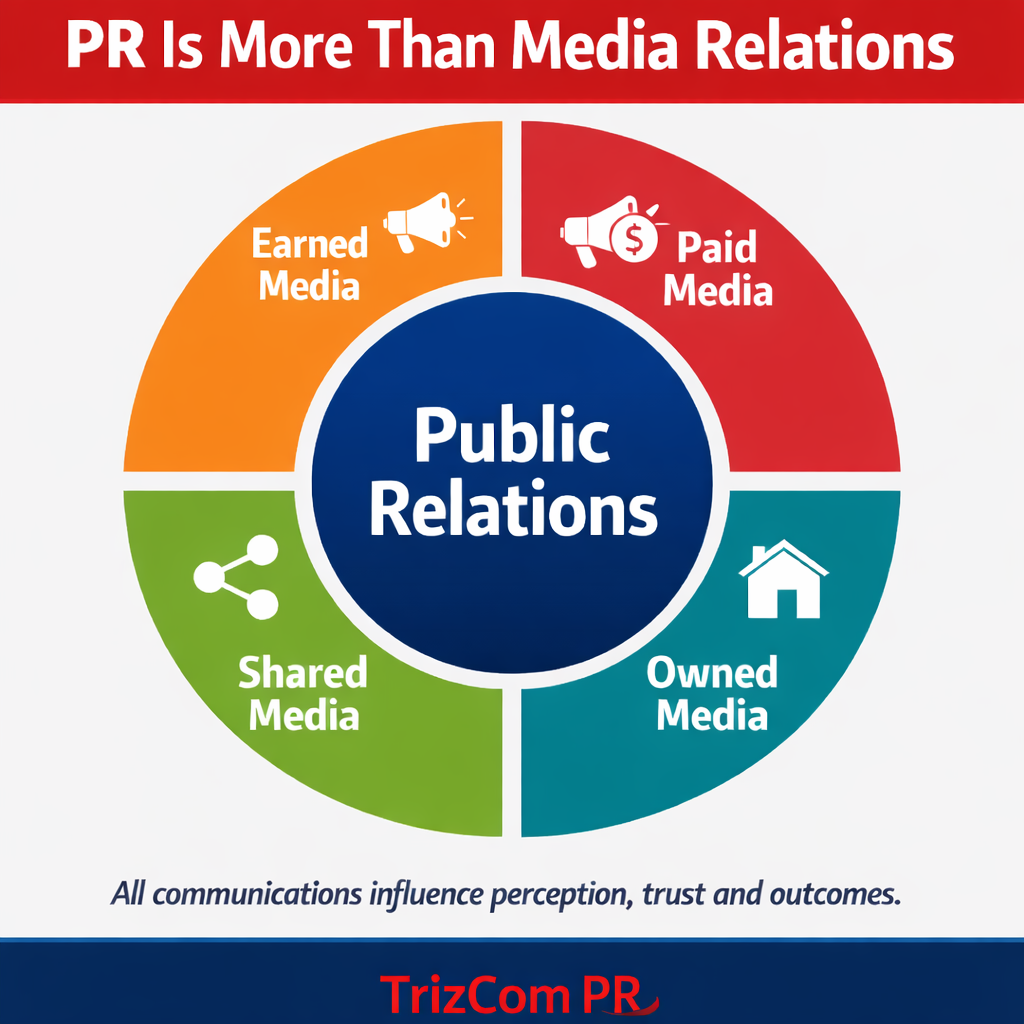
Why Must PR KPIs Be Tied to Business Goals?
PR measurement only works when it starts with a business objective.
Before selecting KPIs, a strong PR firm should understand what success means for the organization. That definition changes depending on whether the priority is revenue growth, lead generation, employee recruitment, market credibility or reputation protection.
Examples of business-aligned PR goals include:
Supporting sales by increasing qualified inbound demand
Improving recruiting by elevating employer trust
Building credibility during expansion or leadership change
Strengthening authority in competitive or regulated markets
PR KPIs should answer one question.
Did this effort move the business closer to its goal?
Vanity metrics like impressions and reach rarely answer that question. Exposure alone does not generate revenue, attract talent or build trust.
Why PR Measurement Starts With a Communications Plan
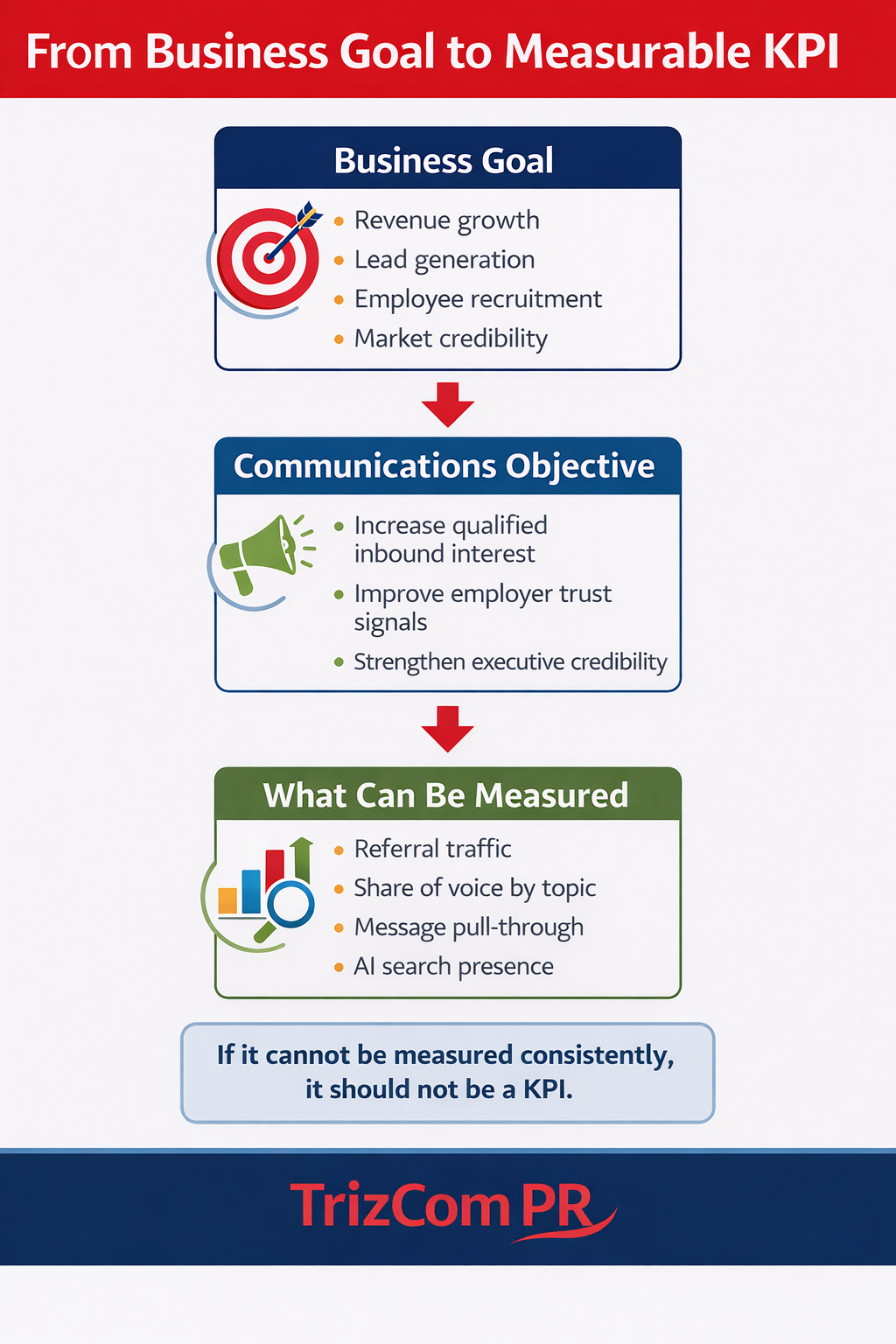
Another reason PR measurement breaks down is straightforward. Many organizations skip the communications plan.
A communications plan forces clarity. It defines the goal, the objective and the measurement before activity begins. Without it, KPIs are often chosen after the fact to justify work already completed.
The sequence matters:
Goal – What business outcome are we supporting?
Objective – What needs to change to support that outcome?
Measurement – What can we realistically and consistently measure?
This is where many brands struggle. Measurement only works when it is tied to something observable and repeatable.
Awareness is a common example. Awareness is often cited as a goal, but without a baseline and follow-up study, it is difficult to measure accurately. Before-and-after brand studies can be effective, but they are time-intensive and costly. When those resources are not available, awareness becomes an abstract concept rather than a measurable objective.
That does not make awareness unimportant. It means the measurement approach must match the reality of budget, timeline and tools.
Strong PR firms help clients choose objectives that can actually be measured, rather than defaulting to goals that sound good but fall apart in reporting.
Are Impressions and Reach Enough to Measure PR?
Impressions and reach are not enough to measure PR success.
They show how far a message traveled, not whether it influenced decisions tied to growth or hiring. Impressions are rarely connected to revenue, lead quality or recruitment outcomes.
They are often used as a proxy for awareness when no baseline exists, which is why they should be treated cautiously. Used carefully, they provide context. Used alone, they obscure impact.
How Do Strong PR Firms Actually Measure Success?
Strong PR firms measure success across multiple categories, each tied back to a business goal. Together, these categories explain visibility, credibility, demand and influence.
Measurement works best when KPIs are selected during planning, not retrofitted after execution.
How Is Visibility and Authority Measured?
Visibility and authority measurement focuses on where a brand appears and whether those placements support business outcomes.
Key KPIs include:
Coverage in tier-one and industry media
Share of voice among defined competitors
Authority and relevance of earned backlinks
AI search visibility, including how often and how accurately the brand appears in AI-generated answers for priority topics
Visibility matters when it influences buyers, recruits or partners. Placement quality and competitive position matter more than volume.
How Is Message Accuracy and Trust Evaluated?
Message accuracy measurement assesses whether the brand’s story is being told correctly and consistently.
Key KPIs include:
Message pull-through
Spokesperson quote usage
Sentiment trends over time
Trust supports revenue, recruiting and long-term growth. PR success includes maintaining clarity during moments that shape perception.
PRO TIP
Media training supports message discipline when questions get sharp and timelines get tight
How Does PR Influence Audience Behavior and Demand?
PR influences consideration, which is why audience behavior is a business-aligned metric.
Relevant KPIs include:
Referral traffic from earned media
Time on site from PR-driven visits
Assisted conversions and lead quality indicators
These metrics show whether PR attracts the right audience and supports demand generation over time.
PRO TIP
This is where PR can support organic demand by earning the right clicks from the right places.
How Is AI Search and Generative Visibility Measured?
AI search visibility measurement reflects how brands appear before a click happens.
Buyers increasingly rely on AI-generated summaries to form opinions. PR shapes those answers through earned credibility and authoritative content.
Key KPIs include:
Brand presence in AI-generated responses
Citation of executives and original content
Topic authority across AI and traditional search
AI visibility matters because it influences buying decisions, recruiting perceptions and stakeholder trust early in the journey.
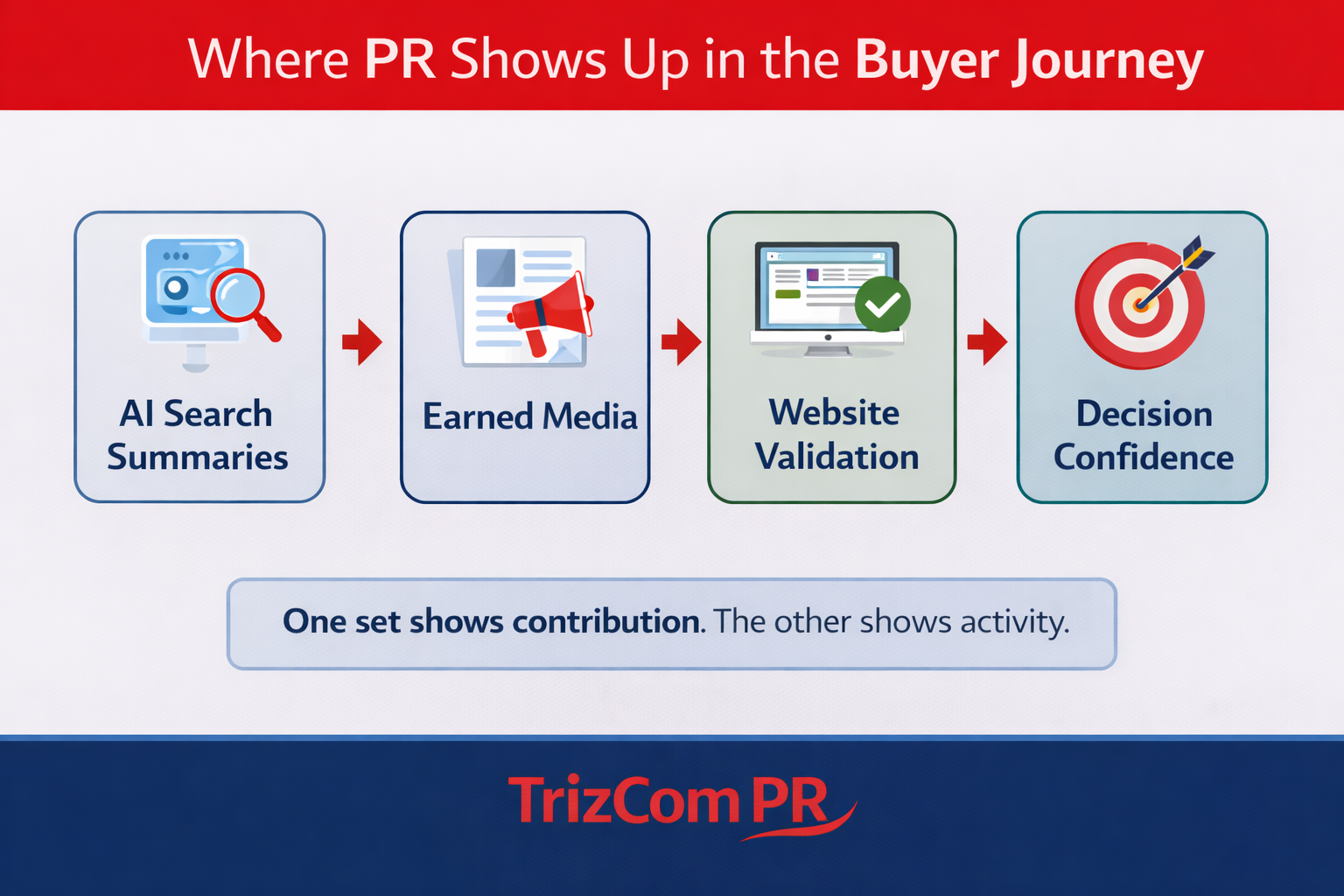
What Do Business-Aligned KPIs Look Like Compared to Vanity Metrics?
| Stronger measurement signals | Weaker measurement signals |
|---|---|
| Share of voice by topic | Impressions reported alone | Referral traffic tied to specific placements | Clip counts with no interpretation |
| Message consistency and sentiment trends | Awareness claims without benchmarks | Search and AI visibility lift | Vanity engagement metrics |
| Lead and recruiting influence over time | Website visitors without conversions |
Business-aligned KPIs show contribution. Vanity metrics show activity.
What Questions Should I Ask a PR Firm About Measurement?
Instead of asking for a list of KPIs, ask how success connects to business priorities.
Questions worth asking include:
How do you define success for this engagement?
Which KPIs matter most in the first 90 days?
Which metrics tie directly to revenue, recruiting or growth goals?
What can you influence and what can you not?
How do you determine what is realistically measurable based on our goals and resources?
How do you adjust strategy when results change?
Clear answers reflect strategic experience. Vague answers signal risk.
Ready to Ask Better Questions About PR Measurement?
If you are evaluating a PR firm or reassessing how success is measured today, clarity matters. The right KPIs should reflect growth, trust, demand and how decisions now start across search and AI platforms.
TrizCom PR helps organizations define meaningful success metrics before campaigns launch, not after reports are delivered.
Request a PR Measurement and Visibility Assessment to understand which KPIs matter most for your business and how to track them with confidence.
Frequently Asked Questions About PR Measurement
What KPIs does TrizCom PR focus on most?
When asking what KPIs TrizCom PR focuses on most, the real answer is that it depends on your business goals. TrizCom PR starts by clarifying what success needs to support, whether that is revenue, lead generation, employee recruitment, investor confidence or reputation protection. From there, we choose KPIs that can be measured consistently over time. That said, a few metrics come up often across engagements, including share of voice for priority topics, message pull-through, website conversions, referral traffic from earned placements and AI search presence to see how your brand appears in generative answers.
Does TrizCom PR still track impressions?
Yes, TrizCom PR tracks impressions as context. Impressions help explain distribution, but TrizCom PR evaluates success using metrics tied to influence and business outcomes.
How does TrizCom PR measure message accuracy?
Message accuracy at TrizCom PR is measured by tracking how consistently key messages and quotes appear across coverage. This helps clients understand how their story supports trust and credibility.
Can PR results be tied to revenue?
PR results are rarely tied to last-click revenue. At TrizCom PR, success is measured through assisted influence that supports sales cycles, lead quality and long-term growth.
How long does it take to see measurable PR results?
Most clients see directional PR indicators within 60 to 90 days. TrizCom PR focuses on trends tied to business goals rather than instant outcomes.
Does TrizCom PR measure AI search visibility?
Yes, TrizCom PR measures how brands appear in AI-generated answers and whether executives and content are cited accurately, which supports early-stage decision-making.
Is sentiment still a useful PR metric?
Sentiment is useful when tracked over time. TrizCom PR looks for patterns that reflect shifts in trust and credibility rather than one-time scores.
How does TrizCom PR report PR performance?
PR performance at TrizCom PR is reported with interpretation. Reports explain what changed, why it matters for the business and what adjustments follow.
Can KPIs change during a PR engagement?
Yes, KPIs should evolve as business priorities shift. TrizCom PR revisits measurement to stay aligned with growth and recruiting goals.
What makes PR measurement effective?
PR measurement is effective when it is planned in advance, tied to real business outcomes and based on metrics that can actually be measured over time. TrizCom PR believes metrics should support clarity, confidence and informed decisions.
Why Content Marketing Is Your Top Priority in 2026

Last week, I read a Cision roundup of PR stats and one line made me pause.
Only 45% of communications leaders said content creation was a top priority. Cision
That number is odd because content is no longer a side project. Content is what powers everything else we say we want: trust, visibility, media interest, search demand and sales conversations that start warmer than “So what do you all do?”
If 2026 is the year your brand wants to be the obvious answer, content marketing is not optional. It is the system.
The quick takeaways
Always on beats campaign mode. Buyers do not make decisions on launch day. They decide in the weeks of small touches leading up to it.
Search is now a mix of Google, TikTok, Reddit and AI answers. If your content cannot be cited, summarized and trusted, you lose visibility even when you “rank.”
Authenticity is now a performance advantage. People have a growing sensitivity to content that feels machine-stamped or overly polished.
Google’s E-E-A-T still matters. Experience, expertise, authoritativeness and trust are also the signals AI systems look for when they decide what to repeat.
Why is content marketing the foundation in 2026
PR used to live on a press release, a pitch and a prayer.
Now PR lives on a search results page, a LinkedIn scroll, a podcast clip, an AI summary and a buyer who wants proof before they take your meeting.
Content is the proof.
It is where your expertise shows up in public. It is where prospects learn your language. It is what reporters check before they reply. It is what AI tools pull from when someone asks, “Who is credible in this space?”
When content is thin, everything downstream gets harder. Pitches feel generic. LinkedIn posts feel like fillers. Sales teams lack stories. Google sees nothing worth ranking. AI sees nothing worth citing.
What replaces campaign-led thinking?
Campaigns are neat. They fit into a quarter. They come with a launch date and a hero asset and a victory slide.
But buying decisions do not happen on your schedule.
Most decisions get shaped by a long chain of small moments: a short video someone sends to a colleague, a newsletter that answers a specific question, a case story that sounds like their situation, a quote that feels like it came from a real person. Cision’s own reporting calls out the shift toward “always on” work.
Always on does not mean posting nonstop. It means building a simple engine that keeps your expertise visible even when you are not launching anything.
What does always on look like in practice?
A weekly or biweekly point of view that answers one buyer's question
A monthly proof piece that shows outcomes, not adjectives
A steady stream of short social posts pulled from real work, real conversations and real client outcomes
A distribution plan that does not rely on “we posted it”
If your 2026 plan has three major campaigns and a quiet calendar in between, your competitors will own the weeks when buyers are actively researching.
Why 2026 content needs to be written for AI answers, not only Google clicks
Don’t get me wrong, Google still matters. But it is no longer the only front door.
People ask ChatGPT, Claude and Perplexity for comparisons, recommendations and summaries. They search TikTok for “what to buy” and Reddit for “what is it really like.” AI-driven shopping and zero-click experiences are pulling clicks away from the old discovery model.
Just today, we took a new client call. Early in the conversation I asked the question I always ask, “Where did you find us?”
Their answer was short and sweet.
“I asked ChatGPT.”
No Google search. No referral from a friend. No scrolling through pages of agency sites. They typed a question into Chat, got a list of options and we were on it.
That moment is the new reality check for 2026. Your buyer does not need to click ten links to form an opinion. They can get a summary in seconds. If your content is not built to show up inside that summary, you are invisible even if your website is strong.
So, the goal changes. You still want rankings and traffic. But you also want content that reads like an answer. Clear language. Specific proof. Real examples. A point of view that feels like it came from a person who has done the work.
So, the goal changes.
In 2026, content has two jobs:
Get cited and trusted when someone asks for an AI tool
That second job is new to many teams. It also explains why E-E-A-T is back on the main stage.
The E-E-A-T reality check
Google’s Quality Rater Guidelines make trust the core of E-E-A-T.
For your content, which means your pages need signals that a human would trust and that an algorithm can verify:
Clear authorship and credentials
Specific experience, not vague “we help brands”
Sources and citations when you reference claims
Real examples, real numbers, real context
Evidence that your expertise exists outside your own website
That is not “SEO fluff.” That is credibility engineering.
Why authenticity wins and glossy content loses ground?
A lot of teams are learning the hard way that polishing does not automatically mean persuasive.
There is growing evidence of a trust penalty around AI-generated marketing content and rising consumer concern about authenticity.
Bynder’s study also found that many consumers can identify AI-generated copy and reported lower engagement when they suspect content is AI-made.
This is not an anti-AI rant. AI can help teams work faster and think more broadly.
But if your output reads like it was assembled from five competitor blogs and a prompt, people feel it. Sometimes they cannot name it. They just scroll.
What “authentic” actually means in 2026
Authentic content is not messy on purpose. It is specific on purpose.
A founder describing a decision they made and what it cost
An employee explaining how they solved a customer problem
A customer story told in the customer’s language
A behind-the-scenes lesson that a competitor cannot copy
The most convincing content in 2026 will sound like someone who has done the work talking to someone who needs it.
The part that too many comms teams miss
That 45% stat (45% of communications leaders said content creation was a top priority) matters for another reason.
Content is not just a priority. It takes real capability to do it well.
Cision’s report also notes a gap between prioritizing content and feeling “excellent” at telling a compelling brand story.
I see that gap frequently. The brand is smart. The leadership team is experienced. The marketing team is stretched. Then the content becomes “one more thing,” and the calendar fills with posts that sound like no one.
That is why 2026 content marketing needs a system, not a scramble.
Frequently asked questions about content marketing in 2026
1) How often should we publish content in 2026 to stay visible?
Aim for a cadence you can sustain for six to 12 months. For many teams, that looks like one strong long-form piece every one to two weeks, plus three to five short-form posts pulled from it. At TrizCom PR, we build an always-on calendar that matches your team’s capacity and keeps publishing steady without turning into a scramble.
2) What content formats are most likely to show up in AI answers?
AI tools tend to pull from pages that answer a question clearly and then support the answer with proof. “Explainer” pages, comparison pages, FAQs, glossaries and original research posts are often easier for AI to cite than brand storytelling alone. At TrizCom PR, we map these formats to your buyer questions so your content gets pulled into both AI summaries and search results.
3) How do we track whether AI tools are mentioning our brand?
Start by searching your category questions (incognito) inside the tools your buyers use (ChatGPT, Google Gemini (Google), Perplexity, Claude (Anthropic), Microsoft Copilot, Grok (xAI), Meta AI or Character.AI and document what shows up each month. Then watch for referral traffic from AI sources in your analytics and track brand mentions in earned media and community threads that AI tools commonly reference. At TrizCom PR, we use a number of paid platforms that allow us to track share-of-answer alongside rankings and referrals so you can see where you are showing up and where you are missing.
4) How do you decide which topics to own as a brand?
Choose topics where you have lived experience, a clear point of view and proof you can share. If your sales team hears the same question every week, that topic belongs on your content calendar. At TrizCom PR, we turn those repeat sales questions into a focused topic map (thought leadership) so your brand becomes the go-to answer in your category.
5) What is the fastest content upgrade that improves E-E-A-T?
Add clear authorship and a detailed author box to your highest traffic pages, then strengthen them with specific examples and citations where relevant. Updating outdated pages often moves the needle faster than publishing brand new ones. At TrizCom PR, we prioritize “money pages” first and rebuild them with proof, author credibility and clear next steps.
6) How do we repurpose one piece of content without it feeling repetitive?
Repurposing works when you change the angle, not just the format. Pull one stat, one story, one framework and one contrarian takeaway and turn each into its own post, video or newsletter section. At TrizCom PR, we design content to be repurposed from day one, so one strong piece becomes a full month of distribution.
7) Should leaders write content themselves or can a team ghostwrite it?
A team can ghostwrite, but leaders still need to provide the raw material: stories, opinions, and the real trade-offs behind decisions. The best process is a short interview that turns their lived experience into content without adding more work to their week. At TrizCom PR, we interview leaders, capture their point of view and turn it into publish-ready content that still sounds like them.
What is the best way to use AI tools without sounding like everyone else?
Use AI for outlines, idea expansion, editing and research organization, then replace generic sections with your real examples, metrics and language. If a sentence could apply to any competitor, it is a signal to rewrite it with specifics. At TrizCom PR, we use AI as an assistant, not the author, and we anchor every piece in real proof, so it reads human and credible.
How does media relations and content marketing work together in 2026?
Earned media gives you third-party credibility, and content gives you a place to send attention when coverage hits. When you plan them together, your coverage links to pages that build trust, answer questions, and convert, rather than dumping visitors on a homepage. At TrizCom PR, we align pitches with the right landing pages, so every placement strengthens search visibility and pipeline, not just awareness.
When should a brand use sponsored content instead of earned media?
Sponsored content makes sense when you need guaranteed reach in a specific niche, timeline or geography. Earned media makes sense when you need credibility and long tail trust, so many brands use sponsored placements to amplify proof that earned coverage already created. At TrizCom PR, we help brands use sponsored placements strategically so they extend earned credibility instead of replacing it.
How is AI search content different from organic search content?
Organic search content is written to win a click. AI search content is written to win a citation.
Google still sends traffic when you rank for the right keywords. But AI tools often answer the question inside the interface. They draw from sources that appear clear, credible and easy to summarize. That changes how you write and how you structure the page.
What does organic search rewards most?
Matching keywords and intent
Strong on-page structure with helpful depth
Internal links that guide people to the next step
Fast pages and clean technical SEO
Backlinks that signal authority
What does AI search rewards most?
Direct answers that can be quoted in one or two sentences
Clear claims backed by evidence, examples, data or sources
Strong E E A-T signals like author bio, credentials, real experience
Scannable formatting that makes it easy to extract key points
Consistent terminology so the model understands who you are and what you do
The simplest way to think about it
Organic search asks: “Will someone click this?”
AI search asks: “Is this safe to repeat?”
How to write one piece for both
Start each section with a plain language question, then answer it in the first 2 to 3 sentences
Add proof right after the answer, like a metric, a mini case story, a quote, a citation or a specific example
Use short headings, bullets and labeled steps so AI can lift clean chunks
Include an author box and update dates so trust is obvious
Add a FAQ section that mirrors how people talk, not how marketers write
If your content reads like an answer, it can rank on Google and show up in AI summaries without you having to create two separate versions.
A simple content engine for 2026
Here is a structure that works across industries, whether you run a cybersecurity firm, a professional services team or a wellness brand.
1) What do buyers ask before they trust you?
Collect the real questions from:
Sales calls
Customer support tickets
RFP language
DMs and comments
The questions your team gets at events
Reddit threads
Those questions are your editorial plan. Not trend lists.
2) What proof can you publish without breaking confidentiality?
Proof is not always a full case study.
Proof can be:
A before-and-after metric with context
A decision framework you use with clients
A lesson learned from a project
A myth you see in your industry and why it persists
3) What can your team say that AI cannot invent?
AI can remix. It cannot live your meetings.
Pull content from:
The debates your team has behind closed doors
The mistakes you stopped making years ago
The tradeoffs you choose and why
The advice you give clients do not want to hear but need
That is where your differentiation hides.
4) How will each piece get distributed?
Publishing is not distribution.
Build a plan for:
One owned channel that compounds, like a blog or landing page
One LinkedIn Article
One third-party channel where you show up with expertise, like podcasts, trades or community platforms
Earned media that builds third-party credibility, like interviews, contributed (byline) articles or press coverage in outlets your buyers trust
Sponsored content that puts your message in front of the right audience, like newsletter placements, podcast sponsorships or paid features in trade publications
5) What will you measure that is not vanity?
Likes are not useless. They are just incomplete.
In 2026, useful signals include:
Search impressions for high-intent questions
Referral traffic from credible sites
Newsletter replies and forwards
Mentions in the places your buyer’s trust
A few lines worth stealing
· Content is the evidence your PR runs on.
In 2026, the brands that win are the ones AI can cite and humans can trust.
Always on is not a posting schedule. It is a credibility habit.
Authentic beats polished because specificity beats performance.
Content Creation in 2026
If content creation is a top priority for only 45% of communications leaders, the other 55% are leaving visibility and trust to chance.
In 2026, content marketing is the simplest lever that improves every channel at once: PR, organic search, AI search visibility, social performance and sales readiness.
Not because you publish more.
Because you publish what only you can say, you publish it consistently and you make it easy for both people and machines to trust.
Want your brand to show up when buyers ask AI
If your team is still treating content as “nice to have,” 2026 will make that expensive. TrizCom PR helps leaders turn expertise into a content system that earns trust across Google, AI answers, social and earned media. If you want your brand to be the name that shows up when someone types “Who do you trust for this?” let’s talk.
Everyone has a story. Let TrizCom PR tell yours.
Author
Jo Trizila, Founder & CEO, TrizCom Public Relations
Jo Trizila leads Dallas‑based TrizCom PR, an award‑winning digital public relations agency she founded in 2008. She has guided integrated PR programs for startups, middle‑market companies and national brands, with deep experience in crisis communications, expert positioning and data‑driven media strategy.
Jo is also the creator of Pitch PR, a press release distribution company and a frequent speaker on earned media ROI, including sessions at the Earned Media Mastery virtual summit.
For more information contact jo@trizcom.com or 214-242-9282.
Should You Still Blog When AI Answers Most Questions Today?

If AI answers everything, why blog?
AI and Google pull from what already exists. I’m going to repeat that, AI and Google pull from what already exists. If your expertise is not on the page, it is not in the results. A steady, useful blog does four jobs at once: earns search visibility, feeds AI overviews with clean facts, arms sales with links that answer real questions and gives reporters quotable lines they trust. Blogging is not a journal. It is a library of answers your customer needs.
When readers land on your site, they want clarity fast. Your blog is the place to explain key ideas, show proof and offer next steps in one visit. Done well, each post becomes an asset that works long after publish day.
“Blogging is not a journal. It is a library of answers your customer needs.”
This blog walks through the why, the how and the proof so you can decide with confidence.
What you will learn
Why blogging still matters when AI answers quickly
How to use user intent keywords to match what people actually want
The signals AI and Google reward and how to bake them into every post
A cadence plan you can keep without burning out
Content formats that teach, compare, prove and convert
Where AI can speed the work and where humans protect voice and facts
AI search vs search engines. Who is winning
AI-powered search tools like ChatGPT and Perplexity are gaining ground. People use them for quick answers, summaries and idea starters. Growth is real and conversational results feel efficient for narrow tasks. Even with that momentum, traditional search engines still carry most of the daily traffic. For broad discovery, shopping and research across many sources, Google and Bing remain the first stop for most users. The behavior shift is visible, but it has not replaced classic search.
What this means for content is simple. Plan for both patterns. Write posts that answer the core question in the first screen, then expand with steps, tables and FAQs that AI can cite cleanly. Keep facts up to date, name entities clearly and link to related guides, pricing and case studies. Use Article schema and add FAQ or How-Tos when they fit. This approach helps posts rank in search while making them easy for AI to reference accurately.
Net: it is not either or. Plan content that can rank in search and be cited cleanly by AI.
AI Search VS Organic Web Traffic Statistics
Roughly 60% of Google searches now end with no click to a website (so-called zero-click results). Search Engine Land
Zero-click share has risen year over year; one analysis shows increases across the U.S., EU and UK in 2025. Search Engine Land
For queries that trigger AI Overviews, the average CTR on the #1 organic result fell from 7.3% to 2.6% year over year, a ~65% relative drop in clicks to that top listing. Digital Content Next
Consulting research estimates 15–25% reductions in organic site traffic attributable to zero-click/AI summary behavior across categories. Bain
News publishers show the sharpest impact: some report traffic declines up to 40% since AI Overviews rolled out, with zero-click rates in news rising from 56% to 69%. (Impact varies by outlet; Google disputes parts of these studies.) New York Post
What is SEO and how can PR help?
SEO is the practice of making your site easy to find and trust in search results. It mixes clear content, technical basics like speed and mobile and links from reputable sites. PR strengthens SEO by earning credible mentions and backlinks from news outlets, trade media and quality blogs. Those links act like votes of confidence that lift rankings. PR also builds entity authority with consistent names for people, products and locations, which helps search engines connect your brand to key topics. Strong PR assets make better SEO pages too: quotable spokespeople, verified stats, case studies and images with alt text. Add article, FAQ or How-To schema, keep facts dated and link posts to service, pricing and case study pages. When PR and SEO plan topics together, you win both awareness and qualified traffic.
What is LLM and how can PR help?
A large language model is AI that predicts words to answer questions or create text. It relies on patterns learned from public content and favors recent, structured and trustworthy sources when citing. PR helps LLM visibility by publishing quality content worth citing. Think clear definitions, timelines, data tables and FAQs that answer in the first 150 words. Use consistent entity names, author bios, dates and linked sources. Mark up pages with article plus FAQ or How-To schema. Place quotable lines and short summaries that models can lift cleanly. Distribute those assets through earned media, partner sites and bylines to broaden trusted signals and links. Monitor common AI answers to your core queries, then fill gaps with new explainers, comparisons and case studies. In short, PR produces the credible source material LLMs look for and keeps it current.
The data that ends the debate
Neil Patel’s team compared 20 companies over 12 months. Ten kept publishing. Ten stopped. The gap was clear.

Two takeaways:
Pausing a blog accelerates organic decline. Teams that stopped saw more than double the SEO (search engine optimization) drop.
Consistent publishing correlates with large LLM gains and real revenue lift.
Why this happens:
Fresh, structured, sourced articles send the signals search engines and AI systems use to rank, cite and recommend.
When publishing stalls, those signals fade. Competitors fill the gap with newer, clearer content.
The lesson is simple. Keep publishing on a schedule, keep posts current and keep structure tight. Momentum compounds when your content stays fresh and useful.
Source: Neil Patel email, Oct 29, 2025.
Signals AI and Google reward
Search engines and AI tools reward content that feels recent, credible and easy to scan. Think of each post as a product. Label it, package it and make the value obvious from the first paragraph.
Freshness: recent posts with clear dates, updated stats and current examples
Structure: scannable headers, short paragraphs, pull quotes, lists and a TLDR box up top
Authority: named author with credentials, sources linked, quotes from experts, first party data
Entities: precise names for people, products, locations and definitions of key terms
Schema: Article plus FAQ or How-To where it fits organization and person markup on your site
Answers fast: state the answer in the first 150 words and expand below
Internal links: point to related guides, pricing, case studies and service pages
Media assets: original charts, images with alt text, short clips and downloadable checklists
Consistency: a steady cadence that keeps signals flowing to search engines and AI systems
Experience: fast load, mobile friendly, clean design, no intrusive pop-ups
“Think of each post as a product. Label it, package it and make the value obvious from the first paragraph.”
When you ship posts that check these boxes, you make it easier for readers to understand and easier for systems to surface your content. That is how rankings, citations and conversions move.
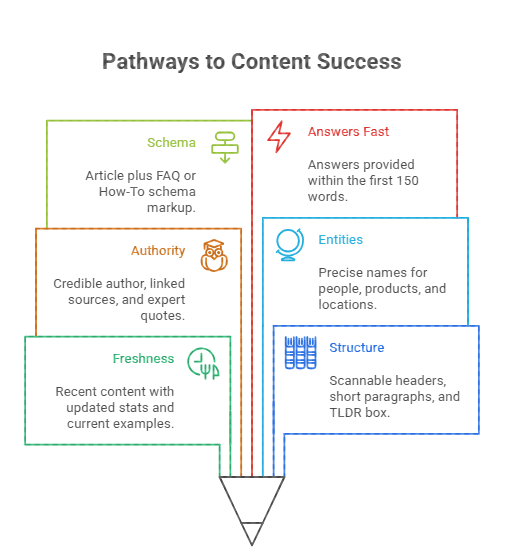
Write for your customer with user intent keywords
What are user intent keywords?
User intent keywords are the words and phrases people type or say that show what they want to do right now. They go beyond a topic and signal purpose: learn, compare, buy or navigate. Search engines exist to match that intent with the most relevant result.
Simple example:
If someone types Italian food, the results will likely feature restaurants. That query reads like a place or cuisine search. If the person types Italian recipes or how to make lasagna, the results shift to step-by-step guides and ingredient lists. Same subject, different intent.
How to write for your customer using user intent keywords?
Start with the words your customers use. Pull phrases from sales calls, support tickets, social comments and onsite search. Real language beats guesswork.
Group by intent:
Informational: what is, how to, pros cons, cost to
Comparative: vs, best for, alternative to
Transactional: pricing, demo, near me, book
Navigational: brand terms like login, case studies
Local: service + city, neighborhoods, landmarks
Match format to intent:
Informational -> explainers, checklists, FAQs, glossaries
Comparative -> X vs Y tables, scorecards, decision guides
Transactional -> pricing pages, ROI calculators, implementation timelines
Local -> city pages with service details, maps, local testimonials
Build titles and H2s with intent modifiers:
Pair the topic with a verb or outcome
Franchise PR pricing guide
Media training checklist for first TV interview
Integrated marketing examples for multi-location brands
Answer the next question:
Add a summary at the top, a quick table and a short What’s next box
Include three to five FAQs that mirror People Also Ask phrasing
On-page cues that reinforce intent:
First paragraph answers the core task
One table or list per post for skimming
Internal links guide readers to the next stage in the journey
Apply FAQ or How-To schema when it supports the page
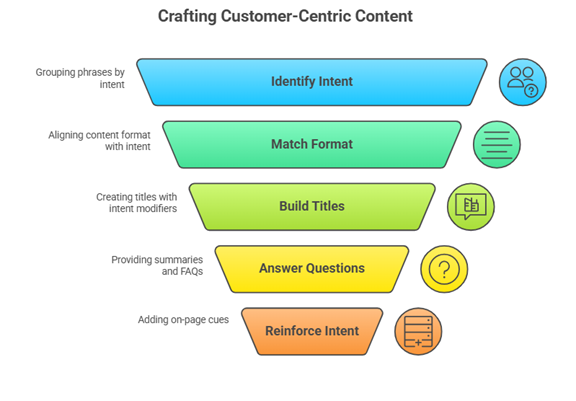
Quick checklist:
Who is this for and what are they trying to do
Primary intent plus 2 or three modifiers
One clear outcome promised in the title
Answer visible without scrolling
One data point, one example, one CTA that matches the intent
Writing to intent keeps posts useful and discoverable. It also helps sales and support point customers to the right answer without extra back and forth.
Cadence plan that teams can keep
A calendar you can keep beats a burst that burns out. Pick a tier that fits your team and protect it.
Pick a tier and protect it:
Minimum viable: Two posts per month per service line
Healthy growth: one post per week
Aggressive: Two to three posts per week during launches or peak season
Use a 3:2:1 monthly mix:
Three evergreen explainers that target informational intent
Two timely POVs or newsjacks tied to current coverage
One conversion story such as a case study, comparison or pricing guide
Lock a publishing day:
Choose one weekday, publish at the same time and treat it like a standing meeting
Assign clear roles:
Owner sets topics and briefs
Writer drafts with sources and quotes
Editor checks facts, voice, links and schema
Publisher loads, optimizes and ships on time
Keep a two month runway:
Maintain at least six ready to publish drafts
Refresh one older post each month with new data, links and a short update note
Weekly rhythm:
Mon plan and pull voice of customer notes
Tue draft
Wed edit and add assets
Thu load CMS, internal links, schema
Fri publish, distribute to email and social, log metrics
Consistency builds trust with readers and with search systems. Protect the cadence and the channel will start paying you back.
Content types that win across SEO and AI
Your blog works best when each post has a clear job. Mix formats that teach, compare, prove and guide. Use explainers to answer core questions, comparisons to help choices, case studies to show outcomes and checklists to drive action. This variety meets different intents, keeps readers engaged and gives search and AI systems clean signals to surface and cite.
Evergreen explainers
Define key terms, show steps, include a TLDR table and three to five FAQs.
Example: “Franchise PR explained” with a glossary and media list starter kit.
Decision guides and comparisons
Help readers choose with criteria, scorecards and pros and cons.
Example: “Media training agency vs DIY” with a cost and outcome table.
Pricing and timelines
Set expectations with ranges, factors and sample schedules.
Example: “How long does national TV take from pitch to air?” with a week-by-week plan.
Case studies with numbers
Lead with the outcome, then show the playbook and assets used.
Example: “How a regional launch earned 24 placements and three speaking invites.”
Questions hubs
Collect top customer and sales questions on one page, marked up with FAQ schema.
Example: “Crisis communications FAQ for franchise systems.”
Playbooks and checklists
Step-by-step, printable and linkable for journalists and partners.
Example: “First TV interview checklist” plus a one-page download.
Newsjacks and timely POVs
Add expert context to a breaking story with one chart and two quotes.
Example: “What the new local search update means for multi-location brands.”
Local intent pages
Blend service details with city-specific information, maps and local testimonials.
Example: “Media training in Dallas” with venue options and travel tips.
Original data and mini studies
Publish small, repeatable benchmarks or surveys.
Example: “Average response time from morning TV producers in Q1.”
How-to videos and short clips
Embed a 60 to 120-second walkthrough with captions and a transcript.
Example: “How to build a spokesperson one-liner.”
What to include in every post:
Clear summary up top
One table or checklist
Sources, dates and named author
Internal links to related guides, pricing and case studies
Article schema plus FAQ or How-To when it fits
A next step that matches the reader’s intent
The mix above creates a library that works across search, AI summaries, media outreach and sales enablement. Each post has a job and a place in the journey.
AI assist playbook that saves time without losing voice
AI speeds up the work. Your team supplies the thinking. Use AI where it removes friction and keeps humans on strategy, accuracy and tone.
Where AI helps:
Research sweep: expand topics, questions, related entities, common objections
Outline drafts: headings, talking points, FAQ ideas, table structures
Language variants: title and meta options, pull quotes, social snippets
On-page SEO: internal link suggestions, alt text drafts, FAQ and How-To starters
Schema scaffolding: Article, FAQ, How-To fields to hand to the CMS
Repurposing: turn a post into a byline, newsletter blurb, two short videos
AI Guardrails:
Fact check every stat and date
Cite sources with links and names
Keep brand voice. Edit for tone and clarity
Run a quick originality check
Avoid filler. Add first party data, examples, quotes
Label images and charts with plain alt text
Chat GPT PR Prompt recipes for blogs:
Outline: “Give me an H2/H3 outline for [topic] for [audience]. Include a TLDR table, five FAQs and one short case example.”
Title set: “Write 10 titles with the primary intent [informational/comparative/transactional] and the outcome [result]. 55 to 60 characters. (including spaces)”
Internal links: “From this post, suggest eight internal links to these URLs grouped by stage [top, middle, bottom]. Give anchor text ideas.”
Schema: “Draft minimal JSON LD for Article plus FAQ with these questions and answers. No fluff.”
Quality checklist:
Answer in the first 150 words
At least one table or checklist
Two internal links in, two out
One quote or data point we can verify
Clear next step that matches the reader intent
Use AI as a co author that never ships without human review. That balance keeps quality high and speed manageable.
Why blogs fail
Blogs do not fail because the channel is broken. They fail because the work is unstructured, sporadic and disconnected from real questions. If you blog to check a box without a plan to repurpose, measure and refresh, the results will fade.
Common failure patterns
No clear audience or intent per post
Topics chosen by guesswork, not voice of customer
Irregular cadence that resets momentum
Walls of text with no summary, table or FAQs
Thin content that repeats competitors with no data or examples
Missing schema, slow mobile pages, weak internal links
No repurposing into email, social, sales decks or bylines
No refresh cycle or scorecard tied to outcomes
How to turn it around
Define audience, intent and outcome before drafting
Lock a publish day and a 3:2:1 monthly mix
Add a TLDR, one table and 3 to 5 FAQs to every post
Mark up Article plus FAQ or How-To where it fits
Repurpose each post into two channels and refresh one post monthly
Track entrances, citations, links and assisted conversions
Publish answers AI and search engines can trust that people can use
If AI answers everything, your job is to give it something accurate to cite and give people something useful to read. Keep the cadence, write to intent and package each post so value is obvious in the first scroll. When the library grows, search lifts, sales get better links and reporters find clean quotes. Ready to put this system to work?
An example of the power of blogs
At TrizCom PR, we deliberately shifted to publishing more owned content, including long-form blog posts. The effect is clear in Google Analytics. More than 60 percent of our organic website traffic now comes from keyword-optimized blog posts. The other 40 percent arrives through AI search that cites or summarizes those same posts.
Why this works
Posts are written to user intent, so answers appear in the first screen
Article plus FAQ or HowTo schema mirrors on page text
Internal links connect blogs to services, pricing, and case studies
We refresh older posts with new data and note the update
What we did next
We repurposed top performers into email, short video, and bylines, then linked everything back to the pillar posts. The result is steady nonbrand traffic, better qualified leads, and a content library that AI and search can trust.
TrizCom PR can help
If you want a blog that feeds SEO, AI search, sales and PR, we can run the full system or coach your team. We plan clusters, write human led posts, add structure AI can cite and report on what moves the business. Ready for a 90 day pilot that proves it. Reach out and let’s talk.
Everyone has a story. Let TrizCom PR tell yours!
About the Author:
Jo Trizila – Founder & CEO of TrizCom PR
Jo Trizila is the founder and CEO of TrizCom PR, a leading Dallas-based public relations firm known for delivering strategic communications that drive business growth and enhance brand reputations as well as Pitch PR, a press release distribution agency. With over 25 years of experience in PR and marketing, Jo has helped countless organizations navigate complex communication challenges, ranging from crisis management to brand storytelling. Under her leadership, TrizCom PR has earned recognition for its results-driven approach, combining traditional and integrated digital strategies to deliver impactful, measurable outcomes for clients across various industries, including healthcare, technology and nonprofit sectors. Jo is passionate about helping businesses amplify their voices and connect with audiences meaningfully. Her hands-on approach and commitment to excellence have established TrizCom PR as a trusted partner for companies seeking to elevate their brand and achieve lasting success. Contact Jo at jo@TrizCom.com.
AI Search and Blogging FAQ
How to use AI for blogs?
Use AI to speed planning and polish, not to replace judgment. Start with a brief that defines the audience, user intent and the outcome. Ask AI for an outline, title options, FAQs and a TLDR box. Use it to expand a research list, surface related entities and suggest internal links. Draft in your voice, then have AI propose meta descriptions, alt text and schema starters for Article and FAQ. Fact check every stat, add first party examples and cite sources with dates. Finish with a table or checklist and a clear next step. Repurpose the post into a byline, newsletter blurb and two short clips. Measure nonbrand entrances, assisted conversions and new links, then feed wins back into the brief.
Are blogs still a thing?
Yes. Blogs remain the easiest way to publish structured expertise that search engines and AI can understand and cite. A steady blog gives you a library of answers for customers, sales and reporters. What changed is how blogs work. Short intros, clear H2s, an upfront summary and one table or checklist help readers and machines. Add Article schema and use FAQ or How-to when it fits. Refresh older posts with new data and internal links. Plan a cadence you can keep, such as one post per week and track outcomes like nonbrand entrances and assisted conversions. Blogs that publish consistently, write to user intent and provide sources still perform.
SEO vs content quality writing.
It is not either or. Quality writing clarifies the answer for a human. SEO helps the right person find it. Start with user intent (also known as search intent), then write a plain language summary, followed by steps, examples and a small table. Add sources with dates, define people and products precisely and include internal links to the next logical page. Technical basics still matter: mobile speed, clean HTML, descriptive alt text and valid schema. If you have to choose, ship a clear, accurate post, then iterate with SEO improvements. The best results come from quality writing that is structured so search and AI can understand it.
Has AI killed SEO and blogging?
No. AI changed the playing field but did not remove the need for trusted sources. AI systems rely on published, structured and current content. If your expertise is not on the page, it will not be found or cited. What is different is format and cadence. Lead with the answer, add a TLDR box, use H2s that mirror real questions, include a table or checklist and provide sources. Add Article schema and consider a FAQ or How-to. Keep a weekly schedule and refresh older posts. Plan for both search and AI by writing posts that can rank and be quoted cleanly.
The power of frequently asked questions.
FAQs match how people search and how AI formats answers. Add three to five FAQs that mirror “People also ask” language. Keep answers short, factual and linked to deeper guides. Place FAQs near the bottom so the main narrative flows. Mark up the section with FAQ schema when the content is visible on the page. Good FAQs reduce support tickets, help sales answer objections and improve your odds of earning rich results and AI citations. Update FAQs when pricing, timelines or regulations change and link each answer to a next step such as a comparison, calculator or booking page.
What is a schema markup?
Schema markup is structured data that helps search engines understand your page. It is added as JSON-LD in the HTML and describes the content type and key properties. For blogs, start with Article. When the page contains real Q&A, add FAQ. For tutorials, consider How-to articles. Keep fields accurate and consistent with visible text. Include author, date, headline, description and mainEntity for FAQs. Proper schema improves eligibility for rich results and makes it easier for AI systems to parse and cite your content. Validate with Google’s Rich Results Test and update schema when the page changes.
Why are backlinks so important?
Backlinks are links from other sites to your pages. They signal trust, relevance and authority. High quality links from news outlets, trade media, universities and respected blogs help pages rank and can improve how often AI systems encounter your brand while training or retrieving. Earn links with useful assets: data tables, checklists, glossaries and clear definitions. PR helps by placing bylines, quotes and case studies that credit your site. Avoid buying links or using spam tactics. Focus on relevance, editorial context and sources that real readers use. Track new referring domains and link growth to priority pages.
What metrics to use to measure your blog’s success?
Measure visibility, engagement, authority and conversion. For visibility, track non-brand organic entrances, impressions, clicks, featured snippets and AI overview mentions. For engagement, monitor scroll depth to 75 percent, average engaged time and clicks on tables, downloads or jump links. For authority, watch new referring domains and internal links to service and pricing pages. For conversion, use assisted demo or contact submissions from blog paths and newsletter signups. Operationally, track publish-on-time rate, valid schema, and refreshes shipped. Review monthly, compare to a 90-day target and double down on formats and topics that create assisted conversions.
Can I use ChatGPT to write my blogs?
Yes, as an assistant. Use ChatGPT for outlines, title sets, FAQs, meta ideas and first drafts. Then apply Google’s EEAT framework to make the post worth ranking and citing.
Experience: add first-hand examples, screenshots, quotes from your team and lessons learned.
Expertise: name the author, include credentials and explain the why behind your advice.
Authoritativeness: link to reputable sources, publish case studies and earn mentions from trusted sites.
Trustworthiness: fact check dates and stats, disclose conflicts and keep policies and pricing current.
Keep the human voice. Edit for clarity and intent, not just keywords. Put the core answer in the first 150 words, add one table or checklist and include Article plus FAQ or How-to schema when it fits. Finish with internal links to related guides, pricing and case studies. AI speeds the work. EEAT earns results.
How can I repurpose blog content?
Here’s a simple, repeatable plan.
Start with a pillar
Pick a strong post. Add a TLDR, one table, FAQs, and clear next steps. That structure makes repurposing easier.
Break it into formats
Email: one-sentence hook, key takeaway, single CTA
Social: 4 to 6 posts with a pull quote, stat, or checklist item
Short video: 60–90 seconds that walks through the table or steps
Carousel or infographic: turn the table or FAQs into slides
Sales enablement: a one-page PDF summary and a short talk track
Webinar or live: outline becomes a 20-minute demo with Q&A
Byline: adapt into an opinion piece for trade media
FAQ hub: move the Q&A into your central FAQ with internal links
System and cadence
Repurpose within seven days of publication
Link every asset back to the pillar page
Track nonbrand entrances, saves, shares, and assisted conversions
Refresh the pillar quarterly with new data and relaunch the set
Use AI to draft outlines and captions. Keep humans on voice, facts, and examples.
Is AIO (AI Optimization) and SEO the same?
No. They overlap, but they are not the same.
SEO makes your pages easy to find and trust in classic search. It focuses on user intent, clear structure, fast pages, internal links, schema, and earning quality backlinks.
AIO (AI optimization) makes your pages easy for AI systems to parse, quote, and cite. It favors upfront answers, TLDR boxes, precise entities, dated sources, FAQ or How-to patterns, and clean JSON-LD that mirrors on-page text.
How they work together
Lead with the answer in the first 150 words
Use H2s that match real questions
Include one table or checklist per post
Add Article plus FAQ or How-to schema when it fits
Name the author, add credentials, and link sources with dates
Build internal links to pricing, case studies, and guides
Result: SEO helps people find you. AIO helps AI cite you. Do both.
PR Metrics That Matter
Last quarter I sat with a CEO who proudly told me their team earned 35 million impressions on a product launch. Big number. I asked a simple follow up. What did those impressions do for the business? Silence.
That is the trap with vanity. Numbers that look impressive on a slide can disconnect from outcomes. In public relations, where numbers can be dazzling and deceptive, it is easy to get lost in the sparkle. Strong leaders do not.
What are vanity PR metrics?
Vanity metrics are the stats that look good without proving success. Impressions. Raw follower counts. Likes. These inflate visibility but rarely show if anyone cared, trusted or acted.
They are not meaningless, but they are not enough. You would not judge your sales team only on doors knocked. You would ask how many opened, how many conversations happened and how many deals closed. PR deserves the same rigor.
Case in point. Your team lands a story on Forbes.com. Cision lists Forbes with an audience of 16,273,661. That is a platform number, not your readership. Treating 16,273,661 as reads is misleading, yet many reports still drop that number into reach. Big numbers can start a conversation. Actionable numbers close it.
What are actionable PR metrics?
Actionable PR metrics show whether communications move people toward a decision that matters to the business. A few to anchor your dashboard:
Share of voice vs named competitors
Quality and relevance of backlinks from earned coverage
Referral traffic from specific placements
Engagement that signals intent, such as saves, comments, shares, replies
Conversions tied to PR touchpoints, such as demo requests, email signups, store visits
Growth in branded and category search
Presence in AI search results for priority queries
Message pull through in coverage and interviews
Sentiment shifts among priority audiences
Cost per outcome, such as cost per qualified media mention or cost per referral lead
These are the numbers that help a CMO decide where to place the next dollar. They help a CEO see how communications contribute to revenue and reputation.
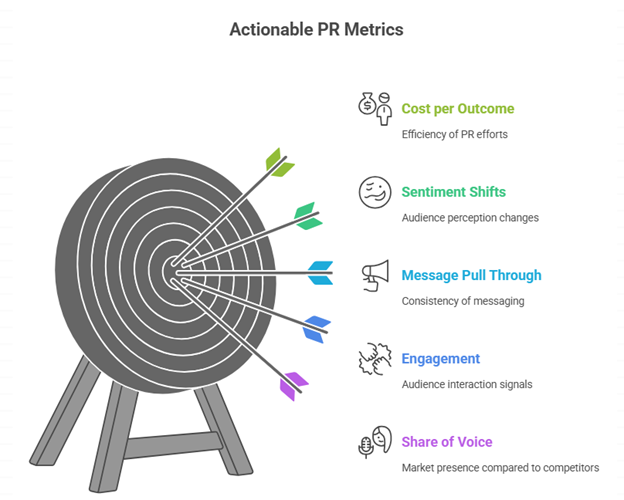
Map PR metrics to the customer journey
PR works across the full funnel. Your metrics should too.
Awareness
Share of voice, unique reach of earned coverage, category search lift, branded search lift, new users from referral traffic
Consideration
Time on PR landing pages, return visits from placements, content downloads, email growth from PR content, analyst briefing requests
Decision
Sales-qualified leads with PR as first or assist touch, coupon redemptions tied to PR codes, foot traffic tied to local coverage, store locator starts
Loyalty and advocacy
Repeat purchase tied to customers sourced from PR, reviews volume and rating after PR bursts, UGC volume, owned community growth
This is how PR Metrics stop being a scoreboard and start being a steering wheel.

Tie metrics to the PESO model
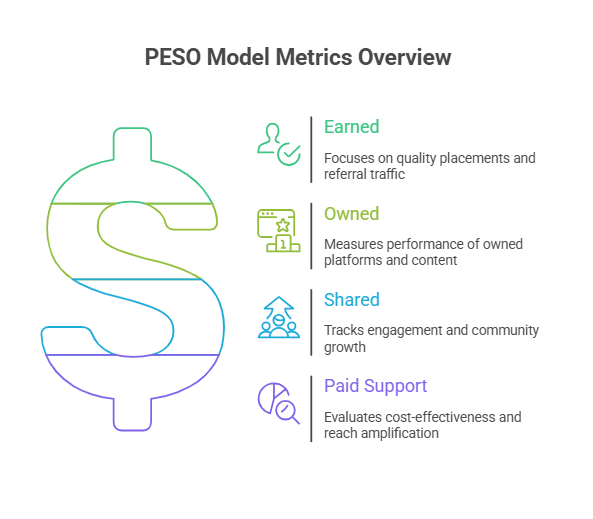
Your plan likely blends paid, earned, shared and owned. Measure each channel on what it does best, then show how the pieces reinforce each other.
Earned
Placement quality, domain authority of outlets, backlink quality, message pull through, referral traffic, conversions from earned pages
Owned
PR hub performance, newsroom traffic, average time on page, scroll depth, conversions from bylines and explainers
Shared
Saves, shares, comments, click-through to owned content, community growth tied to PR moments
Paid support
Cost to amplify earned hits, incremental reach on target, lift in branded search when you boost coverage, assisted conversions
When you connect the dots across a fully integrated program, executives see how communications compounds.
Why the difference matters in the boardroom
Quick story from my desk. A franchise brand was spending heavily on influencers. The vanity report sparkled. Big reach. Pretty content. Many likes. We traced referral traffic and coupon redemptions. Almost no conversion. We shifted to fewer creators with buyer overlap and tighter briefs. Reach dropped by half. Sales inquiries quadrupled.
Boards do not need to see every click. They need clarity. Is PR driving outcomes that matter to this business? Actionable PR Metrics earn their place in that answer.
Why asking for tactics first misses the point
Too many new business calls start the same way. A brand leads with tactics. We want a press release. We want The New York Times. A press release and one media hit rarely make a significant impact.
When selecting a PR agency, start with your business goals, not a wish list of outlets. Lead with a real outcome. We need to grow holiday sales 15 percent year over year. Can you help? Now you will get strategy. That is why you hire a firm.
Think of it this way. You would not tell a cardiologist how to perform heart surgery. You would not instruct an attorney on contract law. You hire experts because they know how to solve the problem.
And when the CEO and board review the sales impact and PR is not present, the shiny headline loses its appeal.
Build a PR metrics framework you can defend
Here is a simple framework we use with executives who want confidence, not clutter.
Start with one business objective
State it in plain language with a number and a deadline. Example: Increase qualified pipeline from healthcare prospects by 20 percent this quarter.
Then we define two or three PR outcomes that influence that objective
Examples: Double meetings with healthcare trade media. Secure three analyst briefings that cite our product category. Earn ten backlinks from healthcare domains with domain authority over 60.
We pick a short set of leading and lagging indicators
Leading: analyst inquiries, inbound media requests, PR-driven traffic to healthcare landing pages
Lagging: demo requests from healthcare domains, proposal volume, closed-won with PR as first or assist touchWe instrument the journey
Use UTM links, dedicated landing pages, unique discount or RSVP codes, call tracking, QR codes at events, click-to-call in local listings. Remove guesswork.
Then we set thresholds for action
Decide what triggers a change. If the message pull-through drops below 60 percent, revise the brief. If referral traffic from earned is below 10 percent of total traffic, revisit the outlet mix.
We report with context
Replace wall-of-numbers reports with a one-page narrative. What we tried. What happened. What we are changing. One chart per stage is plenty.
Finally, we close the loop with sales and service
Confirm that PR-sourced leads progress faster or close at higher rates. Capture feedback on objections PR can address with content or executive visibility.
That is a framework a board can respect.
Practical examples of replacing vanity with value
A few common swaps you can make this quarter.
Instead of total impressions
Track unique reach to priority audiences and the percent of coverage with message pull-throughInstead of follower counts
Track saves, replies and shares on posts tied to PR stories, plus click-through to owned contentInstead of raw clip counts
Track outlet quality, domain authority, backlink presence and referral traffic from those clipsInstead of made-up AEV (advertising value equivalency)
Track cost to replicate outcomes with paid media, plus cost per qualified outcome, such as cost per referral leadInstead of a single viral moment
Track compounding effects such as search lift, brand mentions and secondary pickups two to four weeks after the hit
The role of AI and PR metrics
Executives ask about AI search. It belongs in your PR Metrics mix. Treat it like a new channel of discovery.
Track presence in AI overviews for your priority queries
Log cited sources when your brand appears
Expand your media plan to include credible sources AI often cites in your niche
Compare shifts in branded search and direct traffic after AI mentions
Watch your owned content quality. Clear headlines, strong subheads, schema, expert bios, citations
AI does not replace PR. It rewards credible coverage and clear content.
Avoid the most common measurement mistakes
A short list we often see.
Counting potential audience as readership
Platform audience is not people who read your story.
Cherry picking only the good clips
Executives want the full picture. Include neutral or negative coverage with a plan to address it.
Treating AEV as a monetary north star
AEV is a flawed metric and ignores quality, message pull-through and behavior. Please retire this metric.
Reporting everything, learning nothing
Ten pages of charts do not equal insight. Pick a few numbers that will change what you do next month.
Never connecting to sales
If your CRM does not see PR, your board will not either. Build UTM discipline with sales and marketing ops.
Skipping baselines
Start every program with a baseline for share of voice, search, sentiment and referral traffic.
A five-part PR metrics dashboard that executives will read
Keep it to one page. No fluff.
Objective
One sentence with a number and a date
What we did
Three bullet points on actions that matter
What happened
Five to seven metrics split across awareness, consideration, decision, loyalty
What we learned
Two or three short insights tied to outcomes
What we are changing
One to three concrete changes for the next cycle
That is how PR Metrics earn trust. Not through volume, but through clarity and decisions.
What to ask your PR team
If you are reviewing reports this month, try these questions.
Which of these metrics tie directly to our business goals
Can you show me the pathway from this media placement to engagement or sales
What did we learn this quarter that changes how we approach the next one
How are we instrumenting PR, so attribution is not guesswork
What will you stop doing based on these results
If the answers circle back to look at how big the number is, you are in vanity land.
A short buyer’s guide to PR measurement
Choosing a new firm or evaluating the one you have
Ask for a sample dashboard that hides the client’s name but shows structure and clarity.
Request one case where the team cut a tactic based on data and what happened next.
Confirm the tool stack and how they combine data across tools to avoid double-counting.
Ask how they measure message pull-through and sentiment?
Push on sales alignment. How will they get PR data into your CRM or analytics?
Ask for definitions up front. What do they mean by reach, reads, engagement and conversion?
You will learn more from how a firm measures than from any reel of highlights.
So, what does this mean
PR is not about inflating numbers. It is about influence, credibility and outcomes. Impressions have their place, but executives should press for metrics that inform decisions and drive growth. Otherwise, you end up buying bigger fireworks with no light after they fade.
Trade vanity for value
At TrizCom PR, we cut through the fluff. Our reporting is not designed to pad a deck. It is built to answer the question every executive asks. What did this campaign do for the business? If you are tired of vanity and want clarity, accountability and outcomes you can take to the boardroom, let's talk.