
Increase Sales with PR: How Strategic Visibility Drives Revenue
How strategic visibility drives revenue
TL;DR
Public relations increases sales by reducing buyer risk before a sales conversation begins. Earned visibility, third-party credibility, and thought leadership shorten sales cycles, improve conversion rates, and support higher deal values. When PR objectives are tied directly to business goals and measured inside revenue systems, PR becomes a sales accelerator rather than a brand exercise.
Why Sales Growth Rarely Starts with Sales
Most buying decisions are already leaning yes or no before a sales team ever engages.
Buyers research independently. They look for signals that a company is credible, established, and safe to do business with. Headlines, analyst commentary, executive bylines, and brand mentions quietly shape that perception long before outreach begins.
This is why experienced PR firms like TrizCom PR focus on shaping visibility early in the buyer journey, before sales conversations ever begin.
PR does not close deals. It creates the conditions that make deals easier, faster, and less risky to approve.
What Public Relations Really Does for Sales
Public relations operates as a trust-building and risk-reduction function.
It establishes credibility before the first conversation, creates familiarity that lowers hesitation, and positions a company as a confident choice. By the time sales enters the discussion, the buyer often feels informed and aligned.
At TrizCom PR, this philosophy is reflected in how integrated communications programs are designed to support real business outcomes rather than surface-level exposure.
How PR Influences the Buyer’s Decision Process
Buyers rarely move from discovery straight to purchase.
They research.
They validate.
They justify decisions internally.
PR supports each of these stages. Earned media and thought leadership act as proof points buyers reference when explaining their recommendation to peers, finance teams, or leadership. Consistent visibility across trusted outlets reinforces confidence that the decision is sound.
This dynamic is especially visible in national and multi-market campaigns where buyers encounter a brand repeatedly across credible sources.
Why PR Objectives Must Start with Business Goals
PR is most effective when it is designed backward from business outcomes.
Too often, PR objectives are framed around outputs like impressions or coverage volume. Those measures indicate activity, but they do not explain impact. Revenue leaders care about pipeline quality, deal velocity, retention, and growth.
When PR objectives are anchored to business goals, alignment improves across the organization. Media strategy focuses on outlets buyers trust. Messaging reflects real objections sales teams hear. Measurement tracks contribution to revenue rather than exposure alone.
This business-first approach is core to how TrizCom PR structures strategy engagements.
PR vs Advertising vs Marketing: Where PR Impacts Revenue Most
Advertising and marketing play important roles, but PR carries unique weight at the decision stage.
Advertising is paid and expected. Marketing is owned and persuasive. Public relations is earned and validated by others. That distinction matters because it lowers perceived risk.
When a third party vouches for a brand, buyers feel safer attaching their name to the purchase, especially in high-consideration categories such as financial services.
| Function | Primary Role | Buyer Perception | Revenue Impact |
|---|---|---|---|
| Advertising | Paid promotion | Expected | Awareness |
| Marketing | Brand-owned messaging | Informative | Consideration |
| Public relations | Earned validation | Credible | Decision confidence |
The Direct Ways PR Helps Increase Sales
PR influences revenue in ways sales teams feel quickly.
Earned visibility drives inbound interest from buyers who already trust the brand. Conversion rates improve because credibility is established early. Sales cycles shorten because fewer objections need to be addressed. Deal sizes increase when authority and expertise are clear.
These outcomes are common in sectors like automotive and mobility, where TrizCom PR supports complex buying journeys.
How PR Supports Sales Teams
PR becomes a sales enablement asset when it is integrated into the sales process and aligned with how buyers search and validate information.
Media placements and bylines support pitch decks, proposals, and follow-up conversations. Thought leadership content helps address common objections before they surface. Press mentions give sales teams third-party validation they can reference without overselling.
Strong PR also strengthens SEO and AI-driven discovery. Earned coverage increases authoritative backlinks, reinforces brand entities, and improves how search engines and AI platforms interpret credibility. When prospects search for a company or see it referenced in AI-generated answers, PR visibility often shapes that first impression.
Clients working with TrizCom PR often incorporate earned media directly into sales materials while also benefiting from stronger organic search presence through integrated PR and SEO strategies.
Why Thought Leadership Drives Long-Term Revenue
Thought leadership shapes both who enters the pipeline and how prepared they are.
When companies consistently share expertise, prospects arrive more informed and aligned. These buyers tend to move faster, ask better questions, and focus less on price. Over time, thought leadership builds preference and pricing power rather than short-term attention.
This approach is reflected in executive visibility programs designed to support sustained demand rather than one-time announcements.
Common Reasons PR Fails to Drive Sales
PR usually underperforms when it is disconnected from business objectives.
This happens when success is measured only by impressions, when PR operates separately from sales and marketing, when messaging changes by channel, or when there is no clear link between PR activity and revenue outcomes.
These challenges are often addressed during PR audits and assessments that realign strategy with growth goals.
How to Measure PR’s Impact on Sales
PR measurement should reflect the same business goals leadership already tracks and live inside the systems they trust.
Rather than isolated PR reports, performance should be evaluated alongside sales data. Key indicators include:
· Lead quality by source
· Conversion rates before and after earned coverage
· Sales cycle length
· Deal velocity
· Pipeline influence
This measurement philosophy is explored further in TrizCom PR’s perspective on meaningful metrics.
What a Sales-Focused PR Strategy Looks Like
A sales-focused PR strategy begins by defining the business goal first and designing visibility to support it.
Media strategy aligns to buyer stages rather than volume. Messaging remains consistent across earned, owned, and shared channels. Performance is reviewed regularly and adjusted based on sales feedback and data.
This integrated execution model reflects the PESO framework TrizCom PR applies across client programs. (The PESO Model© was developed by Gini Dietrick).
PR Is a Sales Accelerator, Not a Vanity Play
PR does not replace sales. It removes friction.
By building trust early, reducing buyer risk, and reinforcing credibility at key decision points, PR makes selling easier and more efficient. When visibility is earned, consistent, and tied to business goals, PR becomes a growth driver rather than a nice-to-have.
This philosophy underpins TrizCom PR’s work with growth-focused brands.
Ready to Make PR Work for Revenue?
If your sales team is doing the work but deals are still slowing, stalling, or discounting late in the process, the issue may not be sales execution. It may be what buyers believe before the conversation starts.
At TrizCom PR, we help leadership teams align PR with real business goals so visibility supports pipeline quality, deal velocity, and long-term growth. That means earned credibility, consistent messaging, and measurement that connects directly to revenue, not vanity metrics.
If you want PR to make selling easier, faster, and more effective, it starts with a strategy designed for how buyers actually decide. Let’s talk.
FAQ: How PR Drives Sales and Revenue
Does public relations directly increase sales?
Public relations does not close deals directly, but it increases sales by building trust and reducing risk before buyers speak with sales. At TrizCom PR, this means shaping credible visibility early in the buyer journey so prospects enter sales conversations more confident, better informed, and closer to a decision. The result is often higher conversion rates and shorter sales cycles, especially in complex buying environments.
How does PR support sales teams?
PR supports sales teams by aligning earned, owned, shared, and paid content to reinforce credibility at every stage of the buying process. At TrizCom PR, sales enablement starts with consistent messaging across media coverage, executive thought leadership, owned content, and shared amplification so buyers encounter the same proof points wherever they research. This integrated approach gives sales teams assets they can use confidently in pitches, proposals, and follow-ups. It also helps address common objections before they surface, because prospects have already seen the brand validated through multiple trusted channels rather than a single touchpoint.
Why is earned media more trusted than advertising?
Earned media is more trusted because it comes from independent third parties rather than the brand itself. Buyers place greater confidence in validation from journalists, analysts, and industry outlets than in paid messaging. This principle guides how TrizCom PR approaches media relations, focusing on credibility and relevance over volume.
How should PR objectives be set?
PR objectives should be based on business goals such as pipeline growth, deal velocity, or market positioning, not on impressions or coverage volume alone. TrizCom PR works with leadership teams to align measurable PR objectives with the outcomes the business is already accountable for, which strengthens buy-in and improves results.
How can companies measure PR’s impact on revenue?
PR’s impact on revenue can be measured through lead quality, conversion rates, sales cycle length, deal velocity, and pipeline influence when PR data is tracked inside CRM and sales systems. Increasingly, TrizCom PR also evaluates how brands appear in search results and AI-generated answers, since those signals influence buyer confidence before sales engagement.
Author
Jo Trizila, Founder & CEO, TrizCom Public Relations
Jo Trizila leads Dallas‑based TrizCom PR, an award‑winning digital public relations agency she founded in 2008. She has guided integrated PR programs for startups, middle‑market companies and national brands, with deep experience in crisis communications, expert positioning and data‑driven media strategy.
Jo is also the creator of Pitch PR, a press release distribution company and a frequent speaker on earned media ROI, including sessions at the Earned Media Mastery virtual summit.
For more information contact jo@trizcom.com or 214-242-9282.
How Do PR Firms Measure Success? What KPIs Should I Ask About?
TL; DR
PR success should be measured against business goals, not vanity metrics. Strong PR firms track KPIs tied to revenue support, lead generation, employee recruitment, trust and AI search visibility. Impressions alone rarely connect to business outcomes. If a PR firm cannot explain how its KPIs support growth or credibility, measurement is likely surface-level.
Why Is Measuring PR Success Still So Confusing?
Measuring PR success is confusing because public relations influences decisions over time, not just immediate clicks or conversions. Many executives expect measurement that looks like paid media reporting, but PR works differently.
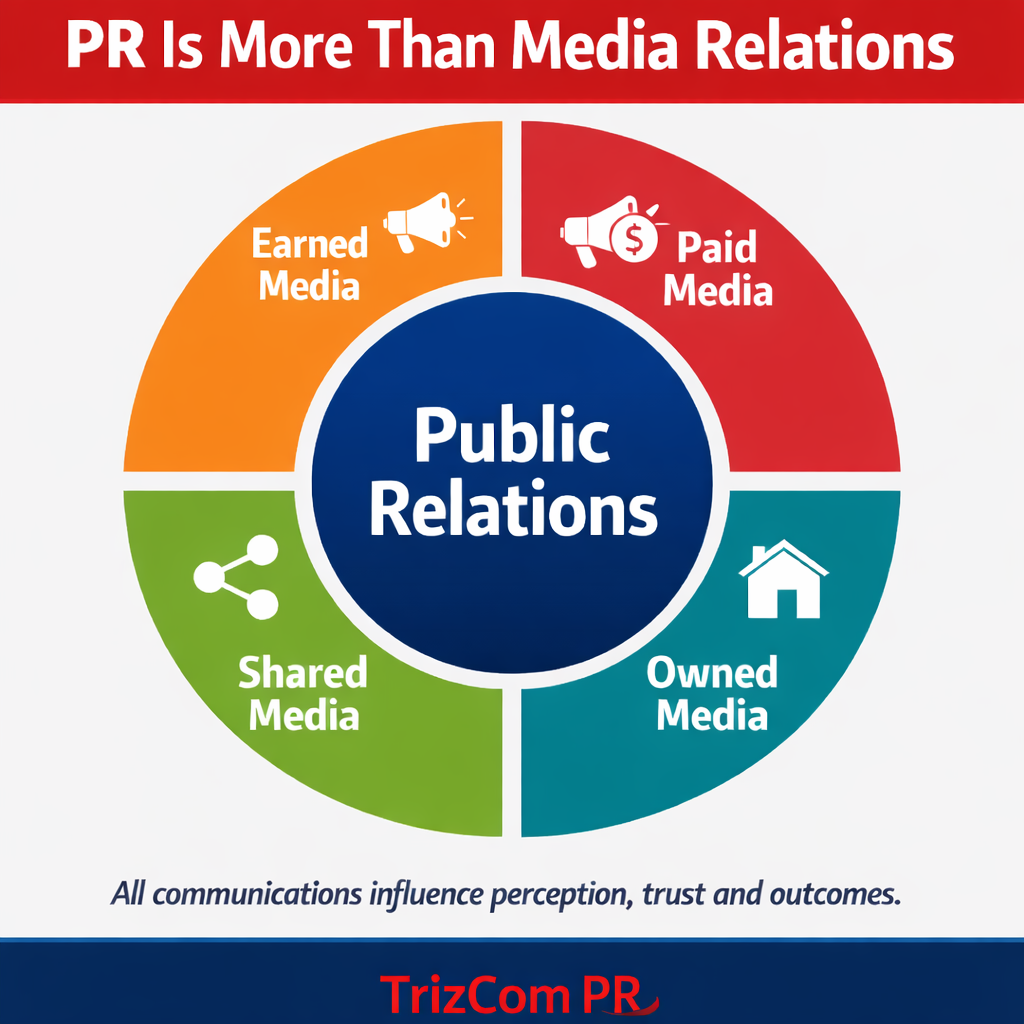
Another reason this question persists is that PR is often reduced to media relations alone. Many people, including some PR firms, still equate PR with earned media coverage. In reality, PR encompasses all organizational communications, including earned, paid, shared and owned media working together.
PR today supports revenue growth, recruiting, investor confidence and buyer trust across every one of those channels. It also shapes how brands appear in AI-generated answers before someone ever visits a website. Measurement must reflect the full scope of communication, not just headlines and clips.
When KPIs are chosen without a clear business goal or without accounting for the full PR ecosystem, reporting becomes activity-based rather than outcome-based.
Why Must PR KPIs Be Tied to Business Goals?
PR measurement only works when it starts with a business objective.
Before selecting KPIs, a strong PR firm should understand what success means for the organization. That definition changes depending on whether the priority is revenue growth, lead generation, employee recruitment, market credibility or reputation protection.
Examples of business-aligned PR goals include:
Supporting sales by increasing qualified inbound demand
Improving recruiting by elevating employer trust
Building credibility during expansion or leadership change
Strengthening authority in competitive or regulated markets
PR KPIs should answer one question.
Did this effort move the business closer to its goal?
Vanity metrics like impressions and reach rarely answer that question. Exposure alone does not generate revenue, attract talent or build trust.
Why PR Measurement Starts With a Communications Plan
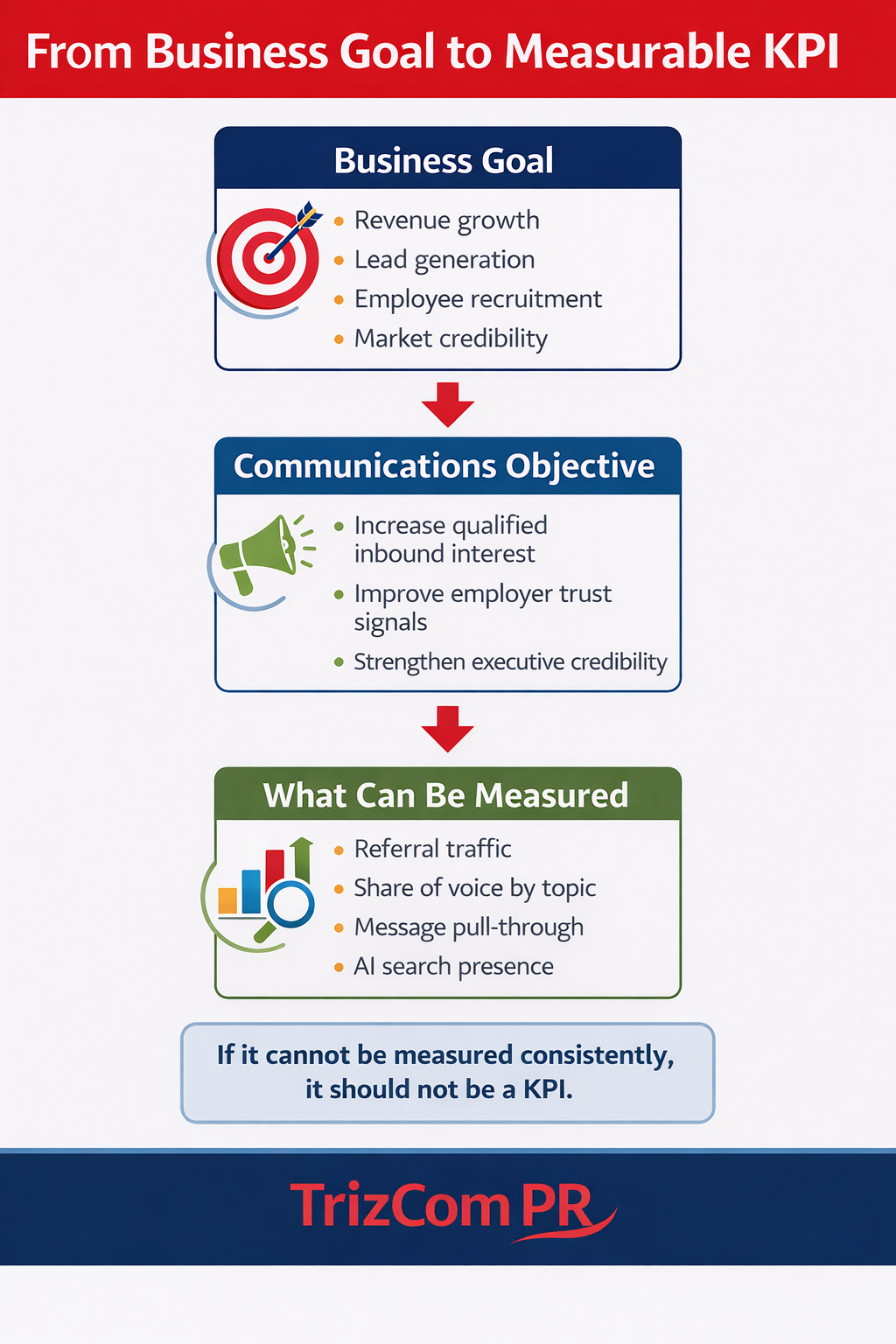
Another reason PR measurement breaks down is straightforward. Many organizations skip the communications plan.
A communications plan forces clarity. It defines the goal, the objective and the measurement before activity begins. Without it, KPIs are often chosen after the fact to justify work already completed.
The sequence matters:
Goal – What business outcome are we supporting?
Objective – What needs to change to support that outcome?
Measurement – What can we realistically and consistently measure?
This is where many brands struggle. Measurement only works when it is tied to something observable and repeatable.
Awareness is a common example. Awareness is often cited as a goal, but without a baseline and follow-up study, it is difficult to measure accurately. Before-and-after brand studies can be effective, but they are time-intensive and costly. When those resources are not available, awareness becomes an abstract concept rather than a measurable objective.
That does not make awareness unimportant. It means the measurement approach must match the reality of budget, timeline and tools.
Strong PR firms help clients choose objectives that can actually be measured, rather than defaulting to goals that sound good but fall apart in reporting.
Are Impressions and Reach Enough to Measure PR?
Impressions and reach are not enough to measure PR success.
They show how far a message traveled, not whether it influenced decisions tied to growth or hiring. Impressions are rarely connected to revenue, lead quality or recruitment outcomes.
They are often used as a proxy for awareness when no baseline exists, which is why they should be treated cautiously. Used carefully, they provide context. Used alone, they obscure impact.
How Do Strong PR Firms Actually Measure Success?
Strong PR firms measure success across multiple categories, each tied back to a business goal. Together, these categories explain visibility, credibility, demand and influence.
Measurement works best when KPIs are selected during planning, not retrofitted after execution.
How Is Visibility and Authority Measured?
Visibility and authority measurement focuses on where a brand appears and whether those placements support business outcomes.
Key KPIs include:
Coverage in tier-one and industry media
Share of voice among defined competitors
Authority and relevance of earned backlinks
AI search visibility, including how often and how accurately the brand appears in AI-generated answers for priority topics
Visibility matters when it influences buyers, recruits or partners. Placement quality and competitive position matter more than volume.
How Is Message Accuracy and Trust Evaluated?
Message accuracy measurement assesses whether the brand’s story is being told correctly and consistently.
Key KPIs include:
Message pull-through
Spokesperson quote usage
Sentiment trends over time
Trust supports revenue, recruiting and long-term growth. PR success includes maintaining clarity during moments that shape perception.
PRO TIP
Media training supports message discipline when questions get sharp and timelines get tight
How Does PR Influence Audience Behavior and Demand?
PR influences consideration, which is why audience behavior is a business-aligned metric.
Relevant KPIs include:
Referral traffic from earned media
Time on site from PR-driven visits
Assisted conversions and lead quality indicators
These metrics show whether PR attracts the right audience and supports demand generation over time.
PRO TIP
This is where PR can support organic demand by earning the right clicks from the right places.
How Is AI Search and Generative Visibility Measured?
AI search visibility measurement reflects how brands appear before a click happens.
Buyers increasingly rely on AI-generated summaries to form opinions. PR shapes those answers through earned credibility and authoritative content.
Key KPIs include:
Brand presence in AI-generated responses
Citation of executives and original content
Topic authority across AI and traditional search
AI visibility matters because it influences buying decisions, recruiting perceptions and stakeholder trust early in the journey.
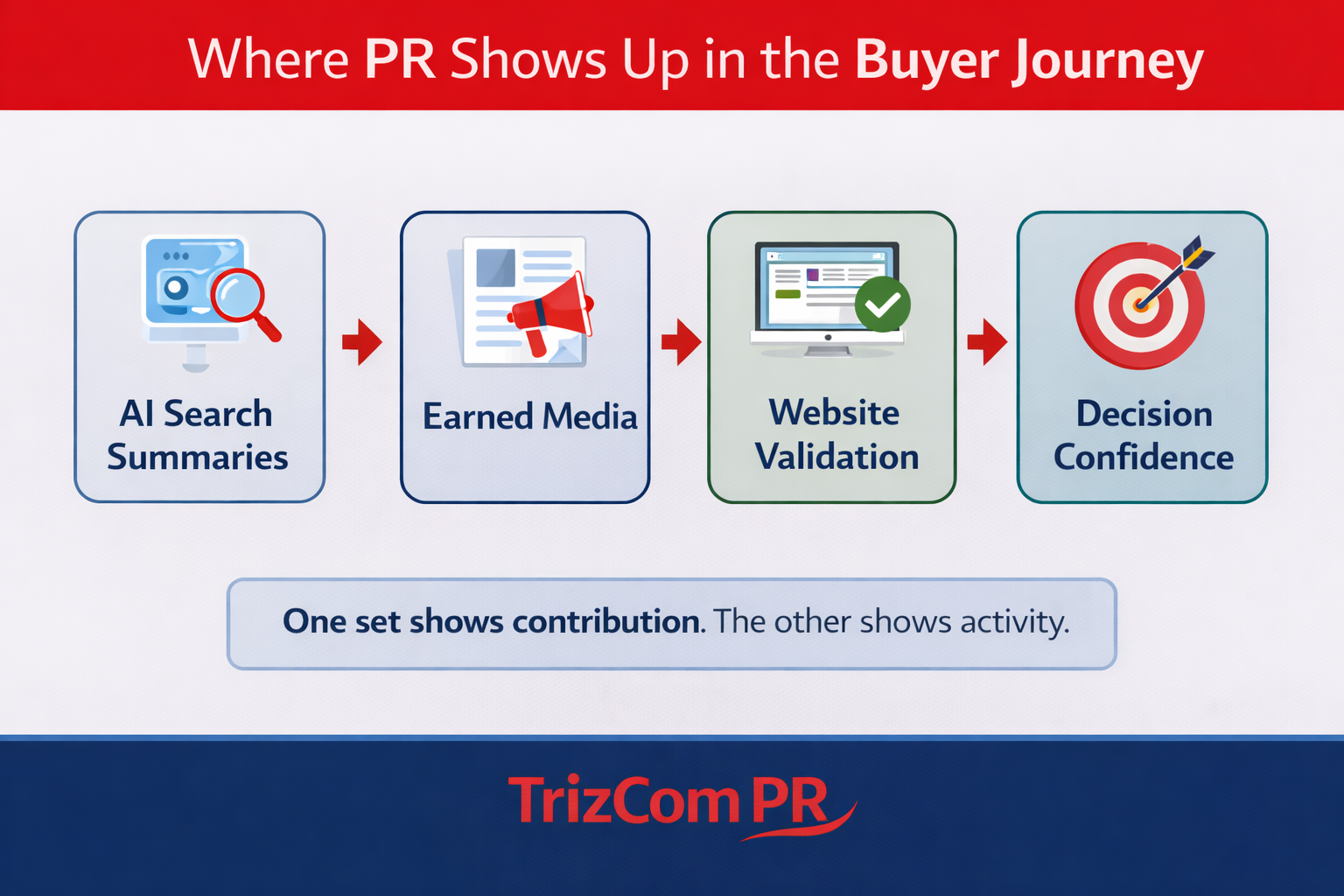
What Do Business-Aligned KPIs Look Like Compared to Vanity Metrics?
| Stronger measurement signals | Weaker measurement signals |
|---|---|
| Share of voice by topic | Impressions reported alone | Referral traffic tied to specific placements | Clip counts with no interpretation |
| Message consistency and sentiment trends | Awareness claims without benchmarks | Search and AI visibility lift | Vanity engagement metrics |
| Lead and recruiting influence over time | Website visitors without conversions |
Business-aligned KPIs show contribution. Vanity metrics show activity.
What Questions Should I Ask a PR Firm About Measurement?
Instead of asking for a list of KPIs, ask how success connects to business priorities.
Questions worth asking include:
How do you define success for this engagement?
Which KPIs matter most in the first 90 days?
Which metrics tie directly to revenue, recruiting or growth goals?
What can you influence and what can you not?
How do you determine what is realistically measurable based on our goals and resources?
How do you adjust strategy when results change?
Clear answers reflect strategic experience. Vague answers signal risk.
Ready to Ask Better Questions About PR Measurement?
If you are evaluating a PR firm or reassessing how success is measured today, clarity matters. The right KPIs should reflect growth, trust, demand and how decisions now start across search and AI platforms.
TrizCom PR helps organizations define meaningful success metrics before campaigns launch, not after reports are delivered.
Request a PR Measurement and Visibility Assessment to understand which KPIs matter most for your business and how to track them with confidence.
Frequently Asked Questions About PR Measurement
What KPIs does TrizCom PR focus on most?
When asking what KPIs TrizCom PR focuses on most, the real answer is that it depends on your business goals. TrizCom PR starts by clarifying what success needs to support, whether that is revenue, lead generation, employee recruitment, investor confidence or reputation protection. From there, we choose KPIs that can be measured consistently over time. That said, a few metrics come up often across engagements, including share of voice for priority topics, message pull-through, website conversions, referral traffic from earned placements and AI search presence to see how your brand appears in generative answers.
Does TrizCom PR still track impressions?
Yes, TrizCom PR tracks impressions as context. Impressions help explain distribution, but TrizCom PR evaluates success using metrics tied to influence and business outcomes.
How does TrizCom PR measure message accuracy?
Message accuracy at TrizCom PR is measured by tracking how consistently key messages and quotes appear across coverage. This helps clients understand how their story supports trust and credibility.
Can PR results be tied to revenue?
PR results are rarely tied to last-click revenue. At TrizCom PR, success is measured through assisted influence that supports sales cycles, lead quality and long-term growth.
How long does it take to see measurable PR results?
Most clients see directional PR indicators within 60 to 90 days. TrizCom PR focuses on trends tied to business goals rather than instant outcomes.
Does TrizCom PR measure AI search visibility?
Yes, TrizCom PR measures how brands appear in AI-generated answers and whether executives and content are cited accurately, which supports early-stage decision-making.
Is sentiment still a useful PR metric?
Sentiment is useful when tracked over time. TrizCom PR looks for patterns that reflect shifts in trust and credibility rather than one-time scores.
How does TrizCom PR report PR performance?
PR performance at TrizCom PR is reported with interpretation. Reports explain what changed, why it matters for the business and what adjustments follow.
Can KPIs change during a PR engagement?
Yes, KPIs should evolve as business priorities shift. TrizCom PR revisits measurement to stay aligned with growth and recruiting goals.
What makes PR measurement effective?
PR measurement is effective when it is planned in advance, tied to real business outcomes and based on metrics that can actually be measured over time. TrizCom PR believes metrics should support clarity, confidence and informed decisions.
PR Metrics That Matter
Last quarter I sat with a CEO who proudly told me their team earned 35 million impressions on a product launch. Big number. I asked a simple follow up. What did those impressions do for the business? Silence.
That is the trap with vanity. Numbers that look impressive on a slide can disconnect from outcomes. In public relations, where numbers can be dazzling and deceptive, it is easy to get lost in the sparkle. Strong leaders do not.
What are vanity PR metrics?
Vanity metrics are the stats that look good without proving success. Impressions. Raw follower counts. Likes. These inflate visibility but rarely show if anyone cared, trusted or acted.
They are not meaningless, but they are not enough. You would not judge your sales team only on doors knocked. You would ask how many opened, how many conversations happened and how many deals closed. PR deserves the same rigor.
Case in point. Your team lands a story on Forbes.com. Cision lists Forbes with an audience of 16,273,661. That is a platform number, not your readership. Treating 16,273,661 as reads is misleading, yet many reports still drop that number into reach. Big numbers can start a conversation. Actionable numbers close it.
What are actionable PR metrics?
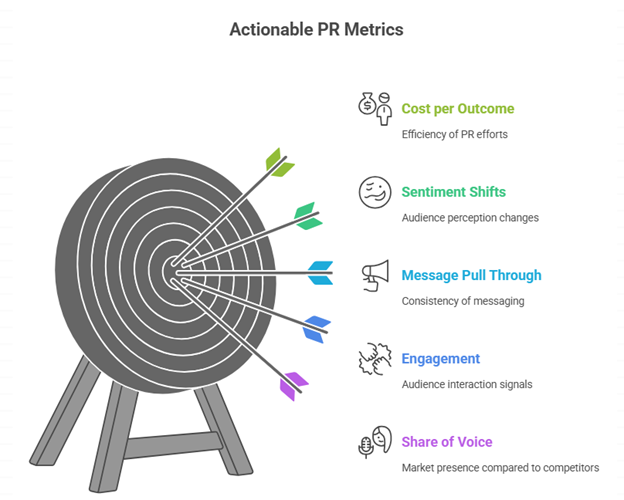
Actionable PR metrics show whether communications move people toward a decision that matters to the business. A few to anchor your dashboard:
Share of voice vs named competitors
Quality and relevance of backlinks from earned coverage
Referral traffic from specific placements
Engagement that signals intent, such as saves, comments, shares, replies
Conversions tied to PR touchpoints, such as demo requests, email signups, store visits
Growth in branded and category search
Presence in AI search results for priority queries
Message pull through in coverage and interviews
Sentiment shifts among priority audiences
Cost per outcome, such as cost per qualified media mention or cost per referral lead
These are the numbers that help a CMO decide where to place the next dollar. They help a CEO see how communications contribute to revenue and reputation.
Map PR metrics to the customer journey
PR works across the full funnel. Your metrics should too.
Awareness
Share of voice, unique reach of earned coverage, category search lift, branded search lift, new users from referral traffic
Consideration
Time on PR landing pages, return visits from placements, content downloads, email growth from PR content, analyst briefing requests
Decision
Sales-qualified leads with PR as first or assist touch, coupon redemptions tied to PR codes, foot traffic tied to local coverage, store locator starts
Loyalty and advocacy
Repeat purchase tied to customers sourced from PR, reviews volume and rating after PR bursts, UGC volume, owned community growth
This is how PR Metrics stop being a scoreboard and start being a steering wheel.

Tie metrics to the PESO model
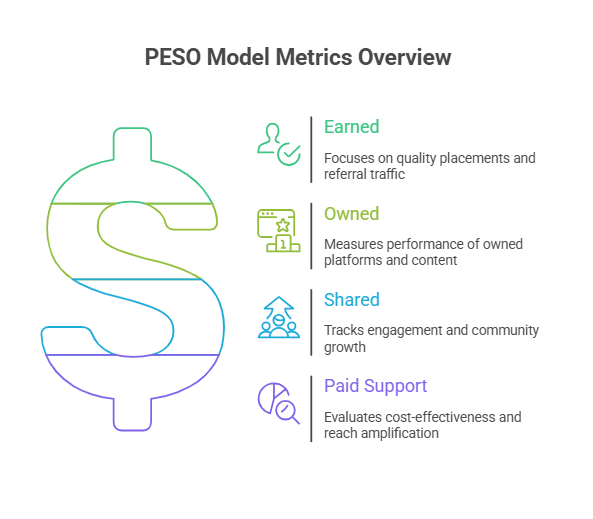
Your plan likely blends paid, earned, shared and owned. Measure each channel on what it does best, then show how the pieces reinforce each other.
Earned
Placement quality, domain authority of outlets, backlink quality, message pull through, referral traffic, conversions from earned pages
Owned
PR hub performance, newsroom traffic, average time on page, scroll depth, conversions from bylines and explainers
Shared
Saves, shares, comments, click-through to owned content, community growth tied to PR moments
Paid support
Cost to amplify earned hits, incremental reach on target, lift in branded search when you boost coverage, assisted conversions
When you connect the dots across a fully integrated program, executives see how communications compounds.
Why the difference matters in the boardroom
Quick story from my desk. A franchise brand was spending heavily on influencers. The vanity report sparkled. Big reach. Pretty content. Many likes. We traced referral traffic and coupon redemptions. Almost no conversion. We shifted to fewer creators with buyer overlap and tighter briefs. Reach dropped by half. Sales inquiries quadrupled.
Boards do not need to see every click. They need clarity. Is PR driving outcomes that matter to this business? Actionable PR Metrics earn their place in that answer.
Why asking for tactics first misses the point
Too many new business calls start the same way. A brand leads with tactics. We want a press release. We want The New York Times. A press release and one media hit rarely make a significant impact.
When selecting a PR agency, start with your business goals, not a wish list of outlets. Lead with a real outcome. We need to grow holiday sales 15 percent year over year. Can you help? Now you will get strategy. That is why you hire a firm.
Think of it this way. You would not tell a cardiologist how to perform heart surgery. You would not instruct an attorney on contract law. You hire experts because they know how to solve the problem.
And when the CEO and board review the sales impact and PR is not present, the shiny headline loses its appeal.
Build a PR metrics framework you can defend
Here is a simple framework we use with executives who want confidence, not clutter.
Start with one business objective
State it in plain language with a number and a deadline. Example: Increase qualified pipeline from healthcare prospects by 20 percent this quarter.
Then we define two or three PR outcomes that influence that objective
Examples: Double meetings with healthcare trade media. Secure three analyst briefings that cite our product category. Earn ten backlinks from healthcare domains with domain authority over 60.
We pick a short set of leading and lagging indicators
Leading: analyst inquiries, inbound media requests, PR-driven traffic to healthcare landing pages
Lagging: demo requests from healthcare domains, proposal volume, closed-won with PR as first or assist touchWe instrument the journey
Use UTM links, dedicated landing pages, unique discount or RSVP codes, call tracking, QR codes at events, click-to-call in local listings. Remove guesswork.
Then we set thresholds for action
Decide what triggers a change. If the message pull-through drops below 60 percent, revise the brief. If referral traffic from earned is below 10 percent of total traffic, revisit the outlet mix.
We report with context
Replace wall-of-numbers reports with a one-page narrative. What we tried. What happened. What we are changing. One chart per stage is plenty.
Finally, we close the loop with sales and service
Confirm that PR-sourced leads progress faster or close at higher rates. Capture feedback on objections PR can address with content or executive visibility.
That is a framework a board can respect.
Practical examples of replacing vanity with value
A few common swaps you can make this quarter.
Instead of total impressions
Track unique reach to priority audiences and the percent of coverage with message pull-throughInstead of follower counts
Track saves, replies and shares on posts tied to PR stories, plus click-through to owned contentInstead of raw clip counts
Track outlet quality, domain authority, backlink presence and referral traffic from those clipsInstead of made-up AEV (advertising value equivalency)
Track cost to replicate outcomes with paid media, plus cost per qualified outcome, such as cost per referral leadInstead of a single viral moment
Track compounding effects such as search lift, brand mentions and secondary pickups two to four weeks after the hit
The role of AI and PR metrics
Executives ask about AI search. It belongs in your PR Metrics mix. Treat it like a new channel of discovery.
Track presence in AI overviews for your priority queries
Log cited sources when your brand appears
Expand your media plan to include credible sources AI often cites in your niche
Compare shifts in branded search and direct traffic after AI mentions
Watch your owned content quality. Clear headlines, strong subheads, schema, expert bios, citations
AI does not replace PR. It rewards credible coverage and clear content.
Avoid the most common measurement mistakes
A short list we often see.
Counting potential audience as readership
Platform audience is not people who read your story.
Cherry picking only the good clips
Executives want the full picture. Include neutral or negative coverage with a plan to address it.
Treating AEV as a monetary north star
AEV is a flawed metric and ignores quality, message pull-through and behavior. Please retire this metric.
Reporting everything, learning nothing
Ten pages of charts do not equal insight. Pick a few numbers that will change what you do next month.
Never connecting to sales
If your CRM does not see PR, your board will not either. Build UTM discipline with sales and marketing ops.
Skipping baselines
Start every program with a baseline for share of voice, search, sentiment and referral traffic.
A five-part PR metrics dashboard that executives will read
Keep it to one page. No fluff.
Objective
One sentence with a number and a date
What we did
Three bullet points on actions that matter
What happened
Five to seven metrics split across awareness, consideration, decision, loyalty
What we learned
Two or three short insights tied to outcomes
What we are changing
One to three concrete changes for the next cycle
That is how PR Metrics earn trust. Not through volume, but through clarity and decisions.
What to ask your PR team
If you are reviewing reports this month, try these questions.
Which of these metrics tie directly to our business goals
Can you show me the pathway from this media placement to engagement or sales
What did we learn this quarter that changes how we approach the next one
How are we instrumenting PR, so attribution is not guesswork
What will you stop doing based on these results
If the answers circle back to look at how big the number is, you are in vanity land.
A short buyer’s guide to PR measurement
Choosing a new firm or evaluating the one you have
Ask for a sample dashboard that hides the client’s name but shows structure and clarity.
Request one case where the team cut a tactic based on data and what happened next.
Confirm the tool stack and how they combine data across tools to avoid double-counting.
Ask how they measure message pull-through and sentiment?
Push on sales alignment. How will they get PR data into your CRM or analytics?
Ask for definitions up front. What do they mean by reach, reads, engagement and conversion?
You will learn more from how a firm measures than from any reel of highlights.
So, what does this mean
PR is not about inflating numbers. It is about influence, credibility and outcomes. Impressions have their place, but executives should press for metrics that inform decisions and drive growth. Otherwise, you end up buying bigger fireworks with no light after they fade.
Trade vanity for value
At TrizCom PR, we cut through the fluff. Our reporting is not designed to pad a deck. It is built to answer the question every executive asks. What did this campaign do for the business? If you are tired of vanity and want clarity, accountability and outcomes you can take to the boardroom, let's talk.
Is PR Getting Harder Or Is Traditional Media Just Shrinking

Seventeen years ago our agency wore a simple badge of honor: we get you in the news or we keep you out of the news. Back then, media relations stood in for PR. A booking on the morning show felt like a trophy you could place on the conference room shelf. Reporters had defined beats, producers had time to listen, and a thoughtful pitch could still win the day.
Then the ground shifted. Newsrooms consolidated. Beats blended. Timelines tightened. Around 2015 my team and I took a hard look at results across clients and asked a basic question: are headlines alone shaping reputation and business outcomes the way they used to? The answer was no. Clips still mattered, but they were not the whole story.
We reframed our work around the full mix of channels where reputation now lives. Owned content started carrying more weight because it offered context and proof. Earned coverage added credibility when it pointed back to something substantive. Shared and paid helped people actually find the information. Picture a four-legged stool. Media relations is a leg worth protecting, but you do not want to sit on one leg and call it a chair.
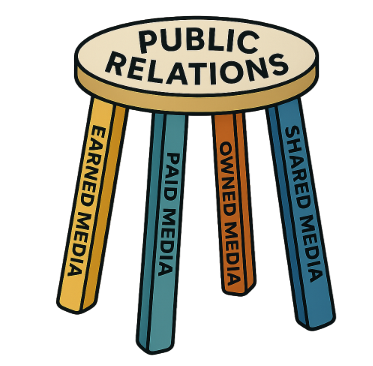
That shift did not make PR harder. It made it more honest about where trust is built. When people ask if PR is harder or if traditional media is shrinking, they are really asking whether the old playbook still explains how reputations are formed. It explains part of it. Not all of it.
What Public Relations Actually Means
Public relations is the discipline that builds and protects reputation so an organization can meet its goals. At its core, PR is about earning attention and credibility with the people who matter to your work. Media coverage is one way to do that. It is not the only way.
Think of PR as a system, not a stunt. It shapes how your story is told across four connected spaces:
Owned: what you publish yourself, from your website to your newsletters. This is where clarity, proof and consistency live.
Earned: independent coverage you do not pay for. It tests whether your story stands on its own.
Shared: conversations and distribution on platforms you share with others (social media), like LinkedIn and industry communities.
Paid: placements you buy that are labeled as such, useful when speed or targeting matters.
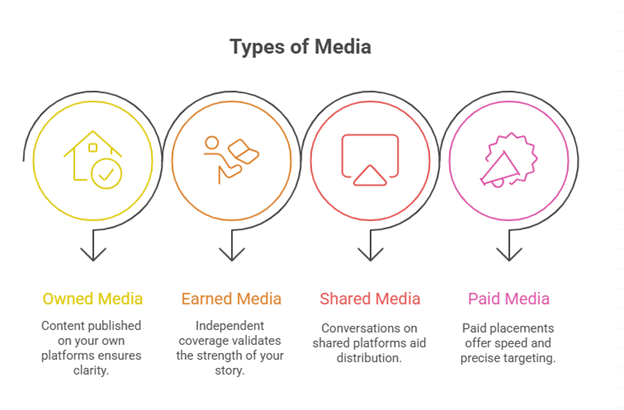
Why does this definition matter in a conversation about shrinking traditional media? Because when people equate PR with press hits, they miss how reputation now travels. When your content is clear, credible and well structured, AI assistants pull it into answers, putting your brand in front of buyers, reporters and regulators before they ever visit your site. A clear explainer on your site can inform a journalist, a buyer and a regulator. A well reported article can point readers to your primary sources. A thoughtful podcast can put a decision maker’s voice in the room during a stakeholder meeting. The pieces reinforce each other.
So when you hear that PR feels harder, it often means the work is being judged by a narrow slice of what PR actually is. When PR is understood as a system that earns trust across owned, earned, shared and paid, the landscape makes more sense. Traditional media has less inventory than it did and PR has a broader canvas.
What Media Relations Means
Media relations is the part of PR that earns independent coverage from newsrooms. At its best, it is a relationship between a source and a journalist built on accuracy, speed and relevance to the audience. The center of gravity is the newsroom’s readers or viewers, not the brand. That is why a good story survives edits and stands on its own.
What it is:
Building useful, ethical relationships with reporters, editors and producers
Offering clear facts, timely access and a point of view that serves the public interest
Understanding how a newsroom works so your pitch fits the format and the moment
What it is not:
Paying for placement
Affiliate listicles presented as neutral reporting
Spray and pray emails that ignore beats or basic accuracy
Newsrooms changed, so media relations changed with them. Many reporters cover multiple beats in a single week. Timelines are shorter. Formats vary from quick hits to explainers to long features. The constant is simple. If the story helps the audience, it has a chance. If it reads like an ad, it does not.
What Traditional Media Includes
Traditional media covers broadcast television, radio, print newspapers and magazines and wire services. These outlets still shape public conversation. They also operate with fewer people than a decade ago. Consolidation reduced desks. Freelancers fill gaps. A metro section that once had five beat reporters may now have two who split duties across city hall, business and public safety.
A few realities help explain the landscape:
Lead times differ. Monthly magazines plan far ahead while local TV can turn a segment in hours.
Geography matters. Regional coverage narrowed in some markets as national desks grew louder.
Formats blend. A single outlet may publish a quick brief, a service explainer and a weekend feature on the same topic.
When people say traditional media is shrinking, they are often reacting to staffing charts and fewer page inches. The audience did not vanish. It moved across platforms and expects clarity, proof and context no matter where it reads or watches. Traditional outlets still set agendas. They do it with tighter teams and tougher choices about what earns space.
The Wall That Once Separated Editorial And Advertorial
There used to be a high wall between the newsroom and the sales floor. That wall still exists, but it has gates. Revenue models changed and with them the mix of what appears on the page.
Today you will see three distinct buckets side by side:
True editorial
Independently reported stories shaped by editors. No payment for placement. Sources are chosen for relevance and credibility.Sponsored content
Pieces paid for by a brand and labeled as such. The outlet controls the frame, the brand funds the space.Advertorial and affiliate content
Brand authored or brand approved articles placed for a fee, often tied to commerce links. Labels include sponsored, partner content and paid post.

Labels matter because they set expectations. A reader approaches a reported investigation differently from a paid product roundup. A producer reviews a paid segment differently from a news hit. Trust grows when the line is clear.
A quick example makes this concrete. You search for Best accounting apps. One result is a reported review from a business desk. Another is a list built by a commerce team that earns a commission if you click. Both can be useful. They are not the same thing. Knowing the difference helps you read the landscape without confusion.
The Expanded Media Map
The map is bigger than it looks from a TV studio. Alongside newspapers and broadcast you will find trade journals, industry podcasts, independent newsletters, community outlets and creator-leading channels with loyal audiences. Many of these publish faster, go deeper on niche topics and give subject matter experts more room to explain.
A few examples that sit next to traditional press, not beneath it:
Trade journals that track regulation, procurement cycles and product shifts week by week
Podcasts where decision makers speak in full sentences instead of sound bites
Newsletters that curate a beat for a focused readership in a specific region or sector
Creator channels that test ideas with communities and surface early signals
Brand newsrooms that publish primary data, timelines and FAQs for anyone to reference

Standards vary, but credibility does not belong to one format. A well reported trade feature can shape a market. A respected newsletter can move a conversation. Traditional outlets often cite these sources and the cycle runs both ways.
Why PR Feels Harder Even When Options Grew
Choice can feel like chaos. There are more places to tell a story, more formats to consider and less attention to go around. That creates pressure. It also raises the bar. Audiences expect clarity and proof. Editors and hosts expect a point of view that teaches something new. The days of a vague pitch sailing through are over.
A few forces drive the feeling:
Shrinking desks, rising volume
Fewer full time reporters and more inbound email mean good ideas get buried unless they are sharp and relevantBlended labels
Editorial, sponsored and affiliate content now live side by side which confuses readers and leaders who grew up with a harder lineFragmented attention
People graze across TV, podcasts, newsletters and feeds, so repetition without substance fades quicklyOld scorecards
If success is still defined as clip count alone, today’s landscape will feel like loss even when reputation is improving
What looks like “harder” is often “different.” Traditional media has less inventory. The broader ecosystem asks for clearer ideas, real examples and transparency about what is paid and what is earned. Once you view PR through that lens, the trends line up with what you see in your own feeds every day.
How Measurement Thinking Changed
For years the scoreboard was impressions, reach and ad value. Those numbers were easy to collect and looked big on a slide. They were also blunt. A mention did not always equal attention and attention did not always equal trust.
The questions inside boardrooms shifted. Did the story change what people understand. Did it lower perceived risk. Did it move someone from curiosity to consideration. Evidence now looks different across the mix:
After a major article, more people look for you by name rather than generic terms
Coverage sends readers to sources that explain your product or policy, not just the home page
Interviews show up in sales conversations because a buyer quotes them back
Analysts, trade editors or community leaders start referencing your data as a source of record
Think of the old metrics as a headcount outside a theater. Useful, but not the same as knowing who took a seat, watched the show and told a friend it was worth the ticket. The point is not to worship a new number. It is to match proof to how reputation is actually formed.
Common Misconceptions
PR is only about headlines
Headlines help, but reputation is shaped across owned, earned, shared and paid working together (integrated PR).Sponsored equals fake
Paid pieces can inform when labeled clearly and grounded in facts. They are different from independent reporting, not automatically lesser.Traditional press is gone
It is smaller and more selective. It still sets agendas and defines stakes, especially in moments of risk.Owned media is just marketing
Owned sources often supply the context reporters, partners and regulators need. When they are clear and factual, they raise the quality of every other channel.More clips mean more impact
Ten thin mentions rarely beat one well reported feature that people read, save and cite.Good stories sell themselves
In lean newsrooms even strong ideas need clarity, access to decision makers and verifiable proof.
Clearing out these myths makes the landscape less confusing. What looks like a contradiction becomes a simple map of where trust is built and how it travels.
A Brief Composite Example
A regional brand leaned hard on morning show segments for years. Producers liked the founder, segments were lively and the clip reel looked impressive. Then the bookings slowed. New producers rotated in. Beats changed. The same pitch did not land.
Inside the company, leaders felt like PR had gotten harder. In reality, the landscape around them had shifted. Reporters needed clearer proof and tighter angles. Readers wanted context they could trust. Over the next quarter, the brand became a better source. They published plain language explanations of their space, offered a customer story with verifiable details and made senior voices available for comment. Traditional coverage returned, now with deeper reporting and a link to something useful. The conversation moved from clever segment to credible reference point.
So, What Does This Mean
Traditional media is smaller. PR is broader. Media relations still matters, but it sits inside a larger ecosystem where trust is built across formats and channels. The work feels different because the scoreboard and the routes into a story changed. Clear ideas, transparent labels and credible proof travel farther than volume alone. When leaders see PR as the system that connects those pieces, the question shifts from is PR getting harder to are we telling a story worth someone’s time.
Work with TrizCom PR
If this raised more questions than it answered, that is a good sign. Let’s talk about your reality, your goals and how PR can support both.
Email Jo@TrizCom.com
Call 214-242-9282
Share one business goal and one challenge. I will give you a clear read on where earned, shared, paid and owned can support outcomes your board cares about. No jargon. Straight talk and next steps.
An Integrated Marketing Campaign That Actually Worked

Brands are in a constant state of competition—not just for market share but for attention, trust and loyalty. That competition isn’t being fought in a single ad, platform or content type. It’s happening across every touchpoint. And the brands that win? They’re the ones that masterfully connect the dots across all those touchpoints through unified, cohesive and impactful storytelling.
That’s the power of integrated marketing campaigns. These campaigns align message, tone, visuals and timing across all marketing channels—owned, earned, paid and shared media—to deliver an intentional, memorable and trust-building brand experience.
What was once considered a “best practice” is now a business imperative.
Why Integration Now?
The rise of multi channel engagement and the shift in how consumers research and interact with brands has raised expectations. Today’s customers don’t see your media channels as silos—they see one brand. And if your touchpoints feel inconsistent, confusing or out of sync, they lose interest.
Integration solves that.
An integrated marketing strategy gives your brand one cohesive voice across multiple channels, one unified narrative across departments and one shared set of metrics that tracks performance in a way that truly supports business outcomes.
This is where traditional marketing falls short. It’s not enough to “be on social” or “send a newsletter.” Success lies in the ability to orchestrate all your efforts in sync—something only integrated marketing campaigns can deliver.
What Is an Integrated marketing Campaign?
At its core, an integrated marketing campaign is a unified effort to communicate a brand message across all relevant platforms in a way that aligns with your brand’s visual identity, voice, values and strategic goals.
These campaigns incorporate:
Email marketing that matches what’s being said on social media
Social media posts that support your latest paid media push
Owned content (like blogs, videos or whitepapers) that’s reflected in your media relations efforts
Earned media that links back to high-value landing pages or downloadable resources
Paid campaigns that amplify high-performing content from all channels
When all those tactics are executed around a common narrative, the result is consistent branding and stronger customer connections.
Why Consistent Messaging Matters More Than Ever
The average person encounters up to 10,000 brand messages a day. That might sound like an exaggeration—until you consider every ad, label, headline, social feed, push notification, podcast pre-roll and email subject line competing for attention.
In that environment, only one thing cuts through: consistent messaging that creates mental availability.
When your brand message is aligned across all marketing channels, customers are more likely to recognize, remember and trust your brand. You stop being noise—and start being the signal they’re looking for.
Multi Channel vs. Omnichannel vs. Integrated: What’s the Difference?
Let’s clear up a common confusion:
Multi channel marketing means using more than one channel (e.g., you have a website, an email list and social media accounts).
Omnichannel marketing focuses on delivering a seamless experience across all platforms—typically in ecommerce environments.
Integrated marketing communication connects the dots between strategy, messaging and execution across all of these touchpoints.
A multi channel plan says, “We’re showing up.”
An omnichannel plan says, “We’re making it seamless.”
An integrated marketing communication plan says, “We’re making it meaningful, measurable and strategic.”
How to Build an Integrated marketing Campaign
Here’s a step-by-step guide to building your next integrated marketing campaign:
1. Define the Core Message
Before you launch a campaign, get crystal clear on the single most important thing you want your audience to walk away with. This message should serve as the north star for all content, creative and communications.
Ask yourself:
What’s the one idea that should come across in every interaction?
Is this message aligned with our brand’s voice, tone and values?
Does it support both our short-term campaign goal and long-term brand equity?
For example, if you're launching a new service, your core message might be:
“[Product] empowers small businesses to scale with less stress.”
Everything else—blogs, emails, ads, videos—should echo and reinforce this central promise.
Pro Tip: Use this message as the starting point in all briefing documents and creative kickoffs.
2. Align Around a Big Idea
The “big idea” is not the slogan. It’s the emotional or conceptual framework that makes your campaign memorable and relevant. It’s the thematic hook that ties everything together.
Your big idea should:
Tap into an audience belief, behavior or cultural moment
Elevate your product or message beyond functional benefits
Spark internal alignment among your team
Example: For a health brand launching a wellness app, the big idea might be:
“Health isn’t a destination—it’s a relationship.”
This positioning gives your team narrative direction and storytelling flexibility across multiple channels, while making sure everyone is rowing in the same direction.
3. Map the PESO Model

Every campaign should intentionally use the four types of media: Paid, Earned, Shared and Owned (Also known as The PESO Model©, developed by Gini Dietrich) . This framework allows you to diversify your reach and multiply your message impact.
➤ Paid Media
Ads, sponsored content, boosted posts. Use this to expand reach quickly and target specific audience segments.
➤ Earned Media
PR placements, podcast interviews, analyst endorsements. Use this for third-party validation and credibility.
➤ Shared Media
Organic social content, UGC, influencer posts. Use this to engage your audience and encourage amplification.
➤ Owned Media
Blog posts, landing pages, newsletters, webinars. Use this to go deeper and drive conversion.
Map each tactic to your campaign objectives and identify how each will support the others. For example, a blog post (owned) can be used in a newsletter (owned), pitched to media (earned), boosted on LinkedIn (paid) and reshared on Facebook (shared).
4. Develop a Content Engine
You don’t need dozens of ideas—you need one great piece of content that feeds all others. That’s the power of anchor content.
Start with a high-value, high-effort asset like:
A data-backed case study
A white paper or research report
A branded video series
A webinar or expert interview
Then repurpose it across formats:
Turn stats into social infographics
Break quotes into shareable quote cards
Repurpose the narrative into blog posts, emails and PR pitches
Extract soundbites for short-form video or podcast clips
This approach keeps your campaign consistent, efficient and high-performing across multiple channels.
Pro Tip: Build a campaign asset matrix to track which content types are needed for each channel, along with production timelines.
5. Optimize for Each Channel
While your message should remain consistent, your execution should be customized. Each platform speaks a different language—your campaign should be fluent in all of them.
For example:
Your Instagram post might focus on visual storytelling with short captions.
Your LinkedIn post may emphasize thought leadership with a longer, insight-driven format.
Your email subject line should deliver value and urgency quickly.
Your press release should lead with the news angle and include compelling data.
The mistake many brands make is copying and pasting across platforms. But integrated doesn't mean identical. It means tailored storytelling that feels native, not forced.
Pro Tip: Use a brand voice and tone guide to ensure cohesion, even when formats shift.
6. Automate Where It Matters
Integration isn’t just about messaging—it’s also about operations. Using the right tools can streamline workflow, reduce human error and keep your campaign cadence consistent.
Key areas to automate:
Email marketing sequences and drip campaigns
Social media scheduling with tools like Buffer, Later or Sprout Social
Lead nurturing and segmentation in your CRM
Internal communications via Slack workflows or weekly updates
Task tracking with platforms like Asana, Trello or Monday.com
Just make sure automation never replaces human oversight. It should support strategic thinking, not stifle it.
Pro Tip: Create a master campaign calendar that integrates tasks, deadlines, approvals and launch dates in one place for cross-functional transparency.
7. Measure What Matters
Every campaign should begin with clear KPIs—and end with a full performance analysis. But don’t just track surface-level metrics. Dig deeper.
Here’s how to measure each PESO component:
PESO Element Sample KPIs
Paid CTR, CPC, ROAS, conversion rate
Earned Media impressions, brand mentions, backlinks, share of voice
Shared Engagement rate, shares, comments, UGC volume
Owned Page views, time on site, lead form completions, email open/click rates
Beyond the numbers, track qualitative signals too:
Are influencers tagging your campaign organically?
Are journalists referencing your content in coverage?
Are prospects mentioning the campaign in sales calls?
And most importantly: how did the campaign impact business outcomes?
Pro Tip: Use advanced analytics and reporting tools to create a unified dashboard that combines channel-specific data into one cohesive performance story.
The Brand Experience Starts (and Ends) With Integration
A brand experience is the sum total of every interaction someone has with your company. If that experience feels fragmented, trust erodes. If it’s seamless, your brand becomes memorable and trustworthy.
This matters whether you’re a startup or an enterprise-level operation. TrizCom PR’s integrated approach helps brands of all sizes find the structure, support and synergy they need.

Case Study Think Pink, Plan Big: How Barbie’s Marketing Team Delivered a Seamless Brand Experience
When Barbie’s marketing team launched what became one of the most successful integrated marketing campaigns of the decade to support the 2023 film release, they didn’t rely solely on trailers or paid advertising. They executed an integrated marketing campaign that was so comprehensive, it turned a single movie into a full-blown cultural moment.
The brilliance of the Barbie campaign wasn’t just in its creativity—it was in its consistency across multiple channels. Whether you were scrolling TikTok, flipping through a magazine, walking through a mall, watching morning TV or shopping online, you saw one unifying brand message: Barbie is for everyone and she’s back in a big way.
Here’s what made their campaign a textbook example of effective integrated marketing communications in action:
PR and Media Relations: Warner Bros. secured high-profile editorial coverage in Vogue, TIME, The New York Times and every major entertainment outlet. The media narrative focused not only on the film but on the feminist themes, visual style and global anticipation—giving the campaign thought leadership weight and social value.
Influencer Collaborations: Social media creators across fashion, beauty, parenting and pop culture verticals posted Barbie-inspired content for weeks. These influencers were activated strategically across Instagram, YouTube, TikTok and even LinkedIn—creating a shared message from a diverse set of voices, all reinforcing the same brand tone.
Social Media & Shared Media: Barbie memes, countdowns, behind-the-scenes reels and viral trends (like “Barbenheimer”) flooded platforms. Branded filters, challenges and hashtags created billions of organic impressions—and not one felt off-brand. It was a seamless, pink-soaked takeover.
Owned Media: The Barbie website featured custom landing pages, themed merchandise drops, educational tie-ins and behind-the-scenes interviews—all designed to drive fan engagement and capture data. Email marketing and web experiences delivered personalized content while reflecting the same visual identity seen in theaters and on social.
Paid Media: Traditional and digital advertising reinforced every message, from airport takeovers to pre-roll ads, Spotify audio spots and programmatic campaigns across streaming platforms. But it never felt disconnected from the narrative seen in organic channels—it was additive, not disruptive.
Brand Partnerships: Perhaps most impressive was the sheer volume of co-branded partnerships—from Airbnb’s Barbie Dreamhouse to collaborations with Gap, Crocs, Xbox, Ruggable and more. Each brand activated its own audience through product placement, packaging and promotions—all wrapped in a recognizable, unified look and voice.
This campaign didn’t feel like dozens of teams doing different things. It felt like one brand telling one story in many different ways. That’s the hallmark of an integrated marketing campaign: consistent messaging, platform-specific execution and a unified strategy designed to amplify—not fragment—the experience.
The takeaway for marketers? True brand momentum happens when earned media, social media, paid ads, email marketing and content strategy are aligned—not just launched.
Barbie didn’t go viral by accident. It was by design. And that design was integrated.
Integration Is the New Standard
The next time you plan a launch, a push or even a press release—ask yourself: Are all my teams, platforms and audiences speaking the same language?
Because in today’s market, fragmented messaging isn't just unproductive—it's expensive.
But integrated marketing campaigns? They’re efficient, measurable and scalable.
And they’re what TrizCom PR does best.
Need help pulling your channels together into one high-performing narrative?
Let’s build your next integrated marketing campaign together. Give us a call.
Everyone has a story. Let TrizCom PR tell yours!

About the Author:
Jo Trizila – Founder & CEO of TrizCom PR
Jo Trizila is the founder and CEO of TrizCom PR, a leading Dallas-based public relations firm known for delivering strategic communications that drive business growth and enhance brand reputations as well as Pitch PR, a press release distribution agency. With over 25 years of experience in PR and marketing, Jo has helped countless organizations navigate complex communication challenges, ranging from crisis management to brand storytelling. Under her leadership, TrizCom PR has earned recognition for its results-driven approach, combining traditional and integrated digital strategies to deliver impactful, measurable outcomes for clients across various industries, including healthcare, technology and nonprofit sectors. Jo is passionate about helping businesses amplify their voices and connect with audiences meaningfully. Her hands-on approach and commitment to excellence have established TrizCom PR as a trusted partner for companies seeking to elevate their brand and achieve lasting success. Contact Jo at jo@TrizCom.com.
Why and How to Check Website Ranking for Marketing

This comprehensive guide explores how to check website ranking effectively, a crucial skill for online success. It covers the importance of rankings, free and paid tools for monitoring, and strategies for improvement. The article discusses key concepts like search volume, SERP features, and the differences between desktop and mobile rankings. It emphasizes the need for regular rank checking and continuous optimization. The guide provides step-by-step instructions on using ranking tools and offers tips for interpreting results. It also touches on future trends in SEO and mobile optimization. Overall, this resource equips readers with the knowledge to track, analyze, and improve their website's search engine visibility, ultimately driving more organic traffic and business growth.