Why Does PR Help My Brand Show Up in AI Search?

 
black woman in yellow sweater - How does public relations help companies appear in AI search results?

Public relations helps companies appear in AI search results by creating content and building credibility through mentions in authoritative third-party sources, such as news outlets, podcasts and trade publications. AI models rely on trusted external data to generate answers. They look beyond keywords and websites, instead prioritizing earned media, consistent messaging, and structured content they can process and cite. When AI PR is done well, it establishes your brand as a reliable source AI systems feel confident referencing.

We are now in the age of AI search, where generative AI search and AI search engines like Google's AI Overviews have transformed the landscape from traditional web search and blue links to AI-generated summaries and AI overviews. Instead of relying solely on traditional SEO tactics, brands must focus on building trust signals, credibility signals, and domain authority through strategic PR and media placements to influence AI engines and AI-powered search engines. Digital marketing and digital PR are now essential for building brand visibility and online visibility in the AI era.

It also starts with great, fresh content that answers questions. PR is communication at its core, which is why PR teams are well-positioned to write content that is clear, accurate and ready to be referenced across the web. Creating content is now crucial not only for human audiences and human readers, but also for AI platforms and AI discovery, ensuring your brand is included in AI-generated summaries and search answers.

For chief marketing officers and business owners, this shift changes how visibility is earned. Being discoverable now depends on what you publish about yourself and on what credible sources say about you. PR pros, PR firms, and PR agencies play a crucial role in establishing trust signals, credibility signals, and domain authority, which directly influence AI engines and AI-powered search engines. Unlike traditional SEO, link building, and paid ads, the current focus is on earning high value media placements, authoritative mentions, and securing brand mentions in respected publications to improve search rankings and brand authority. Reputation management and brand reputation are now central to influencing AI results, AI-generated summaries, and search answers in Google's AI Overviews and AI search results. To future-proof your brand's presence and stay visible in the AI search era, leverage owned media, specific expertise, and consistent PR efforts.

Why do AI search tools rely on public relations signals?

AI systems summarize information rather than display ranked links. To do that, they pull from sources they recognize as accurate and independent.

Those sources include:

PR places your brand inside those environments, which AI models treat as trusted training data. PR pros and PR agencies are skilled at securing authoritative mentions and media placements in respected publication, which AI engines and AI platforms use for AI discovery.

How does PR build trust and authority for AI systems?

AI models learn patterns. When your company appears repeatedly in respected outlets through interviews, quotes and features, the system begins to associate your brand with credibility.

PR builds trust by:

  • Securing consistent earned media mentions

  • Positioning executives as expert sources

  • Reinforcing the same message across multiple publications

  • Building trust signals and credibility signals that AI systems recognize as indicators of authority and trustworthiness

Over time, this teaches AI tools that your brand is a dependable authority within its category.

PR firms focus on reputation management and building domain authority and brand authority, which can improve your search rankings in AI-driven environments.

How does PR shape what AI says about your brand?

AI-generated summaries, AI Overviews, and Google's AI Overviews are influenced by the information already available across the web. If that information is inconsistent or incomplete, the output will be too.

PR shapes your brand narrative by:

  • Aligning messaging across earned and owned channels

  • Reinforcing accurate descriptions of your products and expertise

  • Securing brand mentions and authoritative mentions from reputable sources to ensure accurate search answers in AI outputs

  • Reducing the likelihood of outdated or misleading summaries

This consistency helps AI systems present your company clearly and accurately.

Why does earned media acts as training data for AI models?

Executive interviews, contributed articles, podcast appearances, and media placements in respected publications provide context AI systems value. These formats explain who you are, what you do and why it matters in plain language.

Earned content works as training data because it:

  • Comes from third-party AI already trusts

  • Includes real explanations instead of marketing copy

  • Offers quotable statements AI can reuse

  • Highlights your specific expertise in earned content, increasing its value for AI

This is one reason executive visibility outperforms brand-only content. Earning high value coverage in respected publications further increases your brand’s recognition and trustworthiness in AI-driven search.

How do press releases help with AI search visibility?

Press releases remain useful when they are written for clarity and structure rather than promotion, and can be distributed through owned media channels to ensure direct control over brand messaging.

Well-structured releases:

  • Follow predictable formats AI can parse

  • Reinforce consistent terminology

  • Serve as reference points for news coverage

  • Allow brands to create content that supports AI recognition

When press releases lead to earned coverage, they strengthen AI recognition even further. PR agencies can help maximize the impact of press releases by securing strategic placements and optimizing distribution for greater AI search visibility.

Why relevant mentions matter more than volume?

AI systems favor relevance over reach. A mention in the right trade publication often carries more weight than broad coverage in unrelated outlets.

PR drives relevant mentions by:

  • Targeting niche and industry-specific media

  • Securing analyst and expert commentary

  • Aligning placements with buyer search behavior

  • PR pros focusing on securing authoritative mentions and brand mentions in targeted outlets

This ensures your brand appears in the conversations AI prioritizes.

What PR strategies improve AI visibility most?

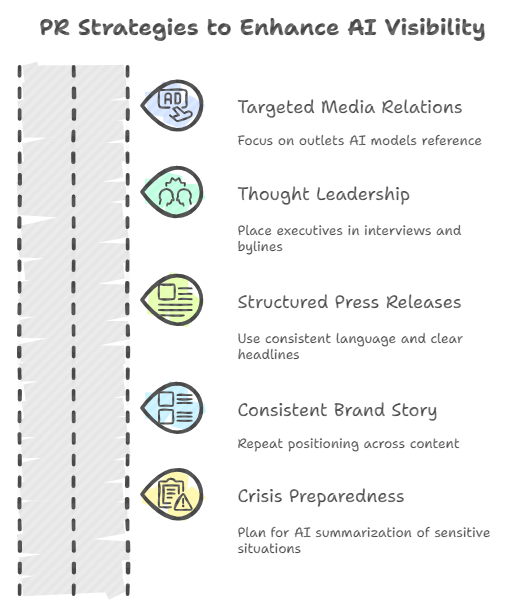
Targeted media relations

Focus on outlets AI models frequently reference, including major news organizations and respected industry publications. Digital PR strategies help future proof your brand in the AI search era by building a resilient digital presence that adapts to evolving AI search technologies.

Thought leadership

Place executives in interviews and bylines that explain category challenges and solutions in clear terms.

Structured press releases

Use consistent language, clear headlines and factual framing to support AI ingestion.

Consistent brand story

Repeat the same positioning across earned and owned content so AI systems recognize patterns.

Leverage link building and reputation management to support AI discovery and long-term visibility. Earning authoritative links and maintaining a positive reputation help AI systems identify your brand as trustworthy and relevant, increasing your chances of being surfaced in AI-driven search results.

Crisis preparedness

Plan for how AI might summarize sensitive situations and have processes in place to correct inaccuracies quickly.

CHART FOR PR STRATEGIES TO ENHANCE AI VISIBILITY

How Public Relations Drives AI Search Visibility

PR Strategy What It Does Why AI Systems Value It Impact on AI Search Visibility
Earned Media Placements Secures coverage in national, regional and trade publications Third-party validation signals credibility and independence Increases likelihood of brand mentions in AI-generated summaries
Executive Thought Leadership Positions executives in interviews, bylines and podcasts Human expertise signals strengthen authority patterns Improves brand attribution in AI answers
Consistent Messaging Across Channels Aligns language across earned and owned media AI models detect repetition and pattern consistency Reduces vague or conflicting AI summaries
Structured Press Releases Uses clear headlines, factual framing and consistent terminology Predictable structure makes content easier for AI to parse Strengthens recognition and terminology alignment
Targeted Industry Outreach Focuses on niche and analyst-driven publications Relevance carries more weight than volume Improves visibility in category-specific AI searches
Reputation Management Reinforces accurate positioning and corrects misinformation AI systems adjust outputs based on updated credible sources Helps correct or prevent misleading AI summaries
Owned Content Hubs Publishes FAQs, executive bios and resource pages Structured, well-organized content improves AI ingestion Supports accurate AI descriptions of products and services
Podcast and Interview Visibility Secures context-rich conversations and quotable insights Natural language explanations give AI reusable context Enhances inclusion in AI-generated responses
 

How TrizCom PR supports AI search visibility

As one of the leading pr firms and pr agencies specializing in digital marketing for AI search, TrizCom PR helps middle-market companies strengthen AI discoverability through earned media strategy and executive positioning. Our approach focuses on placing brands inside trusted sources AI systems already use, reinforcing consistent narratives and producing structured content that supports accurate summaries. These strategies help strengthen your brand's presence across AI and digital platforms.

Want your brand to show up in AI answers when buyers ask the questions?

When AI systems decide which brands to mention, they rely on trust, repetition and clarity. Public relations supplies all three by placing your expertise inside the sources AI already trusts. PR also helps your brand appear in ai results and ai generated summaries, ensuring your messaging is included when AI-powered search tools and language models present information.

If your company is investing in AI, content and visibility but still is not appearing in AI-generated answers, it is time to look beyond keywords. As AI search evolves, it is crucial to stay visible by leveraging strategic PR, which helps ensure your brand becomes part of the data AI uses to explain your category.

If you want to understand how your brand is currently represented in AI search results and what it would take to improve that visibility, talk with the team at TrizCom PR. A focused conversation can help you identify gaps, opportunities and a clear path to becoming a trusted source AI systems recognize and reference.

Frequently asked questions about PR and AI search

How long does it take PR to influence AI search results?

PR can quickly influence AI search results, especially when you consistently earn coverage (the opposite of SEO, which sometimes takes months to rank). AI engines and AI powered search engines respond rapidly to new authoritative mentions and media placements, rewarding brands that are cited in reputable sources. Stronger citation patterns typically emerge after sustained placements across multiple authoritative sources, as AI systems respond to repetition in credible environments.

Can AI tools pull from press releases directly?

AI tools can (and do) pull from press releases directly, but press releases matter most when trusted outlets pick them up, reference them or use them as source material. However, owned media, such as your brand's website or newsroom, allows you to create content that AI tools can access directly, ensuring your messaging is clear and available for AI-driven search. A release that stays on your site often has less influence than a release that leads to third-party coverage.

Is PR more important than SEO for AI visibility?

PR is not more important than SEO for AI visibility because they do different jobs. PR builds trust and authority signals through third-party validation. SEO improves structure, crawlability and clarity on your owned channels. Most brands need both to show up reliably in AI answers.

However, traditional SEO tactics like keyword optimization and link building are no longer sufficient for visibility in AI-driven search results. Instead, digital PR and reputation management have become crucial. Digital PR helps earn authoritative media coverage and builds a strong digital footprint, while reputation management ensures your brand is seen as credible and trustworthy, factors that AI systems increasingly prioritize.

Do podcasts and interviews help with AI search?

Yes, podcasts and interviews help with AI search because they provide context-rich explanations and quotable expert commentary. By participating in podcasts and interviews, you are securing brand mentions and highlighting your specific expertise, which AI systems recognize and use to improve your brand's visibility in search results. AI platforms often prioritize these types of expert-driven mentions, especially when they appear in trusted trade publications or local news.

Does company size affect AI visibility?

No, company size does not affect AI visibility as much as authority signals do. In fact, brand authority and domain authority are more important than company size for AI visibility. AI systems tend to reward brands that show consistent expertise in credible sources, and reputable media coverage with high-quality backlinks can boost your domain authority, signaling credibility and trustworthiness to AI-driven search engines. Middle-market companies often compete well when their executives are visible and their messaging stays consistent.

What types of outlets matter most for AI?

The outlets that matter most for AI are national business media, respected trade publications, respected publications, and analyst-driven platforms. Strategic media placements in these respected publications are prioritized by AI systems, as they are seen as high-confidence references that enhance a brand’s credibility and visibility. These sources tend to carry more weight because AI systems treat them as higher-confidence references.

Can inconsistent messaging hurt AI summaries?

Yes. Inconsistent messaging and conflicting numbers undermine AI summaries because AI systems struggle to determine accuracy. When your company is described differently across interviews, bylines, bios and coverage, AI outputs can become vague, outdated or outright incorrect. This inconsistency can also negatively impact how your brand appears in AI-generated summaries and AI Overviews, making it less likely that your brand will be accurately or prominently featured in these AI-powered search results.

How do you correct AI misinformation about a brand?

You correct AI misinformation about a brand by publishing clearer, more consistent information in sources AI trusts. That usually means reinforcing accurate details through earned media, executive commentary, and updated owned content hubs that AI systems frequently reference. Additionally, reinforcing authoritative mentions from reputable third-party outlets and focusing on reputation management helps correct AI misinformation by building trust and credibility, which AI systems recognize and prioritize.

Should executives be visible or should brands speak alone?

Executives should be visible because AI models rely heavily on human expertise signals. When executives are quoted, interviewed or published as authors, AI systems have more context to cite, which often leads to stronger brand attribution than brand-only messaging. Executive visibility also appeals to both human audiences and human readers, ensuring that PR content resonates with real people while simultaneously providing authoritative data for AI systems to reference.

How do you measure AI search impact?

You measure AI search impact by tracking how often your brand is mentioned in AI tools and how accurately it is described. Monitor your brand's presence in ai results and across different ai search engines, such as ChatGPT and Google AI Overviews, to see how your brand is represented. Look for patterns in brand mentions across platforms, referral traffic from AI sources, and whether earned coverage lines up with what AI systems are summarizing.


Everyone has a story to tell. Let TrizCom PR tell yours.

 
Jo Trizila, Founder & CEO, TrizCom Public Relations

Author

Jo Trizila, Founder & CEO, TrizCom Public Relations

Jo Trizila leads Dallas‑based TrizCom PR, an award‑winning digital public relations agency she founded in 2008. She has guided integrated PR programs for startups, middle‑market companies and national brands, with deep experience in crisis communications, expert positioning and data‑driven media strategy.

Jo is also the creator of Pitch PR, a press release distribution company and a frequent speaker on earned media ROI, including sessions at the Earned Media Mastery virtual summit.

For more information contact jo@trizcom.com or 214-242-9282.


How To Be A Podcast Guest - Crafting Your Podcast Guest Bio

 
Smiling person wearing headphones at a desk with a microphone and laptop in a bright home studio, text overlay reads “How To Be A Podcast Guest.”

Podcast guesting is more than a nice conversation. It is a focused way to earn links, citations, and attention that appear in organic search and AI answers. When you prepare like a pro and give the host clean assets, your language lands in titles, show notes and transcripts. That is where discovery happens. Pair each interview with a simple landing page, an edited transcript and a short promotion plan. One appearance can fuel weeks of content and a steady stream of qualified visitors. Below are 14 Q&A that will help you prep, perform and turn each episode into measurable results. For a more detailed guide on crafting an effective podcast guest bio, check out our comprehensive blog post.

Show up prepared, present and helpful. Know the audience, the host’s style and the show’s recent topics. Bring one sharp angle, one story and one resource that matches the theme. The first word and introduction of your podcast guest bio are crucial, as they capture the attention of many podcast listeners who might otherwise tune out if the opening isn't engaging. Answer the question asked, not the one you wish was asked. Speak in tight, complete thoughts so editors can pull clean clips. Avoid jargon. Share one stat with a source. Mention the URL once early and once near the end. Respect time. Wear headphones. Use a decent mic. Close with gratitude and a clear next step for listeners. Then follow through on promotion. Hosts remember guests who make their job easy and bring value to their audience.

How to be a good podcast guest?

Show up prepared, present and helpful. Know the audience, the host’s style and the show’s recent topics. Bring one sharp angle, one story and one resource that matches the theme. Answer the question asked, not the one you wish was asked. Speak in tight, complete thoughts so editors can pull clean clips. Avoid jargon. Share one stat with a source. Mention the URL once early and once near the end. Respect time. Wear headphones. Use a decent mic. Close with gratitude and a clear next step for listeners. Then follow through on promotion. Hosts remember guests who make their job easy and bring value to their audience.

How to prepare for a podcast interview as a guest?

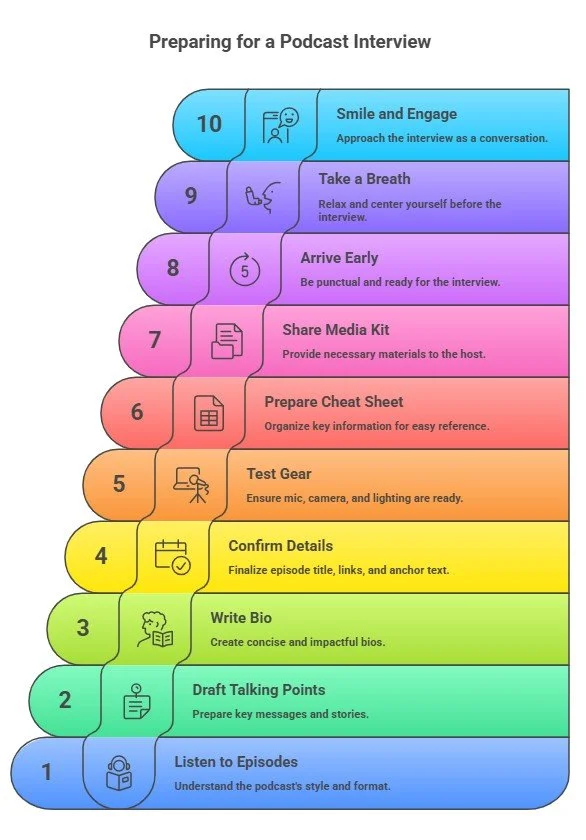
Listen to two recent episodes. Note the pacing, question patterns and segment transitions. Draft three talking points, three example stories and three quotable lines under 120 characters. Write your short bio in 40 words and 90 words. Confirm the episode title options, links and preferred anchor text. Test your mic, camera and lighting. Being well-prepared with your gear and media kit helps you feel confident during the interview. Silence notifications. Place a glass of water nearby. Keep a one-page cheat sheet with your framework, stat with source and the short URL you will say on air. Share your media kit with the host 48 hours ahead. Show up five minutes early. Take a breath. Smile. Think conversation, not monologue. Use a checklist or tool to track your preparation steps and outreach to podcast hosts.

preparing for a podcast interview graphic

Do I have to travel for my guest podcast?

Almost never. Most guest interviews happen remotely over Riverside, SquadCast or Zoom. You need a quiet room, a USB mic, closed-back headphones and stable internet. If a show records in studio and invites you in person, weigh the upside. Studio quality can be higher and the relationship building is real. If travel is not practical, ask for a remote slot. Offer to ship your headshot and B-roll photo to support promotion. The goal is a clear recording and a useful conversation. You do not need a plane ticket to deliver that.

Are podcasts videotaped?

Many are. Audio-only is still common, but more shows capture video for YouTube and clips. Assume cameras are on unless told otherwise. Frame your shot at eye level. Use natural light or a simple ring light. Neutral background. No noisy patterns. Wear solid colors. Avoid clanking jewelry. Look at the camera when you deliver your key line. Your voice and tone are just as important on video as they are in audio-only podcasts, so focus on clear, engaging delivery. Ask the host if they plan vertical clips so you can center yourself in frame. Video gives you more assets to repurpose. Treat it like a bonus, not an obstacle.

How can I use my podcast appearance in other content?

Think building blocks. Each podcast episode can be repurposed into multiple content formats. Post the edited transcript on your site with H2s and internal links. Write a recap blog with the three takeaways and two links to commercial pages. Cut a 30 to 60-second clip and a carousel for social. Add the episode to your Media Room with a short description and the show logo. Pull one quote into your About page or a sales deck. Drop the link in onboarding emails and nurture sequences. Pitch a related reporter with a data angle you discussed. Schedule reshares at 30, 60 and 90 days. One interview can fuel weeks of content if you plan it.

Does Google index podcasts?

Yes, through the pages around them. Google crawls show notes, transcripts and episode pages. It also sees your site if you publish an edited transcript and a recap. Make those pages clean and structured. Use descriptive titles, H2s that match real questions and links to a resource and a proof page. If the show publishes on YouTube, that video can rank for queries too. The audio itself is not the hero. The surrounding text is. Give Google and AI systems clear language, consistent names and fast pages. That is how your episode gets found after release week.

How can I make my story memorable?

Anchor it to a moment. A date, a client scene, a number that snaps attention. Use a simple framework to organize the lesson. Problem, choice, outcome. Keep details concrete. One quote from a customer beats five adjectives. Name the tension and how you resolved it. Share one mistake you will not repeat. End with a practical step listeners can take today. Then deliver your short URL that ties directly to the story. People remember specifics, not slogans. Give them a reason to retell your story in one sentence.

What is a podcast tour?

A podcast tour is a focused run of guest appearances across several shows in a set window, all tied to one message or launch. Being featured on other podcasts and shows allows you to reach new audiences and increase your visibility. Appearing on someone else's show helps you tap into someone else's audience, expanding your reach beyond your own listeners. Think six to 12 interviews over six to eight weeks. You bring one angle, one resource and a promotion plan that repeats. The value is momentum. Repetition helps your message stick. Links and mentions stack. Search and AI panels see consistent language. Plan the tour like a mini-campaign, with targets, assets, a landing page, and KPIs. It is not spraying and praying. It is a tightly sequenced piece with purpose.

How do I prepare the podcast host?

Send a tidy media kit 48 hours before recording. Include a 40 and 90-word bio, correct name and title with pronunciation, three title options under 60 characters, five show note bullets, one sourced stat, your three-step framework, headshot, horizontal image and two links with preferred anchor text. Provide a compelling introduction for the host to use during the episode, this should be an engaging opening statement that establishes your credibility and piques listener curiosity. Add your short URL, social handles and promotion commitments. Confirm tech, date, time zone and release timing. Share any topics to avoid and a landmine list if needed. Ask if they want sample questions or timestamps. The easier you make it to copy and paste, the more likely your language is to land on the page where it can be found.

Can you promote your podcast guest appearance?

Please do. Promotion helps the host and helps you. Day 0, post on LinkedIn and X with a quote from the host and tag the show. Day 2, share a 30 second clip with captions. Day 7, publish the recap blog and link it in comments. Add the episode to your Media page. Highlight where audiences can hear your interview, such as linking directly to the episode or sharing platforms where your appearance is featured. Email your list with three takeaways and one CTA. Share the short URL in sales follow ups. If budget allows, put a small paid boost behind the best clip to your warm audience. Promotion is part of being a good guest. Say yes to it. Effective promotion can help you attract new listeners to your brand or podcast.

Should I leave a review after my podcast appearance?

If the show asks, yes. Keep it honest and short. Thank the host by name, note one specific thing you enjoyed and mention the audience you think will benefit. Do not pitch your product in the review. Share the episode link in your channels and tag the show. A thoughtful review, a social post and timely promotion build goodwill. Goodwill turns into future invites and referrals. In podcasting, relationships travel farther than hype.

How can a podcast help with my SEO?

Podcasts help when you treat each appearance like a content asset. Show notes on reputable sites link back to your pages, which can lift rankings. Publish an edited transcript on your site with clear H2s that match real questions. Add a short summary, one sourced stat and links to a resource page and a proof page. Be sure to include your unique insights to demonstrate expertise and attract more podcast opportunities. Create a focused landing page for listeners with one primary CTA and a brief FAQ. Interlink the transcript and recap blog to your services and case studies. Make pages fast on mobile and easy to scan. Schedule a few reshares over 30, 60 and 90 days. The result is simple. More quality links, more crawlable text and a steady stream of visitors who already care.

Can a podcast help with AI Answers?

Yes, when you structure it with intention.

AI systems pull from text they can crawl, attribute and connect to a clear entity. A podcast appearance becomes useful for AI Answers when it produces indexable assets with consistent language tied to your name and brand.

Here is where the lift happens:

  • Show notes that include your full name, title and company with a live link

  • A clean transcript published on the host site

  • An edited transcript republished on your site with question-based H2s

  • A YouTube description that mirrors the same phrasing

  • A focused landing page built for listeners

When those elements align, AI platforms can connect your expertise to specific topics. Over time, multiple interviews using similar language reinforce entity recognition. Consistency matters more than volume.

We have seen brands move from zero visibility in generative search to being cited in AI summaries after a coordinated podcast tour supported by structured transcripts and internal linking. The audio alone did not drive the result. The surrounding text did.

A podcast will not guarantee AI citation. It does create credible, third-party context. When paired with SEO structure, clear messaging and ongoing AI monitoring, it becomes a meaningful contributor to AI search visibility.

That is how earned media evolves in the age of AI.

Podcast Guest Strategy Snapshot

Below is a simple view of what separates a casual guest appearance from a strategic visibility asset that supports SEO and AI Answers.

Area Strategic Podcast Guest Casual Podcast Guest
Bio 40 and 90 word versions aligned with key search terms One generic bio sent last minute
Messaging One clear angle repeated across interviews Different talking points every time
Show Notes Full name, title and company with live link Name mentioned without context or link
Transcript Edited transcript published with question-based H2s No transcript republished on guest site
Landing Page Dedicated listener page with one CTA and FAQ Homepage link only
SEO Structure Internal links to services and case studies No interlinking strategy
AI Signals Consistent phrasing across bio, notes and YouTube description Inconsistent titles and descriptions
Promotion 30, 60 and 90 day reshare plan One social post on launch day
Measurement Traffic, backlinks, branded search lift, AI citations Download numbers only

Podcast guesting is not about airtime. It is about structure. When you treat each appearance as part of a coordinated digital PR plan, the impact extends beyond the episode. The surrounding text, links and consistency are what search engines and AI systems read, store and reference.

What equipment do I need to be a podcast guest?

Here’s the simple kit that works:

Quick setup tips:

  • Put the mic four to six inches from your mouth, use a pop filter if you have one

  • Turn off notifications and HVAC noise

  • Keep water nearby and notes at eye level

  • Share your short URL and bio with the host before you join

Clean audio, steady internet and a calm room beat fancy gear every time.

Finding guesting opportunities

Becoming a sought-after podcast guest starts with finding the right shows that align with your expertise and target audience. Begin by identifying podcasts in your niche that speak directly to the listeners you want to reach. Take the time to listen to a few episodes of each podcast you’re considering. This helps you get a feel for the host’s style, the show’s tone, and the types of guests and topics they feature. By immersing yourself in their content, you’ll quickly see if you’d be a good fit and if your message will resonate with their audience.

To discover new podcasts, use platforms like Apple Podcasts or Spotify, as well as directories such as Rephonic and Podchaser. These tools make it easy to filter by topic, audience size, and even guest history. As you research, look for podcasts with a broad audience or a highly engaged niche following. Check their social media profiles to see how they interact with podcast listeners and whether they have an active online community. Reading their show notes and blog posts can also give you insight into their approach and the value they deliver to their audience.

Once you’ve built a list of potential podcasts, it’s time to stand out as a valuable guest. Create a compelling podcast guesting bio that highlights your professional background, expertise, and what makes you unique. Keep your bio concise, ideally under 100 words, and include a fun fact or detail that helps you stand out from other potential guests. Make it clear who you help and how, so podcast hosts can instantly see the value you’ll bring to their show.

Alongside your bio, prepare a one-sheet that includes links to your website, social media profiles, and any relevant content such as blog posts, videos, or previous podcast episodes. This one-sheet serves as your podcast guesting resume, making it easy for hosts to review your credentials and determine whether you’re a good fit for their audience. The more accessible and relevant your information, the more likely you are to be invited for a guest interview.

When reaching out to podcast hosts, always personalize your message. Reference a specific episode or topic that resonated with you, and explain why you believe you’d be a valuable guest for their podcast listeners. Show that you’ve done your homework and that you’re genuinely interested in contributing to their show. Building a relationship with the host and demonstrating your understanding of their audience will help you stand out among other potential guests.

In final thoughts, finding the right guesting opportunities is about research, preparation, and a deep understanding of your target audience. By identifying podcasts that align with your message, crafting a compelling podcast guesting bio, and preparing a professional one-sheet, you’ll increase your chances of being booked and making a lasting impression on a new audience. Remember to be engaging, authentic, and focused on providing value to both podcast hosts and listeners. As Emily Aborn shares, a well-crafted bio and a clear understanding of your audience are essential for successful podcast guesting. With these strategies, you’ll draw listeners in, stand out as a valuable guest, and expand your reach to more podcasts and new audiences.

Make the momentum last

Treat every guest spot like a mini launch. Pick the right rooms, bring one clear angle and make it easy for the host to showcase your story. Publish fast, link smart and promote on a simple cadence. Do this on repeat and you build authority that shows up in blue links and AI summaries. Having your own podcast can further establish your authority and attract more guest opportunities, as it demonstrates your expertise and provides a platform to showcase your knowledge. Being featured on prominent shows also boosts your credibility and helps you stand out to both hosts and audiences. Consistently delivering high-quality appearances is key to maintaining audience interest and ensuring your momentum continues to grow. If you want a plan that turns interviews into measurable results, TrizCom PR can help.

Everyone has a story. Let TrizCom PR tell yours!

Jo Trizila smiling in a red blazer standing by a column; graphic text on red background reads “Jo Trizila TrizCom PR & Pitch PR.”

About the Author:

Jo Trizila – Founder & CEO of TrizCom PR

Jo Trizila is the founder and CEO of TrizCom PR, a leading Dallas-based public relations firm known for delivering strategic communications that drive business growth and enhance brand reputations as well as Pitch PR, a press release distribution agency. With over 25 years of experience in PR and marketing, Jo has helped countless organizations navigate complex communication challenges, ranging from crisis management to brand storytelling. Under her leadership, TrizCom PR has earned recognition for its results-driven approach, combining traditional and integrated digital strategies to deliver impactful, measurable outcomes for clients across various industries, including healthcare, technology and nonprofit sectors. Jo is passionate about helping businesses amplify their voices and connect with audiences meaningfully. Her hands-on approach and commitment to excellence have established TrizCom PR as a trusted partner for companies seeking to elevate their brand and achieve lasting success. Contact Jo at jo@TrizCom.com.

 

What Is a Digital PR Agency and Why Your Brand Needs One in the Age of AI

 
Two business people shaking hands for the blog: What is a digital PR agency

A brand’s reputation is no longer shaped only by what it says about itself. It is defined by what others say online, what search engines rank and now what AI platforms summarize and recommend.

This is where a modern digital PR agency plays a critical role.

By combining traditional public relations strategy with digital marketing, SEO and artificial intelligence insights, digital PR agencies help brands build credibility, secure authoritative media coverage, improve visibility in search engines and increasingly influence how AI tools such as ChatGPT, Google’s AI Overviews and other generative search platforms surface information.

So, what is a digital PR agency today?

Unlike traditional PR, which focused on print, television and radio, digital PR operates in an online ecosystem driven by search engines, algorithms and AI systems. It secures media mentions on high-authority websites, earns high-quality backlinks that boost SEO rankings and develops data-driven campaigns that position brands as trusted sources for both humans and machines.

In an AI-influenced world, digital PR is no longer just about being seen. It is about being cited.

As businesses compete for attention in a crowded digital space, understanding what a digital PR agency does and how AI is reshaping visibility can determine whether your brand becomes a recognized authority or disappears into digital noise.

What Does a Digital PR Agency Do? More Than Just Media Coverage

A digital PR agency helps brands gain online authority through strategic storytelling, media placements, SEO integration and AI-informed content strategies. While securing media coverage remains essential, modern digital PR extends far beyond traditional press.

Generating High-Impact Media Features

Being featured in publications such as Forbes, Entrepreneur or respected niche outlets does more than increase awareness. It establishes trust signals that influence consumers, search engines and AI systems.

Generative AI models pull information from authoritative sources. When your brand is cited in credible media, those references increase the likelihood that AI tools recognize your company as a legitimate authority in its field.

Digital PR agencies:

  • Pitch tailored stories to journalists

  • Position executives as expert sources

  • Align messaging with current media trends

  • Monitor how media coverage influences search and AI visibility

Earned media is no longer just brand validation. It is structured digital credibility.

Building High-Quality Backlinks to Strengthen SEO and AI Visibility

Backlinks remain one of the strongest ranking signals for search engines. But they also influence how AI systems evaluate authority.

When trusted websites link to your content, it signals expertise, experience, authority and trustworthiness. These are core signals that search engines and AI summarization tools evaluate.

Digital PR agencies secure:

  • Editorial backlinks from high-authority media

  • Contextual links within relevant industry stories

  • Expert commentary placements

  • Guest articles that reinforce keyword authority

The result is improved domain authority, stronger search engine results page rankings and increased likelihood of being referenced in AI-generated summaries.

Using AI to Inform Strategy, Targeting and Measurement

AI is not replacing PR strategy. It is enhancing it.

Digital PR agencies now use AI tools to:

AI-driven insights allow campaigns to be more precise, more proactive and more measurable.

Crafting a Digital PR Strategy That Delivers Measurable Results

A modern digital PR strategy includes more than press releases and pitching. It integrates content, SEO and AI visibility.

Key components include:

Strategic content creation

Developing expert articles, research reports and insights structured for both search engines and AI summarization.

Proactive media pitching

Securing coverage in digital publications that reach the right audience and influence AI indexing.

AI Search optimization

Ensuring content is formatted clearly with structured headings, FAQ sections and authoritative citations so AI systems can extract accurate information.

Influencer and expert partnerships

Collaborating with trusted voices who expand reach and strengthen digital credibility.

Issues management and crisis communication

Monitoring online conversations and AI summaries in real time to correct misinformation quickly.

Digital PR agencies do not simply secure attention. They manage how your brand is interpreted across digital and AI platforms.

How a Strong Digital PR Strategy Elevates Brand Authority

Having an online presence is no longer enough. Brands must shape conversations, influence perception and ensure their narrative is reflected accurately in AI-driven environments.

When customers search today, they often see:

  • AI-generated summaries

  • Featured snippets

  • Knowledge panels

  • Media citations

A well-executed digital PR strategy ensures those summaries reflect credible, positive and authoritative information.

The Connection Between Digital PR, SEO and AI Search

Digital PR, SEO and AI search are now inseparable.

Traditional PR might generate awareness. Digital PR generates indexed, searchable authority. AI then synthesizes that authority into summarized recommendations.

When a brand is featured in authoritative media with contextual backlinks, search engines interpret those mentions as endorsements. AI systems interpret them as validation.

A strong digital PR strategy:

The brands that show up consistently across media, search results and AI summaries are the brands that win attention.

Press Releases in the AI-Driven Digital Landscape

Press releases remain valuable, but their purpose has evolved.

Modern digital press releases are optimized for:

  • Keyword relevance

  • Structured formatting

  • Clear expert attribution

  • Authoritative outbound citations

  • Shareability across digital channels

When properly distributed and supported by media outreach, press releases can:

  • Earn authoritative media coverage

  • Support link-building efforts

  • Strengthen AI discoverability

  • Drive referral traffic

However, no digital PR campaign should rely solely on press releases. Integration across earned media, owned media, thought leadership, SEO and paid media is essential.

The Winning Combination: Digital PR, SEO and AI Visibility

Unlike traditional PR, digital PR creates lasting digital assets.

Why this matters:

A well-structured digital PR campaign:

The goal is not short-term buzz. It is sustained digital authority.

Traditional PR vs. Digital PR vs. AI-Driven Digital PR: What’s the Difference?

Understanding what a digital PR agency does today requires context. The discipline has evolved. Traditional PR built awareness. Digital PR built search authority. AI-driven digital PR builds citation authority across search engines and generative AI platforms.

Here is how they compare:

Category Traditional PR Digital PR AI-Driven Digital PR
Primary Focus Media exposure Online visibility plus SEO Search visibility plus AI citation authority
Key Channels Print, TV, radio Online media, blogs, digital publications Online media, search engines, AI platforms
Success Metrics Impressions, reach Backlinks, rankings, referral traffic Rankings, backlinks, AI mentions, citation frequency
Content Strategy Press releases, interviews SEO content, thought leadership, media outreach Structured expert content optimized for AI summarization
Authority Signals Media mentions Backlinks plus domain authority Backlinks plus E-E-A-T signals plus AI extraction readiness
Longevity of Impact Often short-term Long-term search visibility Long-term search plus AI discoverability
Risk Management Reactive crisis PR Digital monitoring plus SEO repair Real-time AI narrative monitoring plus correction strategy

The shift is significant.

Traditional PR asked, “Where did we get coverage?”

Digital PR asked, “How did coverage improve rankings?”

AI-driven digital PR now asks, “Is our brand being cited accurately when AI summarizes our industry?”

This evolution matters because consumer behavior has changed. Buyers now rely on search engines and AI-generated answers to evaluate expertise, compare providers and validate credibility before making decisions.

If your brand does not appear consistently in media, search results and AI summaries, competitors will fill that space.

A modern digital PR agency or AI PR agency understands that visibility is no longer just about placement. It is about structured authority that machines can interpret, validate and recommend.

Measuring the Success of a Digital PR Campaign

Modern digital PR is measurable.

Key performance indicators include:

The Role of Analytics and AI Monitoring

Agencies now use tools to track:

  • Referral traffic and conversions through Google Analytics

  • Domain authority and backlink growth via Ahrefs or Moz

  • Media mentions via monitoring platforms

  • Brand inclusion in AI-generated responses

Tracking AI visibility is an emerging metric. Businesses must understand not only how they rank in search engines but how they are represented in generative AI results.

Choosing the Right Digital PR Agency or AI PR Agency in an AI Era

Not all agencies that call themselves a digital PR agency or AI PR agency are prepared for AI-driven search environments.

When selecting a digital PR agency, look for:

1. A Proven Track Record

  • Documented media placements

  • High-authority backlinks

  • Recognized thought leadership placements

2. SEO and AI Integration Expertise

  • A modern digital PR agency or AI PR agency must understand how search engines and generative AI platforms evaluate authority.

  • Link-building aligned with SEO best practices

  • Content structured for AI summarization

  • Data-driven campaign development

3. Customized Brand Positioning

  • Deep understanding of your audience

  • Clear competitive differentiation

  • Messaging designed for digital discoverability

4. Transparent Reporting

  • Detailed SEO metrics

  • Backlink reporting

  • Media coverage tracking

  • AI visibility monitoring

A strong digital PR agency or AI PR agency does not just promise awareness. It demonstrates measurable impact across search, media and AI visibility.

Why Investing in Digital PR Is Essential for Brand Growth

A digital PR agency or AI PR agency is more than just a media relations partner. It is a strategic asset for brand growth. By combining media outreach, content marketing, SEO, AI visibility strategy and thought leadership, digital PR creates a sustainable online presence that drives long-term credibility across search engines and generative AI platforms.

For businesses looking to stand out in an increasingly digital and AI-influenced world, investing in a well-structured digital PR strategy is no longer optional. It is essential. Whether securing high-profile media placements, improving search rankings, influencing AI-generated summaries or establishing executive thought leadership, a strong digital PR campaign transforms online visibility into measurable business growth.

Take Your Brand to the Next Level with Digital PR

The digital landscape is more competitive than ever. Visibility now depends not only on search rankings but on how AI platforms interpret and surface your brand.

At TrizCom PR, we craft digital PR strategies designed for modern discovery. We secure high-impact media placements, strengthen search engine rankings and position brands for authority in both traditional search and AI-driven environments.

Do not let your brand get overlooked in search results or misrepresented in AI summaries. Partner with TrizCom PR and build a results-driven digital PR campaign tailored to your business goals. Contact us today to get started.


Everyone has a story. Let TrizCom PR tell yours!

Jo Trizila, Founder and CEO of TrizCom PR

About the Author:

Jo Trizila – Founder & CEO of TrizCom PR
Jo Trizila is the founder and CEO of TrizCom PR, a leading Dallas-based public relations firm known for delivering strategic communications that drive business growth and enhance brand reputations as well as Pitch PR, a press release distribution agency. With over 25 years of experience in PR and marketing, Jo has helped countless organizations navigate complex communication challenges, ranging from crisis management to brand storytelling. Under her leadership, TrizCom PR has earned recognition for its results-driven approach, combining traditional and integrated digital strategies to deliver impactful, measurable outcomes for clients across various industries, including healthcare, technology and nonprofit sectors. Jo is passionate about helping businesses amplify their voices and connect with audiences meaningfully. Her hands-on approach and commitment to excellence have established TrizCom PR as a trusted partner for companies seeking to elevate their brand and achieve lasting success. Contact Jo at jo@TrizCom.com.
Digital PR Q&A

What is a digital public relations agency?

A digital public relations agency helps brands build online authority through earned media, SEO strategy and thought leadership content. Unlike traditional firms focused primarily on print and broadcast placements, a digital PR agency strengthens visibility where modern buyers research: search engines, online publications and increasingly AI-driven platforms. At TrizCom PR, digital PR means securing high-authority media coverage, earning quality backlinks and structuring expert content so it ranks in search and is accurately reflected in AI-generated summaries. The objective is not simply exposure. It is sustained credibility that improves rankings, drives referral traffic and positions a company as a trusted voice in its industry.

How does a digital PR agency differ from a traditional PR firm?

Traditional PR firms focus on awareness through newspapers, television and radio. Success is often measured by impressions and audience reach. A digital PR agency expands that approach by integrating SEO, link building and measurable online performance. At TrizCom PR, campaigns are designed to influence both media coverage and search engine visibility. That means securing editorial backlinks, developing keyword-aligned thought leadership and monitoring referral traffic. In today’s AI-influenced environment, digital PR also considers how content is structured for generative platforms. Traditional PR builds reputation. Digital PR builds measurable digital authority that supports business growth.

What is an AI PR agency?

An AI PR agency is the next evolution of digital PR. It focuses on how brands appear not only in search engines but in generative AI platforms such as ChatGPT and Google AI Overviews. At TrizCom PR, AI-informed PR strategies ensure content is structured clearly, supported by authoritative media citations and aligned with expertise signals that AI systems prioritize. This includes strengthening E-E-A-T indicators, securing third-party validation and monitoring how brand narratives appear in AI-generated responses. As more consumers rely on AI for research and decision-making, AI-driven PR ensures your brand is cited accurately and positioned as a trusted authority.

Why is digital PR important for SEO?

Digital PR strengthens SEO by earning authoritative backlinks and increasing domain authority. Search engines interpret backlinks from reputable publications as endorsements. At TrizCom PR, media placements are pursued strategically to support keyword rankings and long-term search performance. Beyond backlinks, digital PR generates expert content that targets relevant search queries and increases branded search activity. These signals improve visibility on search engine results pages and drive sustained organic traffic. Unlike paid advertising, earned media remains indexed, creating long-term value. For businesses focused on measurable growth, digital PR becomes a foundational component of a strong SEO strategy.

How does digital PR influence AI search results?

Generative AI platforms rely on credible, indexed content to produce responses. When brands are cited consistently in authoritative publications, AI systems are more likely to reference them accurately. TrizCom PR structures campaigns to ensure clients earn media coverage that reinforces expertise and authority signals. This includes executive thought leadership, expert commentary and contextual backlinks. As AI tools synthesize information from trusted sources, brands with strong digital PR footprints are more likely to appear in summaries. In an AI-driven environment, visibility depends not just on ranking well but on being cited reliably.

What services does TrizCom PR provide within digital PR?

TrizCom PR offers integrated digital PR services that include media outreach, executive thought leadership, link-building strategy, press release distribution through Pitch PR and reputation management. Campaigns are designed to align earned media with SEO objectives and AI visibility goals. This includes securing authoritative placements, developing structured content and monitoring digital performance metrics. TrizCom PR also supports crisis communication and real-time brand monitoring to protect online reputation. The firm’s approach connects storytelling with measurable search impact, ensuring that every media placement contributes to broader digital authority.

How do you measure the success of a digital PR campaign?

At TrizCom PR, digital PR performance is measured through data, not assumptions. Key indicators include media coverage quality, backlinks earned, improvements in search rankings and referral traffic growth. Domain authority increases, branded search volume and lead generation metrics are also tracked. In more advanced strategies, AI search visibility is monitored to assess how often a brand appears in generative responses. This data-driven approach allows campaigns to be refined and optimized. Digital PR should demonstrate clear return on investment, not just awareness.

How long does it take to see results from digital PR?

Digital PR is a long-term investment. At TrizCom PR, clients typically begin seeing early traction within three to six months, especially in media coverage and referral traffic. Search ranking improvements and domain authority growth often compound over time as backlinks accumulate. AI visibility may also strengthen gradually as authoritative citations increase. Because earned media remains indexed online, the benefits continue long after the initial placement. Consistency is key. Brands that maintain steady thought leadership and media engagement see the strongest sustained impact.

Who should hire a digital PR or AI PR agency?

Organizations that rely on online credibility benefit most from digital PR. This includes B2B firms, healthcare providers, franchise brands, professional services and technology companies. If your customers research providers online or use AI tools to compare options, digital PR becomes essential. TrizCom PR works with organizations seeking to strengthen authority, improve search rankings and elevate executive positioning. Companies operating in competitive markets where trust influences purchasing decisions often see significant gains from a structured digital PR strategy.

Why is digital PR essential in the age of AI?

In the age of AI, buyers rely on search engines and generative summaries to evaluate brands. If your company lacks authoritative digital signals, it may not appear in those summaries. Digital PR ensures your brand is cited in trusted publications, supported by backlinks and structured for search clarity. At TrizCom PR, campaigns are designed to influence both human audiences and AI-driven platforms. The goal is consistent, credible visibility. Today, it is not enough to be known. Your brand must be referenced, validated and discoverable across search and AI environments.


Win the AI Search Game with PR Strategies for Modern CMOs

 
person typing on a laptop computer with Chat AI superimposed for AI Search

The search engine landscape is evolving rapidly. AI search is no longer a future concept—it's actively transforming how users interact with platforms like Google. For PR professionals, this shift necessitates a reevaluation of how content is discovered, evaluated and engaged with.​

According to Pew Research discovered that of February 2024, 23% of U.S. adults reported having used ChatGPT, up from 18% in July 2023. This increase suggests a rising familiarity and comfort with AI tools among the American public. The rapid adoption of AI-driven interfaces highlights how users are increasingly leaning towards AI-enhanced experiences, even when seeking information.

Traditional press releases, blog posts and media pitches are no longer sufficient on their own. To remain visible, credible and relevant, PR content must be optimized not just for human audiences but also for AI algorithms.​

Let's explore what's changing and how PR professionals can adapt.

What is AI Search?

AI search integrates artificial intelligence—particularly machine learning and natural language processing—into search engines to deliver more intuitive, conversational and accurate results. Unlike traditional search, which relies heavily on keyword matching and link-based algorithms, AI search interprets context, intent and relationships between topics to generate synthesized responses.​

How Does It Work?

  • Natural Language Understanding (NLU): AI search engines comprehend questions the way a human might ask them, focusing on the meaning behind a query rather than matching exact keywords.​

  • Generative AI: Tools like Google's Search Generative Experience (SGE) use AI models to pull information from multiple sources, summarizing it into a cohesive answer at the top of the search page.​

  • Continuous Learning: AI systems improve over time, learning from user interactions to refine how they rank sources and generate summaries.​

Think of AI search as a blend of a search engine and a knowledgeable assistant. Instead of providing a list of links, it offers a curated response, pulling from various reputable sources to deliver the best possible answer.​


How AI Search is Transforming Google

AI search isn't just tweaking Google's algorithms; it's reshaping the entire user experience. Google's generative AI tools, like Search Generative Experience (SGE), synthesize information from multiple sources to provide direct answers at the top of search results. This means fewer clicks to individual websites and more emphasis on summarizing information within the search engine itself.​

According to Avenue Z, AI-driven search engines now present conversational, synthesized answers, prioritizing concise, context-rich content. The traditional blue links are being pushed down the page. With this evolution, PR teams must consider how their stories and key messages will surface in these AI-generated snippets.​

Google search screenshot for AI Search

As Forbes notes, "If you're not optimized for AI search, you're invisible." The days of optimizing only for keywords and backlinks are over. Now, PR content must be contextually rich, authoritative and aligned with how AI interprets and generates information.​

What This Means for PR and PR Content

1. Authority Matters More Than Ever

AI search prioritizes trusted sources. Publications with strong reputations and authors with demonstrable expertise are more likely to be referenced in AI-generated results.​

For PR professionals, this reinforces the importance of earned media placements in credible outlets. If your client's story lands in a well-regarded publication, it has a higher chance of being surfaced by AI search. At TrizCom PR, we've always believed in the value of building strong media relationships—this shift makes that mission even more essential.​

2. Contextual Content is Key

AI search tools don't just pull exact keyword matches; they synthesize context across multiple data points. This means your content needs to be comprehensive, clear and aligned with user intent. Press releases and thought leadership pieces must answer the "why" behind the story, not just present the facts.​

For example, if you're promoting a client's new sustainable product, your content should touch on industry trends, environmental impact and consumer benefits—all areas an AI engine might aggregate into a broader response.​

3. Structured Data Gives You an Edge

Behind-the-scenes SEO practices like structured data markup help AI understand the context and credibility of your content. Think of schema markup as a translator between your website and search engines, signaling what your content is about and why it matters.​

Embedding structured data in press releases, case studies and blog posts increases the chances that AI search tools will recognize and feature your content. It's one of those small adjustments with outsized impact.​

4. Refresh and Repurpose Content

AI search favors fresh, relevant content. Regularly updating blog posts, press releases and media kits with new insights, statistics or case studies helps ensure your material remains part of the AI conversation.​

At TrizCom PR, we recommend auditing your content library quarterly. Assess what's performing well, what needs updating and which topics have gained momentum in your industry. These insights help guide content strategy in an AI-driven search environment.​

5. Visuals, Summaries and Snippets

Generative AI search tools often extract quick summaries or visual elements to present in search results. Including concise summaries, bullet points, infographics or videos in your PR content can make it more "AI-friendly."​

Consider adding key takeaway sections to blog posts or creating media kits with easy-to-digest statistics and visuals. The more accessible your content is for both human readers and AI, the better.​


PR's Role in the Age of AI Search

The role of PR remains the same: crafting compelling stories and building trust. But how we deliver those stories—and how they're found—is evolving. In this AI search landscape, PR must work hand-in-hand with SEO, data analytics and digital content teams.​

Here's how TrizCom PR is helping brands stay visible:

  • Integrated Strategies: Combining earned media with optimized digital content that feeds AI search engines. This includes leveraging multimedia, using structured data, and ensuring that content is rich in context and relevance.

  • Data-Driven Insights: Using advanced analytics to track which content performs well in AI-driven search environments. We analyze user behavior, engagement metrics, and search patterns to refine our approach continuously.

  • Ongoing Education: Staying at the forefront of AI developments and training our team to understand new tools and algorithms. This proactive mindset helps us craft PR strategies that are ahead of the curve.

  • Building Authoritative Content: Prioritizing E-E-A-T (Experience, Expertise, Authoritativeness, and Trustworthiness) content, which AI search engines favor. We collaborate with subject matter experts to ensure our content reflects high levels of credibility and insight.

  • Adaptability: Regularly updating and repurposing content to stay relevant. Whether it’s a fresh angle on a familiar topic or new data supporting a client story, we make sure our content evolves along with AI search preferences.

Looking Ahead

AI search is still evolving, but one thing is clear: the lines between PR, content marketing, and SEO are blurring. At TrizCom PR, we see this as an opportunity. It’s a chance to amplify your brand’s story in new ways, ensuring it reaches the right audience—even when that audience is an algorithm.

By staying agile, leveraging data, and prioritizing high-quality content, we help brands not just keep up but lead in the evolving digital landscape.

Ready to make your PR content AI-search ready? Let’s start the conversation.


Want A Quick Summary?

Listen to TrizCom PR's NotebookLM recap with Chuck and Karen for the latest insights and key takeaways!


Jo Trizila – Founder & CEO of TrizCom PR

About the Author:

Jo Trizila – Founder & CEO of TrizCom PR

Jo Trizila is the founder and CEO of TrizCom PR, a leading Dallas-based public relations firm known for delivering strategic communications that drive business growth and enhance brand reputations as well as Pitch PR, a press release distribution agency. With over 25 years of experience in PR and marketing, Jo has helped countless organizations navigate complex communication challenges, ranging from crisis management to brand storytelling. Under her leadership, TrizCom PR has earned recognition for its results-driven approach, combining traditional and integrated digital strategies to deliver impactful, measurable outcomes for clients across various industries, including healthcare, technology and nonprofit sectors. Jo is passionate about helping businesses amplify their voices and connect with audiences meaningfully. Her hands-on approach and commitment to excellence have established TrizCom PR as a trusted partner for companies seeking to elevate their brand and achieve lasting success. Contact Jo at jo@TrizCom.com.
 

An Integrated Marketing Campaign That Actually Worked

 
Four people holding gears to symbolize an  integrated marketing campaign

Brands are in a constant state of competition—not just for market share but for attention, trust and loyalty. That competition isn’t being fought in a single ad, platform or content type. It’s happening across every touchpoint. And the brands that win? They’re the ones that masterfully connect the dots across all those touchpoints through unified, cohesive and impactful storytelling.

That’s the power of integrated marketing campaigns. These campaigns align message, tone, visuals and timing across all marketing channels—owned, earned, paid and shared media—to deliver an intentional, memorable and trust-building brand experience.

What was once considered a “best practice” is now a business imperative.

Why Integration Now?

The rise of multi channel engagement and the shift in how consumers research and interact with brands has raised expectations. Today’s customers don’t see your media channels as silos—they see one brand. And if your touchpoints feel inconsistent, confusing or out of sync, they lose interest.

Integration solves that.

An integrated marketing strategy gives your brand one cohesive voice across multiple channels, one unified narrative across departments and one shared set of metrics that tracks performance in a way that truly supports business outcomes.

This is where traditional marketing falls short. It’s not enough to “be on social” or “send a newsletter.” Success lies in the ability to orchestrate all your efforts in sync—something only integrated marketing campaigns can deliver.

What Is an Integrated marketing Campaign?

At its core, an integrated marketing campaign is a unified effort to communicate a brand message across all relevant platforms in a way that aligns with your brand’s visual identity, voice, values and strategic goals.

These campaigns incorporate:

  • Email marketing that matches what’s being said on social media

  • Social media posts that support your latest paid media push

  • Owned content (like blogs, videos or whitepapers) that’s reflected in your media relations efforts

  • Earned media that links back to high-value landing pages or downloadable resources

  • Paid campaigns that amplify high-performing content from all channels

When all those tactics are executed around a common narrative, the result is consistent branding and stronger customer connections.

Why Consistent Messaging Matters More Than Ever

The average person encounters up to 10,000 brand messages a day. That might sound like an exaggeration—until you consider every ad, label, headline, social feed, push notification, podcast pre-roll and email subject line competing for attention.

In that environment, only one thing cuts through: consistent messaging that creates mental availability.

When your brand message is aligned across all marketing channels, customers are more likely to recognize, remember and trust your brand. You stop being noise—and start being the signal they’re looking for.

Multi Channel vs. Omnichannel vs. Integrated: What’s the Difference?

Let’s clear up a common confusion:

  • Multi channel marketing means using more than one channel (e.g., you have a website, an email list and social media accounts).

  • Omnichannel marketing focuses on delivering a seamless experience across all platforms—typically in ecommerce environments.

  • Integrated marketing communication connects the dots between strategy, messaging and execution across all of these touchpoints.

A multi channel plan says, “We’re showing up.”

An omnichannel plan says, “We’re making it seamless.”

An integrated marketing communication plan says, “We’re making it meaningful, measurable and strategic.”

How to Build an Integrated marketing Campaign

Here’s a step-by-step guide to building your next integrated marketing campaign:

1. Define the Core Message

Before you launch a campaign, get crystal clear on the single most important thing you want your audience to walk away with. This message should serve as the north star for all content, creative and communications.

Ask yourself:

  • What’s the one idea that should come across in every interaction?

  • Is this message aligned with our brand’s voice, tone and values?

  • Does it support both our short-term campaign goal and long-term brand equity?

For example, if you're launching a new service, your core message might be:

“[Product] empowers small businesses to scale with less stress.”

Everything else—blogs, emails, ads, videos—should echo and reinforce this central promise.

Pro Tip: Use this message as the starting point in all briefing documents and creative kickoffs.

2. Align Around a Big Idea

The “big idea” is not the slogan. It’s the emotional or conceptual framework that makes your campaign memorable and relevant. It’s the thematic hook that ties everything together.

Your big idea should:

  • Tap into an audience belief, behavior or cultural moment

  • Elevate your product or message beyond functional benefits

  • Spark internal alignment among your team

Example: For a health brand launching a wellness app, the big idea might be:

“Health isn’t a destination—it’s a relationship.”

This positioning gives your team narrative direction and storytelling flexibility across multiple channels, while making sure everyone is rowing in the same direction.

3. Map the PESO Model

The PESO Model©


Every campaign should intentionally use the four types of media: Paid, Earned, Shared and Owned (Also known as The PESO Model©,  developed by Gini Dietrich) . This framework allows you to diversify your reach and multiply your message impact.

➤ Paid Media

Ads, sponsored content, boosted posts. Use this to expand reach quickly and target specific audience segments.

➤ Earned Media

PR placements, podcast interviews, analyst endorsements. Use this for third-party validation and credibility.

➤ Shared Media

Organic social content, UGC, influencer posts. Use this to engage your audience and encourage amplification.

➤ Owned Media

Blog posts, landing pages, newsletters, webinars. Use this to go deeper and drive conversion.

Map each tactic to your campaign objectives and identify how each will support the others. For example, a blog post (owned) can be used in a newsletter (owned), pitched to media (earned), boosted on LinkedIn (paid) and reshared on Facebook (shared).

4. Develop a Content Engine

You don’t need dozens of ideas—you need one great piece of content that feeds all others. That’s the power of anchor content.

Start with a high-value, high-effort asset like:

  • A data-backed case study

  • A white paper or research report

  • A branded video series

  • A webinar or expert interview

Then repurpose it across formats:

  • Turn stats into social infographics

  • Break quotes into shareable quote cards

  • Repurpose the narrative into blog posts, emails and PR pitches

  • Extract soundbites for short-form video or podcast clips

This approach keeps your campaign consistent, efficient and high-performing across multiple channels.

Pro Tip: Build a campaign asset matrix to track which content types are needed for each channel, along with production timelines.

5. Optimize for Each Channel

While your message should remain consistent, your execution should be customized. Each platform speaks a different language—your campaign should be fluent in all of them.

For example:

  • Your Instagram post might focus on visual storytelling with short captions.

  • Your LinkedIn post may emphasize thought leadership with a longer, insight-driven format.

  • Your email subject line should deliver value and urgency quickly.

  • Your press release should lead with the news angle and include compelling data.

The mistake many brands make is copying and pasting across platforms. But integrated doesn't mean identical. It means tailored storytelling that feels native, not forced.

Pro Tip: Use a brand voice and tone guide to ensure cohesion, even when formats shift.

6. Automate Where It Matters

Integration isn’t just about messaging—it’s also about operations. Using the right tools can streamline workflow, reduce human error and keep your campaign cadence consistent.

Key areas to automate:

  • Email marketing sequences and drip campaigns

  • Social media scheduling with tools like Buffer, Later or Sprout Social

  • Lead nurturing and segmentation in your CRM

  • Internal communications via Slack workflows or weekly updates

  • Task tracking with platforms like Asana, Trello or Monday.com

Just make sure automation never replaces human oversight. It should support strategic thinking, not stifle it.

Pro Tip: Create a master campaign calendar that integrates tasks, deadlines, approvals and launch dates in one place for cross-functional transparency.

7. Measure What Matters

Every campaign should begin with clear KPIs—and end with a full performance analysis. But don’t just track surface-level metrics. Dig deeper.

Here’s how to measure each PESO component:

PESO Element Sample KPIs

Paid CTR, CPC, ROAS, conversion rate

Earned Media impressions, brand mentions, backlinks, share of voice

Shared Engagement rate, shares, comments, UGC volume

Owned Page views, time on site, lead form completions, email open/click rates

Beyond the numbers, track qualitative signals too:

  • Are influencers tagging your campaign organically?

  • Are journalists referencing your content in coverage?

  • Are prospects mentioning the campaign in sales calls?

And most importantly: how did the campaign impact business outcomes?

Pro Tip: Use advanced analytics and reporting tools to create a unified dashboard that combines channel-specific data into one cohesive performance story.

The Brand Experience Starts (and Ends) With Integration

A brand experience is the sum total of every interaction someone has with your company. If that experience feels fragmented, trust erodes. If it’s seamless, your brand becomes memorable and trustworthy.

This matters whether you’re a startup or an enterprise-level operation. TrizCom PR’s integrated approach helps brands of all sizes find the structure, support and synergy they need.

Case Study Think Pink, Plan Big: How Barbie’s Marketing Team Delivered a Seamless Brand Experience

When Barbie’s marketing team launched what became one of the most successful integrated marketing campaigns of the decade to support the 2023 film release, they didn’t rely solely on trailers or paid advertising. They executed an integrated marketing campaign that was so comprehensive, it turned a single movie into a full-blown cultural moment.

The brilliance of the Barbie campaign wasn’t just in its creativity—it was in its consistency across multiple channels. Whether you were scrolling TikTok, flipping through a magazine, walking through a mall, watching morning TV or shopping online, you saw one unifying brand message: Barbie is for everyone and she’s back in a big way.

Here’s what made their campaign a textbook example of effective integrated marketing communications in action:

  • PR and Media Relations: Warner Bros. secured high-profile editorial coverage in Vogue, TIME, The New York Times and every major entertainment outlet. The media narrative focused not only on the film but on the feminist themes, visual style and global anticipation—giving the campaign thought leadership weight and social value.

  • Influencer Collaborations: Social media creators across fashion, beauty, parenting and pop culture verticals posted Barbie-inspired content for weeks. These influencers were activated strategically across Instagram, YouTube, TikTok and even LinkedIn—creating a shared message from a diverse set of voices, all reinforcing the same brand tone.

  • Social Media & Shared Media: Barbie memes, countdowns, behind-the-scenes reels and viral trends (like “Barbenheimer”) flooded platforms. Branded filters, challenges and hashtags created billions of organic impressions—and not one felt off-brand. It was a seamless, pink-soaked takeover.

  • Owned Media: The Barbie website featured custom landing pages, themed merchandise drops, educational tie-ins and behind-the-scenes interviews—all designed to drive fan engagement and capture data. Email marketing and web experiences delivered personalized content while reflecting the same visual identity seen in theaters and on social.

  • Paid Media: Traditional and digital advertising reinforced every message, from airport takeovers to pre-roll ads, Spotify audio spots and programmatic campaigns across streaming platforms. But it never felt disconnected from the narrative seen in organic channels—it was additive, not disruptive.

  • Brand Partnerships: Perhaps most impressive was the sheer volume of co-branded partnerships—from Airbnb’s Barbie Dreamhouse to collaborations with Gap, Crocs, Xbox, Ruggable and more. Each brand activated its own audience through product placement, packaging and promotions—all wrapped in a recognizable, unified look and voice.

This campaign didn’t feel like dozens of teams doing different things. It felt like one brand telling one story in many different ways. That’s the hallmark of an integrated marketing campaign: consistent messaging, platform-specific execution and a unified strategy designed to amplify—not fragment—the experience.

The takeaway for marketers? True brand momentum happens when earned media, social media, paid ads, email marketing and content strategy are aligned—not just launched.

Barbie didn’t go viral by accident. It was by design. And that design was integrated.

Integration Is the New Standard

The next time you plan a launch, a push or even a press release—ask yourself: Are all my teams, platforms and audiences speaking the same language?

Because in today’s market, fragmented messaging isn't just unproductive—it's expensive.

But integrated marketing campaigns? They’re efficient, measurable and scalable.

And they’re what TrizCom PR does best.

Need help pulling your channels together into one high-performing narrative?

Let’s build your next integrated marketing campaign together. Give us a call.

Everyone has a story. Let TrizCom PR tell yours!

Jo Trizila – Founder & CEO of TrizCom PR

About the Author:

Jo Trizila – Founder & CEO of TrizCom PR

Jo Trizila is the founder and CEO of TrizCom PR, a leading Dallas-based public relations firm known for delivering strategic communications that drive business growth and enhance brand reputations as well as Pitch PR, a press release distribution agency. With over 25 years of experience in PR and marketing, Jo has helped countless organizations navigate complex communication challenges, ranging from crisis management to brand storytelling. Under her leadership, TrizCom PR has earned recognition for its results-driven approach, combining traditional and integrated digital strategies to deliver impactful, measurable outcomes for clients across various industries, including healthcare, technology and nonprofit sectors. Jo is passionate about helping businesses amplify their voices and connect with audiences meaningfully. Her hands-on approach and commitment to excellence have established TrizCom PR as a trusted partner for companies seeking to elevate their brand and achieve lasting success. Contact Jo at jo@TrizCom.com.


The Consumer Trust Crisis and Why Brands Must Pivot Now

The Consumer Trust Crisis and Why Brands Must Pivot Now

Consumer trust is declining amid inflation & uncertainty. Learn how brands can strengthen trust with empathy, storytelling, social proof & consistent messaging.

Hiring a PR Agency to Boost Sales? Key Insights You Need To Know

Hiring a PR Agency to Boost Sales? Key Insights You Need To Know

Before hiring a PR agency discover key insights that will help your decision. Whether it’s to boost sales, build brand awareness and achieve long-term success.

Strategies for Building and Maintaining Trust

Strategies for Building and Maintaining Trust

Discover effective strategies for building and maintaining trust with your customers during a crisis, based on insights from the 2020 Edelman Trust Barometer.