PR and SEO integration connects your story with how people search and how AI answers. Public relations builds reputation and trust through earned, owned, paid and shared media, while SEO makes sure that content is discoverable for the phrases your audience actually types into search engines and AI assistants. When they work together, coverage in credible outlets turns into high quality backlinks, better rankings, qualified organic traffic and cleaner citations in LLM search results.
At TrizCom PR, that integration runs through The PESO Model© developed by Gini Dietrich (paid, earned, shared and owned media). We use media relations to earn coverage on authoritative domains, then optimize your website and content so those mentions support core keyword themes and the questions people feed into AI, not just brand vanity searches. Benchmarks usually include non branded organic traffic growth, rankings for priority keywords, growth in referring domains from earned media, AI or LLM citations for key queries and conversion rates from organic sessions.
The outcome is simple you can see how a single story idea becomes a media placement, a trusted backlink, a keyword win, an AI friendly reference and, ultimately, a lead or sale. PR is no longer only about “ink”; it is a direct lever for organic and AI visibility and revenue.

TL;DR
When PR, SEO and AI search work as one program, earned media does more than build awareness it strengthens your authority everywhere people ask questions. Integrated teams use keyword and query research to guide story ideas, secure coverage on high authority sites and point those links to pages built to rank, be cited in LLM answers and convert. Brands that align PR, SEO and LLM visibility see stronger non-branded organic traffic, healthier backlink profiles, more frequent and accurate AI driven mentions and better lead quality. Instead of choosing between “PR” or “digital marketing,” treat them as one visibility engine tied to measurable outcomes.
PR, SEO and the Cost of Keeping Them Separate
As Bob Dylan wrote in 1964, “The Times They Are a‑Changin’.” That line fits PR as well as it fits culture. PR is no longer just about media relations or seeing your name in print. The digital age changed how people discover brands and how those brands earn trust.
At TrizCom PR, we see it in new‑business meetings all the time. Prospects arrive asking for media relations because they hope it will drive website traffic and sales. A quick review of their analytics, however, reveals a different issue they do not rank for user‑intent keywords and they don’t show up in AI-driven search results. Searchers cannot find them when it matters.
When PR and SEO live in separate silos, brands miss compounding effects. Coverage may look impressive, yet it might link to the wrong page or use anchor text that does nothing for search visibility. On the flip side, SEO teams may churn out keyword‑rich content that never earns links or attention because it was not built with a story, a hook or a pitch in mind.
The stakes are higher as AI‑assisted search and summary tools lean heavily on strong domains, cited sources and consistent signals. If your brand is not visible in both the press and search results, you risk losing ground to competitors who treat PR and SEO as one strategy.
Definition & Method
Definition
PR and SEO integration is a communications approach where earned media, on‑site content, technical SEO and analytics are planned and executed as a single program to build authority, increase qualified organic traffic and drive measurable business outcomes.
Method (How We Do It)
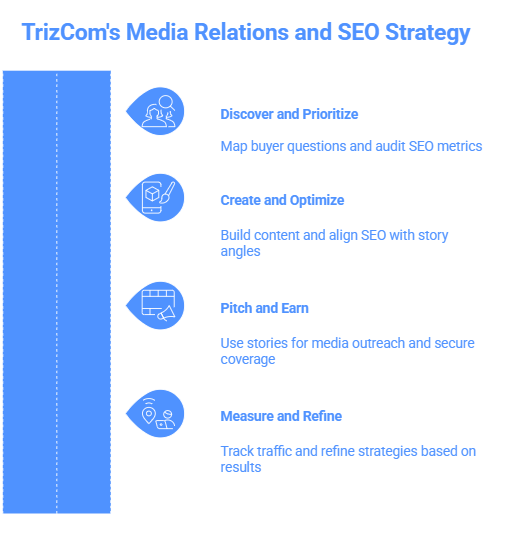
Our method pairs TrizCom’s media relations expertise with SEO strategy in four steps
Discover and prioritize
Map buyer questions and user‑intent keywords across the funnel
Audit current rankings organic traffic, AI- driven search results and backlink profile
Create and optimize
Build or refine content (blogs, landing pages, resource hubs) around those themes
Align on‑page SEO with clear, journalist‑friendly story angles
Pitch and earn
Use those stories for media outreach, thought leadership and digital PR campaigns
Secure coverage on relevant, high‑authority domains with strategic backlinks
Measure and refine
Track organic traffic, rankings, referral traffic and conversions tied to PR activity
Double‑down on outlets, topics and formats that move pipeline, not just impressions
This is how we connect “We got a great article” to “We can see the lift in organic leads.”
PR, SEO and AI Search a Match Worth Engineering
In today’s digital landscape, the connection between public relations, search engine optimization (SEO) and AI search is hard to ignore. All three rely on strong, relevant content. Together, they form a practical alliance that supports organic traffic growth, LLM citations and brand authority.
PR professionals excel at storytelling and building relationships with audiences and the media. When those strengths support high quality content, results extend beyond awareness. PR elevates brand visibility and credibility with people, search engines and the AI systems that scan trusted sources for safe answers.
SEO then makes that same content easy to find and easy to quote. By shaping pages around user intent, common AI prompts and technical best practices, SEO ensures the right people see your stories at the right moment and that LLMs can understand and reuse them. When content aligns with real queries, engagement and sharing follow naturally.
As PR generates buzz and credible backlinks through media outreach, SEO and AI search amplify those signals in rankings and answers. The more your brand appears as a trusted source, the more opportunities arise for new coverage, new links and new citations. Integrated PR, SEO and LLM visibility anchored in quality content become a steady driver of human and machine discovery, rather than three disconnected efforts.
The Content Divide SEO Agencies vs PR Firms
In digital content marketing, SEO agencies and PR firms often start from different assumptions. SEO teams usually build content for search engines and now AI search first. They select keywords and common prompts, structure pages for crawlers, and optimize for specific search queries so content can rank and be safely pulled into LLM answers. The main aim is to climb the search results, earn citations in AI tools, and capture organic traffic.
PR firms, on the other hand, write for people first. Content is designed to resonate with audiences, shape perception and build trust. Stories are framed to attract coverage, spark conversation and support reputation. Keywords and AI friendly phrases still matter, but they are woven into narrative rather than driving it.
Both views bring strengths. SEO driven content can perform well in search and AI summaries but may feel flat or transactional if it lacks a compelling story. PR driven content can engage readers and media but underperform in organic and LLM search if it is not mapped to clear keyword themes, prompts or search demand.
The divide closes when teams collaborate. Keyword and query data informs which stories to tell. Storytelling skills make keyword rich, AI legible content engaging. Media coverage, with its high authority backlinks, feeds domain strength and supports rankings and citations, while SEO ensures those media linked pages are built to convert and to be reused accurately in AI answers.
Securing Valuable Backlinks Through PR That Help SERPs (Search Engine Results Pages)
According to the Search Engine Land article, How important are backlinks for SEO in 2026? One of the clearest ways PR supports SEO is through backlinks from credible outlets and industry publications. These links are more than traffic sources they are signals to search engines that your content is trustworthy. Studies continue to show that backlinks remain a major ranking factor in Google’s algorithm and large language models (LLM), especially when they come from high‑authority domains.
A feature in a respected industry outlet or a mention in a major publication does two things at once it raises your profile and creates a high‑quality backlink. When those links point to pages built around targeted keywords, the SEO impact grows.
PR also helps by shaping content that people want to share. Strong stories original data, expert quotes and useful explainers are more likely to be referenced by journalists, bloggers and partners. Each new, relevant backlink further strengthens the authority of your domain and the pages those stories point to.
Rather than chasing low‑quality links, a PR‑driven approach focuses on earned coverage that already aligns with your brand and audience. The result is a backlink profile that looks natural, supports your reputation and improves your chances of ranking for meaningful, user‑intent keywords.
Measuring the Impact of PR on Organic and LLM-driven Traffic
To make PR part of your organic strategy, you have to measure it that way. That now includes both classic search and LLM-powered results. Setting up analytics and reporting tools such as Google Analytics and SEO platforms (SEMRush, ahrefs and UberSuggest) plus whatever LLM reporting tools you have access to lets you see how PR activity influences search behavior across both.
Key steps include
Tagging PR campaigns with UTM parameters to track referral traffic from coverage
Monitoring changes in non branded organic sessions and unbranded queries in both traditional search and AI search assistants after major PR pushes
Watching keyword rankings and visibility for pages linked in media stories, including how often they appear or are cited in LLM search answers
Tracking brand and executive mentions inside AI summaries where you are cited as a source, then tying those moments back to specific PR efforts
Comparing engagement quality time on site, pages per session and conversions between PR and LLM-driven visitors and other traffic
Some SEO tools come with a steep subscription fee. Many digital PR agencies, including TrizCom PR, already maintain these platforms and can share reporting without adding to your software budget.
The goal is to move past vanity metrics and look at indicators that connect to business outcomes. When you can show that PR mentions correlate with improved rankings, stronger organic traffic and better conversion patterns, it becomes easier to justify integrated investment in PR and SEO. I can’t speak for all PR firms, but at TrizCom PR, we don’t sell our clients hours, we sell them results!
Findings Benchmarks from PR + SEO Integration
Here are three useful data points to anchor your PR + SEO strategy
In a 2025 survey, Digital PR Statistics 2025: Trends, Insights, and Strategies by GiGiEXE, 89.6% of professionals named digital PR as their most effective tactic for building high‑quality backlinks, 83.2% cited it for brand awareness and 77.5% for improving organic traffic and rankings.
According to Clutch’s article, 8 SEO Statistics to Know in 2025, across multiple studies, roughly nine in 10 marketers reported that SEO improved website performance and marketing goals in 2024.
Research on digital PR campaigns in 2024 by REBOOT found that 95% of companies considered link building part of their content marketing strategy and the average domain rating (DR) of digital PR coverage was in the “strong” range around 60.What It Means
What It Means
PR does more than generate coverage
When aligned with SEO, each story can support rankings, organic traffic, conversions and how often you are cited in LLM search results, not just impressions.
SEO becomes more human and more quotable
PR informed content brings narrative, proof points and quotes that make keyword rich pages worth reading, sharing and safe for AI systems to quote as a clean explanation.
Backlinks shift from volume to quality signals
Digital PR focuses on links from relevant, high authority outlets that support reputation, search visibility and the trust signals LLMs look for when choosing sources.
Measurement changes how PR is valued
Tracking rankings, organic sessions, conversions and AI or LLM citations tied to PR activity reframes PR as a channel linked to revenue and visibility, not just “buzz.”
Integrated teams move faster across search and AI
When PR, SEO, content and LLM visibility sit in one plan, it is easier to spot topics that deserve a full campaign and to build assets that perform in media coverage, classic search and AI answers at the same time.
FAQ PR, SEP and LLM Search
1. What is the difference between PR and SEO?
PR focuses on reputation and relationships through storytelling, media outreach and stakeholder communication. SEO focuses on how your site and content appear in search results and, increasingly, how they are selected for AI generated answers. Integrated programs use PR to earn trust and coverage, and SEO to make sure that coverage supports discoverability, conversions and clean explanations LLMs can safely cite.
2. Can PR alone improve our search rankings?
PR alone can help, especially if it earns links from strong domains that search engines and AI systems already trust. Without on site optimization, clear keyword mapping and technical SEO, those gains are usually limited and hard to repeat. The strongest impact comes when PR, SEO and LLM visibility are planned together so each story has a home, a link and a role in search and AI results.
3. How long does it take to see SEO impact from PR?
Search engines need time to crawl new links and adjust rankings, and AI systems refresh on their own cycles. Many brands see early movement in rankings and organic sessions within 60–90 days of consistent PR + SEO activity, with more substantial gains over 6–12 months. LLM citations often lag a bit behind as models update, which makes steady, ongoing PR especially important.
4. How should we split budget between PR and SEO?
There is no single ratio. Many mid market brands do well when PR, SEO, content and LLM visibility sit in one shared budget. That makes it easier to fund the work that is actually performing, whether that is a data story that keeps earning links, an anchor page that ranks and converts or research that AI tools begin to cite. Separate budgets tend to slow that adjustment.
5. Does this approach work for B2B and B2C?
Yes. In B2B, thought leadership, trade coverage and analyst mentions can drive highly qualified traffic, leads and AI citations in tools your buyers use. In B2C, lifestyle, local and review driven outlets shape both traditional search visibility and what people see in AI assistants when they ask for options. The mix of outlets and keywords changes, but the integrated method stays consistent.
6. What should we track to prove ROI?
Useful metrics now include non branded organic sessions, rankings for priority keywords, referring domains from earned media, assisted and direct conversions from organic traffic, branded search volume over time and when possible, how often your brand, executives or research appear in AI or LLM answers for key queries. Together, those signals tell you whether PR is lifting both search and AI visibility.
7. Can we start small?
Yes. Many brands begin by aligning one or two anchor topics across PR, SEO and LLM search, instead of trying to fix everything at once. A focused pilot around a key product, service or issue often gives you enough proof across coverage, rankings, traffic and AI visibility to expand the model with confidence.
References
Digital PR statistics 2025 – summary of how digital PR supports backlinks, brand awareness and organic traffic.
SEO statistics 2024–2025 – data on how marketers view SEO’s impact on website performance and goals.
Digital PR backlink and link‑building research 2024–2025 – analysis of digital PR backlinks, link‑building prevalence and domain authority trends.
Large‑scale Google ranking factor study – correlation between domain‑level link authority and higher search rankings.
These sources are helpful background reading for internal teams, analysts and stakeholders who want third‑party context around PR + SEO integration.
Bringing PR, SEO and AI Search Together
To wrap things up, PR and SEO are no longer separate conversations. When you connect story, search and now LLM visibility, every article, quote and data point starts to work harder for your brand. The brands that win are not the loudest. They are the ones that treat earned media, on-site content and analytics as one system, then keep refining it until reporters, search engines and AI tools all arrive at the same conclusion you are a trusted source.
Talk with TrizCom PR about PR and SEO
If you are ready to see where PR and SEO are helping you and where they are leaving money on the table, let’s talk. TrizCom PR can audit your existing coverage, search performance and AI visibility, then build a practical plan that fits your budget and your internal team. Email me directly at jo@trizcom.com or give me a call at 214-242-9282, and let’s see what happens when your story is built to rank, to be cited and to convert.
Everyone has a story. Let TrizCom PR tell yours.
Author
Jo Trizila, Founder & CEO, TrizCom Public Relations
Jo Trizila leads Dallas‑based TrizCom PR, an award‑winning digital public relations agency she founded in 2008. She has guided integrated PR programs for startups, middle‑market companies and national brands, with deep experience in crisis communications, expert positioning and data‑driven media strategy.
Jo is also the creator of Pitch PR, a press release distribution company and a frequent speaker on earned media ROI, including sessions at the Earned Media Mastery virtual summit.
For more information contact jo@trizcom.com or 214-242-9282.