Should You Still Blog When AI Answers Most Questions Today?


Split graphic showing a human profile bisected down the middle. Left side white labeled “AI Organic Search.” Right side dark labeled “Organic Search.” Header reads “Does Blogging Still Matter?”

If AI answers everything, why blog?

AI and Google pull from what already exists. I’m going to repeat that, AI and Google pull from what already exists. If your expertise is not on the page, it is not in the results. A steady, useful blog does four jobs at once: earns search visibility, feeds AI overviews with clean facts, arms sales with links that answer real questions and gives reporters quotable lines they trust. Blogging is not a journal. It is a library of answers your customer needs.

When readers land on your site, they want clarity fast. Your blog is the place to explain key ideas, show proof and offer next steps in one visit. Done well, each post becomes an asset that works long after publish day.

“Blogging is not a journal. It is a library of answers your customer needs.”

This blog walks through the why, the how and the proof so you can decide with confidence.

What you will learn

  • Why blogging still matters when AI answers quickly

  • How to use user intent keywords to match what people actually want

  • The signals AI and Google reward and how to bake them into every post

  • A cadence plan you can keep without burning out

  • Content formats that teach, compare, prove and convert

  • Where AI can speed the work and where humans protect voice and facts

AI search vs search engines. Who is winning

AI-powered search tools like ChatGPT and Perplexity are gaining ground. People use them for quick answers, summaries and idea starters. Growth is real and conversational results feel efficient for narrow tasks. Even with that momentum, traditional search engines still carry most of the daily traffic. For broad discovery, shopping and research across many sources, Google and Bing remain the first stop for most users. The behavior shift is visible, but it has not replaced classic search.

What this means for content is simple. Plan for both patterns. Write posts that answer the core question in the first screen, then expand with steps, tables and FAQs that AI can cite cleanly. Keep facts up to date, name entities clearly and link to related guides, pricing and case studies. Use Article schema and add FAQ or How-Tos when they fit. This approach helps posts rank in search while making them easy for AI to reference accurately.

Net: it is not either or. Plan content that can rank in search and be cited cleanly by AI.

AI Search VS Organic Web Traffic Statistics

  • Roughly 60% of Google searches now end with no click to a website (so-called zero-click results). Search Engine Land

  • Zero-click share has risen year over year; one analysis shows increases across the U.S., EU and UK in 2025.  Search Engine Land

  • For queries that trigger AI Overviews, the average CTR on the #1 organic result fell from 7.3% to 2.6% year over year, a ~65% relative drop in clicks to that top listing. Digital Content Next

  • Consulting research estimates 15–25% reductions in organic site traffic attributable to zero-click/AI summary behavior across categories. Bain

  • News publishers show the sharpest impact: some report traffic declines up to 40% since AI Overviews rolled out, with zero-click rates in news rising from 56% to 69%. (Impact varies by outlet; Google disputes parts of these studies.) New York Post

What is SEO and how can PR help?

SEO is the practice of making your site easy to find and trust in search results. It mixes clear content, technical basics like speed and mobile and links from reputable sites. PR strengthens SEO by earning credible mentions and backlinks from news outlets, trade media and quality blogs. Those links act like votes of confidence that lift rankings. PR also builds entity authority with consistent names for people, products and locations, which helps search engines connect your brand to key topics. Strong PR assets make better SEO pages too: quotable spokespeople, verified stats, case studies and images with alt text. Add article, FAQ or How-To schema, keep facts dated and link posts to service, pricing and case study pages. When PR and SEO plan topics together, you win both awareness and qualified traffic.

What is LLM and how can PR help?

A large language model is AI that predicts words to answer questions or create text. It relies on patterns learned from public content and favors recent, structured and trustworthy sources when citing. PR helps LLM visibility by publishing quality content worth citing. Think clear definitions, timelines, data tables and FAQs that answer in the first 150 words. Use consistent entity names, author bios, dates and linked sources. Mark up pages with article plus FAQ or How-To schema. Place quotable lines and short summaries that models can lift cleanly. Distribute those assets through earned media, partner sites and bylines to broaden trusted signals and links. Monitor common AI answers to your core queries, then fill gaps with new explainers, comparisons and case studies. In short, PR produces the credible source material LLMs look for and keeps it current.

The data that ends the debate

Neil Patel’s team compared 20 companies over 12 months. Ten kept publishing. Ten stopped. The gap was clear.

Neil Patel's blogging chart

Two takeaways:

  • Pausing a blog accelerates organic decline. Teams that stopped saw more than double the SEO (search engine optimization) drop.

  • Consistent publishing correlates with large LLM gains and real revenue lift.

Why this happens:

  • Fresh, structured, sourced articles send the signals search engines and AI systems use to rank, cite and recommend.

  • When publishing stalls, those signals fade. Competitors fill the gap with newer, clearer content.

The lesson is simple. Keep publishing on a schedule, keep posts current and keep structure tight. Momentum compounds when your content stays fresh and useful.

Source: Neil Patel email, Oct 29, 2025.

Email our team

Signals AI and Google reward

Search engines and AI tools reward content that feels recent, credible and easy to scan. Think of each post as a product. Label it, package it and make the value obvious from the first paragraph.

  • Freshness: recent posts with clear dates, updated stats and current examples

  • Structure: scannable headers, short paragraphs, pull quotes, lists and a TLDR box up top

  • Authority: named author with credentials, sources linked, quotes from experts, first party data

  • Entities: precise names for people, products, locations and definitions of key terms

  • Schema: Article plus FAQ or How-To where it fits organization and person markup on your site

  • Answers fast: state the answer in the first 150 words and expand below

  • Internal links: point to related guides, pricing, case studies and service pages

  • Media assets: original charts, images with alt text, short clips and downloadable checklists

  • Consistency: a steady cadence that keeps signals flowing to search engines and AI systems

  • Experience: fast load, mobile friendly, clean design, no intrusive pop-ups

“Think of each post as a product. Label it, package it and make the value obvious from the first paragraph.”

When you ship posts that check these boxes, you make it easier for readers to understand and easier for systems to surface your content. That is how rankings, citations and conversions move.
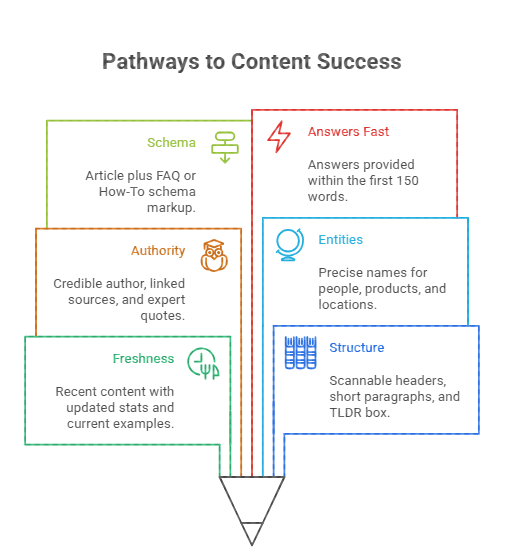
nfographic titled Pathways to Content Success. Six boxes feed into a pencil.

Write for your customer with user intent keywords

What are user intent keywords?

User intent keywords are the words and phrases people type or say that show what they want to do right now. They go beyond a topic and signal purpose: learn, compare, buy or navigate. Search engines exist to match that intent with the most relevant result.

Simple example:

If someone types Italian food, the results will likely feature restaurants. That query reads like a place or cuisine search. If the person types Italian recipes or how to make lasagna, the results shift to step-by-step guides and ingredient lists. Same subject, different intent.

How to write for your customer using user intent keywords?

Start with the words your customers use. Pull phrases from sales calls, support tickets, social comments and onsite search. Real language beats guesswork.

Group by intent:

  • Informational: what is, how to, pros cons, cost to

  • Comparative: vs, best for, alternative to

  • Transactional: pricing, demo, near me, book

  • Navigational: brand terms like login, case studies

  • Local: service + city, neighborhoods, landmarks

Match format to intent:

  • Informational -> explainers, checklists, FAQs, glossaries

  • Comparative -> X vs Y tables, scorecards, decision guides

  • Transactional -> pricing pages, ROI calculators, implementation timelines

  • Local -> city pages with service details, maps, local testimonials

Build titles and H2s with intent modifiers:

  • Pair the topic with a verb or outcome

    • Franchise PR pricing guide

    • Media training checklist for first TV interview

    • Integrated marketing examples for multi-location brands

Answer the next question:

  • Add a summary at the top, a quick table and a short What’s next box

  • Include three to five FAQs that mirror People Also Ask phrasing

On-page cues that reinforce intent:

  • First paragraph answers the core task

  • One table or list per post for skimming

  • Internal links guide readers to the next stage in the journey

  • Apply FAQ or How-To schema when it supports the page
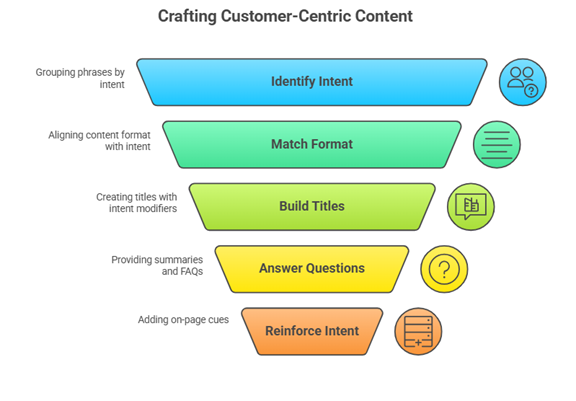
Infographic titled Crafting Customer-Centric Content showing a five-step funnel

Quick checklist:

  • Who is this for and what are they trying to do

  • Primary intent plus 2 or three modifiers

  • One clear outcome promised in the title

  • Answer visible without scrolling

  • One data point, one example, one CTA that matches the intent

Writing to intent keeps posts useful and discoverable. It also helps sales and support point customers to the right answer without extra back and forth.

Cadence plan that teams can keep

A calendar you can keep beats a burst that burns out. Pick a tier that fits your team and protect it.

Pick a tier and protect it:

  • Minimum viable: Two posts per month per service line

  • Healthy growth: one post per week

  • Aggressive: Two to three posts per week during launches or peak season

Use a 3:2:1 monthly mix:

  • Three evergreen explainers that target informational intent

  • Two timely POVs or newsjacks tied to current coverage

  • One conversion story such as a case study, comparison or pricing guide

Lock a publishing day:

  • Choose one weekday, publish at the same time and treat it like a standing meeting

Assign clear roles:

  • Owner sets topics and briefs

  • Writer drafts with sources and quotes

  • Editor checks facts, voice, links and schema

  • Publisher loads, optimizes and ships on time

Keep a two month runway:

  • Maintain at least six ready to publish drafts

  • Refresh one older post each month with new data, links and a short update note

Weekly rhythm:

  • Mon plan and pull voice of customer notes

  • Tue draft

  • Wed edit and add assets

  • Thu load CMS, internal links, schema

  • Fri publish, distribute to email and social, log metrics

Consistency builds trust with readers and with search systems. Protect the cadence and the channel will start paying you back.

Get in touch

Content types that win across SEO and AI

Your blog works best when each post has a clear job. Mix formats that teach, compare, prove and guide. Use explainers to answer core questions, comparisons to help choices, case studies to show outcomes and checklists to drive action. This variety meets different intents, keeps readers engaged and gives search and AI systems clean signals to surface and cite.

Evergreen explainers

Define key terms, show steps, include a TLDR table and three to five FAQs.

Example: “Franchise PR explained” with a glossary and media list starter kit.

Decision guides and comparisons

Help readers choose with criteria, scorecards and pros and cons.

Example: “Media training agency vs DIY” with a cost and outcome table.

Pricing and timelines

Set expectations with ranges, factors and sample schedules.

Example: “How long does national TV take from pitch to air?” with a week-by-week plan.

Case studies with numbers

Lead with the outcome, then show the playbook and assets used.

Example: “How a regional launch earned 24 placements and three speaking invites.”

Questions hubs

Collect top customer and sales questions on one page, marked up with FAQ schema.

Example: “Crisis communications FAQ for franchise systems.”

Playbooks and checklists

Step-by-step, printable and linkable for journalists and partners.

Example: “First TV interview checklist” plus a one-page download.

Newsjacks and timely POVs

Add expert context to a breaking story with one chart and two quotes.

Example: “What the new local search update means for multi-location brands.”

Local intent pages

Blend service details with city-specific information, maps and local testimonials.

Example: “Media training in Dallas” with venue options and travel tips.

Original data and mini studies

Publish small, repeatable benchmarks or surveys.

Example: “Average response time from morning TV producers in Q1.”

How-to videos and short clips

Embed a 60 to 120-second walkthrough with captions and a transcript.

Example: “How to build a spokesperson one-liner.”

What to include in every post:

  • Clear summary up top

  • One table or checklist

  • Sources, dates and named author

  • Internal links to related guides, pricing and case studies

  • Article schema plus FAQ or How-To when it fits

  • A next step that matches the reader’s intent

The mix above creates a library that works across search, AI summaries, media outreach and sales enablement. Each post has a job and a place in the journey.

AI assist playbook that saves time without losing voice

AI speeds up the work. Your team supplies the thinking. Use AI where it removes friction and keeps humans on strategy, accuracy and tone.

Where AI helps:

  • Research sweep: expand topics, questions, related entities, common objections

  • Outline drafts: headings, talking points, FAQ ideas, table structures

  • Language variants: title and meta options, pull quotes, social snippets

  • On-page SEO: internal link suggestions, alt text drafts, FAQ and How-To starters

  • Schema scaffolding: Article, FAQ, How-To fields to hand to the CMS

  • Repurposing: turn a post into a byline, newsletter blurb, two short videos

AI Guardrails:

  • Fact check every stat and date

  • Cite sources with links and names

  • Keep brand voice. Edit for tone and clarity

  • Run a quick originality check

  • Avoid filler. Add first party data, examples, quotes

  • Label images and charts with plain alt text

Chat GPT PR Prompt recipes for blogs:

  • Outline: “Give me an H2/H3 outline for [topic] for [audience]. Include a TLDR table, five FAQs and one short case example.”

  • Title set: “Write 10 titles with the primary intent [informational/comparative/transactional] and the outcome [result]. 55 to 60 characters. (including spaces)”

  • Internal links: “From this post, suggest eight internal links to these URLs grouped by stage [top, middle, bottom]. Give anchor text ideas.”

  • Schema: “Draft minimal JSON LD for Article plus FAQ with these questions and answers. No fluff.”

Quality checklist:

  • Answer in the first 150 words

  • At least one table or checklist

  • Two internal links in, two out

  • One quote or data point we can verify

  • Clear next step that matches the reader intent

Use AI as a co author that never ships without human review. That balance keeps quality high and speed manageable.

Why blogs fail

Blogs do not fail because the channel is broken. They fail because the work is unstructured, sporadic and disconnected from real questions. If you blog to check a box without a plan to repurpose, measure and refresh, the results will fade.

Common failure patterns

  • No clear audience or intent per post

  • Topics chosen by guesswork, not voice of customer

  • Irregular cadence that resets momentum

  • Walls of text with no summary, table or FAQs

  • Thin content that repeats competitors with no data or examples

  • Missing schema, slow mobile pages, weak internal links

  • No repurposing into email, social, sales decks or bylines

  • No refresh cycle or scorecard tied to outcomes

How to turn it around

  • Define audience, intent and outcome before drafting

  • Lock a publish day and a 3:2:1 monthly mix

  • Add a TLDR, one table and 3 to 5 FAQs to every post

  • Mark up Article plus FAQ or How-To where it fits

  • Repurpose each post into two channels and refresh one post monthly

  • Track entrances, citations, links and assisted conversions

Publish answers AI and search engines can trust that people can use

If AI answers everything, your job is to give it something accurate to cite and give people something useful to read. Keep the cadence, write to intent and package each post so value is obvious in the first scroll. When the library grows, search lifts, sales get better links and reporters find clean quotes. Ready to put this system to work?

An example of the power of blogs

At TrizCom PR, we deliberately shifted to publishing more owned content, including long-form blog posts. The effect is clear in Google Analytics. More than 60 percent of our organic website traffic now comes from keyword-optimized blog posts. The other 40 percent arrives through AI search that cites or summarizes those same posts.

Why this works

  • Posts are written to user intent, so answers appear in the first screen

  • Article plus FAQ or HowTo schema mirrors on page text

  • Internal links connect blogs to services, pricing, and case studies

  • We refresh older posts with new data and note the update

What we did next

We repurposed top performers into email, short video, and bylines, then linked everything back to the pillar posts. The result is steady nonbrand traffic, better qualified leads, and a content library that AI and search can trust.

TrizCom PR can help

If you want a blog that feeds SEO, AI search, sales and PR, we can run the full system or coach your team. We plan clusters, write human led posts, add structure AI can cite and report on what moves the business. Ready for a 90 day pilot that proves it. Reach out and let’s talk.

Everyone has a story. Let TrizCom PR tell yours!

Book a quick call
Promotional graphic with a smiling woman in a red blazer standing indoors; red panel reads ‘Jo Trizila’ and ‘TrizCom PR & Pitch PR.’”

About the Author:

Jo Trizila – Founder & CEO of TrizCom PR

Jo Trizila is the founder and CEO of TrizCom PR, a leading Dallas-based public relations firm known for delivering strategic communications that drive business growth and enhance brand reputations as well as Pitch PR, a press release distribution agency. With over 25 years of experience in PR and marketing, Jo has helped countless organizations navigate complex communication challenges, ranging from crisis management to brand storytelling. Under her leadership, TrizCom PR has earned recognition for its results-driven approach, combining traditional and integrated digital strategies to deliver impactful, measurable outcomes for clients across various industries, including healthcare, technology and nonprofit sectors. Jo is passionate about helping businesses amplify their voices and connect with audiences meaningfully. Her hands-on approach and commitment to excellence have established TrizCom PR as a trusted partner for companies seeking to elevate their brand and achieve lasting success. Contact Jo at jo@TrizCom.com.

AI Search and Blogging FAQ

How to use AI for blogs?

Use AI to speed planning and polish, not to replace judgment. Start with a brief that defines the audience, user intent and the outcome. Ask AI for an outline, title options, FAQs and a TLDR box. Use it to expand a research list, surface related entities and suggest internal links. Draft in your voice, then have AI propose meta descriptions, alt text and schema starters for Article and FAQ. Fact check every stat, add first party examples and cite sources with dates. Finish with a table or checklist and a clear next step. Repurpose the post into a byline, newsletter blurb and two short clips. Measure nonbrand entrances, assisted conversions and new links, then feed wins back into the brief.

Are blogs still a thing?

Yes. Blogs remain the easiest way to publish structured expertise that search engines and AI can understand and cite. A steady blog gives you a library of answers for customers, sales and reporters. What changed is how blogs work. Short intros, clear H2s, an upfront summary and one table or checklist help readers and machines. Add Article schema and use FAQ or How-to when it fits. Refresh older posts with new data and internal links. Plan a cadence you can keep, such as one post per week and track outcomes like nonbrand entrances and assisted conversions. Blogs that publish consistently, write to user intent and provide sources still perform.

SEO vs content quality writing.

It is not either or. Quality writing clarifies the answer for a human. SEO helps the right person find it. Start with user intent (also known as search intent), then write a plain language summary, followed by steps, examples and a small table. Add sources with dates, define people and products precisely and include internal links to the next logical page. Technical basics still matter: mobile speed, clean HTML, descriptive alt text and valid schema. If you have to choose, ship a clear, accurate post, then iterate with SEO improvements. The best results come from quality writing that is structured so search and AI can understand it.

Has AI killed SEO and blogging?

No. AI changed the playing field but did not remove the need for trusted sources. AI systems rely on published, structured and current content. If your expertise is not on the page, it will not be found or cited. What is different is format and cadence. Lead with the answer, add a TLDR box, use H2s that mirror real questions, include a table or checklist and provide sources. Add Article schema and consider a FAQ or How-to. Keep a weekly schedule and refresh older posts. Plan for both search and AI by writing posts that can rank and be quoted cleanly.

The power of frequently asked questions.

FAQs match how people search and how AI formats answers. Add three to five FAQs that mirror “People also ask” language. Keep answers short, factual and linked to deeper guides. Place FAQs near the bottom so the main narrative flows. Mark up the section with FAQ schema when the content is visible on the page. Good FAQs reduce support tickets, help sales answer objections and improve your odds of earning rich results and AI citations. Update FAQs when pricing, timelines or regulations change and link each answer to a next step such as a comparison, calculator or booking page.

What is a schema markup?

Schema markup is structured data that helps search engines understand your page. It is added as JSON-LD in the HTML and describes the content type and key properties. For blogs, start with Article. When the page contains real Q&A, add FAQ. For tutorials, consider How-to articles. Keep fields accurate and consistent with visible text. Include author, date, headline, description and mainEntity for FAQs. Proper schema improves eligibility for rich results and makes it easier for AI systems to parse and cite your content. Validate with Google’s Rich Results Test and update schema when the page changes.

Why are backlinks so important?

Backlinks are links from other sites to your pages. They signal trust, relevance and authority. High quality links from news outlets, trade media, universities and respected blogs help pages rank and can improve how often AI systems encounter your brand while training or retrieving. Earn links with useful assets: data tables, checklists, glossaries and clear definitions. PR helps by placing bylines, quotes and case studies that credit your site. Avoid buying links or using spam tactics. Focus on relevance, editorial context and sources that real readers use. Track new referring domains and link growth to priority pages.

What metrics to use to measure your blog’s success?

Measure visibility, engagement, authority and conversion. For visibility, track non-brand organic entrances, impressions, clicks, featured snippets and AI overview mentions. For engagement, monitor scroll depth to 75 percent, average engaged time and clicks on tables, downloads or jump links. For authority, watch new referring domains and internal links to service and pricing pages. For conversion, use assisted demo or contact submissions from blog paths and newsletter signups. Operationally, track publish-on-time rate, valid schema, and refreshes shipped. Review monthly, compare to a 90-day target and double down on formats and topics that create assisted conversions.

Can I use ChatGPT to write my blogs?

Yes, as an assistant. Use ChatGPT for outlines, title sets, FAQs, meta ideas and first drafts. Then apply Google’s EEAT framework to make the post worth ranking and citing.

  • Experience: add first-hand examples, screenshots, quotes from your team and lessons learned.

  • Expertise: name the author, include credentials and explain the why behind your advice.

  • Authoritativeness: link to reputable sources, publish case studies and earn mentions from trusted sites.

  • Trustworthiness: fact check dates and stats, disclose conflicts and keep policies and pricing current.

Keep the human voice. Edit for clarity and intent, not just keywords. Put the core answer in the first 150 words, add one table or checklist and include Article plus FAQ or How-to schema when it fits. Finish with internal links to related guides, pricing and case studies. AI speeds the work. EEAT earns results.

How can I repurpose blog content?

Here’s a simple, repeatable plan.

Start with a pillar

Pick a strong post. Add a TLDR, one table, FAQs, and clear next steps. That structure makes repurposing easier.

Break it into formats

  • Email: one-sentence hook, key takeaway, single CTA

  • Social: 4 to 6 posts with a pull quote, stat, or checklist item

  • Short video: 60–90 seconds that walks through the table or steps

  • Carousel or infographic: turn the table or FAQs into slides

  • Sales enablement: a one-page PDF summary and a short talk track

  • Webinar or live: outline becomes a 20-minute demo with Q&A

  • Byline: adapt into an opinion piece for trade media

  • FAQ hub: move the Q&A into your central FAQ with internal links

System and cadence

  • Repurpose within seven days of publication

  • Link every asset back to the pillar page

  • Track nonbrand entrances, saves, shares, and assisted conversions

  • Refresh the pillar quarterly with new data and relaunch the set

Use AI to draft outlines and captions. Keep humans on voice, facts, and examples.

Is AIO (AI Optimization) and SEO the same?

No. They overlap, but they are not the same.

SEO makes your pages easy to find and trust in classic search. It focuses on user intent, clear structure, fast pages, internal links, schema, and earning quality backlinks.

AIO (AI optimization) makes your pages easy for AI systems to parse, quote, and cite. It favors upfront answers, TLDR boxes, precise entities, dated sources, FAQ or How-to patterns, and clean JSON-LD that mirrors on-page text.

How they work together

  • Lead with the answer in the first 150 words

  • Use H2s that match real questions

  • Include one table or checklist per post

  • Add Article plus FAQ or How-to schema when it fits

  • Name the author, add credentials, and link sources with dates

  • Build internal links to pricing, case studies, and guides

Result: SEO helps people find you. AIO helps AI cite you. Do both.

Let’s get started


The Embargo Play in Public Relations (free download checklist)

 
Man holding a news microphone

If you’ve ever tried to land a clean, coordinated announcement with more moving parts than a Swiss watch, you’ve probably used an embargo. Done right, it buys accuracy and calm. Done wrong, it buys headaches and a Slack channel full of fire emojis.

Embargo definition

An embargo is a simple agreement between you and a journalist to hold your news until a specific date and time. Reporters get the materials early, ask questions and prepare their stories, then publishes the story when the clock hits the agreed lift. The story is still attributed to you, and you must provide verifiable facts, quotes and assets. A proper embargo includes written acceptance, the exact lift time with time zone and clear attribution.

What is an embargo and why should leaders care?

Plain English. In journalism and PR, an embargo is a simple agreement with the press to hold a story until a specific date and time. Reporters can review materials, ask questions and prep coverage. They publish when the clock strikes.

What an embargo is not. It’s not an exclusive. It’s not background. It’s not off the record. With an embargo the reporter still attributes the news to you and you still have to provide facts, assets and quotes.

My point of view. Embargoes buy accuracy and coordination, not hype.

What gets embargoed?

The short list is real news with timing teeth. Think acquisitions and mergers, executive moves, lawsuit filings, recalls and safety updates, market-moving announcements, major product launches tied to an event, peer-reviewed research or data drops and regulatory shifts that hit multiple regions at once.

These can be shared under embargo as a press release, media advisory, backgrounder, data pack, B-roll or even a simple news tip. The format matters less than the timing and clarity.

The goal is to give reporters a head start to verify facts, gather context and line up interviews. When the clock lifts, coverage lands clean, consistent and everywhere at once.

If it’s soft news, minor feature update, routine partnership, feel-good fluff, skip the embargo and ship it on your blog. Embargoes are for moments where simultaneity equals clarity and accuracy matters more than speed.

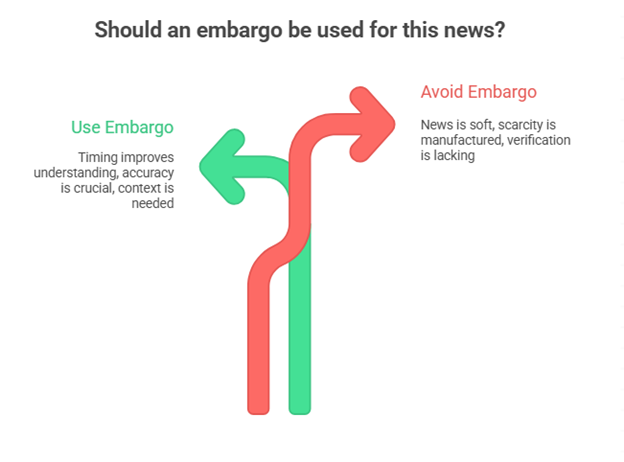
red and green arrows for should an embargo be used for this news?

When should you use an embargo?

Use an embargo when timing improves public understanding.

  • Multi-stakeholder launches with complex facts that need the same numbers everywhere

  • Regulated or market-moving news where accuracy and timestamps matter

  • Research or data drops that need context, charts and a spokesperson on standby

  • Executive transitions that require synchronized notices to staff, partners, customers and media

Quick test. If releasing at the same time helps people grasp the news and avoids confusion, you qualify.

Green, orange, red and pink boxes with icons for embargo usage

When should you avoid an embargo?

  • Soft news or light product updates that can live on your blog

  • Stories built on manufactured scarcity

  • Anything you can’t brief fully or verify with proof

If you’re still polishing the numbers, you’re not embargo-ready.

Learn more

Does an embargo have to be an exclusive?

Short answer: no. An embargo sets timing. An exclusive sets access.

Common models

  • Embargo, multi-outlet. Same materials to several reporters with the same lift time

  • Exclusive, no embargo. One outlet gets the story first on their schedule

  • Hybrid. One outlet gets the first interview; others get embargoed materials for a coordinated lift

blue, green and purple arrows and icons for which embargo model should be used for media outreach?

 How to choose

  • Need broad coverage and accuracy → multi-outlet embargo

  • Need depth, a flagship narrative or a relationship play → exclusive

  • High stakes and you want both → hybrid

Pitfalls to avoid: accidental exclusives, mixed instructions and unequal access without a plan.

Embargo mechanics (make this muscle memory)

  • Time-zone clarity: Always write the lift like this: “Oct 28, 7:30 a.m. CT (8:30 a.m. ET).” If global, mention key market hours/holidays.

  • Written acceptance: Require an explicit “I agree to the embargo” reply before sending assets. Log who accepted and when.

  • Uniform labels: Stamp every file and page header with the lift time and contact line.

Targeting & list hygiene

  • Who gets it: Beat-matched reporters who’ve shown accuracy and honored embargoes before.

  • Small is safer: Tighter lists reduce leaks and improve responsiveness.

  • Keep a log: Outlet, reporter, acceptance Y/N, assets sent, questions, result. Treat it like CRM.

Asset delivery & preflight

  • Distribution plumbing: Use expiring, view-only links; disable downloads by default; unique URL tokens per outlet.

  • CMS readiness: Stage your newsroom post as noindex/nofollow; pre-warm the CDN; have the canonical URL ready.

  • Rights & accessibility: Confirm image/video licensing, captions, photo credits and alt text.

  • Localization (if relevant): Pre-translate quotes or release snippets for key markets.

Managing the briefing

Pick a format that matches the news and the clock:

  • Written Q&A for speed and clarity

  • A 15-minute background call for nuance

  • A small huddle when several reporters share a beat

State the rules of the road at the start and again at the end. Log every promised follow-up with an owner and a time. Then deliver.

Social and partner coordination

  • Social embargo: Pre-schedule executive/brand posts for lift-time; give explicit “do not post before” guidance to employees and partners.

  • Partner copy kit: Provide timestamped copy, links and creative so partners can lift clean with you.

Legal and compliance guardrails

  • Never promise off the record in an embargo note.

  • If you’re public or regulated, sync with counsel on quiet periods, Reg FD, exchange rules and trading windows.

  • Define the publish trigger in writing (court filing timestamp, all-hands start, wire time).

Contact Us

A quick example from the field

We recently ran an embargo for an acquisition targeting a niche audience. We used a hybrid: one exclusive interview for the key trade, plus embargoed materials for others. The press release hit The Wire at 8:30 a.m. CT; the trade story posted at 8:35. Five minutes apart, on purpose. The exclusive gave authority; the embargo protected accuracy. Together, they created lift. It worked because the news was genuinely newsworthy and the choreography was tight.

Read the Auto Recycling World  story: https://autorecyclingworld.com/crush-software-solutions-acquires-leading-car-recycling-operating-system/

Another real-world example

For a crisis client filing a lawsuit, we offered an Associated Press reporter an exclusive embargo with access to the firm and the family. The rule: as soon as the filing posted, she could publish. AP moved first. Hundreds of dailies followed. Morning shows picked it up. One well-timed exclusive under embargo delivered reach, accuracy and a clear narrative on day one.

Read the AP Story Here: https://www.jacksonville.com/story/news/nation-world/2017/09/09/water-rushing-discovery-body-ends-harvey-mystery/15772364007/

Why it landed

Real news with human stakes • One reporter, clear rules • Trigger tied to the filing • Quotes and data ready

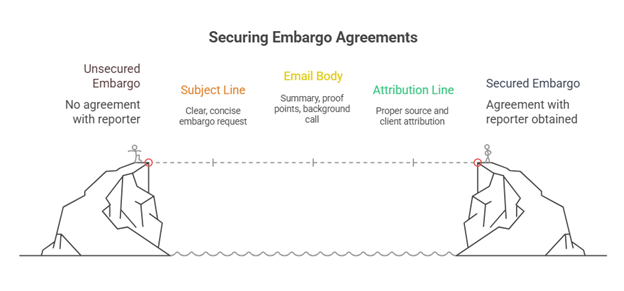
How to ask for an embargo the right way

Subject lines

  • Embargoed for Oct 28, 7:30 a.m. CT: data on [topic]

  • Requesting interest under embargo: interview with [exec], details inside

Email body template

  • Opening line: “Sharing news under embargo until Oct 28, 7:30 a.m. CT. Confirm if you agree and I will send the materials.”

  • One paragraph summary with proof points

  • Offer a 10-minute background call

  • Include the embargo date, time, time zone and attribution line

Attribution line

“Attribution: Jo Trizila, Founder and CEO, TrizCom PR, on behalf of [client].”

Keep it short. Reporters have eyes and calendars. Respect both.

a graphic that spells out the steps for securing embargo agreements

Leak prevention that actually works

  • Get explicit acceptance in writing before you send anything

  • Share via private link with expiry and view-only defaults

  • Watermark PDFs with outlet name and timestamp

  • Use unique tracking links per outlet to spot early access

  • Store all press assets in one versioned folder

  • Keep the list small. Fewer recipients, fewer risks

  • Run a two-minute embargo briefing so no one freelances

What happens if an embargo is leaked?

Unfortunately, embargoes do leak. I’ve lived it. Most PR shops have too. It’s a known risk. That’s why the client must buy into the plan from the start. You can’t hold anyone legally responsible when it happens. You accept the risk because the reward usually outweighs it.

Minute 0–10: Stabilize. Confirm the leak. Screenshot URLs and timestamps. Pause outbound sends. Alert the core team. Lock the facts doc so one owner approves edits.

Minute 10–30: Pick the simplest fix.

  • Partial/low reach → keep your original lift; quietly add context with briefed outlets.

  • Full/spreading → publish now on owned channels and send the link to briefed outlets.

Public lines

  • Holding: “We are aware of early reporting on [topic]. Full details will be available at [time, time zone].”

  • Early lift: “Sharing full details now to ensure accuracy and context,” then link to your post.

Reporter lines

  • Holding: “We’re keeping the original lift so everyone gets the complete story. Happy to answer clarifying questions so you’re ready.”

  • Early lift: “We published early to keep facts clean. Here’s the link, quotes and assets you already have.”

After the dust settles: Thank outlets that honored the embargo. Note patterns if you can. Trim the next list. Tighten controls. Add two lines to the post-mortem: what leaked; what changes.

Got a Story?

When an embargo goes wrong (and what it taught me)

Years ago, on a corporate relocation, I gave an exclusive embargo to a national daily newspaper I trusted. The reporter did their job and confirmed with a second source. The piece ran two days early. Employees hadn’t been told. Painful.

Lessons

Employees first • If internal comms aren’t done, you’re not ready • Exclusives raise the stakes • Assume verification

What I’d do now

Sequence: employees → partners → press • Put the trigger in writing • Keep the circle small, watermark assets • Keep a short confirm ready • If people risk is high, skip the exclusive and use a tight multi-outlet embargo after internal comms land

Publication day orchestration

Sequence matters

  1. Newsroom post goes live with your press release and embargoed story

  2. Press sends land

  3. Executive LinkedIn publishes

  4. Partner emails go out

Have chyron copy ready for broadcast. Track live stories and update your newsroom with rolling links so your audience doesn’t play scavenger hunt.

Metrics that matter

  • Embargo acceptance rate

  • Hit rate within the first two hours of lift

  • Coverage quality: tier, accuracy, message pull-through

  • Share of search movement at seven and 30 days

  • Referral traffic from outlet-specific UTMs

Search & measurement extras

  • Track branded + category keywords in search.

  • Give each outlet a unique UTM.

  • Score each article for accuracy and message pull-through

Wrap-Up & What Matters

Embargoes are not magic; they are choreography. When the story is real, the timing tight and the proof airtight, an embargo turns chaos into clarity. Use it to help reporters get the facts right, keep stakeholders in sync and land coverage that actually travels. Skip it when the news is soft or the numbers are still moving. If a leak happens, do not panic. Steady the ship, publish what is true and keep going.

Call to Action: Put TrizCom PR on the Clock

If you have market-moving news, a delicate transition or a launch that needs to hit everywhere at once, let us make it clean. TrizCom PR can run an Embargo Preflight, build a tight target list and secure written acceptances orchestrate briefings and proof packs and social or partner lifts and stand up a leak response plan with a newsroom ready to publish.


Contact TrizCom PR for a fast read on whether your announcement qualifies and how to make it land on time, accurately and all at once.

DOWNLOAD YOUR FREE EMBARO CHECKLIST

FREE DOWNLOAD: Embargo Preflight Checklist
 

Everyone has a story. Let TrizCom PR tell yours!

Jo Trizila - TrizCom Public Relations

About the Author:

Jo Trizila – Founder & CEO of TrizCom PR

Jo Trizila is the founder and CEO of TrizCom PR, a leading Dallas-based public relations firm known for delivering strategic communications that drive business growth and enhance brand reputations as well as Pitch PR, a press release distribution agency. With over 25 years of experience in PR and marketing, Jo has helped countless organizations navigate complex communication challenges, ranging from crisis management to brand storytelling. Under her leadership, TrizCom PR has earned recognition for its results-driven approach, combining traditional and integrated digital strategies to deliver impactful, measurable outcomes for clients across various industries, including healthcare, technology and nonprofit sectors. Jo is passionate about helping businesses amplify their voices and connect with audiences meaningfully. Her hands-on approach and commitment to excellence have established TrizCom PR as a trusted partner for companies seeking to elevate their brand and achieve lasting success. Contact Jo at jo@TrizCom.com.

Contact Jo Trizila
 

An Integrated Marketing Campaign That Actually Worked

 
Four people holding gears to symbolize an  integrated marketing campaign

Brands are in a constant state of competition—not just for market share but for attention, trust and loyalty. That competition isn’t being fought in a single ad, platform or content type. It’s happening across every touchpoint. And the brands that win? They’re the ones that masterfully connect the dots across all those touchpoints through unified, cohesive and impactful storytelling.

That’s the power of integrated marketing campaigns. These campaigns align message, tone, visuals and timing across all marketing channels—owned, earned, paid and shared media—to deliver an intentional, memorable and trust-building brand experience.

What was once considered a “best practice” is now a business imperative.

Why Integration Now?

The rise of multi channel engagement and the shift in how consumers research and interact with brands has raised expectations. Today’s customers don’t see your media channels as silos—they see one brand. And if your touchpoints feel inconsistent, confusing or out of sync, they lose interest.

Integration solves that.

An integrated marketing strategy gives your brand one cohesive voice across multiple channels, one unified narrative across departments and one shared set of metrics that tracks performance in a way that truly supports business outcomes.

This is where traditional marketing falls short. It’s not enough to “be on social” or “send a newsletter.” Success lies in the ability to orchestrate all your efforts in sync—something only integrated marketing campaigns can deliver.

What Is an Integrated marketing Campaign?

At its core, an integrated marketing campaign is a unified effort to communicate a brand message across all relevant platforms in a way that aligns with your brand’s visual identity, voice, values and strategic goals.

These campaigns incorporate:

  • Email marketing that matches what’s being said on social media

  • Social media posts that support your latest paid media push

  • Owned content (like blogs, videos or whitepapers) that’s reflected in your media relations efforts

  • Earned media that links back to high-value landing pages or downloadable resources

  • Paid campaigns that amplify high-performing content from all channels

When all those tactics are executed around a common narrative, the result is consistent branding and stronger customer connections.

Why Consistent Messaging Matters More Than Ever

The average person encounters up to 10,000 brand messages a day. That might sound like an exaggeration—until you consider every ad, label, headline, social feed, push notification, podcast pre-roll and email subject line competing for attention.

In that environment, only one thing cuts through: consistent messaging that creates mental availability.

When your brand message is aligned across all marketing channels, customers are more likely to recognize, remember and trust your brand. You stop being noise—and start being the signal they’re looking for.

Multi Channel vs. Omnichannel vs. Integrated: What’s the Difference?

Let’s clear up a common confusion:

  • Multi channel marketing means using more than one channel (e.g., you have a website, an email list and social media accounts).

  • Omnichannel marketing focuses on delivering a seamless experience across all platforms—typically in ecommerce environments.

  • Integrated marketing communication connects the dots between strategy, messaging and execution across all of these touchpoints.

A multi channel plan says, “We’re showing up.”

An omnichannel plan says, “We’re making it seamless.”

An integrated marketing communication plan says, “We’re making it meaningful, measurable and strategic.”

How to Build an Integrated marketing Campaign

Here’s a step-by-step guide to building your next integrated marketing campaign:

1. Define the Core Message

Before you launch a campaign, get crystal clear on the single most important thing you want your audience to walk away with. This message should serve as the north star for all content, creative and communications.

Ask yourself:

  • What’s the one idea that should come across in every interaction?

  • Is this message aligned with our brand’s voice, tone and values?

  • Does it support both our short-term campaign goal and long-term brand equity?

For example, if you're launching a new service, your core message might be:

“[Product] empowers small businesses to scale with less stress.”

Everything else—blogs, emails, ads, videos—should echo and reinforce this central promise.

Pro Tip: Use this message as the starting point in all briefing documents and creative kickoffs.

2. Align Around a Big Idea

The “big idea” is not the slogan. It’s the emotional or conceptual framework that makes your campaign memorable and relevant. It’s the thematic hook that ties everything together.

Your big idea should:

  • Tap into an audience belief, behavior or cultural moment

  • Elevate your product or message beyond functional benefits

  • Spark internal alignment among your team

Example: For a health brand launching a wellness app, the big idea might be:

“Health isn’t a destination—it’s a relationship.”

This positioning gives your team narrative direction and storytelling flexibility across multiple channels, while making sure everyone is rowing in the same direction.

3. Map the PESO Model

The PESO Model©


Every campaign should intentionally use the four types of media: Paid, Earned, Shared and Owned (Also known as The PESO Model©,  developed by Gini Dietrich) . This framework allows you to diversify your reach and multiply your message impact.

➤ Paid Media

Ads, sponsored content, boosted posts. Use this to expand reach quickly and target specific audience segments.

➤ Earned Media

PR placements, podcast interviews, analyst endorsements. Use this for third-party validation and credibility.

➤ Shared Media

Organic social content, UGC, influencer posts. Use this to engage your audience and encourage amplification.

➤ Owned Media

Blog posts, landing pages, newsletters, webinars. Use this to go deeper and drive conversion.

Map each tactic to your campaign objectives and identify how each will support the others. For example, a blog post (owned) can be used in a newsletter (owned), pitched to media (earned), boosted on LinkedIn (paid) and reshared on Facebook (shared).

4. Develop a Content Engine

You don’t need dozens of ideas—you need one great piece of content that feeds all others. That’s the power of anchor content.

Start with a high-value, high-effort asset like:

  • A data-backed case study

  • A white paper or research report

  • A branded video series

  • A webinar or expert interview

Then repurpose it across formats:

  • Turn stats into social infographics

  • Break quotes into shareable quote cards

  • Repurpose the narrative into blog posts, emails and PR pitches

  • Extract soundbites for short-form video or podcast clips

This approach keeps your campaign consistent, efficient and high-performing across multiple channels.

Pro Tip: Build a campaign asset matrix to track which content types are needed for each channel, along with production timelines.

5. Optimize for Each Channel

While your message should remain consistent, your execution should be customized. Each platform speaks a different language—your campaign should be fluent in all of them.

For example:

  • Your Instagram post might focus on visual storytelling with short captions.

  • Your LinkedIn post may emphasize thought leadership with a longer, insight-driven format.

  • Your email subject line should deliver value and urgency quickly.

  • Your press release should lead with the news angle and include compelling data.

The mistake many brands make is copying and pasting across platforms. But integrated doesn't mean identical. It means tailored storytelling that feels native, not forced.

Pro Tip: Use a brand voice and tone guide to ensure cohesion, even when formats shift.

6. Automate Where It Matters

Integration isn’t just about messaging—it’s also about operations. Using the right tools can streamline workflow, reduce human error and keep your campaign cadence consistent.

Key areas to automate:

  • Email marketing sequences and drip campaigns

  • Social media scheduling with tools like Buffer, Later or Sprout Social

  • Lead nurturing and segmentation in your CRM

  • Internal communications via Slack workflows or weekly updates

  • Task tracking with platforms like Asana, Trello or Monday.com

Just make sure automation never replaces human oversight. It should support strategic thinking, not stifle it.

Pro Tip: Create a master campaign calendar that integrates tasks, deadlines, approvals and launch dates in one place for cross-functional transparency.

7. Measure What Matters

Every campaign should begin with clear KPIs—and end with a full performance analysis. But don’t just track surface-level metrics. Dig deeper.

Here’s how to measure each PESO component:

PESO Element Sample KPIs

Paid CTR, CPC, ROAS, conversion rate

Earned Media impressions, brand mentions, backlinks, share of voice

Shared Engagement rate, shares, comments, UGC volume

Owned Page views, time on site, lead form completions, email open/click rates

Beyond the numbers, track qualitative signals too:

  • Are influencers tagging your campaign organically?

  • Are journalists referencing your content in coverage?

  • Are prospects mentioning the campaign in sales calls?

And most importantly: how did the campaign impact business outcomes?

Pro Tip: Use advanced analytics and reporting tools to create a unified dashboard that combines channel-specific data into one cohesive performance story.

The Brand Experience Starts (and Ends) With Integration

A brand experience is the sum total of every interaction someone has with your company. If that experience feels fragmented, trust erodes. If it’s seamless, your brand becomes memorable and trustworthy.

This matters whether you’re a startup or an enterprise-level operation. TrizCom PR’s integrated approach helps brands of all sizes find the structure, support and synergy they need.

Case Study Think Pink, Plan Big: How Barbie’s Marketing Team Delivered a Seamless Brand Experience

When Barbie’s marketing team launched what became one of the most successful integrated marketing campaigns of the decade to support the 2023 film release, they didn’t rely solely on trailers or paid advertising. They executed an integrated marketing campaign that was so comprehensive, it turned a single movie into a full-blown cultural moment.

The brilliance of the Barbie campaign wasn’t just in its creativity—it was in its consistency across multiple channels. Whether you were scrolling TikTok, flipping through a magazine, walking through a mall, watching morning TV or shopping online, you saw one unifying brand message: Barbie is for everyone and she’s back in a big way.

Here’s what made their campaign a textbook example of effective integrated marketing communications in action:

  • PR and Media Relations: Warner Bros. secured high-profile editorial coverage in Vogue, TIME, The New York Times and every major entertainment outlet. The media narrative focused not only on the film but on the feminist themes, visual style and global anticipation—giving the campaign thought leadership weight and social value.

  • Influencer Collaborations: Social media creators across fashion, beauty, parenting and pop culture verticals posted Barbie-inspired content for weeks. These influencers were activated strategically across Instagram, YouTube, TikTok and even LinkedIn—creating a shared message from a diverse set of voices, all reinforcing the same brand tone.

  • Social Media & Shared Media: Barbie memes, countdowns, behind-the-scenes reels and viral trends (like “Barbenheimer”) flooded platforms. Branded filters, challenges and hashtags created billions of organic impressions—and not one felt off-brand. It was a seamless, pink-soaked takeover.

  • Owned Media: The Barbie website featured custom landing pages, themed merchandise drops, educational tie-ins and behind-the-scenes interviews—all designed to drive fan engagement and capture data. Email marketing and web experiences delivered personalized content while reflecting the same visual identity seen in theaters and on social.

  • Paid Media: Traditional and digital advertising reinforced every message, from airport takeovers to pre-roll ads, Spotify audio spots and programmatic campaigns across streaming platforms. But it never felt disconnected from the narrative seen in organic channels—it was additive, not disruptive.

  • Brand Partnerships: Perhaps most impressive was the sheer volume of co-branded partnerships—from Airbnb’s Barbie Dreamhouse to collaborations with Gap, Crocs, Xbox, Ruggable and more. Each brand activated its own audience through product placement, packaging and promotions—all wrapped in a recognizable, unified look and voice.

This campaign didn’t feel like dozens of teams doing different things. It felt like one brand telling one story in many different ways. That’s the hallmark of an integrated marketing campaign: consistent messaging, platform-specific execution and a unified strategy designed to amplify—not fragment—the experience.

The takeaway for marketers? True brand momentum happens when earned media, social media, paid ads, email marketing and content strategy are aligned—not just launched.

Barbie didn’t go viral by accident. It was by design. And that design was integrated.

Integration Is the New Standard

The next time you plan a launch, a push or even a press release—ask yourself: Are all my teams, platforms and audiences speaking the same language?

Because in today’s market, fragmented messaging isn't just unproductive—it's expensive.

But integrated marketing campaigns? They’re efficient, measurable and scalable.

And they’re what TrizCom PR does best.

Need help pulling your channels together into one high-performing narrative?

Let’s build your next integrated marketing campaign together. Give us a call.

Everyone has a story. Let TrizCom PR tell yours!

Jo Trizila – Founder & CEO of TrizCom PR

About the Author:

Jo Trizila – Founder & CEO of TrizCom PR

Jo Trizila is the founder and CEO of TrizCom PR, a leading Dallas-based public relations firm known for delivering strategic communications that drive business growth and enhance brand reputations as well as Pitch PR, a press release distribution agency. With over 25 years of experience in PR and marketing, Jo has helped countless organizations navigate complex communication challenges, ranging from crisis management to brand storytelling. Under her leadership, TrizCom PR has earned recognition for its results-driven approach, combining traditional and integrated digital strategies to deliver impactful, measurable outcomes for clients across various industries, including healthcare, technology and nonprofit sectors. Jo is passionate about helping businesses amplify their voices and connect with audiences meaningfully. Her hands-on approach and commitment to excellence have established TrizCom PR as a trusted partner for companies seeking to elevate their brand and achieve lasting success. Contact Jo at jo@TrizCom.com.


Harnessing Brand Activations to Ignite Consumer Bonds

 
People at a festival concert for brand activations

In today’s instant-gratification world, grabbing people’s attention is only half the battle. Capturing their hearts, creating an emotional connection and making them feel personally connected to your brand is the other half—and, arguably, the most important. That’s where brand activations come in. These immersive, high-energy and often hands-on experiences are the new frontier of marketing strategies, offering brands a powerful way to stand out in crowded markets, elevate your brand image and build genuine, long-lasting brand loyalty.

Below, we’ll explore:

  • What brand activations are and why they matter

  • How Lululemon’s latest pivot underscores the future of marketing activation

  • The types of brand activations and unique experiences you can deploy

  • How brand activation differs from a PR stunt

  • Proven tactics for a successful brand activation campaign

  • Why immersive tactics matter more than ever as we move through 2025 and beyond

From free samples at a local pop-up event to larger-than-life music festival sponsorships, every experiential marketing campaign holds the potential to forge deeper relationships with consumers. Let’s dive in!

The Rise of Brand Activations

What Are Brand Activations?

Brand activations are purposeful, engaging events or campaigns that encourage consumers to take an active role in the brand created experience. Rather than telling people about your product or service, you’re inviting them to connect with your target audience in a meaningful, tangible way. This can involve anything from pop-up shops and virtual reality demos to product samplings and influencer meetups.

While traditional advertising targets people from a distance—think TV commercials, billboards or online ads—brand activations immerse participants in an experiential marketing campaign that inspires them to engage with the brand on a personal level. This fosters:

  • Emotional connection: People are far more likely to develop strong feelings for a brand when they’ve physically interacted with it.

  • Memorability: Activations are designed to be share-worthy, generating word-of-mouth buzz and user-generated content on social media.

  • Deeper loyalty: When customers actively participate, they become invested in the brand’s story, mission or community.

Why Are Brand Activation Important for 2025?

As our digital ecosystems grow increasingly complex, consumers have come to crave unique experiences that break through the white noise of nonstop marketing. They want something real, dynamic and impactful—something that resonates on a personal and emotional level. Think about it: There’s a reason a brand’s presence at a music festival or a marathon can be more powerful than any billboard. It’s all about shared passion, energy and authenticity.

By the end of 2025, research suggests we’ll see a major shift toward immersive experiences that blur the line between physical and virtual. If you incorporate augmented reality, champion philanthropic causes or partner with high-profile influencers in ways that genuinely add value, you can create memorable moments that go far beyond a basic advertisement.

Lululemon: A Case Study in Modern Brand Activations

A recent pivot by Lululemon illustrates just how crucial brand activation is becoming—particularly for large, established brands. Once primarily focused on selling top-tier athleisure clothing, Lululemon has recognized a change in consumer mindsets. Foot traffic to physical stores is not a given and brand loyalty can’t simply be assumed. They’re tackling these challenges head-on with a renewed emphasis on experiences and connections.

How They’re Doing It

Local Pop-Ups and New Franchises

From glow-themed pop-ups to new store openings with star athletes and community leaders, Lululemon is creating moments where customers can sample products, mingle with brand ambassadors and walk away feeling personally connected. These events often offer something special—like free samples of new gear, guided fitness sessions or opportunities to meet Olympians—making each gathering feel exclusive and impactful.

Ambassador Firepower

By enlisting professional golfers, tennis pros, Olympic figure skaters and more, Lululemon appeals to multiple sports fans and lifestyles. These ambassadors often lead specialized events or workouts, giving attendees a unique experience that ties real athletic performance to the brand’s vision. It’s a brilliant way to tap into new demographics, strengthening brand loyalty among a diverse audience.

Future-Focused, Global Approach

In new markets overseas, Lululemon doesn’t just open stores. They stage micro-events, partner with local fitness or wellness influencers and use hyper-local brand activations to ensure each new location resonates. For a brand that’s scaling internationally, these brand activation strategies create a strong initial impression, forging connections that could last for years.

Why This Matters

In an era where consumers are inundated with ads, people crave deeper experiences. Lululemon’s strategy is a perfect demonstration of how a successful brand activation can reinforce a brand’s core identity while broadening its appeal. If one of the world’s most recognizable athleisure brands is investing so heavily in marketing activations, it’s clear that experiential tactics aren’t just a trend—they’re a new standard for companies that want to stand out and maintain consumer interest.

Types of Brand Activations

Brand activations come in many shapes and sizes. Below are several common forms, each with its own value and approach:

  1. Pop-Up Shops and Retail Events

    • Goal: Generate buzz, test new markets, let customers interact directly with products.

    • Example: A sneaker brand might create a one-week pop-up with custom footwear stations, live DJ sets and cameo appearances by star athletes.

  2. Live Demonstrations and Sampling

    • Goal: Let potential customers taste, see or feel the product firsthand, prompting immediate trial and feedback.

    • Example: A food company setting up a booth at a local farmer’s market, giving away free samples while explaining the brand’s commitment to sustainable sourcing.

  3. Experiential Installations

    • Goal: Provide visually stunning or sensorily engaging environments that produce share-worthy moments.

    • Example: An electronics company builds a pop-up “smart home” at a major tradeshow, allowing attendees to discover the brand’s innovation in a hands-on setting.

  4. Music Festival or Sporting Event Sponsorship

    • Goal: Leverage an already-captive audience that’s there for fun and community, aligning your brand with positive, uplifting vibes.

    • Example: A skincare company creates a “hydration station” at a music festival, offering cooling face mist and consultations. Attendees leave feeling refreshed—and with positive memories of the brand.

  5. Influencer Meet & Greets

    • Goal: Merge online fan bases with real-life brand interactions, heightening excitement and media coverage.

    • Example: A cosmetics brand hosts a meet-and-greet featuring a prominent beauty influencer, turning social media followers into in-person event guests.

  6. Philanthropic or Community Events

    • Goal: Demonstrate corporate social responsibility, reinforce shared values and create an emotional connection with participants.

    • Example: A beverage brand partners with a local charity to host a neighborhood cleanup day, then serves refreshments while highlighting its environmental commitments.

No matter which format you choose, each of these types of brand activations is designed to immerse consumers in a distinctive moment that ties your product or service to a memorable experience.

How Do Brand Activations Differ from a PR Stunt?

On the surface, brand activations and PR stunts might appear similar—both generate buzz and invite public attention. However, there are some key distinctions:

  1. Depth vs. Novelty

    • A PR stunt is often a short-lived spectacle designed primarily to grab headlines or go viral on social media. It can be flashy or controversial, but it may not foster a lasting connection.

    • A brand activation campaign aims to foster genuine engagement and create an ongoing relationship. While it can be visually striking, the focus is on delivering unique experiences that resonate with attendees well beyond the event.

  2. Strategic Alignment

    • PR stunts sometimes feel tangential to a brand’s core mission—more about shock value or rapid exposure than meaningful interaction.

    • Brand activations, on the other hand, seamlessly align with larger marketing strategies. Every element, from décor to messaging, fits into the brand’s overarching identity and long-term goals.

  3. Audience Participation

    • With PR stunts, audiences are often observers—watching from the outside.

    • During a brand activation, consumers are active participants, immersed in immersive experiences that make them feel personally connected. They’re encouraged to try, taste, create or otherwise engage with the brand created environment.

  4. Long-Term Impact

    • A PR stunt may generate a short burst of media attention, but it can quickly fade from public memory.

    • A successful brand activation can sustain momentum. People walk away with stories to share and emotional memories that build brand loyalty over the long haul.

In essence, a PR stunt might spark curiosity, but a brand activation fuels emotional connection, loyalty and repeat engagement. Both can have value, but if your goal is to truly elevate your brand and connect with your target audience, brand activations offer a more substantive, transformative approach.

Crafting a Successful Brand Activation Campaign

  1. Align on Your Why

    Every brand activation campaign should start by clarifying your core objectives. Are you aiming to introduce a new product? Break into a new geographic market? Reinforce loyalty among existing customers? Understanding your “why” ensures that every decision—from venue selection to event design—supports a larger strategic goal.

  2. Weave in Storytelling

    Great marketing efforts tell a story and brand activation events are no different. People want to know who you are, what you stand for and why it matters. If your brand has a core mission around wellness or sustainability, for instance, integrate those themes into the event décor, the content of any presentations and the immersive experiences you offer.

  3. Choose the Right Channel

    Where you activate often matters as much as how. Consider whether a physical event, virtual experience or hybrid approach best suits your audience. For brands with younger, tech-savvy fan bases, augmented reality or interactive smartphone apps could be a natural fit. For brands seeking community engagement, a local fair or community center might be more impactful.

  4. Collaborate with Influencers and Partners

    Finding the right partners—whether they’re local charities, popular influencers or relevant sponsors—can turbocharge your event’s reach. Additionally, a partner’s existing audience can become your audience overnight, creating new opportunities to connect with your target audience.

  5. Harness Social Media Amplification

    Before, during and after your event, social media is your best friend. Post teasers, behind-the-scenes prep and live updates to drive FOMO (fear of missing out). Incorporate shareable elements—like photo booths or unique event hashtags—to encourage attendees to post about your brand activation campaign. This user-generated content can then fuel a second wave of post-event buzz.

  6. Measure and Optimize

    Brand activation is only as powerful as the insights you glean. Track metrics like attendance, product sales, social shares, media mentions or sign-ups. Follow up with attendees via email or social surveys to learn what resonated. Then, refine your approach for the next event—activation is an ongoing process of testing, learning and iterating.

Emotional Connection - Why It All Matters

Consumers in 2025 and beyond want more than transactional touchpoints. They seek brands that stand for something, that offer experiences and that invite them into a community. When done right, a brand activation can turn a one-time buyer into a lifelong supporter. This is invaluable because loyal customers are more likely to:

  • Recommend your brand to others

  • Spend more over their lifetime

  • Give honest feedback, helping you improve

  • Defend your brand during challenging times

Think of these activations as a chance to build “brand trust equity” into your marketing mix. Because once people have had a memorable experience with you—especially one that feels personal and energizing—they’re more likely to champion the brand, both online and off.

Why Brand Activation Is Important Now More Than Ever

  1. Cutting Through Digital Noise

    We live in an era of constant notifications, pop-up ads and fleeting online content. Physical or hybrid activations help your brand stand out by delivering in-person, tangible experiences.

  2. Building a Human Connection

    Despite the convenience of online shopping and digital marketing, people crave real-world interactions. Even if you’re a largely digital brand, offering occasional offline, in-person experiences can humanize your business in powerful ways.

  3. Adaptability & Scalability

    Activations can be big or small, local or global. A successful brand activation doesn’t always require a massive budget. It just requires creativity, thoughtful planning and an authentic desire to connect with your target audience.

  4. Longevity

    Unlike a short-lived ad, brand activations have a longer shelf life. They can generate buzz before the event, capture widespread attention during it and spark user-generated content and conversations afterward.

How TrizCom PR Helps Brands Elevate Their Activations

At TrizCom PR, we specialize in orchestrating brand activation strategies that fuse creativity with data-driven insights. Over the years, we’ve helped clients host everything from small community events to nationwide brand launches, each tailored to personally connect with the audience. Our approach typically involves:

  1. Goal-Oriented Planning

    We begin by defining what success looks like for you. Whether it’s raising brand awareness, boosting product sales or championing a social cause, we make sure every part of the activation aligns with that objective.

  2. Creative Concepting

    Our team loves turning ambitious visions into reality. We’ll collaborate with you to design immersive experiences and set the stage for an event that resonates deeply with attendees.

  3. Multi-Channel Promotion

    We don’t just rely on word-of-mouth. We integrate influencer partnerships, targeted social media campaigns and strategic PR outreach to ensure maximum reach and impact for every brand activation campaign.

  4. Coordinated Multi-City Rollouts

    Through our connection with PRConsultants Group, we can seamlessly plan and execute large-scale initiatives across multiple markets at once. This means each location benefits from consistent messaging, on-the-ground support and synchronized timelines—amplifying your brand’s presence from city to city.

  5. On-Site Coordination

    For larger activations, our staff can be there to handle event logistics, media check-ins, ambassador coordination and any unexpected issues that arise. This attention to detail allows you to focus on building emotional connection with attendees.

  6. Measurement & Follow-Through

    After your event, we compile the data—social impressions, earned media coverage, sales lift, attendee feedback—to illustrate the campaign’s impact and help refine future activations.

Through this end-to-end process, we help brands elevate their presence, forge meaningful connections and spark loyalty that can last well past the event.

The Future of Brand Activations

Lululemon’s pivot is just one shining example of how top-tier brands are recognizing that brand activation is the future of marketing. From pop-up experiences in big cities to philanthropic tie-ins that engage local communities, the possibilities are endless. What makes brand activation important is its unique capacity to bring a brand’s story to life—beyond conventional marketing channels.

If you’re seeing slowing foot traffic or an oversaturated online marketplace, it’s time to consider how experiential tactics can bring new energy to your marketing mix. By inviting consumers to play an active role in your brand’s world—whether through freebies, events, influencer meetups or advanced digital integrations—you’re setting the stage for deeper emotional ties and greater advocacy.

People want to feel personally connected to the brands they support. They crave unique experiences that spark an authentic sense of excitement and wonder. Whether you’re hosting a small-scale product demo or a large-scale music festival takeover, a successful brand activation captures hearts and headlines alike.

Ready to Activate?

At TrizCom PR, we’re passionate about helping you craft brand activation strategies that deliver both immediate buzz and long-term business value. Now is the perfect moment to experiment with new marketing strategies that speak to the shifting priorities of modern consumers. If you’re ready to create experiences that will elevate your brand and leave a lasting impression, let’s talk.

We’ve entered an era of unprecedented marketing evolution, with new waves of innovation, heightened competition and ever-rising consumer expectations. The real question is: can your brand thrive in this age of immersive, experiential marketing campaigns? With a clear vision, strategic planning and a dash of bold creativity, you can spark excitement, resonate with the right audiences and set your brand apart in a crowded marketplace.

See you out there—front and center—at the next great brand activation.

Everyone has a story. Let TrizCom PR tell yours!

Jo Trizila CEO of TrizCom PR and Pitch PR

About the Author

Jo Trizila – Founder & CEO of TrizCom PR

Jo Trizila is the founder and CEO of TrizCom PR, a leading Dallas-based public relations firm known for delivering strategic communications that drive business growth and enhance brand reputations, as well as Pitch PR, a press release distribution agency. With over 25 years of experience in PR and marketing, Jo has helped countless organizations navigate complex communication challenges, ranging from crisis management to brand storytelling. Under her leadership, TrizCom PR has earned recognition for its results-driven approach, combining traditional and integrated digital strategies to deliver impactful, measurable outcomes for clients across various industries, including healthcare, technology and nonprofit sectors. Jo is passionate about helping businesses amplify their voices and connect with audiences meaningfully. Her hands-on approach and commitment to excellence have established TrizCom PR as a trusted partner for companies seeking to elevate their brand and achieve lasting success. Contact Jo at jo@TrizCom.com.


What is a Video News Release and How to Use It Effectively

 
Woman being filmed with a camera for a video news release


As a marketer, you face the daily challenge of standing out in an oversaturated media landscape. How do you ensure your story resonates with your audience and grabs the attention of media outlets? The answer might just lie in a video news release (VNR). By combining the power of video production with the strategic impact of press releases, a VNR can effectively tell your story and elevate your brand across platforms.

What is a Video News Release?

A video news release is a pre-produced video designed to provide newsworthy content to media outlets, complementing a written press release. It typically includes b-roll footage, interviews with spokespeople and a clear narrative that aligns with your brand’s messaging. This makes VNRs give journalists ready-to-use content that fits seamlessly into their broadcasts or articles. Unlike traditional press releases, which rely solely on text, VNRs use visuals and audio to connect emotionally with audiences, making stories more memorable and impactful.

Peppa Pig Groundbreaking: A Case Study in VNR Success

The PEPPA PIG Theme Park Groundbreaking event showcases the effectiveness of a well-crafted video news release. The TrizCom PR team created a dynamic VNR by capturing vibrant visuals from the event, including interviews with spokespeople, children interacting with Peppa Pig and key moments like the ceremonial groundbreaking (we had children in pink hard hats, pink shovels shoveling pink sand from a small excavator).

What set this video news release apart was the speed of execution. Within two hours of the event, the footage was edited into a concise four-minute b-roll package. Alongside a press release, the VNR was distributed to newsrooms nationwide.

The result? The story went viral. Media outlets were eager to use the polished, engaging content, which required minimal additional editing on their part. This case study highlights the importance of speed, quality visuals and targeted distribution in achieving VNR success​.

Jill Renick Crisis Case: Raw and Authentic Storytelling

On the other end of the spectrum, the Jill Renick VNR demonstrates the power of authenticity in storytelling. Following a devastating family tragedy during Hurricane Harvey, TrizCom PR created a video news release to tell Jill’s story respectfully while minimizing the burden on her grieving family.

Using a simple iPhone, the team recorded heartfelt answers from Jill’s sister to 15 pre-prepared questions. The resulting footage, raw and unpolished, struck an emotional chord with audiences. News outlets across the U.S. picked up the VNR, captivated by its genuine and moving content.

This case shows that VNRs don’t always require expensive production equipment. Sometimes, the authenticity of the story itself is what makes the biggest impact​.

Why You Need a VNR in Your Media Strategy

Engages Media and Audiences

A video news release provides media outlets with high-quality, ready-to-use content, making it easier for your story to be featured. It’s an invaluable tool for enhancing your media relations strategy.

Expands Visibility Across Platforms

VNRs work seamlessly across TV stations, social media platforms and online channels, giving your story a broader reach and increasing audience engagement.

Tells a Compelling Story

With visuals, interviews and b-roll footage, a video news release brings your story to life in a way that written press releases alone cannot achieve.

How to Create a High-Quality VNR

Plan Your Narrative

Outline your key message and identify the visuals needed to support it. Whether it’s a joyful event or a sensitive issue, the narrative should align with your products, services and overall branding.

Focus on Production Value

Capture high-quality visuals and interviews that resonate with your audience. Ensure your video is clear, visually appealing and easy to edit for different formats.

Distribute Strategically

Pair your video news release with a detailed press release and send it to targeted media outlets. Tailor the content for social media platforms to maximize reach.

From Event Highlights to Crisis Response: The Power of VNRs

The Peppa Pig and Jill Renick examples highlight the versatility and power of Video News Releases in driving media coverage and audience engagement. Whether you’re celebrating a milestone event or sharing a heartfelt story, a VNR can amplify your message and leave a lasting impression.

Maximizing Media Engagement with a Strategic VNR Approach

Ready to create a Video News Release that captures attention and drives results? Let TrizCom PR help you craft a VNR tailored to your unique story. Contact us today to get started!

Everyone has a story. Let TrizCom PR tell yours!


Jo Trizila

About the Author:


Jo Trizila – Founder & CEO of TrizCom PR
Jo Trizila is the founder and CEO of TrizCom PR, a leading Dallas-based public relations firm known for delivering strategic communications that drive business growth and enhance brand reputations as well as Pitch PR, a press release distribution agency. With over 25 years of experience in PR and marketing, Jo has helped countless organizations navigate complex communication challenges, ranging from crisis management to brand storytelling. Under her leadership, TrizCom PR has earned recognition for its results-driven approach, combining traditional and digital strategies to deliver impactful, measurable outcomes for clients across various industries, including healthcare, technology, and nonprofit sectors. Jo is passionate about helping businesses amplify their voices and connect with audiences meaningfully. Her hands-on approach and commitment to excellence have established TrizCom PR as a trusted partner for companies seeking to elevate their brand and achieve lasting success. Contact Jo at jo@TrizCom.com.

Learn more


Video News Release FAQs

What is a Video News Release (VNR)?

A Video News Release (VNR) is a professionally produced video designed to share a newsworthy story with media outlets. It combines visuals like b-roll footage, interviews, and a scripted narrative with a press release, providing journalists with ready-to-use content. VNRs are essential tools for enhancing media coverage, engaging audiences, and amplifying brand messaging across platforms.

Why are VNRs effective?

Video News Releases (VNRs) are effective because they combine compelling visuals and strategic storytelling to capture attention. They provide media outlets with ready-to-use content, reducing production time, and engage audiences more powerfully than text-based press releases. VNRs also enhance reach by performing well on social media platforms, making them a versatile tool for amplifying brand messages.

How to create a VNR?

Creating a Video News Release (VNR) involves planning a clear narrative, capturing high-quality visuals and interviews, and aligning the story with your brand message. Start by scripting key points, then film b-roll footage and spokesperson soundbites. Edit the content into a concise, engaging video, and distribute it alongside a press release to media outlets and social platforms for maximum impact.

How to use a VNR?

To use a Video News Release (VNR) effectively, pair it with a well-crafted press release and distribute it to targeted media outlets. Share the video on social media platforms to maximize reach and engagement. Tailor the content for various channels, including TV stations and online platforms, ensuring it aligns with your brand goals and resonates with your audience.


PR Tips and Tricks - Seven Secrets Reporters WANT You to Know

PR Tips and Tricks - Seven Secrets Reporters WANT You to Know

Discover essential PR tips and tricks to master media relations. Build genuine connections, craft compelling pitches, and become a trusted source for reporters.

Essential Metrics for Evaluating PR Campaign Success

Essential Metrics for Evaluating PR Campaign Success

Discover the essential PR measurement strategies for evaluating campaign success and impact. From analyzing website traffic and viral impact to conducting message recall surveys and sentiment analysis, learn how to effectively measure PR outcomes.

Maximizing Impact: The Power of Earned Content Amplification

Maximizing Impact: The Power of Earned Content Amplification

Learn how to get the most out of your earned media and amplify its reach through content repurposing. Discover the power of earned media in building credibility with our tips on content amplification.

11 Public Relations Tools Every Business Should Absolutely Use

11 Public Relations Tools Every Business Should Absolutely Use

Discover 11 essential public relations tools and software to help your business save time, optimize processes, gain insights into campaigns & analytics, identify trends in communication strategies, and collaborate with colleagues more.

Five Public Relations Tips Every Executive Must Know

Five Public Relations Tips Every Executive Must Know

Want to ensure you're communicating with your key audiences effectively? Here are five public relations tips that every executive should know in order to succeed!