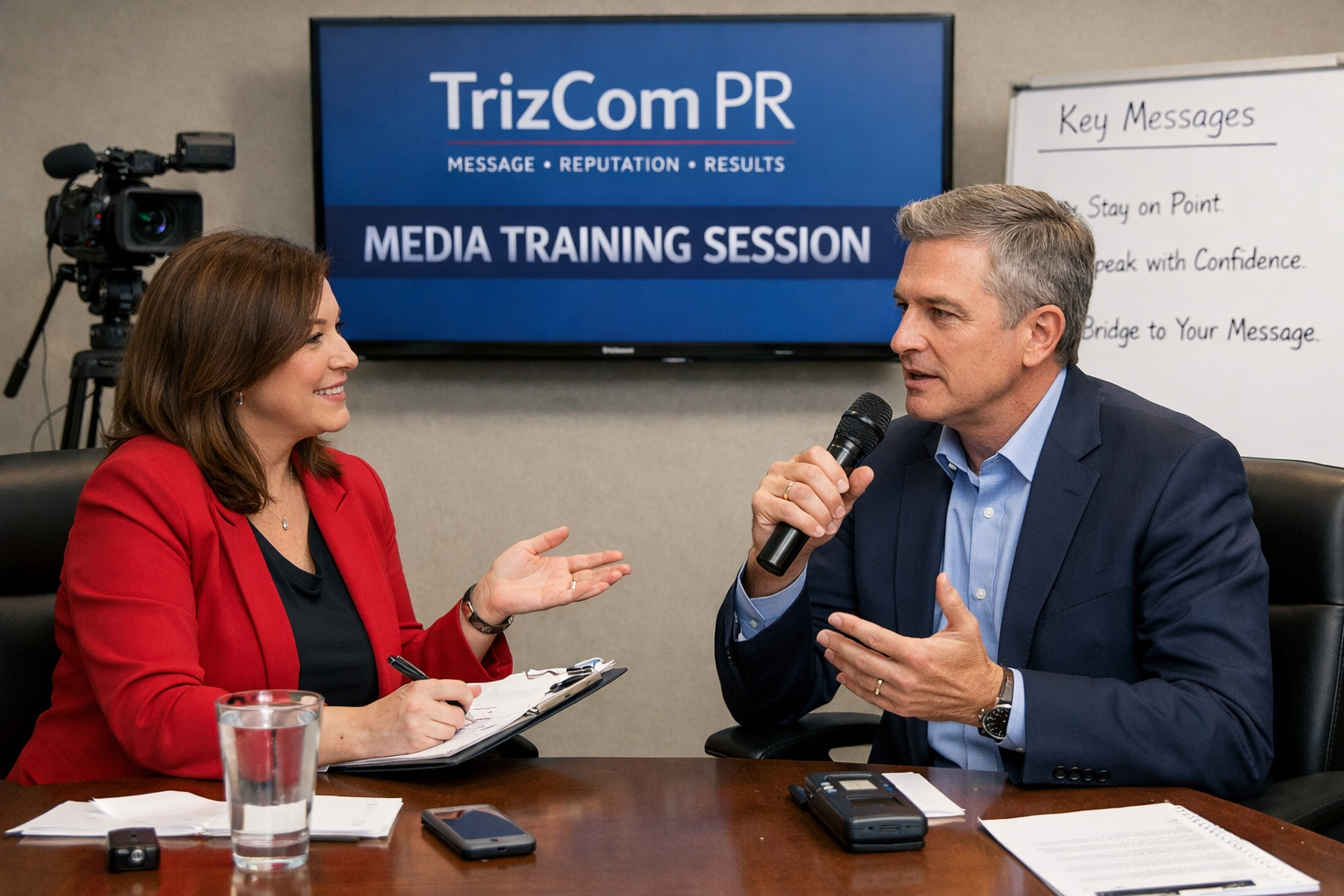
Media training is more than a 2-hour performance session learning how to play “gotcha” on camera. In reality, it is a strategic course that helps executives approach interviews with confidence and communicate a message under pressure.
Media trainers help spokespeople understand interview dynamics, including the perceived power structure. The same executives who instinctively lead a board meeting can easily let a reporter take control during a media interview and lose sight of their message.
Why does that happen? A media interview creates an artificial environment where spokespeople assume the reporter has an agenda and a list of questions. A well-trained spokesperson approaches an interview differently. They come prepared with key messages, and they know how to bring every answer back to what matters most.
Below are the top five concerns we hear from executives, along with the key takeaways from media training that help leaders become interview-savvy.
Key Takeaways: Executive Media Interview Prep
A media interview is a structured conversation, not an interrogation
Reporters rarely provide a list of questions in advance
The best spokespeople use five to six key messages to answer almost anything
In recorded interviews, you may be able to restart an answer if you misspeak
Tough questions are handled through preparation, reframing, and calm delivery
1) Are reporters trying to trap me? Why should I ever do a media interview?
Short answer: Most reporters are not out to get you. They are looking for a strong story, which means clear information and compelling quotes.
Reporters ask questions for different reasons. Sometimes they need background. Sometimes they need a quote that brings the story to life. Interviews are conversations managed on both ends with skill and practice. The goal is to stay on message while remaining quotable.
Media interviews also build credibility and visibility. If you are not participating, someone else is shaping the story without you.
What to say (examples):
“Here’s what matters most for your audience.”
“The most important point is this.”
“Let me put that into context.”
“What we are focused on is…”
2) Do reporters give you the questions in advance?
Short answer: No. A reporter rarely shares specific questions in advance.
A seasoned reporter comes prepared with a direction, not a script. They are also listening closely. One word can change the direction of the interview.
During a mock interview, an ER doctor once answered my question about “what could go wrong” with “well, they could die.” I was looking for information, but the negative wording immediately shifted the tone. A better response would have been, “That’s not what we are focused on. We are focused on saving lives.”
Side note: This question mirrors a similar one: “When do I get to fact check the story?” That usually does not happen either, except in rare cases.
What to say (examples):
“I do not want to speculate, but I can tell you what we know.”
“That’s not what we are focused on. What we are focused on is…”
“Here’s the context your audience needs.”
“Let me make sure I’m clear on the priority.”
3) What can executives safely say in a media interview?
Short answer: Stick to five to six key messages and support them with proof, examples and real stories.
The safest approach is not silence. It is preparation. Your key messages should sound conversational, credible and memorable.
If one of your messages is “We are committed to keeping employees safe,” and it is true, you should include specifics and stories to back it up. Pride matters too. Spokespeople get into trouble when they do not believe what they are saying. Audiences can detect that quickly.
Side note: Do not go “off the record.” If you feel like you should not say something, do not say it.
What to say (examples):
“What I can share is…”
“Here’s what we know right now.”
“The facts are…”
“I want to be careful not to speculate, but I can confirm…”
4) Can you fix a mistake during a recorded interview?
Short answer: Sometimes. If the interview is recorded, you can often pause and ask to restart.
Ideally, you are not doing a high-stakes interview live without training and experience. In a recorded interview, if you stumble or do not like what you said, you can ask the reporter if you can start that over. A little self-deprecation helps.
Will they always allow it? No. But many will, because they want a clean, usable quote.
What to say (examples):
“Let me say that more clearly. Can I restart that answer?”
“I want to make sure I get that right. Can I take that again?”
“That was not my best wording. Let me try that again.”
5) How do executives handle hostile or difficult interview questions?
Short answer: Reframe the intent of the question and return to your key messages.
Most questions are not hostile. They are requests for information. Seasoned spokespeople stay calm and maintain control because they know their messages and how to return to them.
In crisis interviews, questions can become more contentious. The good news is that crisis interview questions are usually predictable. Preparation matters most here. Strong prep for a crisis interview includes practicing answers to every foreseeable question before the interview.
What to say (examples):
“I understand why you’re asking. Here’s what people should know.”
“Let’s talk about what we are doing to address that.”
“The bigger issue is…”
“What matters most right now is…”
Executive Media Training Cheat Sheet (Concern → Goal → What to Say)
| Executive Concern (What Keeps You Up) | Media Training Goal | What to Say (Sample Line) | Best Skill to Practice |
|---|---|---|---|
| Reporters are trying to trap metd> | Reframe the interview as a conversation you can lead | “Here’s what matters most for your audience.” | Validate the question and pivot into your message |
| I want the questions in advance | Prepare messages, not scripts | “What we are focused on is…” | Message discipline |
| What can I safely say? | Stay inside 5 to 6 approved key messages | “What I can share is…” | Key message development |
| I made a mistake on camera | Recover fast, correct clearly | “Let me say that more clearly. Can I restart?” | Resetting under pressure |
| The questions feel hostile | Stay calm, acknowledge, reframe | “I understand why you’re asking. Here’s what people should know.” | Reframing and tone control |
Ready to Feel Confident Before Your Next Media Interview?
If you are preparing for a high-visibility interview, a tough reporter, or a topic that needs careful messaging, do not wing it. The executives who come across as calm, credible and in control are rarely “naturals.” They are prepared.
That is exactly what media training is built for.
At TrizCom PR, we train executives and spokesperson teams to:
stay on message under pressure
handle tough questions without sounding defensive
deliver clear, quotable answers that protect your reputation
show up on camera with confidence and authority
If you have an interview coming up or you want to proactively prepare your leadership team, we can help.
Contact TrizCom PR today to schedule executive media training.
Everyone has a story to tell. Let TrizCom PR tell yours.
FAQ: Media Training and Executive Interviews
What is media training for executives?
Media training helps executives prepare for interviews by learning how to answer questions clearly, stay on message and deliver strong, quotable responses under pressure. At TrizCom PR, media training also focuses on helping leaders understand how interviews actually work so they do not unintentionally give up control of the conversation.
Do reporters send interview questions in advance?
Usually not. Reporters may share the general topic or angle, but most do not provide a list of exact questions. That is why TrizCom PR trains executives to prepare messages, not scripts. When you know what you need to say, you can handle almost any question that comes your way.
How do you stay on message during a media interview?
The most effective spokespeople use five to six key messages and practice bridging from any question back to those points. At TrizCom PR, we help executives build those messages and practice delivering them until staying on message feels natural, not forced.
What should executives never say in a media interview?
Avoid speculation, absolutes you cannot prove and anything you would not want quoted publicly. Also avoid saying something is “off the record.” At TrizCom PR, we remind clients that if something should not appear in print or on air, it should not be said at all.
How do I stop rambling in a media interview?
Use a headline-first answer. Lead with your main point in one clear sentence, support it with one proof point or example, then stop. TrizCom PR coaches executives to answer most questions in 15 to 30 seconds so responses stay tight, confident and quotable.
How do I answer when I do not know something?
Do not guess. Say what you know, explain what you are confirming and then bridge to what you can share right now. This approach, which TrizCom PR reinforces in every training session, protects credibility and keeps you in control of the interview.
About the Author
Karen Carrera, APR
Karen Carrera, APR, is a 40-under-40 award recipient recognized in 2003 and a senior communications counselor with more than 20 years of experience advising executives on strategic communications, brand positioning and reputation management across healthcare, construction and design, education, energy, finance, insurance, government and utilities.
Karen has media-trained hundreds of corporate spokespeople on how to handle media interviews and deliver strong industry presentations. Karen’s approach helps leaders share their stories with confidence while staying focused on key business messages that support long-term organizational goals.
Throughout her career, Karen has developed and executed integrated communications campaigns that build visibility, strengthen brands and generate measurable business results. Her work includes initiatives such as Anheuser-Busch’s We All Make a Difference campaign, hospital brand evolutions, the launch of new healthcare institutes and clinics, and national branding for an architectural design firm.
Most recently, Karen led a comprehensive brand evolution for Medical City, overseeing a new brand identity and guiding a full website overhaul. The redesigned, reprogrammed and fully rewritten website launched in six months with updated content aligned to the organization’s evolving vision and services.
Karen holds the Accreditation in Public Relations (APR) credential, reflecting her commitment to communications ethics and strategy. She is active in professional organizations and is often called upon to mentor other public relations practitioners.