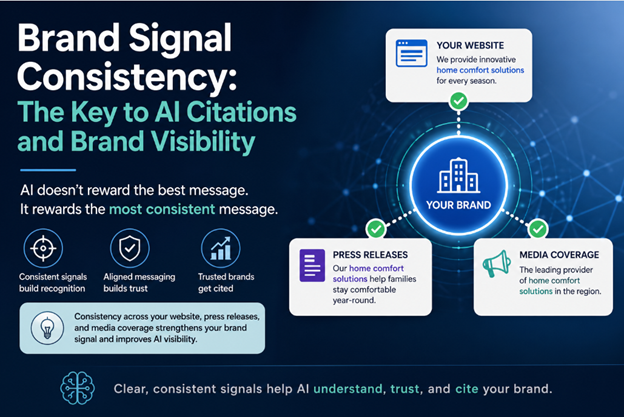
Brand signal consistency definition
Brand signal consistency is the use of identical company name, positioning, and core business descriptions across website, press releases, and third-party sources to improve AI recognition and citation likelihood.
The Real Reason Your Brand Isn’t Showing Up in AI Results
Most brands do not have a visibility problem. They have a consistency problem.
You can publish press releases, invest in SEO, land media coverage and still get ignored by AI search. Not because you lack content, but because your content does not agree with itself.
AI does not understand your brand the way people do. It builds an understanding based on patterns. If those patterns shift across your website, press releases and third-party coverage, you dilute your chances of being cited.
That is where a Brand Signal Consistency Scorecard becomes useful. It forces you to see your brand the way AI sees it.
What Is a Brand Signal Consistency Scorecard
A Brand Signal Consistency Scorecard compares how your brand shows up across three core sources:
Your website
Your press releases
Third-party coverage
It evaluates whether key elements match or vary across those channels.
Here is a simplified example using a well-known brand.
Brand Signal Consistency Scorecard Example
Before you look at the scorecard, here’s the reality most brands miss.
You think your brand is consistent because your team knows how to describe it. Your website sounds right. Your press releases feel aligned. Your media coverage looks accurate.
AI does not see it that way.
AI compares how your brand shows up across sources and looks for exact matches. Not similar language. Not “close enough.” Matching patterns. When those patterns shift, even slightly, your brand becomes less defined and less reliable as a source.
This chart breaks that down using a brand everyone recognizes. It shows how the same company is described across its website, press releases and third-party coverage and where those signals align or fall apart.
The goal is not to critique the brand. The goal is to show how easily inconsistency creeps in and how that inconsistency weakens AI confidence.
As you review it, do not focus on Nike. Focus on what this would look like if your brand were in the table.
| Element | Website | Press Releases | Third-Party Coverage | Consistency Score | Notes |
|---|---|---|---|---|---|
| Company Name | Nike, Inc. | NIKE, Inc. | Nike | ⚠️ Partial | Minor formatting differences but still recognizable |
| Tagline / Positioning | “Just Do It” | Athletic footwear and apparel | Sportswear brand | ❌ Inconsistent | Tagline not consistently reinforced as positioning |
| Primary Product Description | Athletic footwear, apparel, equipment | Performance products for athletes | Shoes, clothing, gear | ⚠️ Partial | Similar but not identical phrasing |
| Target Audience | Athletes and active consumers | Global athletes | General consumers, sports fans | ⚠️ Partial | Broad but slightly inconsistent framing |
| Location / Origin | Beaverton, Oregon | Oregon-based company | U.S.-based or global brand | ⚠️ Partial | Varies in specificity |
| Leadership (CEO) | CEO listed on site | CEO quoted in releases | Often omitted | ❌ Inconsistent | Missing in many third-party mentions |
| Core Offering | Performance-driven products | Innovation in sportswear | Apparel and footwear | ⚠️ Partial | Messaging shifts between innovation and product |
Scoring Key
✅ Consistent = Same language across all channels
⚠️ Partial = Minor variation but still recognizable
❌ Inconsistent = Different descriptions or missing entirely
What Brand Signal Inconsistency Looks Like in the Real World
Brand signal consistency issues are not obvious when you are inside the business. They show up clearly when you compare how your brand is described across sources.
Consider a regional HVAC company.
On its website, it describes itself as “heating and cooling services.”
In press releases, it uses “home comfort solutions.”
In media coverage, it appears as “HVAC contractor.”
Each version sounds reasonable. None of them match.
AI systems do not interpret these as variations of the same idea.
They treat them as separate signals.
When brand descriptions vary, AI builds a broader and less precise understanding of the business.
That leads to:
· Weaker category definition
· Lower confidence in the brand
· Fewer citations in AI-generated answers
Consistent language creates a clear signal. Inconsistent language creates multiple weak signals.
This is how brands lose visibility without realizing it.
What This Scorecard Reveals
Even a brand as dominant as Nike is not perfectly consistent.
That matters because AI systems do not rely on brand familiarity. They rely on repeated signals.
When signals vary, three things happen.
Categories Become Blurred
“Athletic brand,” “sportswear company,” and “footwear company” may seem interchangeable. To AI, they are not.
Instead of a precise category, the system builds a broader, less defined identity.
Taglines Lose Strategic Value
If a tagline appears in one place but not reinforced elsewhere, AI treats it as decoration, not definition.
That weakens your positioning.
Entity Depth Breaks Down
When leadership, location or core details are missing in some sources, AI has less confidence in the entity.
Lower confidence leads to fewer citations.
Nike can absorb that inconsistency because of scale. Most brands cannot.
Why Consistency Drives AI Citations
AI systems prioritize three things:
Repetition
Alignment
Clarity
If your brand shows up differently across sources, you create:
Multiple interpretations
Lower confidence scores
Fewer citations
This is not theoretical. It is how AI assembles answers.
A consistent brand signal makes it easier for AI to:
Identify your company
Understand what you do
Trust the information
Include you in results
Why Press Releases Play a Critical Role
Press releases are one of the few assets you fully control that also live in third-party environments.
They act as a bridge between:
Owned content like your website
When written with consistency in mind, they reinforce:
Your official company name
Your positioning
Your product or service descriptions
That alignment strengthens your overall signal across the web.
The Real Risk Most Brands Ignore
Inconsistency does not just confuse your audience. It fragments your identity.
If your website says one thing, your press releases say another and media coverage says something else, AI does not reconcile that.
It averages it.
And when AI averages your message, you lose precision.
That is how brands become:
Vague
Generic
Replaceable in search results
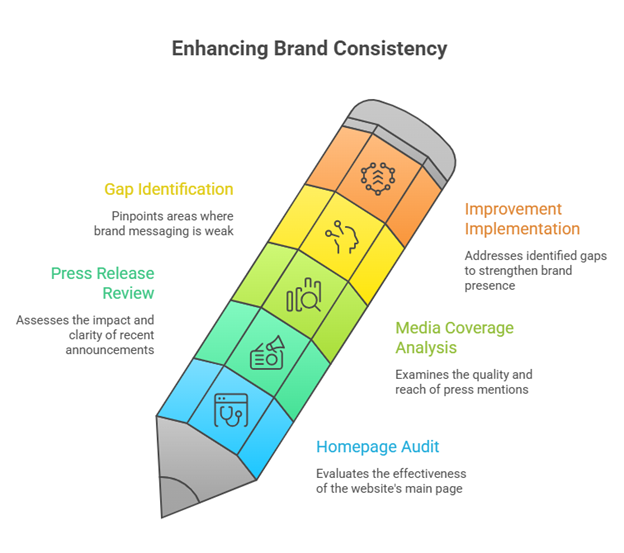
How to Use This Scorecard for Your Brand
Start by building your own version of this chart.
Audit:
Your homepage
Recent press releases
Top media coverage
Score each element honestly.
Then fix the gaps.
Standardize Your Company Name
Choose one format and use it everywhere.
Define One Positioning Statement
Not three variations. One.
Align Product or Service Descriptions
Use the same core language across all content types.
Reinforce Key Entity Details
Make sure leadership, location and core offerings appear consistently.
How to Measure Brand Signal Consistency
Brand signal consistency is not subjective. It can be measured.
Tracking consistency helps you identify gaps, prioritize fixes, and improve how AI systems interpret your brand.
Key metrics to track:
Percentage of content using the exact company name
Review your website, press releases, and media coverage.
Calculate how often your company name appears in the same format.
Higher consistency strengthens entity recognition.
Alignment of service or product descriptions across channels
Compare how your offerings are described in each source.
Look for identical or closely matched language.
Misalignment reduces clarity and weakens category definition.
Frequency of consistent messaging in third-party mentions
Analyze how media outlets describe your business.
Track how often they use your preferred positioning and terminology.
Consistent third-party language reinforces credibility.
Brand signal consistency improves when key elements are repeated in the same way across sources.
What gets measured gets fixed.
What gets fixed gets cited.
What Happens When You Get This Right
When your signals align:
AI recognizes your brand faster
Your category becomes clearer
Your authority strengthens across sources
You move from being mentioned to being cited.
That is a different level of visibility.
Brand Signal Consistency FAQ
Q: What is a Brand Signal Consistency Scorecard?
A Brand Signal Consistency Scorecard compares how a brand is described across its website, press releases, and third-party coverage. It highlights where messaging aligns and where it varies. This helps identify gaps that can weaken AI understanding and visibility.
Q: Why does brand consistency matter for AI search?
AI systems rely on repeated, matching information across sources to determine credibility. When your messaging is consistent, AI is more confident in describing and citing your brand. Inconsistent signals reduce that confidence and limit visibility
Q: How does AI interpret inconsistent brand messaging?
AI does not choose one version of your message. It blends multiple versions into a broader, less precise understanding. This often results in vague descriptions and fewer citations.
Q: What are the most important elements to keep consistent?
The most critical elements are your company name, positioning, product or service description, and key details like location and leadership. These define your identity across sources. Consistency in these areas strengthens AI recognition.
Q: Can large brands afford to be inconsistent?
Large brands often have enough authority and volume to offset inconsistency. They appear in many high-quality sources, which reinforces their credibility. Smaller brands do not have that advantage and rely more on precision.
Q: How do press releases impact AI visibility?
Press releases reinforce your brand messaging in a structured, third-party environment. They help standardize how your company is described across the web. When aligned with your website, they strengthen your overall signal.
Q: What happens when brand signals are not aligned?
When signals vary, AI sees multiple versions of your brand. This lowers confidence and makes your company less likely to appear in AI-generated answers. Over time, it reduces both visibility and authority.
Q: How can I audit my brand for consistency?
Review your homepage, recent press releases, and top media coverage. Compare how your company is described across each source. Look for differences in wording, positioning, and key details.
Q: What is the fastest way to improve brand consistency?
Start by defining one official company name format and one clear positioning statement. Then standardize your product or service description. Apply that same language across all content and channels.
Q: What is the connection between consistency and AI citations?
Consistency increases AI confidence in your brand as a reliable source. Higher confidence makes your content more likely to be cited in AI-generated results. Inconsistent messaging leads to fewer mentions and weaker visibility.
The One Sentence That Matters
Brands that use consistent language across their website, press releases and media coverage are more likely to be cited in AI-generated search results.
Consistency Is Not Optional If You Want to Be Found
If a global brand shows inconsistencies, your brand almost certainly has more.
The difference is they have volume and authority to compensate.
You do not.
So consistency is not optional. It is foundational.
Score your brand. Fix the gaps. Repeat your message with discipline.
AI does not reward the best message. It rewards the most consistent message.
That is how you stop being invisible in AI-driven search.
Everyone has a story. Let TrizCom PR help tell yours.
If your goal is stronger AI visibility, clearer positioning or results that tie back to business outcomes, it starts with getting your narrative aligned across every touchpoint. Start the conversation.

About the Author:
Jo Trizila – Founder & CEO of TrizCom PR
Jo Trizila is the founder and CEO of TrizCom PR, a leading Dallas-based public relations firm known for delivering strategic communications that drive business growth and enhance brand reputations as well as Pitch PR, a press release distribution agency. With over 25 years of experience in PR and marketing, Jo has helped countless organizations navigate complex communication challenges, ranging from crisis management to brand storytelling. Under her leadership, TrizCom PR has earned recognition for its results-driven approach, combining traditional and integrated digital strategies to deliver impactful, measurable outcomes for clients across various industries, including healthcare, technology and nonprofit sectors. Jo is passionate about helping businesses amplify their voices and connect with audiences meaningfully. Her hands-on approach and commitment to excellence have established TrizCom PR as a trusted partner for companies seeking to elevate their brand and achieve lasting success. Contact Jo at jo@TrizCom.com.