

Why Avoiding PR Disasters Starts With Respecting Reporters

Smart or stupid? Hilarious or heinous? The President of the United States has once again separated our country into two camps when he called a reporter “Piggy.” Why the insult? Because he didn’t like her questions and wanted to silence her. Beyond the unnecessary shaming of a fellow human, which is the root of the issue, let’s take a look at why his name-calling falls into the stupid-move PR hall of fame and why avoiding PR disasters should always come first.
The Cost of Losing Your Cool
Now, some thought it was hilarious. A deserved comeuppance. How many times has a spokesperson been angered by a reporter’s questions and wanted to lash out? Many, many, many times. But trust me, as a professional media training program leader and crisis manager, the price you pay is simply not worth it. Here is why:
You Look Dodgy
When you deflect a question by spouting off to a reporter, you look like you are evading the subject and have something to hide. According to Harvard Business Review, leaders who respond thoughtfully under pressure maintain credibility and control over the narrative.
You Undermine Your Leadership Power
You look like a bully and a petulant child and you lose credibility with a large part of your audience. Even if you argue that members of Trump’s MAGA base loved it, elections are too close these days to erode other votes.
You Derail Your Message
The worst PR consequence of the incident is that the hours, airtime and ink spent telling the world Trump was nasty to a reporter could have been spent on a proactive, strategic message. Staying focused on message discipline is essential for avoiding PR disasters. Forbes notes that controlling your messaging during a crisis is crucial to protecting reputation.
History Repeats Itself
Bobby Knight Example
Lashing out at reporters is not a new faux pas. Another classic example comes from an ESPN interview with former Indiana Head Coach Bobby Knight after he was fired when a video emerged showing him grabbing a player. During the lengthy interview with Jeremy Schaap, Knight became frustrated with the provocative questions and told Schaap, “You have a long way to go to be as good as your dad, you better keep that in mind.”
The moment Knight said that, he derailed his message and validated the firing. Before he lost his cool, his message was positive. He had been talking about how proud he was of the program and how proud he was of the kids they turned out. Instead of staying composed and steering the topic back, he let the reporter control the narrative. This was the opposite of avoiding PR disasters. According to Pew Research, a respectful media environment helps maintain public trust in both reporters and leaders.
When I use that clip during interactive media trainings, participants’ reactions are often divided. Some see Knight as the petulant child, but others point out that he was known for his volatile leadership style, which appealed to some. True. But I challenge organizational and political leaders to decide what kind of leader they want to be and what kind of legacy they want to leave behind.
Katie Porter Example
A more modern example comes from California 2026 gubernatorial candidate Katie Porter, who was rude and condescending to a reporter giving all candidates identical interviews. Porter became combative and walked out of the interview, announcing, “I am calling it.” Her behavior prompted reporters to unearth other incidents of rudeness to staffers. Her behavior, like Trump’s and Knight’s, became the story. Reports say her support suffered as opponents questioned her ability to handle simple questions. That interview will remain part of her legacy.
A Leader’s Legacy is Shaped in Moments Like These
The same can be said about Trump. His pedestal is even higher than Knight’s and Porter’s. As president, he is expected to be dignified, honorable and composed. People want to see him confident and steady, not acting like a street fighter. His response to a simple question revealed far more about his leadership than the reporter ever intended. Respecting reporters is not only about courtesy. It is a critical part of avoiding PR disasters and maintaining a strong leadership legacy.
Ready to Strengthen Your Media Strategy?
If you want to prepare your leaders, spokespeople or organization to stay composed under pressure, protect your message and build a reputation that lasts, our award-winning PR agency is here to help. Our proprietary media training program equips leaders with the skills, confidence and message discipline needed to excel in any interview or high-stakes moment.
Explore our digital PR and communications services, learn about our internal communications solutions and read more PR insights and thought leadership.
Contact TrizCom PR today to learn how our proven media training and strategic communication services can help you avoid your next PR disaster and take control of the narrative.
Everyone has a story to tell. Let TrizCom PR tell yours.
About the author
Karen Carrera
Karen Carrera APR is a 40-under-40 award recipient recognized in 2003. With more than 20 years of experience, she advises senior executives on strategic communications brand positioning and reputation management across healthcare construction and design education energy finance insurance government and utilities. Her ability to work across diverse industries has made her a trusted counselor to executive leadership teams navigating complex communications challenges.
She has media trained hundreds of corporate spokespeople on how to handle media interviews and deliver strong industry presentations. Karen’s approach helps executives share their stories with confidence while staying focused on key business messages that support long-term organizational goals.
Throughout her career Karen has developed and executed integrated communications campaigns that build visibility strengthen brands and generate measurable business results. She has led initiatives such as Anheuser Busch’s We all Make a Difference campaign hospital brand evolutions the launch of new healthcare institutes and clinics and national branding for an architectural design firm. Her programs reflect a balance of research-driven planning creativity and practical business strategy.
Recently Karen led a comprehensive brand evolution for Medical City. She oversaw the development of a new brand identity and guided a full website overhaul. In just six months the redesigned reprogrammed and fully rewritten website launched with updated content that aligned with the organization’s evolving vision and services.
Karen holds the Accreditation in Public Relations credential which reflects her expertise in communications ethics and strategy. She is active in professional organizations and is often called upon to mentor other public relations practitioners.
Should You Still Blog When AI Answers Most Questions Today?

If AI answers everything, why blog?
AI and Google pull from what already exists. I’m going to repeat that, AI and Google pull from what already exists. If your expertise is not on the page, it is not in the results. A steady, useful blog does four jobs at once: earns search visibility, feeds AI overviews with clean facts, arms sales with links that answer real questions and gives reporters quotable lines they trust. Blogging is not a journal. It is a library of answers your customer needs.
When readers land on your site, they want clarity fast. Your blog is the place to explain key ideas, show proof and offer next steps in one visit. Done well, each post becomes an asset that works long after publish day.
“Blogging is not a journal. It is a library of answers your customer needs.”
This blog walks through the why, the how and the proof so you can decide with confidence.
What you will learn
Why blogging still matters when AI answers quickly
How to use user intent keywords to match what people actually want
The signals AI and Google reward and how to bake them into every post
A cadence plan you can keep without burning out
Content formats that teach, compare, prove and convert
Where AI can speed the work and where humans protect voice and facts
AI search vs search engines. Who is winning
AI-powered search tools like ChatGPT and Perplexity are gaining ground. People use them for quick answers, summaries and idea starters. Growth is real and conversational results feel efficient for narrow tasks. Even with that momentum, traditional search engines still carry most of the daily traffic. For broad discovery, shopping and research across many sources, Google and Bing remain the first stop for most users. The behavior shift is visible, but it has not replaced classic search.
What this means for content is simple. Plan for both patterns. Write posts that answer the core question in the first screen, then expand with steps, tables and FAQs that AI can cite cleanly. Keep facts up to date, name entities clearly and link to related guides, pricing and case studies. Use Article schema and add FAQ or How-Tos when they fit. This approach helps posts rank in search while making them easy for AI to reference accurately.
Net: it is not either or. Plan content that can rank in search and be cited cleanly by AI.
AI Search VS Organic Web Traffic Statistics
Roughly 60% of Google searches now end with no click to a website (so-called zero-click results). Search Engine Land
Zero-click share has risen year over year; one analysis shows increases across the U.S., EU and UK in 2025. Search Engine Land
For queries that trigger AI Overviews, the average CTR on the #1 organic result fell from 7.3% to 2.6% year over year, a ~65% relative drop in clicks to that top listing. Digital Content Next
Consulting research estimates 15–25% reductions in organic site traffic attributable to zero-click/AI summary behavior across categories. Bain
News publishers show the sharpest impact: some report traffic declines up to 40% since AI Overviews rolled out, with zero-click rates in news rising from 56% to 69%. (Impact varies by outlet; Google disputes parts of these studies.) New York Post
What is SEO and how can PR help?
SEO is the practice of making your site easy to find and trust in search results. It mixes clear content, technical basics like speed and mobile and links from reputable sites. PR strengthens SEO by earning credible mentions and backlinks from news outlets, trade media and quality blogs. Those links act like votes of confidence that lift rankings. PR also builds entity authority with consistent names for people, products and locations, which helps search engines connect your brand to key topics. Strong PR assets make better SEO pages too: quotable spokespeople, verified stats, case studies and images with alt text. Add article, FAQ or How-To schema, keep facts dated and link posts to service, pricing and case study pages. When PR and SEO plan topics together, you win both awareness and qualified traffic.
What is LLM and how can PR help?
A large language model is AI that predicts words to answer questions or create text. It relies on patterns learned from public content and favors recent, structured and trustworthy sources when citing. PR helps LLM visibility by publishing quality content worth citing. Think clear definitions, timelines, data tables and FAQs that answer in the first 150 words. Use consistent entity names, author bios, dates and linked sources. Mark up pages with article plus FAQ or How-To schema. Place quotable lines and short summaries that models can lift cleanly. Distribute those assets through earned media, partner sites and bylines to broaden trusted signals and links. Monitor common AI answers to your core queries, then fill gaps with new explainers, comparisons and case studies. In short, PR produces the credible source material LLMs look for and keeps it current.
The data that ends the debate
Neil Patel’s team compared 20 companies over 12 months. Ten kept publishing. Ten stopped. The gap was clear.

Two takeaways:
Pausing a blog accelerates organic decline. Teams that stopped saw more than double the SEO (search engine optimization) drop.
Consistent publishing correlates with large LLM gains and real revenue lift.
Why this happens:
Fresh, structured, sourced articles send the signals search engines and AI systems use to rank, cite and recommend.
When publishing stalls, those signals fade. Competitors fill the gap with newer, clearer content.
The lesson is simple. Keep publishing on a schedule, keep posts current and keep structure tight. Momentum compounds when your content stays fresh and useful.
Source: Neil Patel email, Oct 29, 2025.
Signals AI and Google reward
Search engines and AI tools reward content that feels recent, credible and easy to scan. Think of each post as a product. Label it, package it and make the value obvious from the first paragraph.
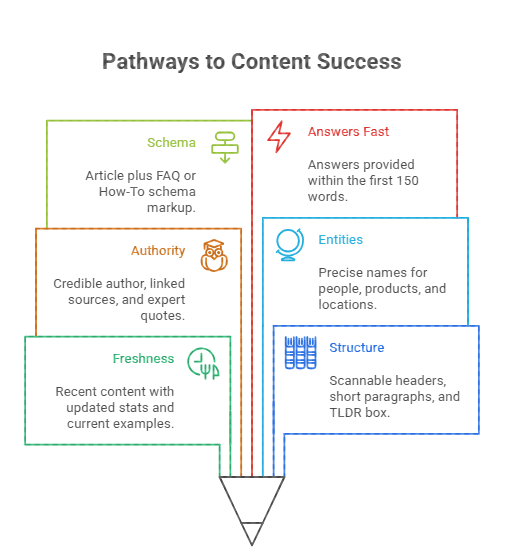
Freshness: recent posts with clear dates, updated stats and current examples
Structure: scannable headers, short paragraphs, pull quotes, lists and a TLDR box up top
Authority: named author with credentials, sources linked, quotes from experts, first party data
Entities: precise names for people, products, locations and definitions of key terms
Schema: Article plus FAQ or How-To where it fits organization and person markup on your site
Answers fast: state the answer in the first 150 words and expand below
Internal links: point to related guides, pricing, case studies and service pages
Media assets: original charts, images with alt text, short clips and downloadable checklists
Consistency: a steady cadence that keeps signals flowing to search engines and AI systems
Experience: fast load, mobile friendly, clean design, no intrusive pop-ups
“Think of each post as a product. Label it, package it and make the value obvious from the first paragraph.”
When you ship posts that check these boxes, you make it easier for readers to understand and easier for systems to surface your content. That is how rankings, citations and conversions move.
Write for your customer with user intent keywords
What are user intent keywords?
User intent keywords are the words and phrases people type or say that show what they want to do right now. They go beyond a topic and signal purpose: learn, compare, buy or navigate. Search engines exist to match that intent with the most relevant result.
Simple example:
If someone types Italian food, the results will likely feature restaurants. That query reads like a place or cuisine search. If the person types Italian recipes or how to make lasagna, the results shift to step-by-step guides and ingredient lists. Same subject, different intent.
How to write for your customer using user intent keywords?
Start with the words your customers use. Pull phrases from sales calls, support tickets, social comments and onsite search. Real language beats guesswork.
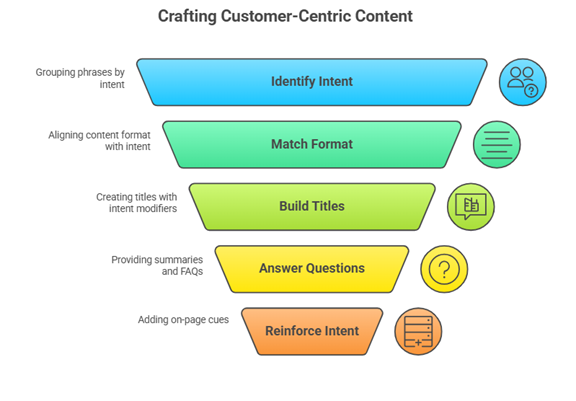
Group by intent:
Informational: what is, how to, pros cons, cost to
Comparative: vs, best for, alternative to
Transactional: pricing, demo, near me, book
Navigational: brand terms like login, case studies
Local: service + city, neighborhoods, landmarks
Match format to intent:
Informational -> explainers, checklists, FAQs, glossaries
Comparative -> X vs Y tables, scorecards, decision guides
Transactional -> pricing pages, ROI calculators, implementation timelines
Local -> city pages with service details, maps, local testimonials
Build titles and H2s with intent modifiers:
Pair the topic with a verb or outcome
Franchise PR pricing guide
Media training checklist for first TV interview
Integrated marketing examples for multi-location brands
Answer the next question:
Add a summary at the top, a quick table and a short What’s next box
Include three to five FAQs that mirror People Also Ask phrasing
On-page cues that reinforce intent:
First paragraph answers the core task
One table or list per post for skimming
Internal links guide readers to the next stage in the journey
Apply FAQ or How-To schema when it supports the page
Quick checklist:
Who is this for and what are they trying to do
Primary intent plus 2 or three modifiers
One clear outcome promised in the title
Answer visible without scrolling
One data point, one example, one CTA that matches the intent
Writing to intent keeps posts useful and discoverable. It also helps sales and support point customers to the right answer without extra back and forth.
Cadence plan that teams can keep
A calendar you can keep beats a burst that burns out. Pick a tier that fits your team and protect it.
Pick a tier and protect it:
Minimum viable: Two posts per month per service line
Healthy growth: one post per week
Aggressive: Two to three posts per week during launches or peak season
Use a 3:2:1 monthly mix:
Three evergreen explainers that target informational intent
Two timely POVs or newsjacks tied to current coverage
One conversion story such as a case study, comparison or pricing guide
Lock a publishing day:
Choose one weekday, publish at the same time and treat it like a standing meeting
Assign clear roles:
Owner sets topics and briefs
Writer drafts with sources and quotes
Editor checks facts, voice, links and schema
Publisher loads, optimizes and ships on time
Keep a two month runway:
Maintain at least six ready to publish drafts
Refresh one older post each month with new data, links and a short update note
Weekly rhythm:
Mon plan and pull voice of customer notes
Tue draft
Wed edit and add assets
Thu load CMS, internal links, schema
Fri publish, distribute to email and social, log metrics
Consistency builds trust with readers and with search systems. Protect the cadence and the channel will start paying you back.
Content types that win across SEO and AI
Your blog works best when each post has a clear job. Mix formats that teach, compare, prove and guide. Use explainers to answer core questions, comparisons to help choices, case studies to show outcomes and checklists to drive action. This variety meets different intents, keeps readers engaged and gives search and AI systems clean signals to surface and cite.
Evergreen explainers
Define key terms, show steps, include a TLDR table and three to five FAQs.
Example: “Franchise PR explained” with a glossary and media list starter kit.
Decision guides and comparisons
Help readers choose with criteria, scorecards and pros and cons.
Example: “Media training agency vs DIY” with a cost and outcome table.
Pricing and timelines
Set expectations with ranges, factors and sample schedules.
Example: “How long does national TV take from pitch to air?” with a week-by-week plan.
Case studies with numbers
Lead with the outcome, then show the playbook and assets used.
Example: “How a regional launch earned 24 placements and three speaking invites.”
Questions hubs
Collect top customer and sales questions on one page, marked up with FAQ schema.
Example: “Crisis communications FAQ for franchise systems.”
Playbooks and checklists
Step-by-step, printable and linkable for journalists and partners.
Example: “First TV interview checklist” plus a one-page download.
Newsjacks and timely POVs
Add expert context to a breaking story with one chart and two quotes.
Example: “What the new local search update means for multi-location brands.”
Local intent pages
Blend service details with city-specific information, maps and local testimonials.
Example: “Media training in Dallas” with venue options and travel tips.
Original data and mini studies
Publish small, repeatable benchmarks or surveys.
Example: “Average response time from morning TV producers in Q1.”
How-to videos and short clips
Embed a 60 to 120-second walkthrough with captions and a transcript.
Example: “How to build a spokesperson one-liner.”
What to include in every post:
Clear summary up top
One table or checklist
Sources, dates and named author
Internal links to related guides, pricing and case studies
Article schema plus FAQ or How-To when it fits
A next step that matches the reader’s intent
The mix above creates a library that works across search, AI summaries, media outreach and sales enablement. Each post has a job and a place in the journey.
AI assist playbook that saves time without losing voice
AI speeds up the work. Your team supplies the thinking. Use AI where it removes friction and keeps humans on strategy, accuracy and tone.
Where AI helps:
Research sweep: expand topics, questions, related entities, common objections
Outline drafts: headings, talking points, FAQ ideas, table structures
Language variants: title and meta options, pull quotes, social snippets
On-page SEO: internal link suggestions, alt text drafts, FAQ and How-To starters
Schema scaffolding: Article, FAQ, How-To fields to hand to the CMS
Repurposing: turn a post into a byline, newsletter blurb, two short videos
AI Guardrails:
Fact check every stat and date
Cite sources with links and names
Keep brand voice. Edit for tone and clarity
Run a quick originality check
Avoid filler. Add first party data, examples, quotes
Label images and charts with plain alt text
Chat GPT PR Prompt recipes for blogs:
Outline: “Give me an H2/H3 outline for [topic] for [audience]. Include a TLDR table, five FAQs and one short case example.”
Title set: “Write 10 titles with the primary intent [informational/comparative/transactional] and the outcome [result]. 55 to 60 characters. (including spaces)”
Internal links: “From this post, suggest eight internal links to these URLs grouped by stage [top, middle, bottom]. Give anchor text ideas.”
Schema: “Draft minimal JSON LD for Article plus FAQ with these questions and answers. No fluff.”
Quality checklist:
Answer in the first 150 words
At least one table or checklist
Two internal links in, two out
One quote or data point we can verify
Clear next step that matches the reader intent
Use AI as a co author that never ships without human review. That balance keeps quality high and speed manageable.
Why blogs fail
Blogs do not fail because the channel is broken. They fail because the work is unstructured, sporadic and disconnected from real questions. If you blog to check a box without a plan to repurpose, measure and refresh, the results will fade.
Common failure patterns
No clear audience or intent per post
Topics chosen by guesswork, not voice of customer
Irregular cadence that resets momentum
Walls of text with no summary, table or FAQs
Thin content that repeats competitors with no data or examples
Missing schema, slow mobile pages, weak internal links
No repurposing into email, social, sales decks or bylines
No refresh cycle or scorecard tied to outcomes
How to turn it around
Define audience, intent and outcome before drafting
Lock a publish day and a 3:2:1 monthly mix
Add a TLDR, one table and 3 to 5 FAQs to every post
Mark up Article plus FAQ or How-To where it fits
Repurpose each post into two channels and refresh one post monthly
Track entrances, citations, links and assisted conversions
Publish answers AI and search engines can trust that people can use
If AI answers everything, your job is to give it something accurate to cite and give people something useful to read. Keep the cadence, write to intent and package each post so value is obvious in the first scroll. When the library grows, search lifts, sales get better links and reporters find clean quotes. Ready to put this system to work?
An example of the power of blogs
At TrizCom PR, we deliberately shifted to publishing more owned content, including long-form blog posts. The effect is clear in Google Analytics. More than 60 percent of our organic website traffic now comes from keyword-optimized blog posts. The other 40 percent arrives through AI search that cites or summarizes those same posts.
Why this works
Posts are written to user intent, so answers appear in the first screen
Article plus FAQ or HowTo schema mirrors on page text
Internal links connect blogs to services, pricing, and case studies
We refresh older posts with new data and note the update
What we did next
We repurposed top performers into email, short video, and bylines, then linked everything back to the pillar posts. The result is steady nonbrand traffic, better qualified leads, and a content library that AI and search can trust.
TrizCom PR can help
If you want a blog that feeds SEO, AI search, sales and PR, we can run the full system or coach your team. We plan clusters, write human led posts, add structure AI can cite and report on what moves the business. Ready for a 90 day pilot that proves it. Reach out and let’s talk.
Everyone has a story. Let TrizCom PR tell yours!

About the Author:
Jo Trizila – Founder & CEO of TrizCom PR
Jo Trizila is the founder and CEO of TrizCom PR, a leading Dallas-based public relations firm known for delivering strategic communications that drive business growth and enhance brand reputations as well as Pitch PR, a press release distribution agency. With over 25 years of experience in PR and marketing, Jo has helped countless organizations navigate complex communication challenges, ranging from crisis management to brand storytelling. Under her leadership, TrizCom PR has earned recognition for its results-driven approach, combining traditional and integrated digital strategies to deliver impactful, measurable outcomes for clients across various industries, including healthcare, technology and nonprofit sectors. Jo is passionate about helping businesses amplify their voices and connect with audiences meaningfully. Her hands-on approach and commitment to excellence have established TrizCom PR as a trusted partner for companies seeking to elevate their brand and achieve lasting success. Contact Jo at jo@TrizCom.com.
AI Search and Blogging FAQ
How to use AI for blogs?
Use AI to speed planning and polish, not to replace judgment. Start with a brief that defines the audience, user intent and the outcome. Ask AI for an outline, title options, FAQs and a TLDR box. Use it to expand a research list, surface related entities and suggest internal links. Draft in your voice, then have AI propose meta descriptions, alt text and schema starters for Article and FAQ. Fact check every stat, add first party examples and cite sources with dates. Finish with a table or checklist and a clear next step. Repurpose the post into a byline, newsletter blurb and two short clips. Measure nonbrand entrances, assisted conversions and new links, then feed wins back into the brief.
Are blogs still a thing?
Yes. Blogs remain the easiest way to publish structured expertise that search engines and AI can understand and cite. A steady blog gives you a library of answers for customers, sales and reporters. What changed is how blogs work. Short intros, clear H2s, an upfront summary and one table or checklist help readers and machines. Add Article schema and use FAQ or How-to when it fits. Refresh older posts with new data and internal links. Plan a cadence you can keep, such as one post per week and track outcomes like nonbrand entrances and assisted conversions. Blogs that publish consistently, write to user intent and provide sources still perform.
SEO vs content quality writing.
It is not either or. Quality writing clarifies the answer for a human. SEO helps the right person find it. Start with user intent (also known as search intent), then write a plain language summary, followed by steps, examples and a small table. Add sources with dates, define people and products precisely and include internal links to the next logical page. Technical basics still matter: mobile speed, clean HTML, descriptive alt text and valid schema. If you have to choose, ship a clear, accurate post, then iterate with SEO improvements. The best results come from quality writing that is structured so search and AI can understand it.
Has AI killed SEO and blogging?
No. AI changed the playing field but did not remove the need for trusted sources. AI systems rely on published, structured and current content. If your expertise is not on the page, it will not be found or cited. What is different is format and cadence. Lead with the answer, add a TLDR box, use H2s that mirror real questions, include a table or checklist and provide sources. Add Article schema and consider a FAQ or How-to. Keep a weekly schedule and refresh older posts. Plan for both search and AI by writing posts that can rank and be quoted cleanly.
The power of frequently asked questions.
FAQs match how people search and how AI formats answers. Add three to five FAQs that mirror “People also ask” language. Keep answers short, factual and linked to deeper guides. Place FAQs near the bottom so the main narrative flows. Mark up the section with FAQ schema when the content is visible on the page. Good FAQs reduce support tickets, help sales answer objections and improve your odds of earning rich results and AI citations. Update FAQs when pricing, timelines or regulations change and link each answer to a next step such as a comparison, calculator or booking page.
What is a schema markup?
Schema markup is structured data that helps search engines understand your page. It is added as JSON-LD in the HTML and describes the content type and key properties. For blogs, start with Article. When the page contains real Q&A, add FAQ. For tutorials, consider How-to articles. Keep fields accurate and consistent with visible text. Include author, date, headline, description and mainEntity for FAQs. Proper schema improves eligibility for rich results and makes it easier for AI systems to parse and cite your content. Validate with Google’s Rich Results Test and update schema when the page changes.
Why are backlinks so important?
Backlinks are links from other sites to your pages. They signal trust, relevance and authority. High quality links from news outlets, trade media, universities and respected blogs help pages rank and can improve how often AI systems encounter your brand while training or retrieving. Earn links with useful assets: data tables, checklists, glossaries and clear definitions. PR helps by placing bylines, quotes and case studies that credit your site. Avoid buying links or using spam tactics. Focus on relevance, editorial context and sources that real readers use. Track new referring domains and link growth to priority pages.
What metrics to use to measure your blog’s success?
Measure visibility, engagement, authority and conversion. For visibility, track non-brand organic entrances, impressions, clicks, featured snippets and AI overview mentions. For engagement, monitor scroll depth to 75 percent, average engaged time and clicks on tables, downloads or jump links. For authority, watch new referring domains and internal links to service and pricing pages. For conversion, use assisted demo or contact submissions from blog paths and newsletter signups. Operationally, track publish-on-time rate, valid schema, and refreshes shipped. Review monthly, compare to a 90-day target and double down on formats and topics that create assisted conversions.
Can I use ChatGPT to write my blogs?
Yes, as an assistant. Use ChatGPT for outlines, title sets, FAQs, meta ideas and first drafts. Then apply Google’s EEAT framework to make the post worth ranking and citing.
Experience: add first-hand examples, screenshots, quotes from your team and lessons learned.
Expertise: name the author, include credentials and explain the why behind your advice.
Authoritativeness: link to reputable sources, publish case studies and earn mentions from trusted sites.
Trustworthiness: fact check dates and stats, disclose conflicts and keep policies and pricing current.
Keep the human voice. Edit for clarity and intent, not just keywords. Put the core answer in the first 150 words, add one table or checklist and include Article plus FAQ or How-to schema when it fits. Finish with internal links to related guides, pricing and case studies. AI speeds the work. EEAT earns results.
How can I repurpose blog content?
Here’s a simple, repeatable plan.
Start with a pillar
Pick a strong post. Add a TLDR, one table, FAQs, and clear next steps. That structure makes repurposing easier.
Break it into formats
Email: one-sentence hook, key takeaway, single CTA
Social: 4 to 6 posts with a pull quote, stat, or checklist item
Short video: 60–90 seconds that walks through the table or steps
Carousel or infographic: turn the table or FAQs into slides
Sales enablement: a one-page PDF summary and a short talk track
Webinar or live: outline becomes a 20-minute demo with Q&A
Byline: adapt into an opinion piece for trade media
FAQ hub: move the Q&A into your central FAQ with internal links
System and cadence
Repurpose within seven days of publication
Link every asset back to the pillar page
Track nonbrand entrances, saves, shares, and assisted conversions
Refresh the pillar quarterly with new data and relaunch the set
Use AI to draft outlines and captions. Keep humans on voice, facts, and examples.
Is AIO (AI Optimization) and SEO the same?
No. They overlap, but they are not the same.
SEO makes your pages easy to find and trust in classic search. It focuses on user intent, clear structure, fast pages, internal links, schema, and earning quality backlinks.
AIO (AI optimization) makes your pages easy for AI systems to parse, quote, and cite. It favors upfront answers, TLDR boxes, precise entities, dated sources, FAQ or How-to patterns, and clean JSON-LD that mirrors on-page text.
How they work together
Lead with the answer in the first 150 words
Use H2s that match real questions
Include one table or checklist per post
Add Article plus FAQ or How-to schema when it fits
Name the author, add credentials, and link sources with dates
Build internal links to pricing, case studies, and guides
Result: SEO helps people find you. AIO helps AI cite you. Do both.
The Embargo Play in Public Relations (free download checklist)

If you’ve ever tried to land a clean, coordinated announcement with more moving parts than a Swiss watch, you’ve probably used an embargo. Done right, it buys accuracy and calm. Done wrong, it buys headaches and a Slack channel full of fire emojis.
Embargo definition
An embargo is a simple agreement between you and a journalist to hold your news until a specific date and time. Reporters get the materials early, ask questions and prepare their stories, then publishes the story when the clock hits the agreed lift. The story is still attributed to you, and you must provide verifiable facts, quotes and assets. A proper embargo includes written acceptance, the exact lift time with time zone and clear attribution.
What is an embargo and why should leaders care?
Plain English. In journalism and PR, an embargo is a simple agreement with the press to hold a story until a specific date and time. Reporters can review materials, ask questions and prep coverage. They publish when the clock strikes.
What an embargo is not. It’s not an exclusive. It’s not background. It’s not off the record. With an embargo the reporter still attributes the news to you and you still have to provide facts, assets and quotes.
My point of view. Embargoes buy accuracy and coordination, not hype.
What gets embargoed?
The short list is real news with timing teeth. Think acquisitions and mergers, executive moves, lawsuit filings, recalls and safety updates, market-moving announcements, major product launches tied to an event, peer-reviewed research or data drops and regulatory shifts that hit multiple regions at once.
These can be shared under embargo as a press release, media advisory, backgrounder, data pack, B-roll or even a simple news tip. The format matters less than the timing and clarity.
The goal is to give reporters a head start to verify facts, gather context and line up interviews. When the clock lifts, coverage lands clean, consistent and everywhere at once.
If it’s soft news, minor feature update, routine partnership, feel-good fluff, skip the embargo and ship it on your blog. Embargoes are for moments where simultaneity equals clarity and accuracy matters more than speed.
When should you use an embargo?
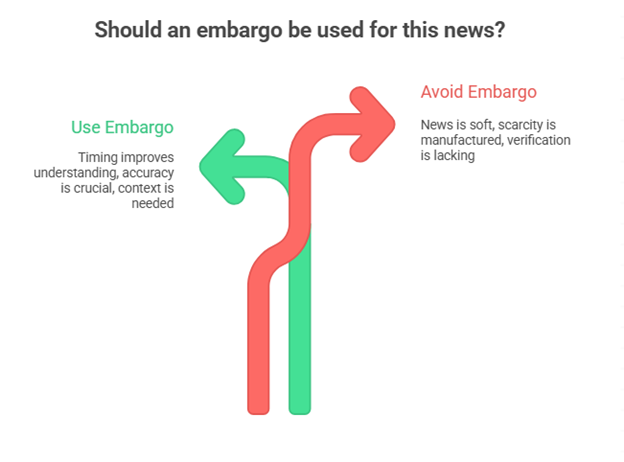
Use an embargo when timing improves public understanding.
Multi-stakeholder launches with complex facts that need the same numbers everywhere
Regulated or market-moving news where accuracy and timestamps matter
Research or data drops that need context, charts and a spokesperson on standby
Executive transitions that require synchronized notices to staff, partners, customers and media
Quick test. If releasing at the same time helps people grasp the news and avoids confusion, you qualify.

When should you avoid an embargo?
Soft news or light product updates that can live on your blog
Stories built on manufactured scarcity
Anything you can’t brief fully or verify with proof
If you’re still polishing the numbers, you’re not embargo-ready.
Does an embargo have to be an exclusive?
Short answer: no. An embargo sets timing. An exclusive sets access.
Common models
Embargo, multi-outlet. Same materials to several reporters with the same lift time
Exclusive, no embargo. One outlet gets the story first on their schedule
Hybrid. One outlet gets the first interview; others get embargoed materials for a coordinated lift

How to choose
Need broad coverage and accuracy → multi-outlet embargo
Need depth, a flagship narrative or a relationship play → exclusive
High stakes and you want both → hybrid
Pitfalls to avoid: accidental exclusives, mixed instructions and unequal access without a plan.
Embargo mechanics (make this muscle memory)
Time-zone clarity: Always write the lift like this: “Oct 28, 7:30 a.m. CT (8:30 a.m. ET).” If global, mention key market hours/holidays.
Written acceptance: Require an explicit “I agree to the embargo” reply before sending assets. Log who accepted and when.
Uniform labels: Stamp every file and page header with the lift time and contact line.
Targeting & list hygiene
Who gets it: Beat-matched reporters who’ve shown accuracy and honored embargoes before.
Small is safer: Tighter lists reduce leaks and improve responsiveness.
Keep a log: Outlet, reporter, acceptance Y/N, assets sent, questions, result. Treat it like CRM.
Asset delivery & preflight
Distribution plumbing: Use expiring, view-only links; disable downloads by default; unique URL tokens per outlet.
CMS readiness: Stage your newsroom post as noindex/nofollow; pre-warm the CDN; have the canonical URL ready.
Rights & accessibility: Confirm image/video licensing, captions, photo credits and alt text.
Localization (if relevant): Pre-translate quotes or release snippets for key markets.
Managing the briefing
Pick a format that matches the news and the clock:
Written Q&A for speed and clarity
A 15-minute background call for nuance
A small huddle when several reporters share a beat
State the rules of the road at the start and again at the end. Log every promised follow-up with an owner and a time. Then deliver.
Social and partner coordination
Social embargo: Pre-schedule executive/brand posts for lift-time; give explicit “do not post before” guidance to employees and partners.
Partner copy kit: Provide timestamped copy, links and creative so partners can lift clean with you.
Legal and compliance guardrails
Never promise off the record in an embargo note.
If you’re public or regulated, sync with counsel on quiet periods, Reg FD, exchange rules and trading windows.
Define the publish trigger in writing (court filing timestamp, all-hands start, wire time).
A quick example from the field
We recently ran an embargo for an acquisition targeting a niche audience. We used a hybrid: one exclusive interview for the key trade, plus embargoed materials for others. The press release hit The Wire at 8:30 a.m. CT; the trade story posted at 8:35. Five minutes apart, on purpose. The exclusive gave authority; the embargo protected accuracy. Together, they created lift. It worked because the news was genuinely newsworthy and the choreography was tight.
Read the Auto Recycling World story: https://autorecyclingworld.com/crush-software-solutions-acquires-leading-car-recycling-operating-system/
Another real-world example
For a crisis client filing a lawsuit, we offered an Associated Press reporter an exclusive embargo with access to the firm and the family. The rule: as soon as the filing posted, she could publish. AP moved first. Hundreds of dailies followed. Morning shows picked it up. One well-timed exclusive under embargo delivered reach, accuracy and a clear narrative on day one.
Read the AP Story Here: https://www.jacksonville.com/story/news/nation-world/2017/09/09/water-rushing-discovery-body-ends-harvey-mystery/15772364007/
Why it landed
Real news with human stakes • One reporter, clear rules • Trigger tied to the filing • Quotes and data ready
How to ask for an embargo the right way
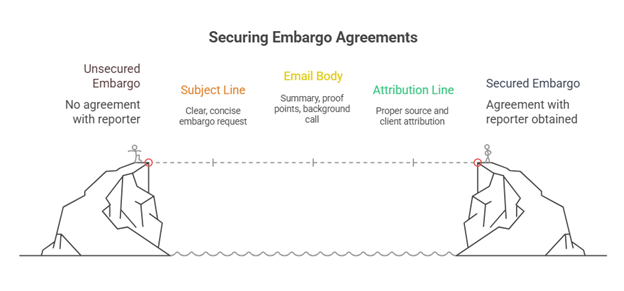
Subject lines
Embargoed for Oct 28, 7:30 a.m. CT: data on [topic]
Requesting interest under embargo: interview with [exec], details inside
Email body template
Opening line: “Sharing news under embargo until Oct 28, 7:30 a.m. CT. Confirm if you agree and I will send the materials.”
One paragraph summary with proof points
Offer a 10-minute background call
Include the embargo date, time, time zone and attribution line
Attribution line
“Attribution: Jo Trizila, Founder and CEO, TrizCom PR, on behalf of [client].”
Keep it short. Reporters have eyes and calendars. Respect both.
Leak prevention that actually works
Get explicit acceptance in writing before you send anything
Share via private link with expiry and view-only defaults
Watermark PDFs with outlet name and timestamp
Use unique tracking links per outlet to spot early access
Store all press assets in one versioned folder
Keep the list small. Fewer recipients, fewer risks
Run a two-minute embargo briefing so no one freelances
What happens if an embargo is leaked?
Unfortunately, embargoes do leak. I’ve lived it. Most PR shops have too. It’s a known risk. That’s why the client must buy into the plan from the start. You can’t hold anyone legally responsible when it happens. You accept the risk because the reward usually outweighs it.
Minute 0–10: Stabilize. Confirm the leak. Screenshot URLs and timestamps. Pause outbound sends. Alert the core team. Lock the facts doc so one owner approves edits.
Minute 10–30: Pick the simplest fix.
Partial/low reach → keep your original lift; quietly add context with briefed outlets.
Full/spreading → publish now on owned channels and send the link to briefed outlets.
Public lines
Holding: “We are aware of early reporting on [topic]. Full details will be available at [time, time zone].”
Early lift: “Sharing full details now to ensure accuracy and context,” then link to your post.
Reporter lines
Holding: “We’re keeping the original lift so everyone gets the complete story. Happy to answer clarifying questions so you’re ready.”
Early lift: “We published early to keep facts clean. Here’s the link, quotes and assets you already have.”
After the dust settles: Thank outlets that honored the embargo. Note patterns if you can. Trim the next list. Tighten controls. Add two lines to the post-mortem: what leaked; what changes.
When an embargo goes wrong (and what it taught me)
Years ago, on a corporate relocation, I gave an exclusive embargo to a national daily newspaper I trusted. The reporter did their job and confirmed with a second source. The piece ran two days early. Employees hadn’t been told. Painful.
Lessons
Employees first • If internal comms aren’t done, you’re not ready • Exclusives raise the stakes • Assume verification
What I’d do now
Sequence: employees → partners → press • Put the trigger in writing • Keep the circle small, watermark assets • Keep a short confirm ready • If people risk is high, skip the exclusive and use a tight multi-outlet embargo after internal comms land
Publication day orchestration
Sequence matters
Newsroom post goes live with your press release and embargoed story
Press sends land
Executive LinkedIn publishes
Partner emails go out
Have chyron copy ready for broadcast. Track live stories and update your newsroom with rolling links so your audience doesn’t play scavenger hunt.
Metrics that matter
Embargo acceptance rate
Hit rate within the first two hours of lift
Coverage quality: tier, accuracy, message pull-through
Share of search movement at seven and 30 days
Referral traffic from outlet-specific UTMs
Search & measurement extras
Track branded + category keywords in search.
Give each outlet a unique UTM.
Score each article for accuracy and message pull-through
Wrap-Up & What Matters
Embargoes are not magic; they are choreography. When the story is real, the timing tight and the proof airtight, an embargo turns chaos into clarity. Use it to help reporters get the facts right, keep stakeholders in sync and land coverage that actually travels. Skip it when the news is soft or the numbers are still moving. If a leak happens, do not panic. Steady the ship, publish what is true and keep going.
Call to Action: Put TrizCom PR on the Clock
If you have market-moving news, a delicate transition or a launch that needs to hit everywhere at once, let us make it clean. TrizCom PR can run an Embargo Preflight, build a tight target list and secure written acceptances orchestrate briefings and proof packs and social or partner lifts and stand up a leak response plan with a newsroom ready to publish.
Contact TrizCom PR for a fast read on whether your announcement qualifies and how to make it land on time, accurately and all at once.
DOWNLOAD YOUR FREE EMBARO CHECKLIST
Everyone has a story. Let TrizCom PR tell yours!
About the Author:
Jo Trizila – Founder & CEO of TrizCom PR
Jo Trizila is the founder and CEO of TrizCom PR, a leading Dallas-based public relations firm known for delivering strategic communications that drive business growth and enhance brand reputations as well as Pitch PR, a press release distribution agency. With over 25 years of experience in PR and marketing, Jo has helped countless organizations navigate complex communication challenges, ranging from crisis management to brand storytelling. Under her leadership, TrizCom PR has earned recognition for its results-driven approach, combining traditional and integrated digital strategies to deliver impactful, measurable outcomes for clients across various industries, including healthcare, technology and nonprofit sectors. Jo is passionate about helping businesses amplify their voices and connect with audiences meaningfully. Her hands-on approach and commitment to excellence have established TrizCom PR as a trusted partner for companies seeking to elevate their brand and achieve lasting success. Contact Jo at jo@TrizCom.com.
PR Metrics That Matter
Last quarter I sat with a CEO who proudly told me their team earned 35 million impressions on a product launch. Big number. I asked a simple follow up. What did those impressions do for the business? Silence.
That is the trap with vanity. Numbers that look impressive on a slide can disconnect from outcomes. In public relations, where numbers can be dazzling and deceptive, it is easy to get lost in the sparkle. Strong leaders do not.
What are vanity PR metrics?
Vanity metrics are the stats that look good without proving success. Impressions. Raw follower counts. Likes. These inflate visibility but rarely show if anyone cared, trusted or acted.
They are not meaningless, but they are not enough. You would not judge your sales team only on doors knocked. You would ask how many opened, how many conversations happened and how many deals closed. PR deserves the same rigor.
Case in point. Your team lands a story on Forbes.com. Cision lists Forbes with an audience of 16,273,661. That is a platform number, not your readership. Treating 16,273,661 as reads is misleading, yet many reports still drop that number into reach. Big numbers can start a conversation. Actionable numbers close it.
What are actionable PR metrics?
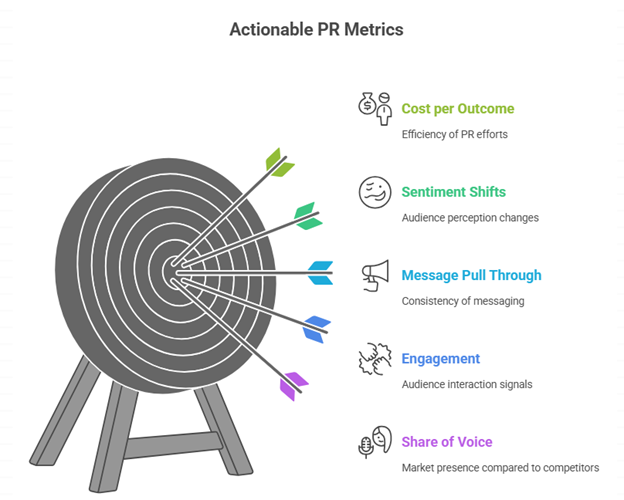
Actionable PR metrics show whether communications move people toward a decision that matters to the business. A few to anchor your dashboard:
Share of voice vs named competitors
Quality and relevance of backlinks from earned coverage
Referral traffic from specific placements
Engagement that signals intent, such as saves, comments, shares, replies
Conversions tied to PR touchpoints, such as demo requests, email signups, store visits
Growth in branded and category search
Presence in AI search results for priority queries
Message pull through in coverage and interviews
Sentiment shifts among priority audiences
Cost per outcome, such as cost per qualified media mention or cost per referral lead
These are the numbers that help a CMO decide where to place the next dollar. They help a CEO see how communications contribute to revenue and reputation.
Map PR metrics to the customer journey
PR works across the full funnel. Your metrics should too.
Awareness
Share of voice, unique reach of earned coverage, category search lift, branded search lift, new users from referral traffic
Consideration
Time on PR landing pages, return visits from placements, content downloads, email growth from PR content, analyst briefing requests
Decision
Sales-qualified leads with PR as first or assist touch, coupon redemptions tied to PR codes, foot traffic tied to local coverage, store locator starts
Loyalty and advocacy
Repeat purchase tied to customers sourced from PR, reviews volume and rating after PR bursts, UGC volume, owned community growth
This is how PR Metrics stop being a scoreboard and start being a steering wheel.

Tie metrics to the PESO model
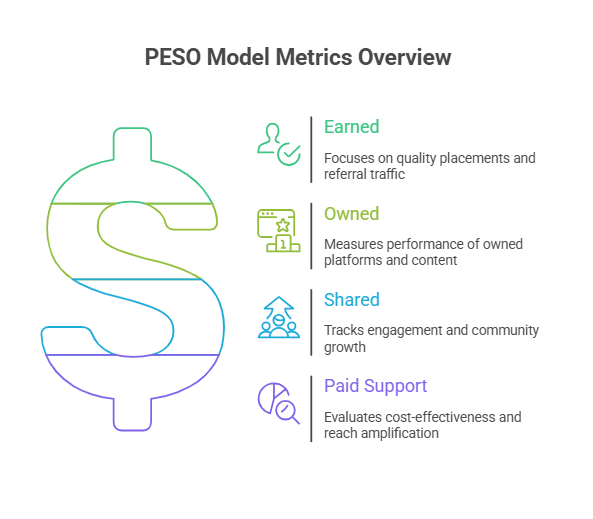
Your plan likely blends paid, earned, shared and owned. Measure each channel on what it does best, then show how the pieces reinforce each other.
Earned
Placement quality, domain authority of outlets, backlink quality, message pull through, referral traffic, conversions from earned pages
Owned
PR hub performance, newsroom traffic, average time on page, scroll depth, conversions from bylines and explainers
Shared
Saves, shares, comments, click-through to owned content, community growth tied to PR moments
Paid support
Cost to amplify earned hits, incremental reach on target, lift in branded search when you boost coverage, assisted conversions
When you connect the dots across a fully integrated program, executives see how communications compounds.
Why the difference matters in the boardroom
Quick story from my desk. A franchise brand was spending heavily on influencers. The vanity report sparkled. Big reach. Pretty content. Many likes. We traced referral traffic and coupon redemptions. Almost no conversion. We shifted to fewer creators with buyer overlap and tighter briefs. Reach dropped by half. Sales inquiries quadrupled.
Boards do not need to see every click. They need clarity. Is PR driving outcomes that matter to this business? Actionable PR Metrics earn their place in that answer.
Why asking for tactics first misses the point
Too many new business calls start the same way. A brand leads with tactics. We want a press release. We want The New York Times. A press release and one media hit rarely make a significant impact.
When selecting a PR agency, start with your business goals, not a wish list of outlets. Lead with a real outcome. We need to grow holiday sales 15 percent year over year. Can you help? Now you will get strategy. That is why you hire a firm.
Think of it this way. You would not tell a cardiologist how to perform heart surgery. You would not instruct an attorney on contract law. You hire experts because they know how to solve the problem.
And when the CEO and board review the sales impact and PR is not present, the shiny headline loses its appeal.
Build a PR metrics framework you can defend
Here is a simple framework we use with executives who want confidence, not clutter.
Start with one business objective
State it in plain language with a number and a deadline. Example: Increase qualified pipeline from healthcare prospects by 20 percent this quarter.
Then we define two or three PR outcomes that influence that objective
Examples: Double meetings with healthcare trade media. Secure three analyst briefings that cite our product category. Earn ten backlinks from healthcare domains with domain authority over 60.
We pick a short set of leading and lagging indicators
Leading: analyst inquiries, inbound media requests, PR-driven traffic to healthcare landing pages
Lagging: demo requests from healthcare domains, proposal volume, closed-won with PR as first or assist touchWe instrument the journey
Use UTM links, dedicated landing pages, unique discount or RSVP codes, call tracking, QR codes at events, click-to-call in local listings. Remove guesswork.
Then we set thresholds for action
Decide what triggers a change. If the message pull-through drops below 60 percent, revise the brief. If referral traffic from earned is below 10 percent of total traffic, revisit the outlet mix.
We report with context
Replace wall-of-numbers reports with a one-page narrative. What we tried. What happened. What we are changing. One chart per stage is plenty.
Finally, we close the loop with sales and service
Confirm that PR-sourced leads progress faster or close at higher rates. Capture feedback on objections PR can address with content or executive visibility.
That is a framework a board can respect.
Practical examples of replacing vanity with value
A few common swaps you can make this quarter.
Instead of total impressions
Track unique reach to priority audiences and the percent of coverage with message pull-throughInstead of follower counts
Track saves, replies and shares on posts tied to PR stories, plus click-through to owned contentInstead of raw clip counts
Track outlet quality, domain authority, backlink presence and referral traffic from those clipsInstead of made-up AEV (advertising value equivalency)
Track cost to replicate outcomes with paid media, plus cost per qualified outcome, such as cost per referral leadInstead of a single viral moment
Track compounding effects such as search lift, brand mentions and secondary pickups two to four weeks after the hit
The role of AI and PR metrics
Executives ask about AI search. It belongs in your PR Metrics mix. Treat it like a new channel of discovery.
Track presence in AI overviews for your priority queries
Log cited sources when your brand appears
Expand your media plan to include credible sources AI often cites in your niche
Compare shifts in branded search and direct traffic after AI mentions
Watch your owned content quality. Clear headlines, strong subheads, schema, expert bios, citations
AI does not replace PR. It rewards credible coverage and clear content.
Avoid the most common measurement mistakes
A short list we often see.
Counting potential audience as readership
Platform audience is not people who read your story.
Cherry picking only the good clips
Executives want the full picture. Include neutral or negative coverage with a plan to address it.
Treating AEV as a monetary north star
AEV is a flawed metric and ignores quality, message pull-through and behavior. Please retire this metric.
Reporting everything, learning nothing
Ten pages of charts do not equal insight. Pick a few numbers that will change what you do next month.
Never connecting to sales
If your CRM does not see PR, your board will not either. Build UTM discipline with sales and marketing ops.
Skipping baselines
Start every program with a baseline for share of voice, search, sentiment and referral traffic.
A five-part PR metrics dashboard that executives will read
Keep it to one page. No fluff.
Objective
One sentence with a number and a date
What we did
Three bullet points on actions that matter
What happened
Five to seven metrics split across awareness, consideration, decision, loyalty
What we learned
Two or three short insights tied to outcomes
What we are changing
One to three concrete changes for the next cycle
That is how PR Metrics earn trust. Not through volume, but through clarity and decisions.
What to ask your PR team
If you are reviewing reports this month, try these questions.
Which of these metrics tie directly to our business goals
Can you show me the pathway from this media placement to engagement or sales
What did we learn this quarter that changes how we approach the next one
How are we instrumenting PR, so attribution is not guesswork
What will you stop doing based on these results
If the answers circle back to look at how big the number is, you are in vanity land.
A short buyer’s guide to PR measurement
Choosing a new firm or evaluating the one you have
Ask for a sample dashboard that hides the client’s name but shows structure and clarity.
Request one case where the team cut a tactic based on data and what happened next.
Confirm the tool stack and how they combine data across tools to avoid double-counting.
Ask how they measure message pull-through and sentiment?
Push on sales alignment. How will they get PR data into your CRM or analytics?
Ask for definitions up front. What do they mean by reach, reads, engagement and conversion?
You will learn more from how a firm measures than from any reel of highlights.
So, what does this mean
PR is not about inflating numbers. It is about influence, credibility and outcomes. Impressions have their place, but executives should press for metrics that inform decisions and drive growth. Otherwise, you end up buying bigger fireworks with no light after they fade.
Trade vanity for value
At TrizCom PR, we cut through the fluff. Our reporting is not designed to pad a deck. It is built to answer the question every executive asks. What did this campaign do for the business? If you are tired of vanity and want clarity, accountability and outcomes you can take to the boardroom, let's talk.
Is PR Getting Harder Or Is Traditional Media Just Shrinking

Seventeen years ago our agency wore a simple badge of honor: we get you in the news or we keep you out of the news. Back then, media relations stood in for PR. A booking on the morning show felt like a trophy you could place on the conference room shelf. Reporters had defined beats, producers had time to listen, and a thoughtful pitch could still win the day.
Then the ground shifted. Newsrooms consolidated. Beats blended. Timelines tightened. Around 2015 my team and I took a hard look at results across clients and asked a basic question: are headlines alone shaping reputation and business outcomes the way they used to? The answer was no. Clips still mattered, but they were not the whole story.
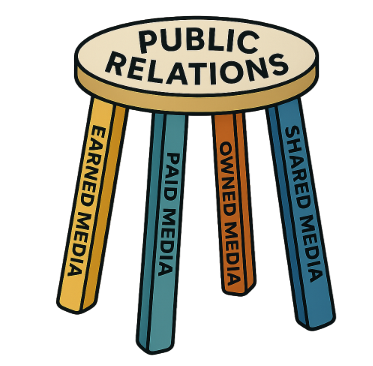
We reframed our work around the full mix of channels where reputation now lives. Owned content started carrying more weight because it offered context and proof. Earned coverage added credibility when it pointed back to something substantive. Shared and paid helped people actually find the information. Picture a four-legged stool. Media relations is a leg worth protecting, but you do not want to sit on one leg and call it a chair.
That shift did not make PR harder. It made it more honest about where trust is built. When people ask if PR is harder or if traditional media is shrinking, they are really asking whether the old playbook still explains how reputations are formed. It explains part of it. Not all of it.
What Public Relations Actually Means
Public relations is the discipline that builds and protects reputation so an organization can meet its goals. At its core, PR is about earning attention and credibility with the people who matter to your work. Media coverage is one way to do that. It is not the only way.
Think of PR as a system, not a stunt. It shapes how your story is told across four connected spaces:
Owned: what you publish yourself, from your website to your newsletters. This is where clarity, proof and consistency live.
Earned: independent coverage you do not pay for. It tests whether your story stands on its own.
Shared: conversations and distribution on platforms you share with others (social media), like LinkedIn and industry communities.
Paid: placements you buy that are labeled as such, useful when speed or targeting matters.
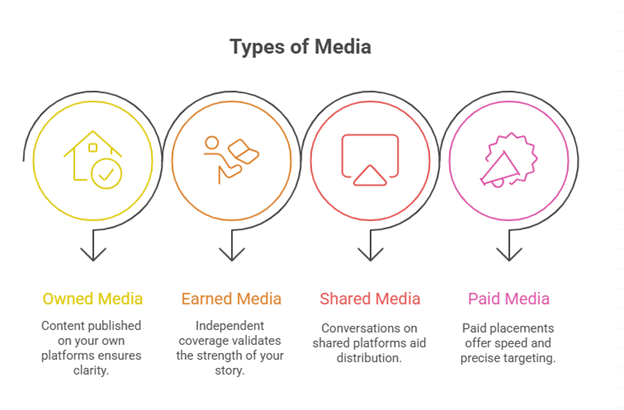
Why does this definition matter in a conversation about shrinking traditional media? Because when people equate PR with press hits, they miss how reputation now travels. When your content is clear, credible and well structured, AI assistants pull it into answers, putting your brand in front of buyers, reporters and regulators before they ever visit your site. A clear explainer on your site can inform a journalist, a buyer and a regulator. A well reported article can point readers to your primary sources. A thoughtful podcast can put a decision maker’s voice in the room during a stakeholder meeting. The pieces reinforce each other.
So when you hear that PR feels harder, it often means the work is being judged by a narrow slice of what PR actually is. When PR is understood as a system that earns trust across owned, earned, shared and paid, the landscape makes more sense. Traditional media has less inventory than it did and PR has a broader canvas.
What Media Relations Means
Media relations is the part of PR that earns independent coverage from newsrooms. At its best, it is a relationship between a source and a journalist built on accuracy, speed and relevance to the audience. The center of gravity is the newsroom’s readers or viewers, not the brand. That is why a good story survives edits and stands on its own.
What it is:
Building useful, ethical relationships with reporters, editors and producers
Offering clear facts, timely access and a point of view that serves the public interest
Understanding how a newsroom works so your pitch fits the format and the moment
What it is not:
Paying for placement
Affiliate listicles presented as neutral reporting
Spray and pray emails that ignore beats or basic accuracy
Newsrooms changed, so media relations changed with them. Many reporters cover multiple beats in a single week. Timelines are shorter. Formats vary from quick hits to explainers to long features. The constant is simple. If the story helps the audience, it has a chance. If it reads like an ad, it does not.
What Traditional Media Includes
Traditional media covers broadcast television, radio, print newspapers and magazines and wire services. These outlets still shape public conversation. They also operate with fewer people than a decade ago. Consolidation reduced desks. Freelancers fill gaps. A metro section that once had five beat reporters may now have two who split duties across city hall, business and public safety.
A few realities help explain the landscape:
Lead times differ. Monthly magazines plan far ahead while local TV can turn a segment in hours.
Geography matters. Regional coverage narrowed in some markets as national desks grew louder.
Formats blend. A single outlet may publish a quick brief, a service explainer and a weekend feature on the same topic.
When people say traditional media is shrinking, they are often reacting to staffing charts and fewer page inches. The audience did not vanish. It moved across platforms and expects clarity, proof and context no matter where it reads or watches. Traditional outlets still set agendas. They do it with tighter teams and tougher choices about what earns space.
The Wall That Once Separated Editorial And Advertorial
There used to be a high wall between the newsroom and the sales floor. That wall still exists, but it has gates. Revenue models changed and with them the mix of what appears on the page.
Today you will see three distinct buckets side by side:
True editorial
Independently reported stories shaped by editors. No payment for placement. Sources are chosen for relevance and credibility.Sponsored content
Pieces paid for by a brand and labeled as such. The outlet controls the frame, the brand funds the space.Advertorial and affiliate content
Brand authored or brand approved articles placed for a fee, often tied to commerce links. Labels include sponsored, partner content and paid post.

Labels matter because they set expectations. A reader approaches a reported investigation differently from a paid product roundup. A producer reviews a paid segment differently from a news hit. Trust grows when the line is clear.
A quick example makes this concrete. You search for Best accounting apps. One result is a reported review from a business desk. Another is a list built by a commerce team that earns a commission if you click. Both can be useful. They are not the same thing. Knowing the difference helps you read the landscape without confusion.
The Expanded Media Map
The map is bigger than it looks from a TV studio. Alongside newspapers and broadcast you will find trade journals, industry podcasts, independent newsletters, community outlets and creator-leading channels with loyal audiences. Many of these publish faster, go deeper on niche topics and give subject matter experts more room to explain.
A few examples that sit next to traditional press, not beneath it:
Trade journals that track regulation, procurement cycles and product shifts week by week
Podcasts where decision makers speak in full sentences instead of sound bites
Newsletters that curate a beat for a focused readership in a specific region or sector
Creator channels that test ideas with communities and surface early signals
Brand newsrooms that publish primary data, timelines and FAQs for anyone to reference

Standards vary, but credibility does not belong to one format. A well reported trade feature can shape a market. A respected newsletter can move a conversation. Traditional outlets often cite these sources and the cycle runs both ways.
Why PR Feels Harder Even When Options Grew
Choice can feel like chaos. There are more places to tell a story, more formats to consider and less attention to go around. That creates pressure. It also raises the bar. Audiences expect clarity and proof. Editors and hosts expect a point of view that teaches something new. The days of a vague pitch sailing through are over.
A few forces drive the feeling:
Shrinking desks, rising volume
Fewer full time reporters and more inbound email mean good ideas get buried unless they are sharp and relevantBlended labels
Editorial, sponsored and affiliate content now live side by side which confuses readers and leaders who grew up with a harder lineFragmented attention
People graze across TV, podcasts, newsletters and feeds, so repetition without substance fades quicklyOld scorecards
If success is still defined as clip count alone, today’s landscape will feel like loss even when reputation is improving
What looks like “harder” is often “different.” Traditional media has less inventory. The broader ecosystem asks for clearer ideas, real examples and transparency about what is paid and what is earned. Once you view PR through that lens, the trends line up with what you see in your own feeds every day.
How Measurement Thinking Changed
For years the scoreboard was impressions, reach and ad value. Those numbers were easy to collect and looked big on a slide. They were also blunt. A mention did not always equal attention and attention did not always equal trust.
The questions inside boardrooms shifted. Did the story change what people understand. Did it lower perceived risk. Did it move someone from curiosity to consideration. Evidence now looks different across the mix:
After a major article, more people look for you by name rather than generic terms
Coverage sends readers to sources that explain your product or policy, not just the home page
Interviews show up in sales conversations because a buyer quotes them back
Analysts, trade editors or community leaders start referencing your data as a source of record
Think of the old metrics as a headcount outside a theater. Useful, but not the same as knowing who took a seat, watched the show and told a friend it was worth the ticket. The point is not to worship a new number. It is to match proof to how reputation is actually formed.
Common Misconceptions
PR is only about headlines
Headlines help, but reputation is shaped across owned, earned, shared and paid working together (integrated PR).Sponsored equals fake
Paid pieces can inform when labeled clearly and grounded in facts. They are different from independent reporting, not automatically lesser.Traditional press is gone
It is smaller and more selective. It still sets agendas and defines stakes, especially in moments of risk.Owned media is just marketing
Owned sources often supply the context reporters, partners and regulators need. When they are clear and factual, they raise the quality of every other channel.More clips mean more impact
Ten thin mentions rarely beat one well reported feature that people read, save and cite.Good stories sell themselves
In lean newsrooms even strong ideas need clarity, access to decision makers and verifiable proof.
Clearing out these myths makes the landscape less confusing. What looks like a contradiction becomes a simple map of where trust is built and how it travels.
A Brief Composite Example
A regional brand leaned hard on morning show segments for years. Producers liked the founder, segments were lively and the clip reel looked impressive. Then the bookings slowed. New producers rotated in. Beats changed. The same pitch did not land.
Inside the company, leaders felt like PR had gotten harder. In reality, the landscape around them had shifted. Reporters needed clearer proof and tighter angles. Readers wanted context they could trust. Over the next quarter, the brand became a better source. They published plain language explanations of their space, offered a customer story with verifiable details and made senior voices available for comment. Traditional coverage returned, now with deeper reporting and a link to something useful. The conversation moved from clever segment to credible reference point.
So, What Does This Mean
Traditional media is smaller. PR is broader. Media relations still matters, but it sits inside a larger ecosystem where trust is built across formats and channels. The work feels different because the scoreboard and the routes into a story changed. Clear ideas, transparent labels and credible proof travel farther than volume alone. When leaders see PR as the system that connects those pieces, the question shifts from is PR getting harder to are we telling a story worth someone’s time.
Work with TrizCom PR
If this raised more questions than it answered, that is a good sign. Let’s talk about your reality, your goals and how PR can support both.
Email Jo@TrizCom.com
Call 214-242-9282
Share one business goal and one challenge. I will give you a clear read on where earned, shared, paid and owned can support outcomes your board cares about. No jargon. Straight talk and next steps.
Why Brands Struggle to Apologize When A Company Crisis Hits

The Crisis Communications Mistake That Keeps Happening
In the highly charged arena of crisis communications, few phrases carry more weight than a simple, direct apology during a company crisis. Yet, for many organizations, expressing sincere regret remains one of the most challenging aspects of managing a reputational crisis. The hesitation to say "I’m sorry" often leads to significant brand damage, prolonged media scrutiny and lost public trust.
In today’s hyper-connected world, where information travels globally within seconds, the delay or absence of a well-executed apology can be far more damaging than the original incident itself. This blog explains why many brands struggle to apologize effectively, the consequences of delayed responses and examples of both poor and effective apology strategies.
The High Cost of Delayed Apologies During a Company Crisis
Silence Escalates the Situation
When a company crisis emerges, the clock starts immediately. Social media amplifies incidents instantly. Videos, posts and commentary spread rapidly across digital platforms. Public opinion can harden within hours. In these moments, organizations face a critical decision. They must respond quickly and authentically or allow silence, legal language or defensive statements to shape the narrative.
Historical Case Studies
United Airlines 2017
The incident involving United Airlines quickly became one of the most widely publicized and discussed crises in recent corporate history. A video showing a passenger being forcibly dragged off an overbooked flight spread rapidly across global media channels. The images of the bloodied passenger, combined with the sound of distressed travelers and the apparent indifference from crew members, generated intense outrage worldwide.
United Airlines' initial response was heavily focused on policy and procedures rather than acknowledging the inhumane treatment of the passenger. The company described the event as "re-accommodating customers," a tone-deaf phrase that amplified public anger. The CEO’s internal email praised employees for following protocol and framed the passenger as disruptive, which only intensified backlash across both traditional media and social platforms.

The failure to address the emotional gravity of the situation allowed the crisis to escalate. Headlines, late-night talk shows and social media users relentlessly criticized United for days. The company’s stock value dipped, and its reputation suffered long-term damage. What made the situation worse was not the initial incident alone but United’s inability to demonstrate immediate empathy and accountability.
Had United Airlines issued a swift public statement expressing genuine sorrow for the incident, acknowledging the mistreatment of the passenger, committing to a thorough investigation and outlining immediate steps to prevent such situations, much of the reputational fallout could have been contained. Instead, the delayed and defensive approach served as a textbook example of how not to handle a public relations crisis.
BP Deepwater Horizon 2010
The Deepwater Horizon disaster stands as one of the most severe environmental catastrophes in modern history. An offshore drilling rig operated by BP suffered a massive explosion, resulting in the tragic loss of 11 crew members and the uncontrolled release of millions of barrels of oil into the Gulf of Mexico over a span of 87 days. The environmental damage was widespread, affecting marine life, coastal communities, fishing industries and tourism for years.
As the crisis unfolded, public scrutiny intensified rapidly. The world watched live video feeds of oil gushing from the seafloor, fueling international outrage and environmental activism. Media outlets covered the disaster around the clock, and social media users shared real-time updates and reactions, amplifying the pressure on BP to respond effectively.

In the critical early days following the disaster, BP's CEO Tony Hayward became the face of the company's response. Instead of offering heartfelt condolences or focusing on those directly affected, Hayward famously stated, "I’d like my life back." The dismissive and self-centered tone of that statement was seen as tone-deaf and deeply insensitive to the scale of the tragedy. Rather than demonstrating empathy, the remark triggered further anger and severely damaged both Hayward's personal reputation and BP's global brand image.
Public confidence in BP eroded quickly. The company's lack of immediate emotional connection with victims and communities, combined with shifting blame and technical jargon, left stakeholders feeling unheard and dismissed. In the absence of sincere leadership, criticism grew from environmental groups, government officials and the general public alike.
A swift and effective response would have required BP to prioritize empathy and accountability from the start. An immediate public statement expressing profound sorrow for the lives lost, acknowledging the severity of the environmental devastation and committing to full-scale cleanup efforts and financial restitution could have helped deescalate the widespread backlash. By failing to lead with humanity, BP allowed the crisis to spiral, ultimately paying billions in fines, settlements and long-lasting reputational harm.
The Deepwater Horizon case continues to serve as a powerful example of how critical it is for organizations to adopt a compassionate, transparent and responsible communication strategy in the earliest moments of a crisis.
Volkswagen Emissions Scandal 2015
The Volkswagen emissions scandal, commonly referred to as "Dieselgate," remains one of the most damaging corporate ethics failures in recent history. Investigations revealed that Volkswagen had deliberately installed software in millions of diesel vehicles worldwide designed to cheat emissions tests. The vehicles appeared compliant under laboratory conditions but emitted up to 40 times the legal limit of nitrogen oxides during real-world driving.
When the scandal broke, it sparked immediate global outrage. Consumers, environmental advocates, regulators and governments expressed deep concern over the deliberate deception. Trust in Volkswagen's commitment to environmental sustainability, which had been a cornerstone of its marketing, was severely undermined.

Volkswagen's initial response attempted to downplay the company's involvement by blaming a small group of rogue engineers. This approach failed to satisfy public demands for accountability. By minimizing the scale of corporate responsibility and portraying the fraud as an isolated technical issue, Volkswagen fueled skepticism among regulators, customers and the media.
The lack of full transparency and ownership delayed the company's ability to begin repairing its reputation. Lawsuits, criminal investigations and government sanctions followed quickly across multiple countries, resulting in billions of dollars in fines, legal settlements and recalls. Public confidence in Volkswagen suffered long-term erosion.
A more effective response would have required Volkswagen’s leadership to immediately accept full responsibility for the emissions violations, publicly acknowledge the breach of trust and outline a clear, transparent corrective plan. This should have included cooperation with regulatory authorities, full disclosure of the scope of the misconduct, swift recalls and investment in clean vehicle technologies to demonstrate meaningful corrective action.
The Dieselgate scandal serves as a case study on how delayed accountability and blame-shifting can intensify reputational damage. Volkswagen’s failure to lead with honesty and integrity in its initial response allowed public outrage to build uncontrollably and transformed a corporate scandal into a global symbol of corporate dishonesty.
Equifax Data Breach 2017
The Equifax data breach in 2017 stands as one of the most significant cybersecurity failures in modern history. The personal information of approximately 147 million consumers was exposed, including sensitive data such as Social Security numbers, birth dates, addresses, credit card numbers and driver’s license details. The scale of the breach placed millions at risk for identity theft, financial fraud and long-term personal security threats.

Public reaction was swift and severe. Consumers demanded answers and protection while regulators and government officials launched multiple investigations. The breach raised national and international concerns about data privacy, corporate responsibility and the security of critical financial infrastructure.
Equifax's initial response severely undermined public trust. The company delayed notifying the public for several weeks after discovering the breach. When it finally went public, its statements were confusing and failed to fully communicate the magnitude of the exposure. The company's attempt to direct affected individuals to a separate website for information and credit monitoring created further frustration and technical issues. Many consumers struggled to access accurate information about whether their data had been compromised.
The company’s lack of clarity and transparency, coupled with reports of insider stock sales by Equifax executives after the breach was discovered but before the public was informed, further fueled public outrage. These missteps created the perception that Equifax prioritized its financial interests over its customers' safety and well-being.
A stronger response would have required Equifax to immediately notify the public once the breach was confirmed. The company should have proactively offered free credit monitoring and identity protection services without requiring complicated registration processes. Clear, honest communication about what had happened, how consumers could protect themselves and what the company was doing to resolve the issue would have demonstrated greater accountability and responsibility.
Instead, Equifax's slow and fragmented communication allowed public confidence to erode rapidly. The breach resulted in numerous lawsuits, government fines, congressional hearings and long-term reputational damage. The Equifax data breach remains a stark reminder of how crucial immediate, transparent and consumer-focused crisis communications are when public trust is on the line.
Pepsi Kendall Jenner Ad 2017
In 2017, Pepsi released a commercial featuring Kendall Jenner that quickly became one of the most controversial advertisements in recent years. The ad depicted Jenner leaving a modeling shoot to join a generic protest scene, ultimately offering a can of Pepsi to a police officer as a symbolic gesture of peace. The visual imagery was widely interpreted as trivializing serious social justice movements, particularly Black Lives Matter, by suggesting that complex societal issues could be resolved with a simple beverage exchange.

The public reaction was immediate and intense. Social media users, civil rights activists, celebrities and advocacy groups criticized the ad for its tone-deaf portrayal of real struggles related to police brutality, racial inequality and protest movements. The backlash escalated within hours, and the advertisement quickly became the subject of widespread mockery, memes and harsh media critiques.
Pepsi's initial response compounded the controversy. The company defended the ad as an attempt to promote a message of unity and peace. This defense was perceived as dismissive of the legitimate concerns raised by the public and further fueled the criticism. By failing to acknowledge the ad's insensitivity, Pepsi allowed the conversation to spiral, with critics framing the company as out of touch with the cultural realities it attempted to reference.
A more effective crisis response would have involved an immediate acknowledgment of the misstep. Pepsi could have issued a sincere statement recognizing the valid concerns expressed by viewers, apologizing for the unintended offense and committing to listen and engage in more informed conversations about complex social issues moving forward.
Eventually, after the backlash continued to mount, Pepsi pulled the ad and released a formal apology. However, the delay in issuing that apology meant the company lost valuable time to demonstrate accountability and empathy when it mattered most.
The Pepsi Kendall Jenner ad remains a prominent example of how brands must approach socially sensitive topics with deep awareness, genuine understanding and a commitment to responsible storytelling. In crisis communications, speed, humility and authenticity often make the difference between a recoverable misstep and lasting reputational harm.
Why Leadership Hesitates to Apologize
Legal Concerns Override Empathy
One of the primary reasons many organizations struggle to issue timely apologies is fear of legal liability. Legal teams often advise against making any statement that could be interpreted as an admission of guilt. While protecting the organization from legal exposure is important, it should not come at the expense of demonstrating compassion.
Expressing regret for harm or offense does not necessarily admit legal fault. An apology that recognizes the seriousness of the situation, empathizes with those affected and communicates steps being taken can be carefully crafted to protect the organization and its stakeholders.
Ego and the Illusion of Control
When a company crisis occurs, the leadership teams and their willingness to prioritize public trust over internal defensiveness will be tested. For some executives, admitting mistakes feels like exposing weakness. The desire to control narratives often leads to delayed responses, shifting blame or issuing heavily sanitized statements that lack emotional resonance.
In crisis communications, the only true control lies in how the organization responds.
Perfection Paralysis
Another common pitfall is the pursuit of a perfect response. As teams review, revise and overanalyze draft statements, valuable time is lost. In today’s media cycle, hours of silence can allow misinformation to spread unchecked, hardening negative perceptions.
The goal should not be perfection but speed combined with sincerity. A timely, straightforward message that reflects honesty and accountability often carries far more weight than a perfectly worded but delayed statement.
The Blueprint for an Effective Apology
Key Elements for Successful Crisis Communications
TrizCom PR has developed a consistent framework for successful apologies through years of guiding organizations through complex crises. The most effective statements include these five essential elements.
Acknowledge the incident with clear and direct language
Express empathy by centering the affected parties
Accept responsibility without minimizing or deflecting
Commit to corrective action with transparent steps
Maintain ongoing communication as new information emerges
When applied swiftly, this formula allows organizations to reset public conversations, demonstrate leadership integrity and begin restoring trust.
The Essential Role of Crisis PR Plans
Building the Foundation Before the Crisis Hits
An effective crisis PR plan is not a luxury; it is a necessity for every organization that values its reputation. At its core, a crisis communications plan provides a proactive blueprint that outlines how an organization will respond when facing an unexpected event that threatens its brand, credibility or operations.
A strong crisis PR plan includes clear roles and responsibilities for decision-makers, ensuring there is no confusion when quick action is needed. It establishes internal communication chains to avoid missteps and conflicting messages. The plan defines pre-approved protocols for messaging, spokesperson responsibilities and approval processes, removing unnecessary delays when response time is critical.
Crisis PR plans also anticipate potential vulnerabilities by identifying likely company crisis scenarios specific to the organization’s industry, operations and public presence. With these scenarios in mind, companies can prepare messaging templates, media holding statements and designated response teams trained to act quickly and confidently.
Proactive planning provides leadership teams with confidence during high-pressure situations when emotions often cloud judgment. A well-designed plan empowers companies to respond decisively while maintaining transparency, empathy and consistency across all communications platforms.
Equally important, these plans emphasize real-time media monitoring and social listening so that organizations can identify emerging threats and respond before issues spiral into full-blown crises.
Organizations that invest in developing and regularly updating crisis PR plans are better positioned to manage both short-term incidents and long-term reputational consequences.
Case Study Apologies Managed Well
HydroChemPSC and the Power of Authentic Leadership
In 2019, HydroChemPSC, now HPC Industrial, faced a viral backlash when a former employee was captured on video engaging in offensive, racially charged behavior. Although the individual no longer worked for the company, social media users incorrectly tied the behavior to the organization. Almost immediately, the company faced public outrage, online accusations and a media storm.
With guidance from TrizCom PR, the company acted decisively. CEO Brad Clark recorded a short, unscripted video message using his iPhone. In the video, Clark publicly disassociated the company from the individual’s actions, validated public concerns, expressed empathy to those impacted, emphasized that HydroChemPSC did not condone such behavior in any form and communicated with transparency and sincerity, avoiding corporate jargon.
The response earned positive public reaction across social media platforms. The video received over 143,000 views on Twitter. Thousands of retweets, likes and supportive comments followed. Facebook also saw significant engagement expressing confidence in the company’s handling of the situation.
This case highlights how clear leadership, decisive action and authentic communication can quickly de-escalate reputational threats.
The Crucial Role of Speed
Timing Shapes Outcomes
Every moment that passes without a strong response diminishes an organization’s ability to regain trust.
Organizations that prepare crisis communications protocols in advance place themselves in a significantly stronger position when reputational threats arise. Preparation empowers teams to respond confidently rather than reactively.
Emotional Intelligence in Crisis Leadership
Compassion Drives Connection
Effective crisis response requires leaders to operate from a foundation of emotional intelligence. The Public Relations Society of America explains that leaders should be prepared to respond, communicate and connect using strong emotional intelligence during a company crisis.
By prioritizing the perspectives and emotions of those affected, organizations humanize their brand and foster goodwill even in difficult circumstances.
Building a Crisis-Ready Organization
Proactive Preparation Creates Confidence
At TrizCom PR, we advise every client to view crisis planning not as an optional exercise but as an essential component of reputation management. Crisis readiness includes developing a comprehensive crisis communications plan with decision-making protocols, identifying and training official spokespeople with media coaching, conducting regular social media monitoring to detect emerging threats, establishing relationships with trusted media contacts and creating pre-approved message templates for rapid response.
Organizations that take these steps position themselves to respond with speed, clarity and consistency when public perception matters most.
Empathy as a Strategic Business Asset
Resilience Through Authenticity
Empathy is not simply a public relations tactic. It is a core leadership competency. Companies that authentically prioritize the well-being of their customers, employees and communities are far better equipped to navigate crises successfully.
Expressing regret, acknowledging harm and demonstrating accountability allows stakeholders to see the organization’s values in action. This often fosters greater loyalty and resilience long after the company crisis has passed.
Partnering with TrizCom PR for Crisis Protection
Trusted Guidance Every Step of the Way
The strongest reputations are not built in calm moments. They are forged during periods of adversity. Partnering with an experienced crisis communications team provides businesses with the tools, training and counsel needed to safeguard their brand when reputations hang in the balance.
TrizCom PR specializes in helping organizations prepare for the unforeseen. From comprehensive crisis planning to immediate response activation, we support our partners at every stage before, during and after a crisis event.
To explore how TrizCom PR can help protect your brand, contact us today.
Effective crisis response starts long before your company crisis occurs. Remember, it is not when a crisis will occur; it’s when it will occur. Let us help you be ready.
Want A Quick Summary?
Listen to TrizCom PR's NotebookLM recap with Chuck and Karen for the latest insights and key takeaways!
Everyone has a story to tell.
Let TrizCom PR tell yours.

About the Author:
Jo Trizila – Founder & CEO of TrizCom PR
Jo Trizila is the founder and CEO of TrizCom PR, a leading Dallas-based public relations firm known for delivering strategic communications that drive business growth and enhance brand reputations as well as Pitch PR, a press release distribution agency. With over 25 years of experience in PR and marketing, Jo has helped countless organizations navigate complex communication challenges, ranging from crisis management to brand storytelling. Under her leadership, TrizCom PR has earned recognition for its results-driven approach, combining traditional and integrated digital strategies to deliver impactful, measurable outcomes for clients across various industries, including healthcare, technology and nonprofit sectors. Jo is passionate about helping businesses amplify their voices and connect with audiences meaningfully. Her hands-on approach and commitment to excellence have established TrizCom PR as a trusted partner for companies seeking to elevate their brand and achieve lasting success. Contact Jo at jo@TrizCom.com.
The Growing Power of Micro Influencers in Brand Marketing

A new era of influence is here and it’s not powered by celebrities.
The days of bankrolling A-listers for mass-market campaigns are waning. What’s rising in their place? Trust. Authenticity. Real connection. And that’s where micro influencers come in. These aren’t red carpet names or viral sensations, they’re everyday creators with dedicated followings and outsize impact.
Micro influencers have emerged as today’s most effective, ROI-driven brand partners. They command smaller but deeply engaged audiences, often within niche communities. And unlike mega influencers or celebrities, they operate with a level of authenticity and accessibility that aligns more closely with how people consume content.
This blog breaks down the who, what and why of micro-influencer strategy: what defines a micro influencer, why their voices matter more than ever and how brands, whether global players or local disruptors, can engage them to spark measurable results.
What Is A Micro Influencer?
Micro influencers are typically defined as individuals with social media followings between 10,000 and 100,000. What they lack in follower count, they more than make up for in influence. Their content often focuses on a specific interest, community or region building loyal audiences who engage not just passively, but personally.
Unlike macro-influencers or celebrities who project a polished, distant persona, micro-influencers come across as relatable and real. They respond to comments. They test products on camera. They engage with their followers like peers, not fans. That peer-to-peer dynamic fuels a higher degree of trust which is the currency of modern marketing.
Platform Presence
You’ll find micro influencers on TikTok, Instagram, Facebook, YouTube and increasingly on platforms like Threads and BeReal. Their strength lies not in omnipresence but in resonance. Communities follow them because they share specific interests or lived experiences, not because they’ve been algorithmically boosted to stardom.
Shifting Media Trust
According to a 2024 Pew Research report, 37% of U.S. adults under 30 now say they “regularly” get news and product information from influencers rather than traditional media or journalists. That’s not just a blip it’s a generational shift in how people define credibility. Platforms once considered social-first have become news sources, product discovery engines and cultural commentary hubs.
In other words, micro influencers aren’t a fringe tactic. They’re foundational to how younger audiences navigate content and make decisions.
Why Micro Influencers Work
Trust and Authenticity
People follow micro influencers for the same reason they listen to friends. They trust them. These creators are often subject matter enthusiasts, niche hobbyists or community voices. They don’t just promote a product; they tell a story, share results and offer feedback that feels unscripted.
In an era when audiences are deeply skeptical of polished brand campaigns and overproduced ads, authenticity wins. According to a Nielsen study, 92% of consumers trust recommendations from individuals even if they don’t know them over branded content. This is especially true among Gen Z and millennials, who prize transparency, real-world relatability and ethical alignment.
Micro influencers offer what traditional marketing can’t: a sense of “this worked for me, it might work for you too.” That emotional proximity drives conversions.
Higher Engagement Rates
More followers doesn’t always mean more impact. In fact, as influencer followings grow, engagement often shrinks. Micro influencers buck that trend. They have tight-knit communities and high interaction levels, which means platforms like TikTok, Instagram and YouTube reward them with visibility.
Recent benchmarks show:
Micro influencers (10K–100K followers): average engagement rate of 3.9%
Macro influencers (100K–1M): average 1.2%
Celebrities (1M+): often below 0.9%
In short, micro influencers don’t just reach people they connect with them. Comments, saves, DMs and shares are common because their followers genuinely care about their opinions.
That type of relevance translates into outcomes. And for brands focused on performance, not prestige, engagement trumps reach every time.
Cost Efficiency and ROI
Micro influencers are a value multiplier. Instead of spending a full campaign budget on one high-profile name, brands can partner with a constellation of micro creators, each targeting a specific audience segment. That strategy not only diversifies risk but also provides more granular performance data.
Partnerships are flexible some creators work via affiliate links, others through gifted content or small flat fees. Many now use platforms like ShopMy or LTK (formerly LIKEtoKNOW.it), which allow brands to track clicks and sales in real time while offering creators a passive income stream.
This model aligns with TrizCom PR’s approach: performance-backed influencer marketing that delivers tangible business outcomes. Whether the goal is brand awareness, web traffic or direct sales, micro influencers allow brands to spend smarter and scale faster.
The Micro Influencer’s Role in the Creator Economy
The creator economy has become a force of its own now estimated to exceed $500 billion globally, according to Vogue Business. But this isn’t just a playground for the viral elite. Micro influencers are foundational players in this economy, operating more like small media businesses than hobbyists.

They film, edit, write, test, publish, analyze and engage all from their phones. Many work across platforms. Some sell their own merch, launch digital courses or partner with brands on long-term content collaborations.
This shift from “creator as personality” to “creator as entrepreneur” has democratized influence. People no longer need a massive platform to drive change or commerce. They just need clarity of voice, relevance to their audience and tools to scale.
Platforms are racing to support them:
TikTok Creator Marketplace connects brands with vetted talent
Instagram Collabs offer dual publishing to expand reach
Substack and Patreon turn niche followings into subscription models
Micro influencers are not stepping stones they’re standalone channels. They help brands move away from paid vanity metrics and toward community-powered impact.
And with the right strategy, they become not just content creators, but strategic brand partners.
How Micro Influencers Drive Revenue
Boosting Sales Through Authenticity
Trust converts. That’s why testimonials from micro influencers often outperform traditional ad creative. Their followers already view them as credible sources so when they recommend a product, it doesn’t feel like a pitch. It feels like a tip.
Many micro influencers use direct links, promo codes and swipe-up features to simplify conversion. This creates a direct path from recommendation to revenue and the results are measurable.
Look at brands like Glossier, Function of Beauty and Mejuri. Each built early traction by partnering with everyday creators who posted unfiltered reviews, tutorials and feedback. That grassroots approach built not just visibility, but community-fueled demand.

https://www.instagram.com/skin.illustrated/
Consumers today are increasingly discovery-driven. They don’t wait to be marketed to they seek out content that answers their questions, aligns with their values and feels like real-world proof. Micro influencers deliver exactly that.
Amplifying Niche Audiences
Mass marketing speaks to everyone and no one. Micro influencers offer the opposite: sharp audience alignment. They thrive in niches whether that’s eco-conscious Gen Z creators promoting sustainability brands or local foodies spotlighting small businesses.
By targeting interest groups, regional audiences or identity-based communities, brands can bypass the noise and go straight to relevance.
Example: A neighborhood coffee shop working with a Dallas lifestyle micro influencer will see more qualified foot traffic than running a broad city-wide ad. Likewise, a skincare brand partnering with Black estheticians on YouTube speaks directly and respectfully to a community that has historically been underserved by beauty marketing.
With micro influencers, it’s not about mass appeal. It’s about precision. And in the digital age, precision is what drives ROI.
Enhancing SEO and Digital Footprint
Micro influencer campaigns don’t just live on social feeds they create lasting digital value. When influencers link to your site, write blogs or upload YouTube content with product mentions, your SEO benefits.
Backlinks from their platforms improve search authority
User-generated content (UGC) feeds long-tail keywords that support organic discovery
Mentions in niche channels increase brand presence across search results
Influencers, especially those with blogs or YouTube channels, act as link-building assets. They generate evergreen content that supports your brand's visibility long after the campaign ends. For brands focused on discoverability and content strategy, micro influencers add infrastructure not just impressions.
Micro Influencers Challenges and How to Navigate Them
Despite their many advantages, micro influencer campaigns require thoughtful planning. Here’s how to tackle the most common hurdles.
Discoverability and Vetting
The challenge: Not every micro influencer is a professional. Follower counts can be inflated and engagement metrics don’t always tell the whole story.
The solution: Use vetting tools like AspireIQ, GRIN or Upfluence to evaluate audience authenticity, comment quality and historical brand partnerships. At TrizCom PR, we go a step further analyzing tone, values and brand fit to ensure alignment that goes beyond vanity metrics.
A successful campaign doesn’t start with the biggest name. It starts with the right name.
Brand Control vs. Creator Freedom
The challenge: You want messaging consistency. They want creative control. How do you find balance?
The solution: Set clear parameters, not scripts. Provide brand guidelines, key messages and campaign objectives but let the influencer decide how to deliver it. Content that feels too “produced” often underperforms.
Think of creators as collaborators, not contractors. The best results happen when you trust them to speak in their voice, not yours.
Disclosure and FTC Compliance
The challenge: Sponsored content must be transparent. Failure to disclose can damage trust or worse, invite legal scrutiny.
The solution: Require clear tags like #ad or #sponsored and lean on platform-native tools (like Instagram’s “Paid Partnership” label). These disclosures don’t hurt performance they increase credibility.
TrizCom PR ensures every campaign follows FTC guidelines and platform best practices, protecting both the brand and the influencer from regulatory risk.
Micro Influencers and Gen Z: A Cultural Fit
For Gen Z, influence is less about aspirational status and more about authentic alignment. This generation grew up in the era of YouTube creators, TikTok tutorials and Reddit threads not red carpets. They aren’t impressed by polish. They’re drawn to realness.
Transparency, identity and activism shape how Gen Z chooses who to follow, listen to and buy from. In fact, Teen Vogue reports that many young consumers now view influencers as cultural commentators or even “news sources,” favoring creators who reflect their own lived experiences over traditional institutions.
That’s why micro influencers particularly those grounded in specific identities, geographies or passions resonate so powerfully. They reflect the communities they speak to, offering a sense of representation and relevance that macro campaigns often miss.
This generation expects:
Relatability over celebrity
Cause-driven content over generic promotions
Two-way interaction over one-way broadcasts
Micro creators meet these expectations. They invite conversation, share imperfections and often use their platforms to talk about mental health, sustainability, inclusion or social justice topics that matter deeply to Gen Z.
Brands that partner with micro influencers aren't just accessing attention they’re earning trust in one of the most values-driven generations we’ve seen.
Building a Micro Influencer Strategy
Effective influencer campaigns don’t start with outreach they start with strategy. Here’s how brands can build a framework that drives measurable results:
Define Your Goals
Be specific. Are you looking for:
Awareness (e.g., impressions, reach)
Engagement (e.g., saves, shares, comments)
Conversions (e.g., sales, downloads, clicks)
Affinity (e.g., positive sentiment, user content)
Your goals will shape your influencer selection, content briefs and performance metrics.
Identify the Right Partners
It’s not about follower count it’s about fit. Vet for:
Tone: Does their content sound like your audience?
Values: Do they align with your brand ethos?
Engagement quality: Do followers comment with genuine interest or just emojis?
Content style: Does their visual identity suit your product?
At TrizCom PR, we approach partnerships like casting every creator needs to “audition” for how well they match your message and audience.
Set Clear Metrics
Once the campaign launches, define how you’ll measure success:
UTM links for traffic and sales attribution
Promo codes to track purchases
Impressions, engagement rate, content saves, shares and sentiment analysis
Use these metrics to refine, retarget and repeat what works.
Foster Long-Term Relationships
Influencer marketing works best when it’s not a one-off. Ambassadorships deepen authenticity and help build brand loyalty over time.
Strategies to explore:
Exclusive discount codes
Early access or product seeding
Behind-the-scenes content or takeovers
Event collaborations and on-site activations
Influencers aren’t just media channels they’re brand storytellers. When you treat them like partners, their audience will treat you like a trusted name.
Case Examples of Brand Success with Micro Influencers
Micro influencers are already behind the success of some of today’s most recognizable brands. These campaigns didn’t hinge on celebrity status they thrived because of community trust, consistent engagement and a smart multi-channel approach.
Skincare: Youth to the People and The Ordinary
Both brands launched with grassroots strategies focused on education and transparency. Rather than relying on big-budget celebrity endorsements, they partnered with micro influencers skinfluencers on YouTube, estheticians on Instagram and wellness creators on TikTok to break down ingredients, share real-time product trials and offer honest reviews. This built long-term loyalty, not just hype.
Tech: Notion and the Productivity Creator Economy
Notion, the digital workspace app, didn’t chase tech journalists or Fortune 500 execs at launch. Instead, it tapped into micro creators on TikTok and YouTube students, startup founders, ADHD productivity coaches who built tutorials, templates and review content. These creators helped shape how Notion was perceived, used and adopted globally. Today, Notion’s community-led growth is a model studied across SaaS.
Food & Beverage: Local Launches with Hyperlocal Creators
From coffee shops to kombucha startups, brands in this space have found that tapping micro influencers in their immediate geography yields real foot traffic. Whether it’s a Dallas-based food blogger announcing a new restaurant opening or a wellness micro creator demoing a new vitamin shot, the results are targeted, relevant and often more impactful than traditional ad spend.
Micro influencers excel at making content feel personal and that’s what moves the needle. These case studies show that success isn’t always about scale. It’s about the right voice, in the right place, saying the right thing.
What This Means for Your Brand
Why the Future Belongs to Micro Influencers
Influence has changed. It’s no longer owned by the loudest or most famous it’s earned by those who connect with authenticity, clarity and consistency. Micro influencers are the modern-day connectors: trusted by their followers, respected in their niches and increasingly essential to a brand’s marketing strategy.
They’re cost-effective, engagement-rich and rooted in community. They move the needle not through spectacle, but through conversation. And they offer brands something increasingly rare in digital marketing: believability.
For brands ready to move beyond generic ads and reach real people in meaningful ways, micro influencers are the signal in the noise.
If you want to be remembered not just seen think small. Start with creators who already have the trust you’re trying to build. Then partner with them, not just as content distributors, but as collaborators.
And if you need help finding the right ones? That’s what we do. TrizCom PR specializes in influencer marketing campaigns that are targeted, measurable and built for today’s digital landscape. Let’s get your product in the hands of the people who can actually make someone listen. Let’s connect.
Want A Quick Summary?
Listen to TrizCom PR's NotebookLM recap with Chuck and Karen for the latest insights and key takeaways!
About the Author:
Jo Trizila – Founder & CEO of TrizCom PR
Jo Trizila is the founder and CEO of TrizCom PR, a leading Dallas-based public relations firm known for delivering strategic communications that drive business growth and enhance brand reputations as well as Pitch PR, a press release distribution agency. With over 25 years of experience in PR and marketing, Jo has helped countless organizations navigate complex communication challenges, ranging from crisis management to brand storytelling. Under her leadership, TrizCom PR has earned recognition for its results-driven approach, combining traditional and integrated digital strategies to deliver impactful, measurable outcomes for clients across various industries, including healthcare, technology and nonprofit sectors. Jo is passionate about helping businesses amplify their voices and connect with audiences meaningfully. Her hands-on approach and commitment to excellence have established TrizCom PR as a trusted partner for companies seeking to elevate their brand and achieve lasting success. Contact Jo at jo@TrizCom.com.
Win the AI Search Game with PR Strategies for Modern CMOs

The search engine landscape is evolving rapidly. AI search is no longer a future concept—it's actively transforming how users interact with platforms like Google. For PR professionals, this shift necessitates a reevaluation of how content is discovered, evaluated and engaged with.
According to Pew Research discovered that of February 2024, 23% of U.S. adults reported having used ChatGPT, up from 18% in July 2023. This increase suggests a rising familiarity and comfort with AI tools among the American public. The rapid adoption of AI-driven interfaces highlights how users are increasingly leaning towards AI-enhanced experiences, even when seeking information.
Traditional press releases, blog posts and media pitches are no longer sufficient on their own. To remain visible, credible and relevant, PR content must be optimized not just for human audiences but also for AI algorithms.
Let's explore what's changing and how PR professionals can adapt.
What is AI Search?
AI search integrates artificial intelligence—particularly machine learning and natural language processing—into search engines to deliver more intuitive, conversational and accurate results. Unlike traditional search, which relies heavily on keyword matching and link-based algorithms, AI search interprets context, intent and relationships between topics to generate synthesized responses.
How Does It Work?
Natural Language Understanding (NLU): AI search engines comprehend questions the way a human might ask them, focusing on the meaning behind a query rather than matching exact keywords.
Generative AI: Tools like Google's Search Generative Experience (SGE) use AI models to pull information from multiple sources, summarizing it into a cohesive answer at the top of the search page.
Continuous Learning: AI systems improve over time, learning from user interactions to refine how they rank sources and generate summaries.
Think of AI search as a blend of a search engine and a knowledgeable assistant. Instead of providing a list of links, it offers a curated response, pulling from various reputable sources to deliver the best possible answer.
How AI Search is Transforming Google
AI search isn't just tweaking Google's algorithms; it's reshaping the entire user experience. Google's generative AI tools, like Search Generative Experience (SGE), synthesize information from multiple sources to provide direct answers at the top of search results. This means fewer clicks to individual websites and more emphasis on summarizing information within the search engine itself.
According to Avenue Z, AI-driven search engines now present conversational, synthesized answers, prioritizing concise, context-rich content. The traditional blue links are being pushed down the page. With this evolution, PR teams must consider how their stories and key messages will surface in these AI-generated snippets.

As Forbes notes, "If you're not optimized for AI search, you're invisible." The days of optimizing only for keywords and backlinks are over. Now, PR content must be contextually rich, authoritative and aligned with how AI interprets and generates information.
What This Means for PR and PR Content
1. Authority Matters More Than Ever
AI search prioritizes trusted sources. Publications with strong reputations and authors with demonstrable expertise are more likely to be referenced in AI-generated results.
For PR professionals, this reinforces the importance of earned media placements in credible outlets. If your client's story lands in a well-regarded publication, it has a higher chance of being surfaced by AI search. At TrizCom PR, we've always believed in the value of building strong media relationships—this shift makes that mission even more essential.
2. Contextual Content is Key
AI search tools don't just pull exact keyword matches; they synthesize context across multiple data points. This means your content needs to be comprehensive, clear and aligned with user intent. Press releases and thought leadership pieces must answer the "why" behind the story, not just present the facts.
For example, if you're promoting a client's new sustainable product, your content should touch on industry trends, environmental impact and consumer benefits—all areas an AI engine might aggregate into a broader response.
3. Structured Data Gives You an Edge
Behind-the-scenes SEO practices like structured data markup help AI understand the context and credibility of your content. Think of schema markup as a translator between your website and search engines, signaling what your content is about and why it matters.
Embedding structured data in press releases, case studies and blog posts increases the chances that AI search tools will recognize and feature your content. It's one of those small adjustments with outsized impact.
4. Refresh and Repurpose Content
AI search favors fresh, relevant content. Regularly updating blog posts, press releases and media kits with new insights, statistics or case studies helps ensure your material remains part of the AI conversation.
At TrizCom PR, we recommend auditing your content library quarterly. Assess what's performing well, what needs updating and which topics have gained momentum in your industry. These insights help guide content strategy in an AI-driven search environment.
5. Visuals, Summaries and Snippets
Generative AI search tools often extract quick summaries or visual elements to present in search results. Including concise summaries, bullet points, infographics or videos in your PR content can make it more "AI-friendly."
Consider adding key takeaway sections to blog posts or creating media kits with easy-to-digest statistics and visuals. The more accessible your content is for both human readers and AI, the better.
PR's Role in the Age of AI Search
The role of PR remains the same: crafting compelling stories and building trust. But how we deliver those stories—and how they're found—is evolving. In this AI search landscape, PR must work hand-in-hand with SEO, data analytics and digital content teams.
Here's how TrizCom PR is helping brands stay visible:
Integrated Strategies: Combining earned media with optimized digital content that feeds AI search engines. This includes leveraging multimedia, using structured data, and ensuring that content is rich in context and relevance.
Data-Driven Insights: Using advanced analytics to track which content performs well in AI-driven search environments. We analyze user behavior, engagement metrics, and search patterns to refine our approach continuously.
Ongoing Education: Staying at the forefront of AI developments and training our team to understand new tools and algorithms. This proactive mindset helps us craft PR strategies that are ahead of the curve.
Building Authoritative Content: Prioritizing E-E-A-T (Experience, Expertise, Authoritativeness, and Trustworthiness) content, which AI search engines favor. We collaborate with subject matter experts to ensure our content reflects high levels of credibility and insight.
Adaptability: Regularly updating and repurposing content to stay relevant. Whether it’s a fresh angle on a familiar topic or new data supporting a client story, we make sure our content evolves along with AI search preferences.
Looking Ahead
AI search is still evolving, but one thing is clear: the lines between PR, content marketing, and SEO are blurring. At TrizCom PR, we see this as an opportunity. It’s a chance to amplify your brand’s story in new ways, ensuring it reaches the right audience—even when that audience is an algorithm.
By staying agile, leveraging data, and prioritizing high-quality content, we help brands not just keep up but lead in the evolving digital landscape.
Ready to make your PR content AI-search ready? Let’s start the conversation.
Want A Quick Summary?
Listen to TrizCom PR's NotebookLM recap with Chuck and Karen for the latest insights and key takeaways!
About the Author:
Jo Trizila – Founder & CEO of TrizCom PR
Jo Trizila is the founder and CEO of TrizCom PR, a leading Dallas-based public relations firm known for delivering strategic communications that drive business growth and enhance brand reputations as well as Pitch PR, a press release distribution agency. With over 25 years of experience in PR and marketing, Jo has helped countless organizations navigate complex communication challenges, ranging from crisis management to brand storytelling. Under her leadership, TrizCom PR has earned recognition for its results-driven approach, combining traditional and integrated digital strategies to deliver impactful, measurable outcomes for clients across various industries, including healthcare, technology and nonprofit sectors. Jo is passionate about helping businesses amplify their voices and connect with audiences meaningfully. Her hands-on approach and commitment to excellence have established TrizCom PR as a trusted partner for companies seeking to elevate their brand and achieve lasting success. Contact Jo at jo@TrizCom.com.
Cutting Ads? Shift Focus to Your PR Budget Instead.

The Headline Nobody Wanted To Read
Last week MediaPost reported that second‑quarter U.S. ad spending “decelerated through May, pacing to be the lowest growth since the pandemic.” For anyone guarding a shrinking PR budget, the Guideline/Standard Media Index data feels like déjà vu: the spring buying season sputtered just when brands normally step on the gas. Piling on, analyst Brian Wieser clipped his 2025 ad‑growth forecast from 4.5 percent to 3.6 percent, and MoffettNathanson warned a recession could vaporize another $45 billion in ad dollars before year‑end.

And if the word decelerate didn’t curl your hair, Reuters piled on: analysts at MoffettNathanson warn a recession could vaporize $45 billion in ad dollars this year alone.
Knee‑jerk reaction #1: “Slash the budget—starting with marketing”
It’s predictable. When the CFO reaches for the chainsaw, paid media is the first limb on the chopping block: quick, visible savings with numbers the finance team grasps instantly.
Knee‑jerk reaction #2: “Go dark until the storm blows over”
Wrong move. History (and more than a few scar‑bearing brands) shows that silence erodes awareness, trust and share of voice faster than you can say TikTok. Rebuilding that equity later costs multiples of what it would have taken to sustain it.
The smarter pivot: Cut your ad spend? Up your PR spend.
Public relations is the economical workhorse of brand communication—especially in a downturn. If you’re considering reallocation, this is the moment to sharpen your PR budget and put it to work. Here’s why and how to deploy it.
1. Don’t Stop Communicating With Your Audience—Do It With PR
Why staying visible matters
Brands that maintain—or even grow—share of voice during recessions outperform later in sales growth and profitability. The effect compounds for years.
Decision cycles lengthen when money gets tight. Customers research longer, seek third‑party validation and look for brands that feel steady. PR excels at feeding those validation loops with credible stories and expert commentary.
Integrated PR services unlock every PESO channel without the media‑buy price tag, while issues management pros keep brewing problems from becoming brand‑breaking crises.
Why PR beats paid when budgets tighten
Credibility dividend – 92 percent of consumers trust earned media over paid ads, according to inBeat.
Defensible spend – PR’s cost structure skews to talent and ideas, not media inventory. If you have smart strategists and a good story, your PR budget can dominate headlines for a fraction of what you'd spend on digital.
Compounding shelf life – A well‑placed article or podcast interview keeps ranking in search, resurfacing in social and bolstering SEO long after a 30‑second spot fades.
What “doubling down on PR” looks like in practice
Prime‑time :30s on national cable
→ Replace with a live expert segment on a business‑news network or a guest spot on high‑authority industry podcasts. You still tap a targeted audience, but now your brand speaks as the trusted voice, not just the paid spot.Paid LinkedIn InMails that vanish after one send
→ Trade up to bylined thought‑leadership articles in the trade journals and newsletters your buyers already trust. Those pieces live online forever, fuel SEO and can be shared by sales in every nurture email.Generic display ads that fight shrinking click‑through rates
→ Invest in building share‑of‑voice, domain authority and high‑quality backlinks through data‑driven PR campaigns. Each credible mention pushes you up the search results page while adding third‑party validation no banner can buy.Endless retargeting banners that chase prospects around the web
→ Aim for executive‑profile features in major dailies and keynote slots at niche conferences. Both put your leaders—and their insights—front and center, generating press coverage, social chatter and warm pipeline conversations that keep paying off long after the cookies expire.
2. PR Is One Of The Most Economy‑Friendly Communication Tools Available
When dollars get squeezed, executives demand ROI math. Good news: PR’s efficiency isn’t anecdotal; it’s measurable.
Direct media cost
PR (earned): $0—coverage is secured on merit, not media spend
Advertising (paid): $$–$$$$ per placement, depending on channel and inventory
Audience trust level
PR: Credibility scores around 92 %; readers view journalists and analysts as impartial sources
Ads*: Hover near 41 % (inBeat study), because everyone knows space was bought
Average shelf life
PR: Articles, podcast episodes and TV replays can drive traffic for months—even years
Ads: Visibility lasts days (or the length of the flight) and disappears when the budget stops
SEO impact
PR: High—authoritative backlinks and keyword‑rich headlines lift search rankings
Ads: Low to none—paid spots rarely pass link equity or organic value
Cost per thousand impressions (CPM)
PR: Effective CPM is often under 10 % of what you’d pay for the same reach in paid media
Ads: Set the 100 % baseline—every impression carries its full price tag
Even the Public Relations Society of America flags cost‑per‑thousand efficiency as a core ROI yardstick.
Stretching every dollar: five thrift‑friendly PR plays
Newsjacking with purpose
Attach expert commentary to real‑time headlines—policy shifts, tariffs, tech rulings. Fast, relevant, almost free.Content atomization
One white paper ≈ eight bylines, two infographics, a webinar outline and a pitch deck. Milk it.Podcast guest tours
Booking fees? Zero. Reach? Massive. Repurpose the transcript for SEO gold.Data mini‑studies
Mine your own CRM or survey 200 customers. Fresh stats equal instant media interest.Community partnerships
Grassroots coverage + internal morale boost = win-win for your PR budget.
3. What PR Can Do For You (That Ads Can’t—At Any Price)
Elevate authority
Third‑party validation puts your brand on the expert podium. When a neutral journalist quotes your CMO, buyers perceive leadership—not self‑promotion.
Turbo‑charge search
High‑authority media domains linking back to your site can move you up Google’s results pages faster than most technical SEO tweaks.
Insure reputation
Earned goodwill is reputation capital. If a crisis hits, a bank of positive coverage buys you critical public patience.
Attract top talent
Prospective employees Google you. Positive press plus thought‑leadership signals culture, mission and stability—priceless in churn‑heavy times.
Support the entire funnel
PR isn’t just top‑of‑funnel fluff:
Awareness – Headlines spark recognition.
Consideration – Detailed bylines answer objections.
Conversion – Case‑study coverage provides social proof.
Advocacy – Awards and rankings give customers bragging rights.
If you’re refining your PR budget, now’s the time to align those dollars to real business outcomes—not just vanity metrics.
How To Re‑Allocate Budget The Smart Way
Ring‑fence a PR innovation fund
Protect 10–15 percent of last year’s paid media spend to pilot bold PR ideas—interactive data hubs, investigative research or documentary‑style video storytelling.Blend paid support surgically
Use micro‑paid pushes (e.g., LinkedIn boosts) only to amplify earned wins, not to replace them. This keeps paid costs predictable and leverages PR’s credibility halo.Measure what matters
Share of Voice, backlinks and inbound leads tell the true story of your PR impact.
A six‑month PR action plan for a Q2 slowdown
Month 1 – Messaging Tune‑Up
Refresh core positioning so every pitch, post and paid asset speaks to the economic‑downturn pain points your buyers feel today. Outcome: a story matrix your entire team can grab and go.
Month 2 – Thought‑Leadership Blitz
Flood the market with helpful expertise: land four bylined articles in priority trades and place at least fifteen quick‑hit expert comments with reporters on deadline.
Month 3 – Data Drop
Commission a bite‑size proprietary study, package the findings and offer a 24‑hour exclusive to a tier‑one outlet. The goal: headline coverage that every other publication then amplifies.
Month 4 – Broadcast Push
Put a friendly face to the narrative. Book the CEO (or designated exec) on three national TV or radio programs and back it up with appearances on five influential podcasts.
Month 5 – Community & CSR Spotlight
Host a local press event that showcases your social‑impact work; distribute a multimedia kit—photos, short‑form video, social snippets—to extend the story across shared and owned channels.
Month 6 – Measure & Optimize
Roll up the numbers: share‑of‑voice gains, new high‑authority backlinks, inbound‑lead lift. Identify which angles over‑performed, retire the weak ones and refresh the roadmap for the next six‑month sprint.
The Silence Tax Is Real
The ad market may be easing off the throttle, but your stakeholders’ need for trustworthy information is sprinting ahead. Brands that hibernate now will pay a silence tax—lost mindshare, eroded trust, slower recovery—when the economy rebounds.
The brands that maintain or increase their share of voice will win the comeback.
Let’s Talk Before the Silence Costs You.
Economic headwinds don’t wait for budget meetings. If your brand is staring down a line-item culling, don’t let PR be an afterthought—make it the centerpiece of your strategy. At TrizCom Public Relations, we help you align your PR budget with strategic visibility, industry leadership and real ROI.
Reach out today—because strategic noise beats silence every time.
Everyone has a story. Let TrizCom PR tell yours!
About the Author:
Jo Trizila – Founder & CEO of TrizCom PR
Jo Trizila is the founder and CEO of TrizCom PR, a leading Dallas-based public relations firm known for delivering strategic communications that drive business growth and enhance brand reputations as well as Pitch PR, a press release distribution agency. With over 25 years of experience in PR and marketing, Jo has helped countless organizations navigate complex communication challenges, ranging from crisis management to brand storytelling. Under her leadership, TrizCom PR has earned recognition for its results-driven approach, combining traditional and integrated digital strategies to deliver impactful, measurable outcomes for clients across various industries, including healthcare, technology and nonprofit sectors. Jo is passionate about helping businesses amplify their voices and connect with audiences meaningfully. Her hands-on approach and commitment to excellence have established TrizCom PR as a trusted partner for companies seeking to elevate their brand and achieve lasting success. Contact Jo at jo@TrizCom.com.