
Quick answer:
AI search visibility is the measurable degree to which AI answer engines such as ChatGPT, Gemini, Perplexity, Claude and Google AI Overviews can accurately find, describe and recommend a company. In 2026, it directly affects vendor shortlists, sales cycles and even deals that reach a CFO's desk, which means it belongs on the executive dashboard next to pipeline and retention, not buried inside a marketing report.
Key Takeaways
AI chatbots and review sites are now running neck and neck as the top influence on B2B vendor shortlists, and G2 data shows the lead changed hands between April and July of 2026 alone.
Most companies are not tracking this closely. Industry estimates suggest roughly one in five marketing teams currently monitor how AI describes their brand.
Visibility problems are showing up as revenue problems. New 2026 research shows AI-sourced recommendations are getting flagged and reversed later in the buying process, often by finance leadership.
The fix is not a technical patch. It requires a coordinated audit of what a company says about itself, who confirms it and how consistently that story appears across the web.
This article introduces a five-part framework, C.L.E.A.R., that CMOs, CEOs and founders can use to run that audit internally before hiring anyone.
Why This Belongs in the Boardroom, Not the Marketing Meeting
G2 published new research on July 22, 2026, and the finding that should concern every CEO and CFO is not about visibility. It is about what happens after visibility.
The report found that 82 percent of B2B software buyers have sourced a software recommendation from an AI chatbot in the last two years. That is no longer news. What is new: nearly half of buyers, 49 percent, say a CFO vetoed a purchase in the last 12 months that had already been approved earlier in the process.
Put those two numbers together and a pattern emerges. AI tools are getting companies onto the shortlist faster than ever. But when a deal reaches a finance leader who was not part of the AI-assisted research, and that leader cannot independently verify what the AI told the buyer, the deal stalls or dies. Visibility got the company in the room. A thin or inconsistent public record got it thrown back out.
That is not a marketing failure. It is a revenue failure with a marketing-shaped root cause.
The Ground Has Shifted Faster Than Most Dashboards Have
Executives who last checked this a year ago are working from outdated numbers. According to G2's Answer Economy report, 51 percent of B2B software buyers now begin their research inside an AI chatbot rather than a traditional search engine, up from 29 percent just 11 months earlier. Seventy-one percent now rely on chatbots at some point in the research process.
Broader industry estimates point the same direction, though the exact figures vary by study and by which purchase stage is measured. Multiple 2026 analyses of B2B buying behavior put AI tool usage somewhere in the 70 to 90 percent range during active research and evaluation. The number moves depending on the source. The trend does not.
Here is the part that should get an executive's attention. This is changing quarter to quarter, not year to year. The chart below compares two G2 findings published just three months apart.
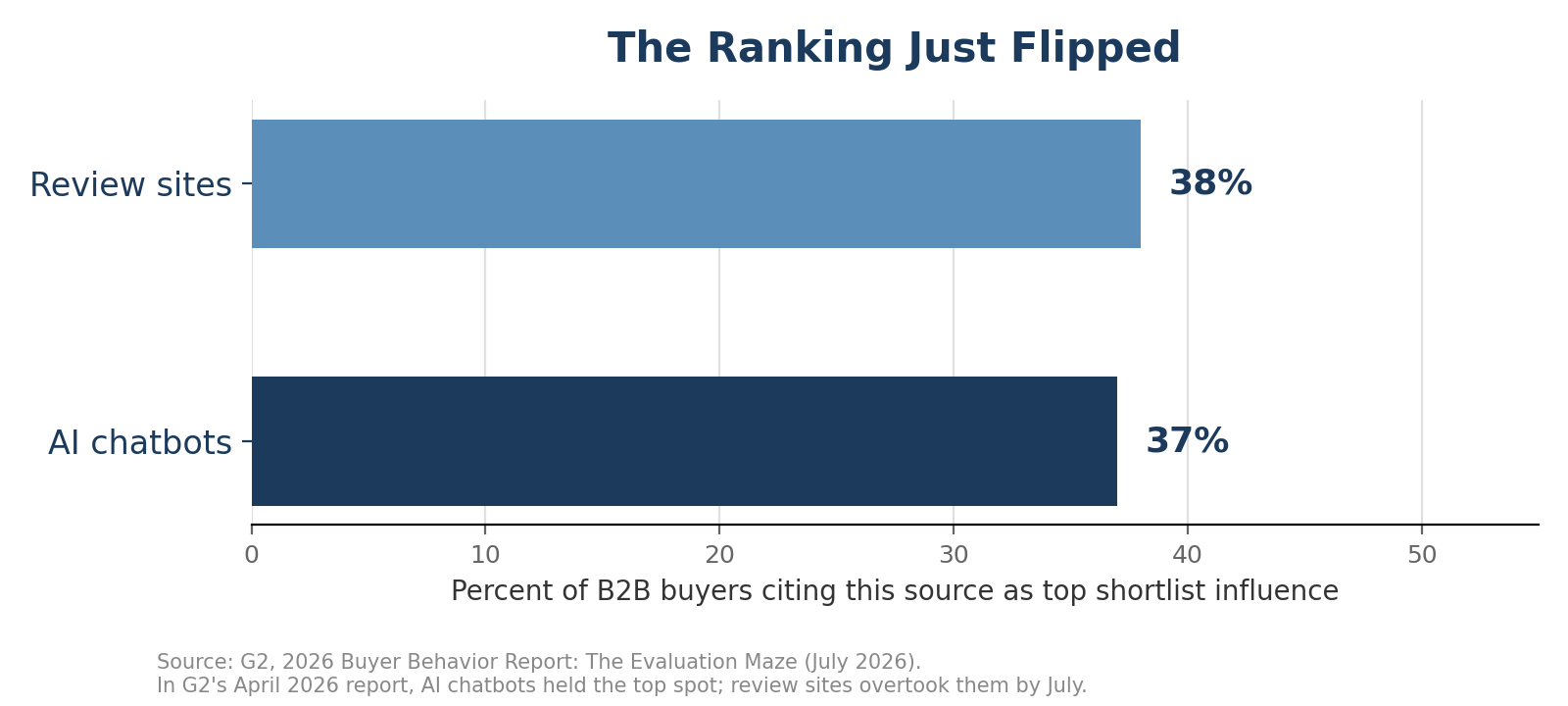
In April 2026, G2 reported that AI chatbots were the single biggest influence on which vendors made a buyer's shortlist. By July, using a newer survey, review sites had edged ahead, 38 percent to 37 percent, the first time that had happened. Neither figure is decisively larger. What matters is that the leader changed within a single quarter.
That is the real lesson for a leadership team, and it has nothing to do with picking the "right" channel to chase. A company optimizing only for AI chatbot visibility, or only for review site presence, is optimizing for last quarter's answer. The companies least exposed to this kind of whiplash are the ones with a strong public record across all of it: clear owned content, credible third-party validation and a leadership team that shows up in outside coverage. That record holds up no matter which source happens to lead this quarter.
What AI Search Visibility Actually Measures
AI search visibility is not a ranking. There is no page one to climb toward. It is a measure of three separate things happening at once:
Discovery. Does the company surface at all when someone asks an AI tool about its category, its services or its competitors?
Accuracy. When it does surface, does the AI describe the company correctly, using current facts, current leadership and current positioning?
Trust transfer. Does the AI treat the company as credible enough to recommend, or does it hedge, qualify or leave the company out of a comparison entirely?
A company can score well on discovery and still fail on trust transfer. That is the gap most audits miss, and it is the gap showing up in the CFO veto data above. The buyer found the vendor. The vendor's public record did not hold up once someone looked closer.
The C.L.E.A.R. Framework: A Self-Audit for Leadership Teams
Most existing advice on this topic stops at "ask AI what it thinks of you." That is a useful first step, but it is diagnostic, not corrective. The five factors below are what actually move the needle once a leadership team knows there is a problem.
Clarity
Can a stranger, or a machine, explain what the company does in one plain sentence after reading the homepage? Vague language such as "innovative solutions" or "transformative results" gives an AI model nothing concrete to repeat. Specific language about who the company serves, what problem it solves and how it is different gives the model something to cite.
Legitimacy
Does independent, third-party evidence back up the claims on the website? This includes press coverage, verified reviews, association memberships, awards and analyst mentions. AI models weigh corroborated, third-party sources more heavily than a company's own marketing copy, because a company describing itself is not a neutral source.
Executive Visibility
Is a named leader at the company recognized, quoted or cited as an expert anywhere outside the company's own channels? An AI model is far more likely to trust and recommend a company whose leadership has a visible, verifiable track record of expertise than one where no individual is associated with the brand at all.
Accessibility
Can AI crawlers and search tools technically reach and parse the company's content? This covers structured data, schema markup, crawlable pages, updated sitemaps and a site architecture that does not bury key facts behind scripts or logins. Strong content that a crawler cannot read might as well not exist.
Recency
Is the information current, or is the AI pulling from a three-year-old bio, an outdated leadership page or a press release about a product the company no longer sells? AI-generated answers update far faster than traditional search rankings. A company that does not actively monitor and refresh its public record will eventually be described by information it no longer controls.
A company that scores weak on even one of these five areas gives an AI model a reason to hedge, omit or misdescribe it. Strength in four areas rarely compensates for a serious gap in the fifth.
A Practical Test Any Executive Can Run This Week
Open ChatGPT, Gemini, Claude and Perplexity. In each one, ask:
What does [company name] do?
Who leads [company name] and what is their background?
How does [company name] compare to its top competitors?
Is [company name] a credible option in its category?
Compare the four answers side by side. Consistency across models is a strong signal of a clear, well-corroborated public record. Wide variation between models, missing details, outdated leadership information or the company being left out of a competitive comparison altogether are signals that the C.L.E.A.R. audit needs to start immediately, not after the next planning cycle.
Frequently Asked Questions
What is AI search visibility?
AI search visibility is how accurately and consistently a company is found, described and recommended by AI-powered tools such as ChatGPT, Gemini, Perplexity and Google AI Overviews, based on the public information those tools can access and verify.
Is AI search visibility the same as SEO?
No. Traditional SEO focuses on ranking web pages in a list of search results. AI search visibility focuses on whether an AI model trusts a company enough to summarize, cite or recommend it directly in a single generated answer, often without the user ever visiting a website
Why are CFOs vetoing AI-influenced purchases?
Recent 2026 research from G2 found that 49 percent of B2B buyers had a CFO veto an already-approved purchase in the past year. When a finance leader who was not part of the AI-assisted research cannot independently verify the vendor's claims through credible outside sources, the deal often stalls at final approval.
How many B2B buyers actually use AI tools to research vendors?
G2 found that 71 percent of B2B software buyers rely on AI chatbots at some point during research, up from 60 percent seven months earlier. Broader industry estimates put overall AI tool usage among B2B buyers in the 70 to 90 percent range, with the exact figure varying by study and by purchase stage
What is the C.L.E.A.R. framework?
C.L.E.A.R. stands for Clarity, Legitimacy, Executive Visibility, Accessibility and Recency. It is a five-part self-audit leadership teams can use to evaluate whether their public information gives AI models enough accurate, verifiable material to describe and recommend the company correctly.
Can a company rank well on Google and still be invisible to AI?
Yes. Traditional search ranking and AI trust are measured differently. A company can hold a strong position on a Google results page and still be omitted from an AI-generated answer if AI models do not find enough corroborated, third-party evidence to treat it as a credible source.
Does publishing more content improve AI search visibility?
Not by itself. Volume without clarity or corroboration does not move the needle. Companies that improve their AI visibility typically do so by sharpening what they say, strengthening third-party validation of it and keeping the information current, not simply by publishing more pages.
What role does executive visibility play in AI search results?
AI models are more likely to recognize and cite a company as an authority when a named leader has a visible, verifiable public record, such as media interviews, bylined articles or conference appearances. A company with no individual associated with its expertise gives the model less to work with when assessing credibility.
Read more about bylined articles.
How often should a company check how AI describes it?
Given how quickly AI-generated answers can shift as new information is indexed, a quarterly check across the major AI tools is a reasonable baseline for most companies, with more frequent monitoring recommended around product launches, leadership changes or funding announcements.
What is trust transfer in AI search visibility?
Trust transfer refers to whether an AI model, having found a company, treats it as credible enough to actively recommend rather than mention with hedging or qualification. A company can be discovered by an AI tool and still fail at trust transfer if its public record does not hold up to scrutiny.
Why does third-party validation matter more than a company's own website content?
AI models treat a company describing itself as an interested source rather than a neutral one. Independent coverage, reviews, association memberships and analyst mentions carry more weight because they represent an outside party confirming the same claims the company makes about itself.
What happens if different AI tools describe a company inconsistently?
Inconsistent descriptions across ChatGPT, Gemini, Claude and Perplexity usually indicate that a company's public information is too vague, outdated or scattered across conflicting sources for any single model to summarize with confidence. That inconsistency is itself a diagnostic signal.
Is AI search visibility primarily a technical SEO issue?
No. While technical accessibility, such as crawlable pages and structured data, is one factor, most visibility gaps trace back to unclear messaging, weak third-party corroboration or outdated information rather than a purely technical fault.
Read more about crawlable pages and structured data or What Should Leaders Fix in Their AI Search Visibility Strategy?
What is the fastest way for a CEO to check their own AI visibility?
Ask ChatGPT, Gemini, Claude and Perplexity the same set of direct questions, such as what the company does, who leads it and how it compares to competitors, then compare the four answers for accuracy and consistency. Significant gaps or omissions point directly to where the audit should begin.
Who should own AI search visibility inside a company?
Because AI visibility depends on messaging clarity, earned media, executive positioning, technical accessibility and ongoing monitoring, it typically sits best under a combined communications and marketing function rather than any single department working in isolation.
Ready to See What AI Is Actually Saying About Your Company?
Every day your public record stays vague, outdated or inconsistent, AI tools are still generating an answer about your company, whether that answer is accurate or not. TrizCom PR helps CEOs, CMOs and founders run a C.L.E.A.R. audit, close the gaps and build the kind of clear, corroborated public record that holds up in a boardroom and in a chatbot answer.
Schedule Your AI Visibility Audit With TrizCom PR
Or reach out directly at jo@trizcom.com or 214-242-9282 to talk through what AI is currently saying about your brand and what it would take to fix it.
TrizCom PR is a Dallas-based public relations firm and a founding member of The Public Relations Collective, helping companies strengthen the clarity, credibility and consistency of their public record for both human and AI audiences.

About the Author:
Jo Trizila – Founder & CEO of TrizCom PR
Jo Trizila is the founder and CEO of TrizCom PR, a leading Dallas-based public relations firm known for delivering strategic communications that drive business growth and enhance brand reputations, as well as Pitch PR, a press release distribution agency. Jo is also a proud founding member of The Public Relations Collective. With over 25 years of experience in PR and marketing, Jo has helped countless organizations navigate complex communication challenges, ranging from crisis management to brand storytelling. Under her leadership, TrizCom PR has earned recognition for its results-driven approach, combining traditional and integrated digital strategies to deliver impactful, measurable outcomes for clients across various industries, including healthcare, technology and nonprofit sectors. Jo is passionate about helping businesses amplify their voices and connect with audiences meaningfully. Her hands-on approach and commitment to excellence have established TrizCom PR as a trusted partner for companies seeking to elevate their brand and achieve lasting success. Contact Jo at jo@TrizCom.com.