
Introducing A New PR Agency Model – The Public Relations Collective

What is the Difference between sales promotions, public relations and advertising?

Executives ask this when money is on the line. You need to know which tactic moves buyers now, which one builds trust that lowers costs later and how to run both without wasting a dollar. The short version is simple. Ads buy reach. Promotions trigger action. PR earns credibility people believe.
The useful version is bigger. None of these tools should live alone they are integrated. At TrizCom PR we plan with The PESO Model©, developed by Gini Dietrich, so paid, earned, shared and owned work as one system. That helps you decide what to run, when to run it and how to measure each one without mixing signals.
This paper is your field guide. We start with plain definitions so your team speaks the same language. Then we break down where each tactic wins, how to set separate goals and what to track. You will see practical calls on direct mail, BOGO offers, loyalty programs and sponsorships. We close with a TrizCom PR case built on The PESO Model and a quick FAQ you can use in your next meeting.
What you will get from this guide:
Clear differences between ads, promotions and PR so you pick the right tool
Simple rules for when to use each one, alone or together
A monthly mix any small team can run
Metrics that prove value without overlap
A real example that shows how PESO turns a plan into results
If you want fewer debates and better outcomes, keep reading. This will help you choose the right move, spend with intent and show the board exactly what you got for the money.
Definitions And Basics
What is advertising?
Advertising is paid placement. You buy space or time and control the message, audience and frequency. Formats include, for example, search, social, display, print, radio, TV, streaming and sponsored content. The job is to put a clear offer or idea in front of the right people at the right time.
What is sales promotion?
Sales promotion is a short-term incentive that compresses action into a window. Examples include a limited time code, BOGO, bundle, gift with purchase, referral credit or contest. You can run a promotion inside any channel. The job is to move products fast, collect leads or tip fence sitters.
What is public relations in a PESO world?
Public relations is not a single tactic. In the PESO Model it is how the four media types work together.
Paid amplifies the best messages and fills reach gaps
Earned includes media relations plus analyst relations, reviews and third-party endorsements
Shared covers social channels, community engagement and partnerships
Owned is your content hub with articles, videos, guides, data and FAQs
Used together, PESO builds reputation, authority and measurable outcomes for the business.
What’s The Difference Between Sales Promotion, Public Relations And Advertising?
Control vs credibility: advertising gives full control; promotions add an incentive; PR trades control for credibility by earning space in trusted places
Time horizon: promotions are sprints; ads run as long as you fund them; PR compounds over time
Primary job: promotions push immediate action; ads build reach and demand; PR builds belief and access that lowers future costs
Cost model: ads cost media dollars; promotions cost margin; PR costs senior time, content and relationships
Is PR Two-Way Communication While Advertising Is One Way?
PR works best as a conversation. You listen, adjust, respond and earn the right to be heard. Media interviews, analyst briefings, employee forums and community work all bring feedback. Advertising is usually one way. You send a paid message and measure response. Both have a place. The difference is how feedback flows.
Does PR Always Mean “No Direct Sale,” Or Can It Drive Purchases Too?
PR can (and does) drive purchases when you connect the story to a path to buy. A credible article or expert feature lowers risk in a buyer’s mind. Add clear next steps on your site and you will see traffic, inquiries and sales. The bigger value of PR is its compounding effect. It shortens sales cycles, raises close rates and protects price because trust is higher.
What Counts As Ads, Promotions Or PR?
Is direct mail considered advertising or sales promotion?
It depends on the content. A postcard with a brand message and no offer is advertising sent by mail. A catalog with a code or coupon is a promotion using the mail channel. The channel does not define the tactic. The presence of an incentive does.
Is a BOGO offer a sales promotion or part of pricing strategy?
Both can be true. A one month BOGO to load trial is a promotion. A permanent BOGO structure is pricing and merchandising. If it is temporary with a hard end date, treat it as a promotion and track lift vs baseline. If it is always on, treat it as pricing and track mix and margin.
Is a customer loyalty program a sales promotion or CRM?
A loyalty program is CRM with promotional tools inside it. The system, data and lifecycle design are CRM. The points and perks are promotions. Measure it as a relationship engine first. Use promotions to shape behavior you want, such as repeat visits or trials of new items.
Does sponsoring a local charity or youth team count as PR?
Yes. Sponsorship is part of community relations inside PR. It can include paid components if you buy signage or naming and promotional elements if you add a code or event. Treat it as PR led with a clear community goal, then decide if you need paid or promotional layers to extend reach.
When I donate to a cause, how do I talk about it without it sounding like an ad?
Lead with the need, not your logo. Share the commitment in plain numbers. Put the nonprofit’s voice first with a quote. Show proof of delivery with photos or receipts. Invite others to help in ways that do not require a purchase. Keep the focus on impact and let others give you credit. (Read more here: Purpose Driven Brands)
Choosing The Right Mix
For a new product, when should I use advertising vs a sales promotion vs PR
Phase 1: Build the story with PR focusing on earned and owned media
Publish a clear problem-solution article, FAQs and a data point on your site
Brief a short list of reporters and analysts with proof and demos
Line up community or category partners who add trust
Phase 2: Add paid media to scale what works
Test two messages in search and social tied to one landing page
Use small budgets to see which proof points pull the best
Retarget people who engaged with earned and owned content
Phase 3: Pulse a promotion to spark trial
Time a code or bundle for the first two weeks after launch
Keep the window tight with a hard end date
Use unique codes by channel so you can see what pulled
Phase 4: Sustain with shared and earned media
Publish early user stories
Pitch bylines and podcasts that reach buyers
Keep issues responses and reviews active to protect momentum

How do I plan a simple monthly mix of ads, promotions and PR for a small business?
Use a four week rhythm that a small team can run.
Week 1: Earned push. Pitch one timely story or expert quote. Update the newsroom on your site
Week 2: Paid test. Run two creative variants to one audience. Keep the budget tight and learn
Week 3: Promotion pulse. Offer a short incentive tied to a real event, not a random discount
Week 4: Review. Check traffic, inquiries, footfall, calls and sentiment. Keep what worked. Drop what did not

If my market is niche with low traffic, should I prioritize trade PR or paid ads?
Start with trade PR plus pinpoint paid. A credible article in the right trade outlet reaches decision makers in one move. Pair that with account based ads and sponsored placements where your buyers already read. Skip broad awareness until you have proof that a wider net returns value.
Measurement And Goals
How do I set goals for PR vs advertising vs promotions that aren’t overlapping?
Give each tool a job with a metric native to that job.
PR: share of voice, message pull through, quality backlinks, qualified inbound, analyst or trade mentions, lift in branded search, organic traffic lift, referral traffic tracked with UTMs and AI search citations
Advertising: reach, frequency, CTR, cost per lead, cost per order, new file rate
Promotion: redemptions, incremental revenue, lift vs baseline, new buyers acquired, repeat rate after the offer ends
Judge each tool by what it is built to do. Then look at how the set performs together.
What’s the best way to measure a charity sponsorship’s impact?
Use three views.
Exposure: audience at the event, estimated impressions from signage, partner social reach
Engagement: QR scans, email or volunteer signups, traffic to a dedicated page, partner referrals
Reputation: sentiment in local media, message recall in a short survey, lift in branded search during the period
If you add a small promotion to the sponsorship, track a unique code so you can tie revenue to the activation. If it stays pure PR, focus on exposure, engagement and reputation.
How do I tell if a loyalty program is working vs just discounting away margin?
Watch four signals.
Earn vs burn: healthy programs have points earned and used in balance. If burn only spikes when you discount, you trained people to wait
Frequency: members should buy more often than non members
Average order value: if AOV drops after a perk, you may be discounting items people would buy anyway
Incremental margin: test vs control by cohort. If members do not produce more gross margin after perks, adjust the offer mix
Reward behaviors that matter: visits, full price trials of new items, referrals, reviews. Do not reward pure discount hunting.
What metrics prove PR value if I’m not running ads at the same time?
Track lifts you earn, not buy.
Month over month branded search
Referral traffic from earned articles and podcasts
Quality backlinks and the change in domain authority
Inbound speaking and partnership requests
Analyst and trade mentions tied to your messages
Win rate and cycle time if PR content is in the sales process
AI search presence: citations in LLM answers and referral traffic from AI assistants
Ask sales which objections shrink after coverage lands. If friction drops, PR is working.
Ethics And Expectations
When does a “PR” activity become advertising and need disclosure?
If money changes hands for coverage, it is paid. Sponsored content, paid influencer posts, native ads and advertorials need clear, near-the-message disclosure. If you provide a material benefit to a creator and expect coverage, they should disclose. Earned media that happens with no exchange does not require a paid label.
How do I talk about community donations in PR without looking performative?
Keep the spotlight on the cause and the community.
Name the need first
State your commitment with numbers
Let the nonprofit speak with a quote and link
Share proof of delivery, not staged scenes
Offer ways to join that do not require a purchase
Report back later with results, not self praise
Tone matters. Let others say thank you while you stay at work.
Budget And Execution
With a small budget, should I spend on local PR, run a BOGO or buy direct mail?
Match the tool to the problem.
Need fast cash flow: run a tight promotion to convert fence sitters. Protect margin with limits
Need to open doors: invest in local PR and community ties so future ads work cheaper
Need targeted reach in a radius: consider direct mail with a clear offer and a code, then retarget digital to households that respond
If you have zero ad history, start with a small digital test before a big mail drop. If you have zero story in market, run PR first so ads do not work alone.
What’s a starter checklist for running each: an ad, a sales promotion and a PR activity?
Ad checklist
One page plan with goal, audience, budget and timeline
One message, one call to action, one landing page
Two creative variants to test
Tracking in place: UTM, pixel or call tracking
Daily checks the first week, then twice a week
Follow up plan for leads you earn
Sales promotion checklist
Clear objective: trial, load-up, referral or win-back
Offer rules with caps and end date
Unique code or QR for tracking
Margin and inventory plan
Simple terms in plain language
Post promo plan to retain new buyers at full price
PR activity checklist using PESO
Core story with proof and a newsroom post ready to publish
Earned targets and angles mapped to outlets and stakeholders
Shared plan for social cutdowns and partner posts
Paid plan to boost the best performing owned or earned content
Spokespeople trained with key messages and FAQs
Measurement plan for share of voice, sentiment and inbound signals
How do I avoid mixing tactics in one message so people don’t get confused?
Pick one lead. If the goal is to tell a story, lead with PR and keep the offer in the background or on a different channel. If the goal is to move inventory this weekend, lead with the promotion and keep the story off the ad. Build a simple message map:
Lead idea: the first line and visual
Support: proof or detail
Action: the next step
Run that map across PESO and keep the order the same, then adjust weight by channel.
A TrizCom PR PESO Example: Total Eclipse DFW
A regional eclipse became a business and public safety moment. TrizCom PR created and led Total Eclipse DFW, a spinoff we owned and operated. We built the plan on the PESO Model from Spin Sucks and set three goals: make DFW the go-to viewing market, educate on ISO-compliant safety and win measurable search and traffic. The work earned PRSA Dallas’ Pegasus Award for Events and Observances.
Owned Media
We built TotalEclipseDFW.com as the hub. In just four months, it drew 60,300 users and 74,325 sessions, with 70.56 percent of traffic from organic search. The site ranked for 3,800 keywords against a goal of 500 and captured top clicks on “total eclipse dfw” and county pages that helped residents plan the day.
Earned Media
Media lifted credibility and fed search. We secured 374 placements against a 250 goal, many with backlinks. Coverage included The Dallas Morning News, CBS News, CW, Forbes and Univision. Referral traffic converted: DallasNews.com visitors produced $9,529 in sales and eclipse.aas.org added $1,000.
Shared Media
Social gave quick reach and useful signals. Facebook drove volume but light engagement, while LinkedIn and YouTube audiences stayed longer and interacted more. Real-time updates beat general content, which shaped what we posted in the final weeks.
Paid Media
We kept spend small and precise. With less than a thousand dollars, on Facebook, we generated 173,895 impressions and a 5.68 percent CTR. Email carried the heavier lift with high open rates and clear calls to action. The pairing built awareness and converted existing relationships.
Promotion
Free glasses from museums and retailers changed buyer behavior. We repositioned ours as premium collectibles, guaranteed ISO-compliant and offered early purchase incentives to lock orders before free distribution ramped up.
Measurement
We tracked traffic, search, referrals and sales by source. Google organic drove 29,523 users and $18,495.16 in sales. Timed coverage moved revenue: Feb 2 stories in The Dallas Morning News and eclipse.aas.org drove 94 sales and $3,345.35. Feb 6 coverage contributed 145 sales and $5,553.91.
What this shows
One plan. Separate jobs. Each PESO lane carried different weight at different times. Owned search kept the lights on, earned spiked momentum, shared tuned the message and paid scaled what worked. The mix produced authority, sales and community impact without wasting budget.
How Does PESO Change How You See PR vs Advertising vs Promotions?
The biggest shift is mental. Instead of choosing one tool in a vacuum, you decide how the four media types support the same goal. Advertising stops competing with PR. Promotions stop undercutting brand work. Owned content stops sitting idle. The plan becomes one system that moves buyers now and builds trust for later. That is what the PESO Model was built to do.
FAQ for leaders who want clarity fast
Is PR just media relations?
No. Media relations is one earned tactic. Public relations uses the full PESO Model across paid, earned, shared and owned. That means media outreach, expert content, social community, owned content and smart amplification work together. The goal is reputation, authority and outcomes tied to real business metrics, not headlines alone.
Can PR drive direct sales?
Yes. Credible coverage reduces risk for buyers and nudges action. Link every earned or owned piece to a clear next step. Use landing pages, CTAs and simple tracking. Let sales teams share articles and clips in follow-ups. Add light paid support to reach lookalike audiences and move qualified traffic.
Do I need ads if PR is strong?
Yes, if you want predictable reach and control. PR opens doors and lowers costs over time. Advertising lets you decide who sees your message, when and how often. The best plans pair both. Use PR to build trust. Use ads to scale what resonates and fill gaps in coverage.
Will promotions hurt my brand?
They can if you train buyers to wait for deals (Think Bed Bath & Beyond). Keep offers short, tied to real events, with clear rules and caps. Reward behaviors you want, like trial of new items or referrals. Measure lift versus baseline, not just redemptions. Protect price, then use promotions as precise tools.
Is direct mail advertising or promotion?
It depends on the content. A postcard that builds awareness with no incentive is advertising delivered by mail. A mailer with a coupon or deadline is a sales promotion. Track with unique codes or QR. Start small, test offers and creative, then scale the version that earns profitable response.
Does sponsorship count as PR?
Yes. Sponsorship lives in community relations. Start with a cause that fits your audience and values. Set goals for exposure, engagement and reputation. Let the nonprofit’s voice lead. Share clear numbers on support and impact. If you need extra reach or trial, add paid boosts or a short offer.
Put seniors on the work that matters
At TrizCom PR you work with senior professionals from pitch to results. We plan with the PESO Model so every dollar funds the right job. We build the team by market and specialty, keep one owner on your work and measure the outcomes your C-suite tracks.
If you want a plan your leadership can trust, email Jo@TrizCom.com or call 972 247 1369.
Author: Jo Trizila, founder and CEO of TrizCom PR. Three decades in earned media, issues management and brand storytelling for leaders who expect results.

Frequently Asked Questions About Sales Promotions, Public Relations and Advertising
Which is more cost-effective: public relations, advertising or sales promotions?
The answer depends on your goal. Advertising delivers immediate reach but requires ongoing media spending. Sales promotions can generate quick revenue but often reduce margins. Public relations typically takes longer to build momentum, but earned credibility can continue generating value long after a campaign ends. The most cost-effective approach is usually a combination of all three, with each tactic assigned a specific role.
How do advertising, public relations and sales promotions work together?
The strongest marketing programs use all three. Public relations builds trust and awareness. Advertising expands reach and reinforces key messages. Sales promotions create urgency and encourage action. When coordinated through a framework like the PESO Model, these tactics support one another rather than compete for budget.
Which tactic should a startup prioritize first?
Most startups benefit from starting with public relations and owned content. Credible media coverage, thought leadership and educational content help establish trust before significant advertising dollars are spent. Once messaging and audience response are validated, paid advertising and targeted promotions can accelerate growth.
Can a business succeed using advertising alone?
Advertising can generate awareness and leads, but without credibility from earned media, customer reviews and reputation-building activities, advertising often becomes more expensive over time. Buyers increasingly seek third-party validation before making purchasing decisions.
How often should a company run sales promotions?
Sales promotions should be used strategically, not continuously. Frequent discounts can train customers to wait for offers rather than buy at full price. Most businesses see stronger results when promotions are tied to specific events, seasons, product launches or customer milestones.
What is the biggest mistake companies make when using promotions?
Many companies focus only on redemption rates instead of profitability. A promotion that generates sales but destroys margin may not be successful. Businesses should measure incremental revenue, customer acquisition costs and post-promotion purchasing behavior to determine true effectiveness.
How does PR help during an economic downturn?
During periods of economic uncertainty, PR helps organizations maintain visibility and credibility when advertising budgets may be reduced. Consistent media coverage, executive thought leadership and expert commentary can keep brands top of mind while preserving marketing resources.
Should B2B companies invest more in PR or advertising?
Most B2B companies benefit from prioritizing PR, trade media coverage, analyst relations and thought leadership. Business buyers often conduct extensive research before making decisions. Credible third-party validation frequently has greater influence than traditional advertising alone.
How do AI search engines affect PR, advertising and promotions?
AI-powered search tools increasingly cite earned media, expert content and authoritative websites when answering user questions. Public relations and owned content now play a larger role in online visibility because AI systems often reference trusted sources rather than advertisements. Businesses should ensure their PR, content and SEO strategies work together to improve AI-search visibility.
What is the best way to allocate a marketing budget between PR, advertising and promotions?
There is no universal formula, but many organizations dedicate resources across all three areas. PR builds long-term authority, advertising drives predictable reach and promotions generate short-term action. Budget allocation should reflect business objectives, competitive conditions and growth stage rather than a fixed percentage.
Why Brand Signal Consistency Is the Missing Piece in AI Visibility
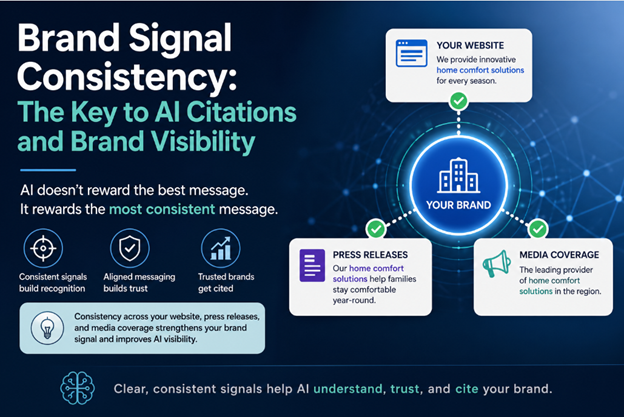
Brand signal consistency definition
Brand signal consistency is the use of identical company name, positioning, and core business descriptions across website, press releases, and third-party sources to improve AI recognition and citation likelihood.
The Real Reason Your Brand Isn’t Showing Up in AI Results
Most brands do not have a visibility problem. They have a consistency problem.
You can publish press releases, invest in SEO, land media coverage and still get ignored by AI search. Not because you lack content, but because your content does not agree with itself.
AI does not understand your brand the way people do. It builds an understanding based on patterns. If those patterns shift across your website, press releases and third-party coverage, you dilute your chances of being cited.
That is where a Brand Signal Consistency Scorecard becomes useful. It forces you to see your brand the way AI sees it.
What Is a Brand Signal Consistency Scorecard
A Brand Signal Consistency Scorecard compares how your brand shows up across three core sources:
Your website
Your press releases
Third-party coverage
It evaluates whether key elements match or vary across those channels.
Here is a simplified example using a well-known brand.
Brand Signal Consistency Scorecard Example
Before you look at the scorecard, here’s the reality most brands miss.
You think your brand is consistent because your team knows how to describe it. Your website sounds right. Your press releases feel aligned. Your media coverage looks accurate.
AI does not see it that way.
AI compares how your brand shows up across sources and looks for exact matches. Not similar language. Not “close enough.” Matching patterns. When those patterns shift, even slightly, your brand becomes less defined and less reliable as a source.
This chart breaks that down using a brand everyone recognizes. It shows how the same company is described across its website, press releases and third-party coverage and where those signals align or fall apart.
The goal is not to critique the brand. The goal is to show how easily inconsistency creeps in and how that inconsistency weakens AI confidence.
As you review it, do not focus on Nike. Focus on what this would look like if your brand were in the table.
| Element | Website | Press Releases | Third-Party Coverage | Consistency Score | Notes |
|---|---|---|---|---|---|
| Company Name | Nike, Inc. | NIKE, Inc. | Nike | ⚠️ Partial | Minor formatting differences but still recognizable |
| Tagline / Positioning | “Just Do It” | Athletic footwear and apparel | Sportswear brand | ❌ Inconsistent | Tagline not consistently reinforced as positioning |
| Primary Product Description | Athletic footwear, apparel, equipment | Performance products for athletes | Shoes, clothing, gear | ⚠️ Partial | Similar but not identical phrasing |
| Target Audience | Athletes and active consumers | Global athletes | General consumers, sports fans | ⚠️ Partial | Broad but slightly inconsistent framing |
| Location / Origin | Beaverton, Oregon | Oregon-based company | U.S.-based or global brand | ⚠️ Partial | Varies in specificity |
| Leadership (CEO) | CEO listed on site | CEO quoted in releases | Often omitted | ❌ Inconsistent | Missing in many third-party mentions |
| Core Offering | Performance-driven products | Innovation in sportswear | Apparel and footwear | ⚠️ Partial | Messaging shifts between innovation and product |
Scoring Key
✅ Consistent = Same language across all channels
⚠️ Partial = Minor variation but still recognizable
❌ Inconsistent = Different descriptions or missing entirely
What Brand Signal Inconsistency Looks Like in the Real World
Brand signal consistency issues are not obvious when you are inside the business. They show up clearly when you compare how your brand is described across sources.
Consider a regional HVAC company.
On its website, it describes itself as “heating and cooling services.”
In press releases, it uses “home comfort solutions.”
In media coverage, it appears as “HVAC contractor.”
Each version sounds reasonable. None of them match.
AI systems do not interpret these as variations of the same idea.
They treat them as separate signals.
When brand descriptions vary, AI builds a broader and less precise understanding of the business.
That leads to:
· Weaker category definition
· Lower confidence in the brand
· Fewer citations in AI-generated answers
Consistent language creates a clear signal. Inconsistent language creates multiple weak signals.
This is how brands lose visibility without realizing it.
What This Scorecard Reveals
Even a brand as dominant as Nike is not perfectly consistent.
That matters because AI systems do not rely on brand familiarity. They rely on repeated signals.
When signals vary, three things happen.
Categories Become Blurred
“Athletic brand,” “sportswear company,” and “footwear company” may seem interchangeable. To AI, they are not.
Instead of a precise category, the system builds a broader, less defined identity.
Taglines Lose Strategic Value
If a tagline appears in one place but not reinforced elsewhere, AI treats it as decoration, not definition.
That weakens your positioning.
Entity Depth Breaks Down
When leadership, location or core details are missing in some sources, AI has less confidence in the entity.
Lower confidence leads to fewer citations.
Nike can absorb that inconsistency because of scale. Most brands cannot.
Why Consistency Drives AI Citations
AI systems prioritize three things:
Repetition
Alignment
Clarity
If your brand shows up differently across sources, you create:
Multiple interpretations
Lower confidence scores
Fewer citations
This is not theoretical. It is how AI assembles answers.
A consistent brand signal makes it easier for AI to:
Identify your company
Understand what you do
Trust the information
Include you in results
Why Press Releases Play a Critical Role
Press releases are one of the few assets you fully control that also live in third-party environments.
They act as a bridge between:
Owned content like your website
When written with consistency in mind, they reinforce:
Your official company name
Your positioning
Your product or service descriptions
That alignment strengthens your overall signal across the web.
The Real Risk Most Brands Ignore
Inconsistency does not just confuse your audience. It fragments your identity.
If your website says one thing, your press releases say another and media coverage says something else, AI does not reconcile that.
It averages it.
And when AI averages your message, you lose precision.
That is how brands become:
Vague
Generic
Replaceable in search results
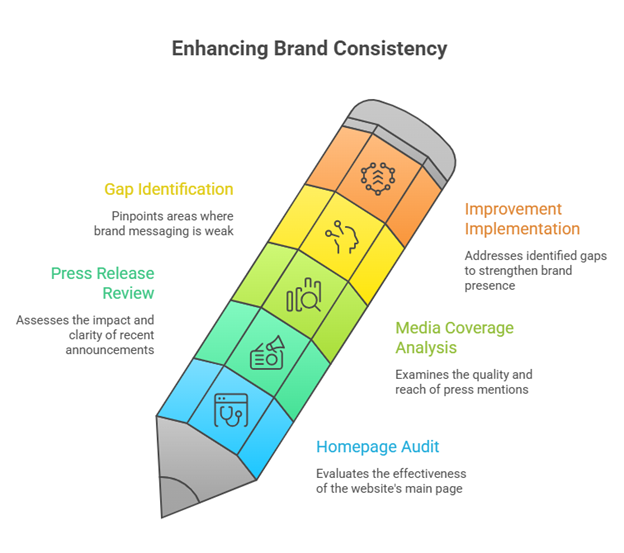
How to Use This Scorecard for Your Brand
Start by building your own version of this chart.
Audit:
Your homepage
Recent press releases
Top media coverage
Score each element honestly.
Then fix the gaps.
Standardize Your Company Name
Choose one format and use it everywhere.
Define One Positioning Statement
Not three variations. One.
Align Product or Service Descriptions
Use the same core language across all content types.
Reinforce Key Entity Details
Make sure leadership, location and core offerings appear consistently.
How to Measure Brand Signal Consistency
Brand signal consistency is not subjective. It can be measured.
Tracking consistency helps you identify gaps, prioritize fixes, and improve how AI systems interpret your brand.
Key metrics to track:
Percentage of content using the exact company name
Review your website, press releases, and media coverage.
Calculate how often your company name appears in the same format.
Higher consistency strengthens entity recognition.
Alignment of service or product descriptions across channels
Compare how your offerings are described in each source.
Look for identical or closely matched language.
Misalignment reduces clarity and weakens category definition.
Frequency of consistent messaging in third-party mentions
Analyze how media outlets describe your business.
Track how often they use your preferred positioning and terminology.
Consistent third-party language reinforces credibility.
Brand signal consistency improves when key elements are repeated in the same way across sources.
What gets measured gets fixed.
What gets fixed gets cited.
What Happens When You Get This Right
When your signals align:
AI recognizes your brand faster
Your category becomes clearer
Your authority strengthens across sources
You move from being mentioned to being cited.
That is a different level of visibility.
Brand Signal Consistency FAQ
Q: What is a Brand Signal Consistency Scorecard?
A Brand Signal Consistency Scorecard compares how a brand is described across its website, press releases, and third-party coverage. It highlights where messaging aligns and where it varies. This helps identify gaps that can weaken AI understanding and visibility.
Q: Why does brand consistency matter for AI search?
AI systems rely on repeated, matching information across sources to determine credibility. When your messaging is consistent, AI is more confident in describing and citing your brand. Inconsistent signals reduce that confidence and limit visibility
Q: How does AI interpret inconsistent brand messaging?
AI does not choose one version of your message. It blends multiple versions into a broader, less precise understanding. This often results in vague descriptions and fewer citations.
Q: What are the most important elements to keep consistent?
The most critical elements are your company name, positioning, product or service description, and key details like location and leadership. These define your identity across sources. Consistency in these areas strengthens AI recognition.
Q: Can large brands afford to be inconsistent?
Large brands often have enough authority and volume to offset inconsistency. They appear in many high-quality sources, which reinforces their credibility. Smaller brands do not have that advantage and rely more on precision.
Q: How do press releases impact AI visibility?
Press releases reinforce your brand messaging in a structured, third-party environment. They help standardize how your company is described across the web. When aligned with your website, they strengthen your overall signal.
Q: What happens when brand signals are not aligned?
When signals vary, AI sees multiple versions of your brand. This lowers confidence and makes your company less likely to appear in AI-generated answers. Over time, it reduces both visibility and authority.
Q: How can I audit my brand for consistency?
Review your homepage, recent press releases, and top media coverage. Compare how your company is described across each source. Look for differences in wording, positioning, and key details.
Q: What is the fastest way to improve brand consistency?
Start by defining one official company name format and one clear positioning statement. Then standardize your product or service description. Apply that same language across all content and channels.
Q: What is the connection between consistency and AI citations?
Consistency increases AI confidence in your brand as a reliable source. Higher confidence makes your content more likely to be cited in AI-generated results. Inconsistent messaging leads to fewer mentions and weaker visibility.
The One Sentence That Matters
Brands that use consistent language across their website, press releases and media coverage are more likely to be cited in AI-generated search results.
Consistency Is Not Optional If You Want to Be Found
If a global brand shows inconsistencies, your brand almost certainly has more.
The difference is they have volume and authority to compensate.
You do not.
So consistency is not optional. It is foundational.
Score your brand. Fix the gaps. Repeat your message with discipline.
AI does not reward the best message. It rewards the most consistent message.
That is how you stop being invisible in AI-driven search.
Everyone has a story. Let TrizCom PR help tell yours.
If your goal is stronger AI visibility, clearer positioning or results that tie back to business outcomes, it starts with getting your narrative aligned across every touchpoint. Start the conversation.

About the Author:
Jo Trizila – Founder & CEO of TrizCom PR
Jo Trizila is the founder and CEO of TrizCom PR, a leading Dallas-based public relations firm known for delivering strategic communications that drive business growth and enhance brand reputations as well as Pitch PR, a press release distribution agency. With over 25 years of experience in PR and marketing, Jo has helped countless organizations navigate complex communication challenges, ranging from crisis management to brand storytelling. Under her leadership, TrizCom PR has earned recognition for its results-driven approach, combining traditional and integrated digital strategies to deliver impactful, measurable outcomes for clients across various industries, including healthcare, technology and nonprofit sectors. Jo is passionate about helping businesses amplify their voices and connect with audiences meaningfully. Her hands-on approach and commitment to excellence have established TrizCom PR as a trusted partner for companies seeking to elevate their brand and achieve lasting success. Contact Jo at jo@TrizCom.com.
Why Does PR Help My Brand Show Up in AI Search?

Public relations helps companies appear in AI search results by creating content and building credibility through mentions in authoritative third-party sources, such as news outlets, podcasts and trade publications. AI models rely on trusted external data to generate answers. They look beyond keywords and websites, instead prioritizing earned media, consistent messaging, and structured content they can process and cite. When AI PR is done well, it establishes your brand as a reliable source AI systems feel confident referencing.
We are now in the age of AI search, where generative AI search and AI search engines like Google's AI Overviews have transformed the landscape from traditional web search and blue links to AI-generated summaries and AI overviews. Instead of relying solely on traditional SEO tactics, brands must focus on building trust signals, credibility signals, and domain authority through strategic PR and media placements to influence AI engines and AI-powered search engines. Digital marketing and digital PR are now essential for building brand visibility and online visibility in the AI era.
It also starts with great, fresh content that answers questions. PR is communication at its core, which is why PR teams are well-positioned to write content that is clear, accurate and ready to be referenced across the web. Creating content is now crucial not only for human audiences and human readers, but also for AI platforms and AI discovery, ensuring your brand is included in AI-generated summaries and search answers.
For chief marketing officers and business owners, this shift changes how visibility is earned. Being discoverable now depends on what you publish about yourself and on what credible sources say about you. PR pros, PR firms, and PR agencies play a crucial role in establishing trust signals, credibility signals, and domain authority, which directly influence AI engines and AI-powered search engines. Unlike traditional SEO, link building, and paid ads, the current focus is on earning high value media placements, authoritative mentions, and securing brand mentions in respected publications to improve search rankings and brand authority. Reputation management and brand reputation are now central to influencing AI results, AI-generated summaries, and search answers in Google's AI Overviews and AI search results. To future-proof your brand's presence and stay visible in the AI search era, leverage owned media, specific expertise, and consistent PR efforts.
Why do AI search tools rely on public relations signals?
AI systems summarize information rather than display ranked links. To do that, they pull from sources they recognize as accurate and independent.
Those sources include:
Trade publications and analyst reports
Expert bylines and quoted commentary
Media placements in respected publications
PR places your brand inside those environments, which AI models treat as trusted training data. PR pros and PR agencies are skilled at securing authoritative mentions and media placements in respected publication, which AI engines and AI platforms use for AI discovery.
How does PR build trust and authority for AI systems?
AI models learn patterns. When your company appears repeatedly in respected outlets through interviews, quotes and features, the system begins to associate your brand with credibility.
PR builds trust by:
Securing consistent earned media mentions
Positioning executives as expert sources
Reinforcing the same message across multiple publications
Building trust signals and credibility signals that AI systems recognize as indicators of authority and trustworthiness
Over time, this teaches AI tools that your brand is a dependable authority within its category.
PR firms focus on reputation management and building domain authority and brand authority, which can improve your search rankings in AI-driven environments.
How does PR shape what AI says about your brand?
AI-generated summaries, AI Overviews, and Google's AI Overviews are influenced by the information already available across the web. If that information is inconsistent or incomplete, the output will be too.
PR shapes your brand narrative by:
Aligning messaging across earned and owned channels
Reinforcing accurate descriptions of your products and expertise
Securing brand mentions and authoritative mentions from reputable sources to ensure accurate search answers in AI outputs
Reducing the likelihood of outdated or misleading summaries
This consistency helps AI systems present your company clearly and accurately.
Why does earned media acts as training data for AI models?
Executive interviews, contributed articles, podcast appearances, and media placements in respected publications provide context AI systems value. These formats explain who you are, what you do and why it matters in plain language.
Earned content works as training data because it:
Comes from third-party AI already trusts
Includes real explanations instead of marketing copy
Offers quotable statements AI can reuse
Highlights your specific expertise in earned content, increasing its value for AI
This is one reason executive visibility outperforms brand-only content. Earning high value coverage in respected publications further increases your brand’s recognition and trustworthiness in AI-driven search.
How do press releases help with AI search visibility?
Press releases remain useful when they are written for clarity and structure rather than promotion, and can be distributed through owned media channels to ensure direct control over brand messaging.
Well-structured releases:
Follow predictable formats AI can parse
Reinforce consistent terminology
Serve as reference points for news coverage
Allow brands to create content that supports AI recognition
When press releases lead to earned coverage, they strengthen AI recognition even further. PR agencies can help maximize the impact of press releases by securing strategic placements and optimizing distribution for greater AI search visibility.
Why relevant mentions matter more than volume?
AI systems favor relevance over reach. A mention in the right trade publication often carries more weight than broad coverage in unrelated outlets.
PR drives relevant mentions by:
Targeting niche and industry-specific media
Securing analyst and expert commentary
Aligning placements with buyer search behavior
PR pros focusing on securing authoritative mentions and brand mentions in targeted outlets
This ensures your brand appears in the conversations AI prioritizes.
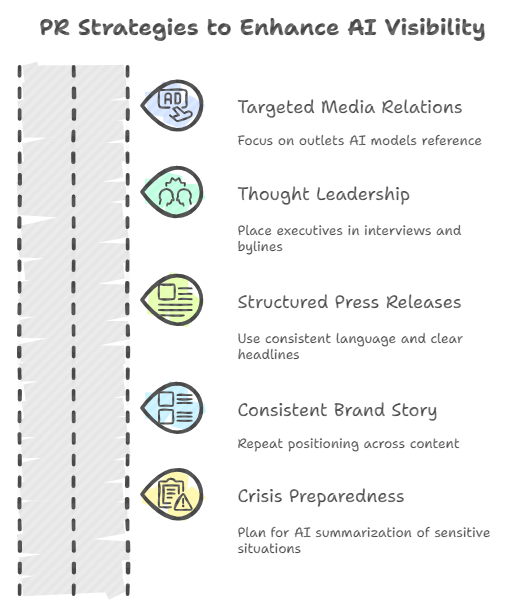
What PR strategies improve AI visibility most?
Focus on outlets AI models frequently reference, including major news organizations and respected industry publications. Digital PR strategies help future proof your brand in the AI search era by building a resilient digital presence that adapts to evolving AI search technologies.
Place executives in interviews and bylines that explain category challenges and solutions in clear terms.
Use consistent language, clear headlines and factual framing to support AI ingestion.
Repeat the same positioning across earned and owned content so AI systems recognize patterns.
Leverage link building and reputation management to support AI discovery and long-term visibility. Earning authoritative links and maintaining a positive reputation help AI systems identify your brand as trustworthy and relevant, increasing your chances of being surfaced in AI-driven search results.
Plan for how AI might summarize sensitive situations and have processes in place to correct inaccuracies quickly.
How Public Relations Drives AI Search Visibility
| PR Strategy | What It Does | Why AI Systems Value It | Impact on AI Search Visibility |
|---|---|---|---|
| Earned Media Placements | Secures coverage in national, regional and trade publications | Third-party validation signals credibility and independence | Increases likelihood of brand mentions in AI-generated summaries |
| Executive Thought Leadership | Positions executives in interviews, bylines and podcasts | Human expertise signals strengthen authority patterns | Improves brand attribution in AI answers |
| Consistent Messaging Across Channels | Aligns language across earned and owned media | AI models detect repetition and pattern consistency | Reduces vague or conflicting AI summaries |
| Structured Press Releases | Uses clear headlines, factual framing and consistent terminology | Predictable structure makes content easier for AI to parse | Strengthens recognition and terminology alignment |
| Targeted Industry Outreach | Focuses on niche and analyst-driven publications | Relevance carries more weight than volume | Improves visibility in category-specific AI searches |
| Reputation Management | Reinforces accurate positioning and corrects misinformation | AI systems adjust outputs based on updated credible sources | Helps correct or prevent misleading AI summaries |
| Owned Content Hubs | Publishes FAQs, executive bios and resource pages | Structured, well-organized content improves AI ingestion | Supports accurate AI descriptions of products and services |
| Podcast and Interview Visibility | Secures context-rich conversations and quotable insights | Natural language explanations give AI reusable context | Enhances inclusion in AI-generated responses |
How TrizCom PR supports AI search visibility
As one of the leading pr firms and pr agencies specializing in digital marketing for AI search, TrizCom PR helps middle-market companies strengthen AI discoverability through earned media strategy and executive positioning. Our approach focuses on placing brands inside trusted sources AI systems already use, reinforcing consistent narratives and producing structured content that supports accurate summaries. These strategies help strengthen your brand's presence across AI and digital platforms.
Want your brand to show up in AI answers when buyers ask the questions?
When AI systems decide which brands to mention, they rely on trust, repetition and clarity. Public relations supplies all three by placing your expertise inside the sources AI already trusts. PR also helps your brand appear in ai results and ai generated summaries, ensuring your messaging is included when AI-powered search tools and language models present information.
If your company is investing in AI, content and visibility but still is not appearing in AI-generated answers, it is time to look beyond keywords. As AI search evolves, it is crucial to stay visible by leveraging strategic PR, which helps ensure your brand becomes part of the data AI uses to explain your category.
If you want to understand how your brand is currently represented in AI search results and what it would take to improve that visibility, talk with the team at TrizCom PR. A focused conversation can help you identify gaps, opportunities and a clear path to becoming a trusted source AI systems recognize and reference.
Frequently asked questions about PR and AI search
How long does it take PR to influence AI search results?
PR can quickly influence AI search results, especially when you consistently earn coverage (the opposite of SEO, which sometimes takes months to rank). AI engines and AI powered search engines respond rapidly to new authoritative mentions and media placements, rewarding brands that are cited in reputable sources. Stronger citation patterns typically emerge after sustained placements across multiple authoritative sources, as AI systems respond to repetition in credible environments.
Can AI tools pull from press releases directly?
AI tools can (and do) pull from press releases directly, but press releases matter most when trusted outlets pick them up, reference them or use them as source material. However, owned media, such as your brand's website or newsroom, allows you to create content that AI tools can access directly, ensuring your messaging is clear and available for AI-driven search. A release that stays on your site often has less influence than a release that leads to third-party coverage.
Is PR more important than SEO for AI visibility?
PR is not more important than SEO for AI visibility because they do different jobs. PR builds trust and authority signals through third-party validation. SEO improves structure, crawlability and clarity on your owned channels. Most brands need both to show up reliably in AI answers.
However, traditional SEO tactics like keyword optimization and link building are no longer sufficient for visibility in AI-driven search results. Instead, digital PR and reputation management have become crucial. Digital PR helps earn authoritative media coverage and builds a strong digital footprint, while reputation management ensures your brand is seen as credible and trustworthy, factors that AI systems increasingly prioritize.
Do podcasts and interviews help with AI search?
Yes, podcasts and interviews help with AI search because they provide context-rich explanations and quotable expert commentary. By participating in podcasts and interviews, you are securing brand mentions and highlighting your specific expertise, which AI systems recognize and use to improve your brand's visibility in search results. AI platforms often prioritize these types of expert-driven mentions, especially when they appear in trusted trade publications or local news.
Does company size affect AI visibility?
No, company size does not affect AI visibility as much as authority signals do. In fact, brand authority and domain authority are more important than company size for AI visibility. AI systems tend to reward brands that show consistent expertise in credible sources, and reputable media coverage with high-quality backlinks can boost your domain authority, signaling credibility and trustworthiness to AI-driven search engines. Middle-market companies often compete well when their executives are visible and their messaging stays consistent.
What types of outlets matter most for AI?
The outlets that matter most for AI are national business media, respected trade publications, respected publications, and analyst-driven platforms. Strategic media placements in these respected publications are prioritized by AI systems, as they are seen as high-confidence references that enhance a brand’s credibility and visibility. These sources tend to carry more weight because AI systems treat them as higher-confidence references.
Can inconsistent messaging hurt AI summaries?
Yes. Inconsistent messaging and conflicting numbers undermine AI summaries because AI systems struggle to determine accuracy. When your company is described differently across interviews, bylines, bios and coverage, AI outputs can become vague, outdated or outright incorrect. This inconsistency can also negatively impact how your brand appears in AI-generated summaries and AI Overviews, making it less likely that your brand will be accurately or prominently featured in these AI-powered search results.
How do you correct AI misinformation about a brand?
You correct AI misinformation about a brand by publishing clearer, more consistent information in sources AI trusts. That usually means reinforcing accurate details through earned media, executive commentary, and updated owned content hubs that AI systems frequently reference. Additionally, reinforcing authoritative mentions from reputable third-party outlets and focusing on reputation management helps correct AI misinformation by building trust and credibility, which AI systems recognize and prioritize.
Should executives be visible or should brands speak alone?
Executives should be visible because AI models rely heavily on human expertise signals. When executives are quoted, interviewed or published as authors, AI systems have more context to cite, which often leads to stronger brand attribution than brand-only messaging. Executive visibility also appeals to both human audiences and human readers, ensuring that PR content resonates with real people while simultaneously providing authoritative data for AI systems to reference.
How do you measure AI search impact?
You measure AI search impact by tracking how often your brand is mentioned in AI tools and how accurately it is described. Monitor your brand's presence in ai results and across different ai search engines, such as ChatGPT and Google AI Overviews, to see how your brand is represented. Look for patterns in brand mentions across platforms, referral traffic from AI sources, and whether earned coverage lines up with what AI systems are summarizing.
Everyone has a story to tell. Let TrizCom PR tell yours.
Author
Jo Trizila, Founder & CEO, TrizCom Public Relations
Jo Trizila leads Dallas‑based TrizCom PR, an award‑winning digital public relations agency she founded in 2008. She has guided integrated PR programs for startups, middle‑market companies and national brands, with deep experience in crisis communications, expert positioning and data‑driven media strategy.
Jo is also the creator of Pitch PR, a press release distribution company and a frequent speaker on earned media ROI, including sessions at the Earned Media Mastery virtual summit.
For more information contact jo@trizcom.com or 214-242-9282.
How To Be A Podcast Guest - Crafting Your Podcast Guest Bio

Podcast guesting is more than a nice conversation. It is a focused way to earn links, citations, and attention that appear in organic search and AI answers. When you prepare like a pro and give the host clean assets, your language lands in titles, show notes and transcripts. That is where discovery happens. Pair each interview with a simple landing page, an edited transcript and a short promotion plan. One appearance can fuel weeks of content and a steady stream of qualified visitors. Below are 14 Q&A that will help you prep, perform and turn each episode into measurable results. For a more detailed guide on crafting an effective podcast guest bio, check out our comprehensive blog post.
Show up prepared, present and helpful. Know the audience, the host’s style and the show’s recent topics. Bring one sharp angle, one story and one resource that matches the theme. The first word and introduction of your podcast guest bio are crucial, as they capture the attention of many podcast listeners who might otherwise tune out if the opening isn't engaging. Answer the question asked, not the one you wish was asked. Speak in tight, complete thoughts so editors can pull clean clips. Avoid jargon. Share one stat with a source. Mention the URL once early and once near the end. Respect time. Wear headphones. Use a decent mic. Close with gratitude and a clear next step for listeners. Then follow through on promotion. Hosts remember guests who make their job easy and bring value to their audience.
How to be a good podcast guest?
Show up prepared, present and helpful. Know the audience, the host’s style and the show’s recent topics. Bring one sharp angle, one story and one resource that matches the theme. Answer the question asked, not the one you wish was asked. Speak in tight, complete thoughts so editors can pull clean clips. Avoid jargon. Share one stat with a source. Mention the URL once early and once near the end. Respect time. Wear headphones. Use a decent mic. Close with gratitude and a clear next step for listeners. Then follow through on promotion. Hosts remember guests who make their job easy and bring value to their audience.
How to prepare for a podcast interview as a guest?
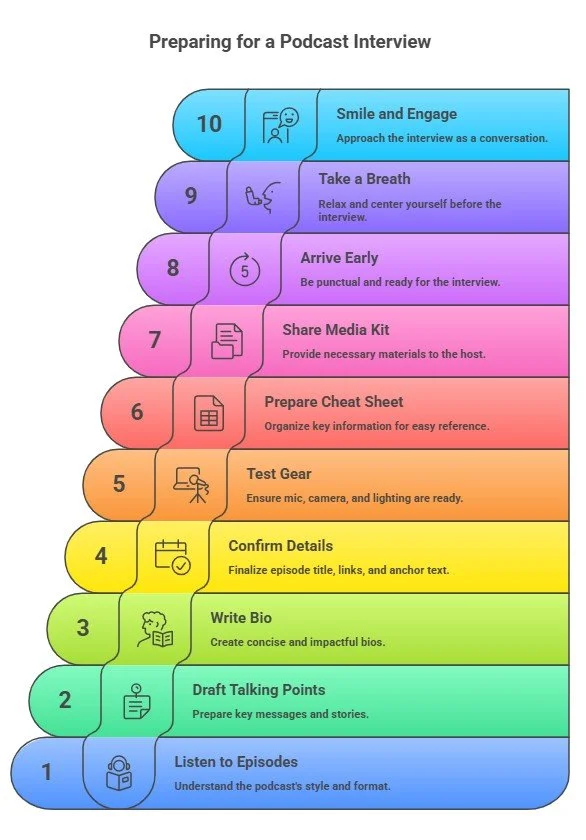
Listen to two recent episodes. Note the pacing, question patterns and segment transitions. Draft three talking points, three example stories and three quotable lines under 120 characters. Write your short bio in 40 words and 90 words. Confirm the episode title options, links and preferred anchor text. Test your mic, camera and lighting. Being well-prepared with your gear and media kit helps you feel confident during the interview. Silence notifications. Place a glass of water nearby. Keep a one-page cheat sheet with your framework, stat with source and the short URL you will say on air. Share your media kit with the host 48 hours ahead. Show up five minutes early. Take a breath. Smile. Think conversation, not monologue. Use a checklist or tool to track your preparation steps and outreach to podcast hosts.
Do I have to travel for my guest podcast?
Almost never. Most guest interviews happen remotely over Riverside, SquadCast or Zoom. You need a quiet room, a USB mic, closed-back headphones and stable internet. If a show records in studio and invites you in person, weigh the upside. Studio quality can be higher and the relationship building is real. If travel is not practical, ask for a remote slot. Offer to ship your headshot and B-roll photo to support promotion. The goal is a clear recording and a useful conversation. You do not need a plane ticket to deliver that.
Are podcasts videotaped?
Many are. Audio-only is still common, but more shows capture video for YouTube and clips. Assume cameras are on unless told otherwise. Frame your shot at eye level. Use natural light or a simple ring light. Neutral background. No noisy patterns. Wear solid colors. Avoid clanking jewelry. Look at the camera when you deliver your key line. Your voice and tone are just as important on video as they are in audio-only podcasts, so focus on clear, engaging delivery. Ask the host if they plan vertical clips so you can center yourself in frame. Video gives you more assets to repurpose. Treat it like a bonus, not an obstacle.
How can I use my podcast appearance in other content?
Think building blocks. Each podcast episode can be repurposed into multiple content formats. Post the edited transcript on your site with H2s and internal links. Write a recap blog with the three takeaways and two links to commercial pages. Cut a 30 to 60-second clip and a carousel for social. Add the episode to your Media Room with a short description and the show logo. Pull one quote into your About page or a sales deck. Drop the link in onboarding emails and nurture sequences. Pitch a related reporter with a data angle you discussed. Schedule reshares at 30, 60 and 90 days. One interview can fuel weeks of content if you plan it.
Does Google index podcasts?
Yes, through the pages around them. Google crawls show notes, transcripts and episode pages. It also sees your site if you publish an edited transcript and a recap. Make those pages clean and structured. Use descriptive titles, H2s that match real questions and links to a resource and a proof page. If the show publishes on YouTube, that video can rank for queries too. The audio itself is not the hero. The surrounding text is. Give Google and AI systems clear language, consistent names and fast pages. That is how your episode gets found after release week.
How can I make my story memorable?
Anchor it to a moment. A date, a client scene, a number that snaps attention. Use a simple framework to organize the lesson. Problem, choice, outcome. Keep details concrete. One quote from a customer beats five adjectives. Name the tension and how you resolved it. Share one mistake you will not repeat. End with a practical step listeners can take today. Then deliver your short URL that ties directly to the story. People remember specifics, not slogans. Give them a reason to retell your story in one sentence.
What is a podcast tour?
A podcast tour is a focused run of guest appearances across several shows in a set window, all tied to one message or launch. Being featured on other podcasts and shows allows you to reach new audiences and increase your visibility. Appearing on someone else's show helps you tap into someone else's audience, expanding your reach beyond your own listeners. Think six to 12 interviews over six to eight weeks. You bring one angle, one resource and a promotion plan that repeats. The value is momentum. Repetition helps your message stick. Links and mentions stack. Search and AI panels see consistent language. Plan the tour like a mini-campaign, with targets, assets, a landing page, and KPIs. It is not spraying and praying. It is a tightly sequenced piece with purpose.
How do I prepare the podcast host?
Send a tidy media kit 48 hours before recording. Include a 40 and 90-word bio, correct name and title with pronunciation, three title options under 60 characters, five show note bullets, one sourced stat, your three-step framework, headshot, horizontal image and two links with preferred anchor text. Provide a compelling introduction for the host to use during the episode, this should be an engaging opening statement that establishes your credibility and piques listener curiosity. Add your short URL, social handles and promotion commitments. Confirm tech, date, time zone and release timing. Share any topics to avoid and a landmine list if needed. Ask if they want sample questions or timestamps. The easier you make it to copy and paste, the more likely your language is to land on the page where it can be found.
Can you promote your podcast guest appearance?
Please do. Promotion helps the host and helps you. Day 0, post on LinkedIn and X with a quote from the host and tag the show. Day 2, share a 30 second clip with captions. Day 7, publish the recap blog and link it in comments. Add the episode to your Media page. Highlight where audiences can hear your interview, such as linking directly to the episode or sharing platforms where your appearance is featured. Email your list with three takeaways and one CTA. Share the short URL in sales follow ups. If budget allows, put a small paid boost behind the best clip to your warm audience. Promotion is part of being a good guest. Say yes to it. Effective promotion can help you attract new listeners to your brand or podcast.
Should I leave a review after my podcast appearance?
If the show asks, yes. Keep it honest and short. Thank the host by name, note one specific thing you enjoyed and mention the audience you think will benefit. Do not pitch your product in the review. Share the episode link in your channels and tag the show. A thoughtful review, a social post and timely promotion build goodwill. Goodwill turns into future invites and referrals. In podcasting, relationships travel farther than hype.
How can a podcast help with my SEO?
Podcasts help when you treat each appearance like a content asset. Show notes on reputable sites link back to your pages, which can lift rankings. Publish an edited transcript on your site with clear H2s that match real questions. Add a short summary, one sourced stat and links to a resource page and a proof page. Be sure to include your unique insights to demonstrate expertise and attract more podcast opportunities. Create a focused landing page for listeners with one primary CTA and a brief FAQ. Interlink the transcript and recap blog to your services and case studies. Make pages fast on mobile and easy to scan. Schedule a few reshares over 30, 60 and 90 days. The result is simple. More quality links, more crawlable text and a steady stream of visitors who already care.
Can a podcast help with AI Answers?
Yes, when you structure it with intention.
AI systems pull from text they can crawl, attribute and connect to a clear entity. A podcast appearance becomes useful for AI Answers when it produces indexable assets with consistent language tied to your name and brand.
Here is where the lift happens:
Show notes that include your full name, title and company with a live link
A clean transcript published on the host site
An edited transcript republished on your site with question-based H2s
A YouTube description that mirrors the same phrasing
A focused landing page built for listeners
When those elements align, AI platforms can connect your expertise to specific topics. Over time, multiple interviews using similar language reinforce entity recognition. Consistency matters more than volume.
We have seen brands move from zero visibility in generative search to being cited in AI summaries after a coordinated podcast tour supported by structured transcripts and internal linking. The audio alone did not drive the result. The surrounding text did.
A podcast will not guarantee AI citation. It does create credible, third-party context. When paired with SEO structure, clear messaging and ongoing AI monitoring, it becomes a meaningful contributor to AI search visibility.
That is how earned media evolves in the age of AI.
Podcast Guest Strategy Snapshot
Below is a simple view of what separates a casual guest appearance from a strategic visibility asset that supports SEO and AI Answers.
| Area | Strategic Podcast Guest | Casual Podcast Guest |
|---|---|---|
| Bio | 40 and 90 word versions aligned with key search terms | One generic bio sent last minute |
| Messaging | One clear angle repeated across interviews | Different talking points every time |
| Show Notes | Full name, title and company with live link | Name mentioned without context or link |
| Transcript | Edited transcript published with question-based H2s | No transcript republished on guest site |
| Landing Page | Dedicated listener page with one CTA and FAQ | Homepage link only |
| SEO Structure | Internal links to services and case studies | No interlinking strategy |
| AI Signals | Consistent phrasing across bio, notes and YouTube description | Inconsistent titles and descriptions |
| Promotion | 30, 60 and 90 day reshare plan | One social post on launch day |
| Measurement | Traffic, backlinks, branded search lift, AI citations | Download numbers only |
Podcast guesting is not about airtime. It is about structure. When you treat each appearance as part of a coordinated digital PR plan, the impact extends beyond the episode. The surrounding text, links and consistency are what search engines and AI systems read, store and reference.
What equipment do I need to be a podcast guest?
Here’s the simple kit that works:
USB mic like Audio-Technica ATR2100x or Samson Q2U
Closed-back headphones to prevent echo
Stable internet ideally wired or sit close to the router
Quiet room with soft surfaces to cut echo
Webcam and light if video, eye-level camera and a small ring light
Quick setup tips:
Put the mic four to six inches from your mouth, use a pop filter if you have one
Turn off notifications and HVAC noise
Keep water nearby and notes at eye level
Share your short URL and bio with the host before you join
Clean audio, steady internet and a calm room beat fancy gear every time.
Finding guesting opportunities
Becoming a sought-after podcast guest starts with finding the right shows that align with your expertise and target audience. Begin by identifying podcasts in your niche that speak directly to the listeners you want to reach. Take the time to listen to a few episodes of each podcast you’re considering. This helps you get a feel for the host’s style, the show’s tone, and the types of guests and topics they feature. By immersing yourself in their content, you’ll quickly see if you’d be a good fit and if your message will resonate with their audience.
To discover new podcasts, use platforms like Apple Podcasts or Spotify, as well as directories such as Rephonic and Podchaser. These tools make it easy to filter by topic, audience size, and even guest history. As you research, look for podcasts with a broad audience or a highly engaged niche following. Check their social media profiles to see how they interact with podcast listeners and whether they have an active online community. Reading their show notes and blog posts can also give you insight into their approach and the value they deliver to their audience.
Once you’ve built a list of potential podcasts, it’s time to stand out as a valuable guest. Create a compelling podcast guesting bio that highlights your professional background, expertise, and what makes you unique. Keep your bio concise, ideally under 100 words, and include a fun fact or detail that helps you stand out from other potential guests. Make it clear who you help and how, so podcast hosts can instantly see the value you’ll bring to their show.
Alongside your bio, prepare a one-sheet that includes links to your website, social media profiles, and any relevant content such as blog posts, videos, or previous podcast episodes. This one-sheet serves as your podcast guesting resume, making it easy for hosts to review your credentials and determine whether you’re a good fit for their audience. The more accessible and relevant your information, the more likely you are to be invited for a guest interview.
When reaching out to podcast hosts, always personalize your message. Reference a specific episode or topic that resonated with you, and explain why you believe you’d be a valuable guest for their podcast listeners. Show that you’ve done your homework and that you’re genuinely interested in contributing to their show. Building a relationship with the host and demonstrating your understanding of their audience will help you stand out among other potential guests.
In final thoughts, finding the right guesting opportunities is about research, preparation, and a deep understanding of your target audience. By identifying podcasts that align with your message, crafting a compelling podcast guesting bio, and preparing a professional one-sheet, you’ll increase your chances of being booked and making a lasting impression on a new audience. Remember to be engaging, authentic, and focused on providing value to both podcast hosts and listeners. As Emily Aborn shares, a well-crafted bio and a clear understanding of your audience are essential for successful podcast guesting. With these strategies, you’ll draw listeners in, stand out as a valuable guest, and expand your reach to more podcasts and new audiences.
Make the momentum last
Treat every guest spot like a mini launch. Pick the right rooms, bring one clear angle and make it easy for the host to showcase your story. Publish fast, link smart and promote on a simple cadence. Do this on repeat and you build authority that shows up in blue links and AI summaries. Having your own podcast can further establish your authority and attract more guest opportunities, as it demonstrates your expertise and provides a platform to showcase your knowledge. Being featured on prominent shows also boosts your credibility and helps you stand out to both hosts and audiences. Consistently delivering high-quality appearances is key to maintaining audience interest and ensuring your momentum continues to grow. If you want a plan that turns interviews into measurable results, TrizCom PR can help.
Everyone has a story. Let TrizCom PR tell yours!
About the Author:
Jo Trizila – Founder & CEO of TrizCom PR
Jo Trizila is the founder and CEO of TrizCom PR, a leading Dallas-based public relations firm known for delivering strategic communications that drive business growth and enhance brand reputations as well as Pitch PR, a press release distribution agency. With over 25 years of experience in PR and marketing, Jo has helped countless organizations navigate complex communication challenges, ranging from crisis management to brand storytelling. Under her leadership, TrizCom PR has earned recognition for its results-driven approach, combining traditional and integrated digital strategies to deliver impactful, measurable outcomes for clients across various industries, including healthcare, technology and nonprofit sectors. Jo is passionate about helping businesses amplify their voices and connect with audiences meaningfully. Her hands-on approach and commitment to excellence have established TrizCom PR as a trusted partner for companies seeking to elevate their brand and achieve lasting success. Contact Jo at jo@TrizCom.com.
What Is a Digital PR Agency and Why Your Brand Needs One in the Age of AI

A brand’s reputation is no longer shaped only by what it says about itself. It is defined by what others say online, what search engines rank and now what AI platforms summarize and recommend.
This is where a modern digital PR agency plays a critical role.
By combining traditional public relations strategy with digital marketing, SEO and artificial intelligence insights, digital PR agencies help brands build credibility, secure authoritative media coverage, improve visibility in search engines and increasingly influence how AI tools such as ChatGPT, Google’s AI Overviews and other generative search platforms surface information.
So, what is a digital PR agency today?
Unlike traditional PR, which focused on print, television and radio, digital PR operates in an online ecosystem driven by search engines, algorithms and AI systems. It secures media mentions on high-authority websites, earns high-quality backlinks that boost SEO rankings and develops data-driven campaigns that position brands as trusted sources for both humans and machines.
In an AI-influenced world, digital PR is no longer just about being seen. It is about being cited.
As businesses compete for attention in a crowded digital space, understanding what a digital PR agency does and how AI is reshaping visibility can determine whether your brand becomes a recognized authority or disappears into digital noise.
What Does a Digital PR Agency Do? More Than Just Media Coverage
A digital PR agency helps brands gain online authority through strategic storytelling, media placements, SEO integration and AI-informed content strategies. While securing media coverage remains essential, modern digital PR extends far beyond traditional press.
Generating High-Impact Media Features
Being featured in publications such as Forbes, Entrepreneur or respected niche outlets does more than increase awareness. It establishes trust signals that influence consumers, search engines and AI systems.
Generative AI models pull information from authoritative sources. When your brand is cited in credible media, those references increase the likelihood that AI tools recognize your company as a legitimate authority in its field.
Digital PR agencies:
Pitch tailored stories to journalists
Position executives as expert sources
Align messaging with current media trends
Monitor how media coverage influences search and AI visibility
Earned media is no longer just brand validation. It is structured digital credibility.
Building High-Quality Backlinks to Strengthen SEO and AI Visibility
Backlinks remain one of the strongest ranking signals for search engines. But they also influence how AI systems evaluate authority.
When trusted websites link to your content, it signals expertise, experience, authority and trustworthiness. These are core signals that search engines and AI summarization tools evaluate.
Digital PR agencies secure:
Editorial backlinks from high-authority media
Contextual links within relevant industry stories
Expert commentary placements
Guest articles that reinforce keyword authority
The result is improved domain authority, stronger search engine results page rankings and increased likelihood of being referenced in AI-generated summaries.
Using AI to Inform Strategy, Targeting and Measurement
AI is not replacing PR strategy. It is enhancing it.
Digital PR agencies now use AI tools to:
Identify trending media topics before they peak
Analyze journalist coverage patterns
Predict headline performance
Monitor brand mentions across digital ecosystems
AI-driven insights allow campaigns to be more precise, more proactive and more measurable.
Crafting a Digital PR Strategy That Delivers Measurable Results
A modern digital PR strategy includes more than press releases and pitching. It integrates content, SEO and AI visibility.
Key components include:
Strategic content creation
Developing expert articles, research reports and insights structured for both search engines and AI summarization.
Proactive media pitching
Securing coverage in digital publications that reach the right audience and influence AI indexing.
AI Search optimization
Ensuring content is formatted clearly with structured headings, FAQ sections and authoritative citations so AI systems can extract accurate information.
Influencer and expert partnerships
Collaborating with trusted voices who expand reach and strengthen digital credibility.
Issues management and crisis communication
Monitoring online conversations and AI summaries in real time to correct misinformation quickly.
Digital PR agencies do not simply secure attention. They manage how your brand is interpreted across digital and AI platforms.
How a Strong Digital PR Strategy Elevates Brand Authority
Having an online presence is no longer enough. Brands must shape conversations, influence perception and ensure their narrative is reflected accurately in AI-driven environments.
When customers search today, they often see:
AI-generated summaries
Featured snippets
Knowledge panels
Media citations
A well-executed digital PR strategy ensures those summaries reflect credible, positive and authoritative information.
The Connection Between Digital PR, SEO and AI Search
Digital PR, SEO and AI search are now inseparable.
Traditional PR might generate awareness. Digital PR generates indexed, searchable authority. AI then synthesizes that authority into summarized recommendations.
When a brand is featured in authoritative media with contextual backlinks, search engines interpret those mentions as endorsements. AI systems interpret them as validation.
A strong digital PR strategy:
Enhances brand credibility
Drives targeted referral traffic
Reinforces expertise signals
The brands that show up consistently across media, search results and AI summaries are the brands that win attention.
Press Releases in the AI-Driven Digital Landscape
Press releases remain valuable, but their purpose has evolved.
Modern digital press releases are optimized for:
Keyword relevance
Structured formatting
Clear expert attribution
Authoritative outbound citations
Shareability across digital channels
When properly distributed and supported by media outreach, press releases can:
Earn authoritative media coverage
Support link-building efforts
Strengthen AI discoverability
Drive referral traffic
However, no digital PR campaign should rely solely on press releases. Integration across earned media, owned media, thought leadership, SEO and paid media is essential.
The Winning Combination: Digital PR, SEO and AI Visibility
Unlike traditional PR, digital PR creates lasting digital assets.
Why this matters:
AI tools rely on indexed, authoritative sources
Search engines reward consistent expertise signals
A well-structured digital PR campaign:
Generates branded searches
The goal is not short-term buzz. It is sustained digital authority.
Traditional PR vs. Digital PR vs. AI-Driven Digital PR: What’s the Difference?
Understanding what a digital PR agency does today requires context. The discipline has evolved. Traditional PR built awareness. Digital PR built search authority. AI-driven digital PR builds citation authority across search engines and generative AI platforms.
Here is how they compare:
| Category | Traditional PR | Digital PR | AI-Driven Digital PR |
|---|---|---|---|
| Primary Focus | Media exposure | Online visibility plus SEO | Search visibility plus AI citation authority |
| Key Channels | Print, TV, radio | Online media, blogs, digital publications | Online media, search engines, AI platforms |
| Success Metrics | Impressions, reach | Backlinks, rankings, referral traffic | Rankings, backlinks, AI mentions, citation frequency |
| Content Strategy | Press releases, interviews | SEO content, thought leadership, media outreach | Structured expert content optimized for AI summarization |
| Authority Signals | Media mentions | Backlinks plus domain authority | Backlinks plus E-E-A-T signals plus AI extraction readiness |
| Longevity of Impact | Often short-term | Long-term search visibility | Long-term search plus AI discoverability |
| Risk Management | Reactive crisis PR | Digital monitoring plus SEO repair | Real-time AI narrative monitoring plus correction strategy |
The shift is significant.
Traditional PR asked, “Where did we get coverage?”
Digital PR asked, “How did coverage improve rankings?”
AI-driven digital PR now asks, “Is our brand being cited accurately when AI summarizes our industry?”
This evolution matters because consumer behavior has changed. Buyers now rely on search engines and AI-generated answers to evaluate expertise, compare providers and validate credibility before making decisions.
If your brand does not appear consistently in media, search results and AI summaries, competitors will fill that space.
A modern digital PR agency or AI PR agency understands that visibility is no longer just about placement. It is about structured authority that machines can interpret, validate and recommend.
Measuring the Success of a Digital PR Campaign
Modern digital PR is measurable.
Key performance indicators include:
Search engine ranking improvements
Brand sentiment analysis
The Role of Analytics and AI Monitoring
Agencies now use tools to track:
Referral traffic and conversions through Google Analytics
Domain authority and backlink growth via Ahrefs or Moz
Media mentions via monitoring platforms
Brand inclusion in AI-generated responses
Tracking AI visibility is an emerging metric. Businesses must understand not only how they rank in search engines but how they are represented in generative AI results.
Choosing the Right Digital PR Agency or AI PR Agency in an AI Era
Not all agencies that call themselves a digital PR agency or AI PR agency are prepared for AI-driven search environments.
When selecting a digital PR agency, look for:
1. A Proven Track Record
Documented media placements
High-authority backlinks
Recognized thought leadership placements
2. SEO and AI Integration Expertise
A modern digital PR agency or AI PR agency must understand how search engines and generative AI platforms evaluate authority.
Link-building aligned with SEO best practices
Content structured for AI summarization
Data-driven campaign development
3. Customized Brand Positioning
Deep understanding of your audience
Clear competitive differentiation
Messaging designed for digital discoverability
4. Transparent Reporting
Detailed SEO metrics
Backlink reporting
Media coverage tracking
AI visibility monitoring
A strong digital PR agency or AI PR agency does not just promise awareness. It demonstrates measurable impact across search, media and AI visibility.
Why Investing in Digital PR Is Essential for Brand Growth
A digital PR agency or AI PR agency is more than just a media relations partner. It is a strategic asset for brand growth. By combining media outreach, content marketing, SEO, AI visibility strategy and thought leadership, digital PR creates a sustainable online presence that drives long-term credibility across search engines and generative AI platforms.
For businesses looking to stand out in an increasingly digital and AI-influenced world, investing in a well-structured digital PR strategy is no longer optional. It is essential. Whether securing high-profile media placements, improving search rankings, influencing AI-generated summaries or establishing executive thought leadership, a strong digital PR campaign transforms online visibility into measurable business growth.
Take Your Brand to the Next Level with Digital PR
The digital landscape is more competitive than ever. Visibility now depends not only on search rankings but on how AI platforms interpret and surface your brand.
At TrizCom PR, we craft digital PR strategies designed for modern discovery. We secure high-impact media placements, strengthen search engine rankings and position brands for authority in both traditional search and AI-driven environments.
Do not let your brand get overlooked in search results or misrepresented in AI summaries. Partner with TrizCom PR and build a results-driven digital PR campaign tailored to your business goals. Contact us today to get started.
Everyone has a story. Let TrizCom PR tell yours!
About the Author:
Jo Trizila – Founder & CEO of TrizCom PR
Jo Trizila is the founder and CEO of TrizCom PR, a leading Dallas-based public relations firm known for delivering strategic communications that drive business growth and enhance brand reputations as well as Pitch PR, a press release distribution agency. With over 25 years of experience in PR and marketing, Jo has helped countless organizations navigate complex communication challenges, ranging from crisis management to brand storytelling. Under her leadership, TrizCom PR has earned recognition for its results-driven approach, combining traditional and integrated digital strategies to deliver impactful, measurable outcomes for clients across various industries, including healthcare, technology and nonprofit sectors. Jo is passionate about helping businesses amplify their voices and connect with audiences meaningfully. Her hands-on approach and commitment to excellence have established TrizCom PR as a trusted partner for companies seeking to elevate their brand and achieve lasting success. Contact Jo at jo@TrizCom.com.
Digital PR Q&A
What is a digital public relations agency?
A digital public relations agency helps brands build online authority through earned media, SEO strategy and thought leadership content. Unlike traditional firms focused primarily on print and broadcast placements, a digital PR agency strengthens visibility where modern buyers research: search engines, online publications and increasingly AI-driven platforms. At TrizCom PR, digital PR means securing high-authority media coverage, earning quality backlinks and structuring expert content so it ranks in search and is accurately reflected in AI-generated summaries. The objective is not simply exposure. It is sustained credibility that improves rankings, drives referral traffic and positions a company as a trusted voice in its industry.
How does a digital PR agency differ from a traditional PR firm?
Traditional PR firms focus on awareness through newspapers, television and radio. Success is often measured by impressions and audience reach. A digital PR agency expands that approach by integrating SEO, link building and measurable online performance. At TrizCom PR, campaigns are designed to influence both media coverage and search engine visibility. That means securing editorial backlinks, developing keyword-aligned thought leadership and monitoring referral traffic. In today’s AI-influenced environment, digital PR also considers how content is structured for generative platforms. Traditional PR builds reputation. Digital PR builds measurable digital authority that supports business growth.
What is an AI PR agency?
An AI PR agency is the next evolution of digital PR. It focuses on how brands appear not only in search engines but in generative AI platforms such as ChatGPT and Google AI Overviews. At TrizCom PR, AI-informed PR strategies ensure content is structured clearly, supported by authoritative media citations and aligned with expertise signals that AI systems prioritize. This includes strengthening E-E-A-T indicators, securing third-party validation and monitoring how brand narratives appear in AI-generated responses. As more consumers rely on AI for research and decision-making, AI-driven PR ensures your brand is cited accurately and positioned as a trusted authority.
Why is digital PR important for SEO?
Digital PR strengthens SEO by earning authoritative backlinks and increasing domain authority. Search engines interpret backlinks from reputable publications as endorsements. At TrizCom PR, media placements are pursued strategically to support keyword rankings and long-term search performance. Beyond backlinks, digital PR generates expert content that targets relevant search queries and increases branded search activity. These signals improve visibility on search engine results pages and drive sustained organic traffic. Unlike paid advertising, earned media remains indexed, creating long-term value. For businesses focused on measurable growth, digital PR becomes a foundational component of a strong SEO strategy.
How does digital PR influence AI search results?
Generative AI platforms rely on credible, indexed content to produce responses. When brands are cited consistently in authoritative publications, AI systems are more likely to reference them accurately. TrizCom PR structures campaigns to ensure clients earn media coverage that reinforces expertise and authority signals. This includes executive thought leadership, expert commentary and contextual backlinks. As AI tools synthesize information from trusted sources, brands with strong digital PR footprints are more likely to appear in summaries. In an AI-driven environment, visibility depends not just on ranking well but on being cited reliably.
What services does TrizCom PR provide within digital PR?
TrizCom PR offers integrated digital PR services that include media outreach, executive thought leadership, link-building strategy, press release distribution through Pitch PR and reputation management. Campaigns are designed to align earned media with SEO objectives and AI visibility goals. This includes securing authoritative placements, developing structured content and monitoring digital performance metrics. TrizCom PR also supports crisis communication and real-time brand monitoring to protect online reputation. The firm’s approach connects storytelling with measurable search impact, ensuring that every media placement contributes to broader digital authority.
How do you measure the success of a digital PR campaign?
At TrizCom PR, digital PR performance is measured through data, not assumptions. Key indicators include media coverage quality, backlinks earned, improvements in search rankings and referral traffic growth. Domain authority increases, branded search volume and lead generation metrics are also tracked. In more advanced strategies, AI search visibility is monitored to assess how often a brand appears in generative responses. This data-driven approach allows campaigns to be refined and optimized. Digital PR should demonstrate clear return on investment, not just awareness.
How long does it take to see results from digital PR?
Digital PR is a long-term investment. At TrizCom PR, clients typically begin seeing early traction within three to six months, especially in media coverage and referral traffic. Search ranking improvements and domain authority growth often compound over time as backlinks accumulate. AI visibility may also strengthen gradually as authoritative citations increase. Because earned media remains indexed online, the benefits continue long after the initial placement. Consistency is key. Brands that maintain steady thought leadership and media engagement see the strongest sustained impact.
Who should hire a digital PR or AI PR agency?
Organizations that rely on online credibility benefit most from digital PR. This includes B2B firms, healthcare providers, franchise brands, professional services and technology companies. If your customers research providers online or use AI tools to compare options, digital PR becomes essential. TrizCom PR works with organizations seeking to strengthen authority, improve search rankings and elevate executive positioning. Companies operating in competitive markets where trust influences purchasing decisions often see significant gains from a structured digital PR strategy.
Why is digital PR essential in the age of AI?
In the age of AI, buyers rely on search engines and generative summaries to evaluate brands. If your company lacks authoritative digital signals, it may not appear in those summaries. Digital PR ensures your brand is cited in trusted publications, supported by backlinks and structured for search clarity. At TrizCom PR, campaigns are designed to influence both human audiences and AI-driven platforms. The goal is consistent, credible visibility. Today, it is not enough to be known. Your brand must be referenced, validated and discoverable across search and AI environments.
Increase Sales with PR: How Strategic Visibility Drives Revenue
How strategic visibility drives revenue
TL;DR
Public relations increases sales by reducing buyer risk before a sales conversation begins. Earned visibility, third-party credibility, and thought leadership shorten sales cycles, improve conversion rates, and support higher deal values. When PR objectives are tied directly to business goals and measured inside revenue systems, PR becomes a sales accelerator rather than a brand exercise.
Why Sales Growth Rarely Starts with Sales
Most buying decisions are already leaning yes or no before a sales team ever engages.
Buyers research independently. They look for signals that a company is credible, established, and safe to do business with. Headlines, analyst commentary, executive bylines, and brand mentions quietly shape that perception long before outreach begins.
This is why experienced PR firms like TrizCom PR focus on shaping visibility early in the buyer journey, before sales conversations ever begin.
PR does not close deals. It creates the conditions that make deals easier, faster, and less risky to approve.
What Public Relations Really Does for Sales
Public relations operates as a trust-building and risk-reduction function.
It establishes credibility before the first conversation, creates familiarity that lowers hesitation, and positions a company as a confident choice. By the time sales enters the discussion, the buyer often feels informed and aligned.
At TrizCom PR, this philosophy is reflected in how integrated communications programs are designed to support real business outcomes rather than surface-level exposure.
How PR Influences the Buyer’s Decision Process
Buyers rarely move from discovery straight to purchase.
They research.
They validate.
They justify decisions internally.
PR supports each of these stages. Earned media and thought leadership act as proof points buyers reference when explaining their recommendation to peers, finance teams, or leadership. Consistent visibility across trusted outlets reinforces confidence that the decision is sound.
This dynamic is especially visible in national and multi-market campaigns where buyers encounter a brand repeatedly across credible sources.
Why PR Objectives Must Start with Business Goals
PR is most effective when it is designed backward from business outcomes.
Too often, PR objectives are framed around outputs like impressions or coverage volume. Those measures indicate activity, but they do not explain impact. Revenue leaders care about pipeline quality, deal velocity, retention, and growth.
When PR objectives are anchored to business goals, alignment improves across the organization. Media strategy focuses on outlets buyers trust. Messaging reflects real objections sales teams hear. Measurement tracks contribution to revenue rather than exposure alone.
This business-first approach is core to how TrizCom PR structures strategy engagements.
PR vs Advertising vs Marketing: Where PR Impacts Revenue Most
Advertising and marketing play important roles, but PR carries unique weight at the decision stage.
Advertising is paid and expected. Marketing is owned and persuasive. Public relations is earned and validated by others. That distinction matters because it lowers perceived risk.
When a third party vouches for a brand, buyers feel safer attaching their name to the purchase, especially in high-consideration categories such as financial services.
| Function | Primary Role | Buyer Perception | Revenue Impact |
|---|---|---|---|
| Advertising | Paid promotion | Expected | Awareness |
| Marketing | Brand-owned messaging | Informative | Consideration |
| Public relations | Earned validation | Credible | Decision confidence |
The Direct Ways PR Helps Increase Sales
PR influences revenue in ways sales teams feel quickly.
Earned visibility drives inbound interest from buyers who already trust the brand. Conversion rates improve because credibility is established early. Sales cycles shorten because fewer objections need to be addressed. Deal sizes increase when authority and expertise are clear.
These outcomes are common in sectors like automotive and mobility, where TrizCom PR supports complex buying journeys.
How PR Supports Sales Teams
PR becomes a sales enablement asset when it is integrated into the sales process and aligned with how buyers search and validate information.
Media placements and bylines support pitch decks, proposals, and follow-up conversations. Thought leadership content helps address common objections before they surface. Press mentions give sales teams third-party validation they can reference without overselling.
Strong PR also strengthens SEO and AI-driven discovery. Earned coverage increases authoritative backlinks, reinforces brand entities, and improves how search engines and AI platforms interpret credibility. When prospects search for a company or see it referenced in AI-generated answers, PR visibility often shapes that first impression.
Clients working with TrizCom PR often incorporate earned media directly into sales materials while also benefiting from stronger organic search presence through integrated PR and SEO strategies.
Why Thought Leadership Drives Long-Term Revenue
Thought leadership shapes both who enters the pipeline and how prepared they are.
When companies consistently share expertise, prospects arrive more informed and aligned. These buyers tend to move faster, ask better questions, and focus less on price. Over time, thought leadership builds preference and pricing power rather than short-term attention.
This approach is reflected in executive visibility programs designed to support sustained demand rather than one-time announcements.
Common Reasons PR Fails to Drive Sales
PR usually underperforms when it is disconnected from business objectives.
This happens when success is measured only by impressions, when PR operates separately from sales and marketing, when messaging changes by channel, or when there is no clear link between PR activity and revenue outcomes.
These challenges are often addressed during PR audits and assessments that realign strategy with growth goals.
How to Measure PR’s Impact on Sales
PR measurement should reflect the same business goals leadership already tracks and live inside the systems they trust.
Rather than isolated PR reports, performance should be evaluated alongside sales data. Key indicators include:
· Lead quality by source
· Conversion rates before and after earned coverage
· Sales cycle length
· Deal velocity
· Pipeline influence
This measurement philosophy is explored further in TrizCom PR’s perspective on meaningful metrics.
What a Sales-Focused PR Strategy Looks Like
A sales-focused PR strategy begins by defining the business goal first and designing visibility to support it.
Media strategy aligns to buyer stages rather than volume. Messaging remains consistent across earned, owned, and shared channels. Performance is reviewed regularly and adjusted based on sales feedback and data.
This integrated execution model reflects the PESO framework TrizCom PR applies across client programs. (The PESO Model© was developed by Gini Dietrick).
PR Is a Sales Accelerator, Not a Vanity Play
PR does not replace sales. It removes friction.
By building trust early, reducing buyer risk, and reinforcing credibility at key decision points, PR makes selling easier and more efficient. When visibility is earned, consistent, and tied to business goals, PR becomes a growth driver rather than a nice-to-have.
This philosophy underpins TrizCom PR’s work with growth-focused brands.
Ready to Make PR Work for Revenue?
If your sales team is doing the work but deals are still slowing, stalling, or discounting late in the process, the issue may not be sales execution. It may be what buyers believe before the conversation starts.
At TrizCom PR, we help leadership teams align PR with real business goals so visibility supports pipeline quality, deal velocity, and long-term growth. That means earned credibility, consistent messaging, and measurement that connects directly to revenue, not vanity metrics.
If you want PR to make selling easier, faster, and more effective, it starts with a strategy designed for how buyers actually decide. Let’s talk.
FAQ: How PR Drives Sales and Revenue
Does public relations directly increase sales?
Public relations does not close deals directly, but it increases sales by building trust and reducing risk before buyers speak with sales. At TrizCom PR, this means shaping credible visibility early in the buyer journey so prospects enter sales conversations more confident, better informed, and closer to a decision. The result is often higher conversion rates and shorter sales cycles, especially in complex buying environments.
How does PR support sales teams?
PR supports sales teams by aligning earned, owned, shared, and paid content to reinforce credibility at every stage of the buying process. At TrizCom PR, sales enablement starts with consistent messaging across media coverage, executive thought leadership, owned content, and shared amplification so buyers encounter the same proof points wherever they research. This integrated approach gives sales teams assets they can use confidently in pitches, proposals, and follow-ups. It also helps address common objections before they surface, because prospects have already seen the brand validated through multiple trusted channels rather than a single touchpoint.
Why is earned media more trusted than advertising?
Earned media is more trusted because it comes from independent third parties rather than the brand itself. Buyers place greater confidence in validation from journalists, analysts, and industry outlets than in paid messaging. This principle guides how TrizCom PR approaches media relations, focusing on credibility and relevance over volume.
How should PR objectives be set?
PR objectives should be based on business goals such as pipeline growth, deal velocity, or market positioning, not on impressions or coverage volume alone. TrizCom PR works with leadership teams to align measurable PR objectives with the outcomes the business is already accountable for, which strengthens buy-in and improves results.
How can companies measure PR’s impact on revenue?
PR’s impact on revenue can be measured through lead quality, conversion rates, sales cycle length, deal velocity, and pipeline influence when PR data is tracked inside CRM and sales systems. Increasingly, TrizCom PR also evaluates how brands appear in search results and AI-generated answers, since those signals influence buyer confidence before sales engagement.
Author
Jo Trizila, Founder & CEO, TrizCom Public Relations
Jo Trizila leads Dallas‑based TrizCom PR, an award‑winning digital public relations agency she founded in 2008. She has guided integrated PR programs for startups, middle‑market companies and national brands, with deep experience in crisis communications, expert positioning and data‑driven media strategy.
Jo is also the creator of Pitch PR, a press release distribution company and a frequent speaker on earned media ROI, including sessions at the Earned Media Mastery virtual summit.
For more information contact jo@trizcom.com or 214-242-9282.
11 PR Stunts That Turned Brands Into Media Sensations
The Power of PR
In the evolving world of marketing, a well-executed publicity stunt can be the spark that sets a brand apart from its competitors. The best PR stunts don’t just make headlines. They create viral moments that capture the public’s imagination and command media attention worldwide. Whether you’re launching a new product, celebrating a milestone, or simply looking to promote your brand in a crowded industry, a creative and innovative stunt can generate the kind of awareness that traditional advertising can only dream of.
What makes a publicity stunt truly powerful is its ability to break through the noise and get people talking. By blending creativity with strategic timing, brands can create experiences that not only engage audiences but also inspire journalists and influencers to share the story far and wide. The result? Massive media coverage, increased brand recognition, and a boost in sales. All from a single, unforgettable event.
As we explore the world of PR stunts, it’s clear that the most successful campaigns are those that dare to be different. They challenge expectations, push boundaries, and invite the public to join in the spectacle. For brands looking to promote themselves, drive sales, and stay ahead of the competition, embracing the power of PR stunts isn’t just an optio. It’s a must.
Public relations (PR) stunts are a powerful way for brands to break through the noise, capture public attention and generate massive media coverage. When executed correctly, they can turn an ordinary marketing campaign into a viral sensation, creating buzz that extends beyond traditional advertising. Whether it’s a world record attempt, a heartwarming publicity stunt or a viral social media moment, PR stunts can make headlines and keep brands top of mind.
In this article, we’ll explore some of our most successful PR stunts, including notable campaigns from TrizCom PR and other brands that took the media by storm. We’ll also delve into how brands can execute national PR activations effectively.
What is a PR Stunt?
A PR stunt is a carefully planned event or campaign designed to grab media attention and spark conversations. These stunts leverage creative storytelling and bold actions to generate publicity and engage audiences.
Successful PR stunts often include:
A strong emotional appeal: Whether humorous, inspiring or shocking, effective PR stunts trigger an emotional response.
A clear brand message: The stunt must align with the company’s values and overall media strategy, supporting the company's reputation management efforts.
Shareability: In today’s digital age, social media plays a key role in amplifying PR stunts, making them go viral.
Earned media potential: The ultimate goal of a PR stunt is to attract media coverage without relying on paid advertising.The best PR stunts are designed to drive earned media across multiple channels, creating conversations that reach millions.
The best PR stunts are designed to drive earned media across multiple channels, creating conversations that reach millions.
From viral social media challenges to large-scale publicity stunts, PR activations can significantly boost a brand’s visibility. Below, we’ll explore real-world example case studies of impactful PR stunts, starting with successful campaigns executed by TrizCom PR.
PR Stunts (Also Known As...)
PR stunts are sometimes referred to as publicity stunts, brand activations or earned media campaigns. No matter the name, they all share the same goal: to spark buzz and conversation that drives visibility without paid advertising. These efforts often cross into the territory of experiential marketing, social media virality and community engagement—making them some of the most versatile tools in a marketer’s toolkit. Whether playful or powerful, PR stunts are rooted in the psychology of storytelling and surprise, aiming to create a moment worth capturing and sharing.
What is Considered a PR Stunt?
A PR stunt is a carefully planned event or action designed to attract public attention and generate media coverage. These stunts can range from the bold and outrageous—like a brand attempting to break a Guinness World Record—to more subtle or socially driven efforts, such as a flash mob promoting a charitable cause or an unexpected product giveaway. The goal of a PR stunt is simple: get people talking and, ideally, generate organic media coverage and social media buzz.
But not all PR stunts have to be dramatic. Sometimes a clever twist on a traditional concept or perfect timing around a trending topic, (check out this amazing newsjacking stunt) can spark just as much attention. The key is creativity, strategy and a deep understanding of the brand's voice and audience. When done well, a PR stunt can dramatically elevate brand visibility. When done poorly, it can backfire—and fast.
How Much Do PR Stunts Cost?
Let’s bust a myth right now: just because you don’t pay for earned media coverage doesn’t mean it’s free. In fact, PR stunts can be costly—depending on the complexity, logistics and team involved. You might not pay a news outlet to run your story, but you do pay professionals to make that story newsworthy and to get it in front of the right people.
Here’s a breakdown of potential costs:
Strategic planning and ideation: Hiring a PR strategist or agency to conceptualize and plan the stunt.
Coordination and logistics: Permits, locations, talent, production crews, props, etc.
Media outreach: Building media lists, pitching reporters, following up and managing interviews or coverage.
Execution day: Staffing, equipment rentals, insurance and onsite coordination.
Post-event follow-up: Press release distribution, media monitoring and engagement with reporters or influencers.
Depending on the scope, a PR stunt can cost anywhere from a few thousand dollars to six figures or more. The investment covers not only the stunt itself but also the countless hours of coordination, creative development and media pitching required to make it successful.
In PR, the spotlight might be free—but getting there never is.
PR Stunt Examples – From TrizCom PR
TrizCom PR has executed powerful PR stunts that captured national attention. Below are some case studies:

Team Escalade Texas
Description: This PR stunt was a creative activation for Cadillac, designed to capture national attention while reinforcing the luxury SUV’s reputation.
Execution: TrizCom PR orchestrated a road-trip storytelling campaign that featured influential personalities, auto journalists and social media influencers driving the Cadillac Escalade across Texas. The campaign highlighted the vehicle’s luxury, technology and performance, generating user-generated content and extensive media coverage. TrizCom PR also ensured high-profile stops, including automotive industry events, influencer meetups and social media live streams to create real-time engagement.
Earned Media: The campaign was covered by major automotive and lifestyle media outlets, including Forbes, Car and Driver and local Texas media. It also trended across social media, generating thousands of organic posts from influencers and fans.
Key Takeaways: Leveraging influencer marketing and experiential storytelling can enhance brand engagement and credibility.
Read the full Team Escalade Texas case study here.

Dallas Fan Expo – Chewbacca Mom
Description: A joyful, authentic viral moment turned into a media phenomenon with the help of strategic PR.
Execution: TrizCom PR leveraged Candace Payne’s viral popularity to generate widespread media coverage around her appearance at Dallas Fan Expo. The team secured high-profile interviews and coordinated with national outlets to maintain momentum, landing placements on “Good Morning America,” “The Late Late Show with James Corden,” and major media platforms including CNN, Time Magazine, and The Washington Post. Our strategic media outreach extended the story well beyond the initial viral moment, positioning Payne as a relatable, feel-good personality and amplifying both her personal brand and the event’s visibility.
Key Takeaways: When PR professionals move quickly and authentically, even the most unexpected viral moment can be elevated into a full-blown cultural event. Real-time responsiveness, paired with strategic media coordination, turns online buzz into sustained media exposure.
Authenticity and real-time engagement can transform a simple moment into a full-scale PR sensation.
Read the full Dallas Fan Expo case study here.
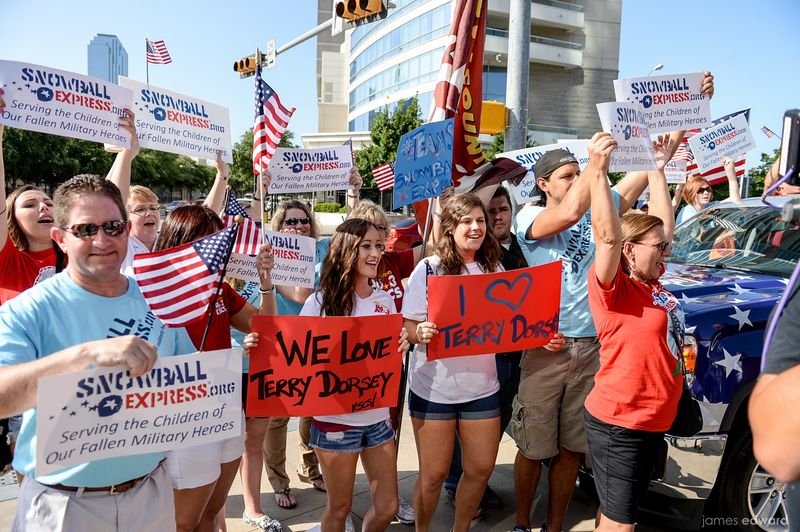
GMC Hashtag Challenge
Description: A social media-driven PR stunt designed to increase brand visibility and engagement.
Execution: GMC launched a social media hashtag challenge, encouraging users to post creative content featuring their GMC vehicles. The challenge incorporated gamification by offering rewards for the most engaging posts. To amplify the campaign, TrizCom PR engaged influencers, bloggers and media partners to participate. Live activations at major auto shows and GMC dealerships allowed participants to interact with the campaign in person, further boosting engagement.
Earned Media: High levels of engagement on Instagram, Twitter and Facebook, with national media outlets covering the challenge and consumer participation driving organic reach. The campaign generated over 5 million hashtag impressions and was featured in automotive publications like Motor Trend and AutoWeek.
Key Takeaways: A combination of digital engagement and real-world participation can elevate a brand’s online presence and credibility.
Read the full GMC Charity Challenge case study here.

$50,000 Giveaway (Q Chevrolet)
Description: An experiential marketing stunt that created excitement and media buzz.
Execution: Q Chevrolet hosted a massive $50,000 giveaway event, generating significant foot traffic and local engagement. TrizCom PR developed a strategic media relations campaign to amplify the event, securing press coverage and social media exposure. They leveraged live radio broadcasts, influencer partnerships and local news channels to create hype leading up to the giveaway. Attendees participated in games and social media challenges to increase engagement.
Earned Media: National and regional news outlets covered the event, including NBC and ABC affiliates. The campaign also generated thousands of social media interactions, with viral posts showcasing excited winners and behind-the-scenes footage of the event.
Key Takeaways: High-stakes giveaways create strong consumer engagement and media interest, driving both brand loyalty and immediate sales impact. (Just be sure to consider the legal requirements and regulations around giveaways.)
Read the full $50,000 Giveaway case study here.

Hospice Wedding (Heroes for Children)
Description: A touching, socially driven PR stunt that demonstrated a brand’s ability to make a real difference.
Execution: TrizCom PR helped coordinate and promote a wedding for a terminally ill patient in hospice care, highlighting the compassionate efforts of Heroes for Children. The stunt showcased the human side of the organization, strengthening its emotional connection with the community. Media outreach included heartfelt storytelling, behind-the-scenes footage and interviews with the couple and medical staff. The event was also streamed live for those unable to attend in person.
Earned Media: Featured in national and local media outlets, including People Magazine, The Today Show and USA Today. The story went viral on social media, with millions of shares and an outpouring of positive responses.
Key Takeaways: Not all PR stunts need to be about selling a product—stunts that focus on human impact and emotion can generate powerful brand goodwill and public trust.
Read the full Hospice Wedding case study here.

The Little Black Dress Experiment
Description: A social experiment turned viral statement about simplicity, sustainability and identity.
Execution: For 31 days, a woman wore the same black dress styled differently each day to spark dialogue about fashion and self-expression. TrizCom PR amplified the story, pitching it as both a minimalist challenge and a media-friendly narrative.
Earned Media: Featured on TODAY, CNN and national morning shows, alongside millions of YouTube views and widespread blog coverage.
Key Takeaways: Personal storytelling with a cultural hook can evolve into a global PR moment.
Read the full Little Black Dress Experiment case study here.
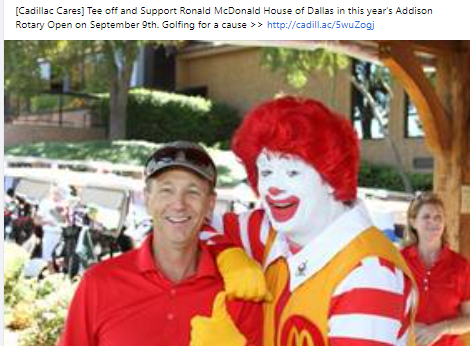
Cadillac Cares
Description: A community-focused campaign that empowered local charities through digital engagement and strategic brand support.
Execution: TrizCom PR and Cadillac launched the Cadillac Cares Challenge in multiple markets including Dallas/Fort Worth and Houston. In each city, community members voted via Facebook for their favorite nonprofit organizations. Winners received $50,000 advertising campaigns that included TV spots on WFAA, CBS Radio promos and features in D Magazine. Runners-up received cash donations. The campaign helped raise awareness for the missions of charities like Heroes for Children, The Family Place, Make-A-Wish North Texas and the YMCA of Greater Houston.
Earned Media: Local TV and radio coverage, widespread social media engagement, increased Facebook fan bases for Cadillac and participating charities and significant cross-promotion between organizations.
Key Takeaways: Combining digital voting, charitable giving and strategic media placements creates a highly engaging and community-driven PR stunt.
Read the full Cadillac Cares case study here.

MrBeast Battle Royale
Description: A high-stakes, gamified experiential stunt that merged YouTube celebrity and brand sponsorship.
Execution: TrizCom PR supported media coverage for MrBeast’s $200,000 airsoft “Battle Royale,” which mimicked popular video game formats. Sponsored by Apex Legends, the event included influencer teams, dramatic visuals and livestreamed content.
Earned Media: Millions of views across YouTube and Twitch, gaming press coverage and major consumer media articles.
Key Takeaways: Fusing entertainment and brand messaging can yield multi-platform earned media.

GMC Terrain Charity Challenge
Description: A philanthropic stunt showcasing both product capability and community investment.
Execution: Teams were challenged to complete physical and service-based missions using GMC Terrains, with proceeds going to local charities. TrizCom PR framed the campaign around giving back, positioning the vehicles as versatile tools for good.
Earned Media: Covered by local stations, featured in automotive press and celebrated by nonprofits.
Key Takeaway: Cause marketing builds stronger brand loyalty when it’s active, visible and tied to community impact.
Read the GMC Terrain Charity Challenge case study here.

Chip and Adele
Description: A whimsical and heartfelt PR campaign that united animal lovers nationwide.
Execution: TrizCom PR partnered with Operation Kindness to tell the real-life story of a Chihuahua puppy named Chip and a kitten named Adele—both orphaned and rescued on the same day. The two were paired together in a foster home where they formed an inseparable bond. Rather than staging a literal wedding, the campaign creatively framed their connection as a “storybook romance,” supported by photos, foster updates and a dedicated social media presence.
Earned Media: Within a week, Chip and Adele’s Facebook page attracted over 30,000 followers and reached more than 8 million people. Their story was featured on BuzzFeed, Good Morning America, Inside Edition and numerous local TV outlets. Donations poured in from across the country.
Key Takeaways: When rooted in authentic storytelling, even the smallest subjects—like a puppy and kitten—can inspire massive community engagement, national media attention and fundraising momentum.
Read Chip and Adele’s case study here.
Best PR Stunts of All Time
Some PR stunts become etched into pop culture, studied in marketing classes, and referenced for years to come. These are attention-grabbing moments intentionally designed to capture the public's attention and generate widespread engagement. Brands use these stunts to spark conversation, drive sales, and create lasting cultural impact.
Below is a table summarizing some of the most iconic and influential PR stunts of all time:
| Brand & Year | Stunt Description | Key Outcome |
|---|---|---|
| Burger King (2018) | Whopper Detour used geofencing technology to offer Whoppers for 1 cent near McDonald’s locations. | Massive app downloads and sales through clever location-based marketing. |
| Duolingo (2025) | “The Death of Duo” viral TikTok storyline. | Over 120 million views demonstrating global social media engagement. |
| State Street Global Advisors (2017) | Fearless Girl statue installed on Wall Street. | Became an instant cultural icon with global media coverage promoting gender diversity. |
| KFC (2018) | “FCK” apology ad following a nationwide chicken shortage. | Turned a crisis into a positive brand moment and generated widespread goodwill. |
| Spotify (since 2016) | Spotify Wrapped personalized year-end listening recaps. | Highly shareable moments driving annual social media engagement surges. |
| CeraVe (2024) | Super Bowl campaign built around a Michael Cera conspiracy narrative. | High engagement, industry awards and amplified celebrity storytelling. |
| Apple TV+ (2022) | Severance glass office installation in Grand Central Terminal. | Immersive experience that drew crowds and extensive media coverage. |
| Miley Cyrus | Intimate concert at Chateau Marmont for superfans. | Created exclusivity and buzz around a single release. |
| Coors Light | Intentional typo on a Times Square billboard. | Sparked online outrage and a 400 percent surge in social conversations. |
| Canva (UK) | Waterloo billboards featuring playful “wrong-but-right” designs. | Viral engagement that resonated strongly with UK audiences. |
| Flagstone (UK) | Sleeping Giant installation made from printed pound notes. | Striking visual highlighting idle money in UK accounts. |
| PUMA (UK) | 10.5-metre illuminated football floating on the Thames. | City-wide attention and domination of social media conversation. |
| Netflix | Nubbin fictional tech device created for Black Mirror. | Fueled online speculation and captured public attention. |
| Aldi | Cap-Aldi rooftop performance by Lewis Capaldi in Nottingham. | Celebrity surprise that deeply engaged fans. |
| Heineken (2024) | Boring Phone launch at Milan Design Week. | Sparked conversation around digital fatigue and modern lifestyle. |
| Oatly | Crisis management microsite addressing brand controversies. | Helped manage brand image and maintain transparency during crises. |
Jo Trizila’s daughter, Kate, with the Fearless Girl Statue in NYC
More Iconic PR Stunts

Red Bull Stratos Space Jump
Description: In 2012, Red Bull sponsored Felix Baumgartner’s record-breaking freefall from the edge of space.
Impact: Broadcast live on YouTube with over 9.5 million concurrent viewers, this stunt reinforced Red Bull’s brand identity around pushing limits and adventure.
Why It Worked: It was a high-risk, high-reward feat that tied directly to the brand’s “gives you wings” ethos while securing massive global media coverage.

ALS Ice Bucket Challenge
Description: The ALS Ice Bucket Challenge was a viral social campaign in 2014 that encouraged participants to pour ice water over themselves and donate to ALS research.
Impact: Raised over $115 million for ALS and engaged millions across social platforms, including celebrities and world leaders.
Why It Worked: It was accessible, emotionally charged and perfectly designed for social sharing, making it a model for nonprofit publicity stunts.

Thom Carroll/PhillyVoice.com
Taco Bell Buys the Liberty Bell (Spoof)
Description: On April Fool's Day in 1996, Taco Bell ran ads claiming it had purchased and renamed the Liberty Bell.
Impact: Generated a flood of media attention and consumer conversations. Though clearly a hoax, it raised Taco Bell's visibility dramatically.
Why It Worked: It was irreverent, humorous and executed with perfect timing—proving that a great PR stunt can be built on clever satire.
How to Activate a National PR Stunt
Executing a national PR stunt across multiple markets can be both complex and rewarding. To begin the planning process for a national PR stunt, it's important to outline your objectives, identify key markets, and coordinate resources early. National activation requires detailed planning, local insights, and a scalable structure. TrizCom PR, through its membership with PRConsultants Group (PRCG), is uniquely equipped to manage this.
Nationwide Reach, Local Expertise
PRCG is a network of seasoned communications professionals in every major U.S. market. This gives TrizCom PR the capability to execute stunts that feel both globally aligned and locally relevant.
Consistency Across Markets
With a unified strategy, TrizCom PR ensures that messaging, brand voice, and outcomes remain consistent regardless of geography.
On-the-Ground Support
Local team members help coordinate logistics, manage media relations, and monitor outcomes, ensuring real-time responsiveness.
Strategic Amplification
TrizCom PR pairs local execution with national amplification, securing coverage in top-tier outlets while maintaining community-level connections.
Whether it’s launching a product, hosting a live event, building a multi-city tour, or driving targeted website traffic, TrizCom PR ensures that every touchpoint is executed with purpose and precision.
From Bold Ideas to Media Sensations
PR stunts, when done right, can turn a brand into a media sensation overnight. From heartfelt human stories to humor-filled viral moments, the power of a well-timed publicity stunt lies in its ability to resonate emotionally and culturally. TrizCom PR has proven time and again that with creativity, strategic insight, and the right network, brands of any size can create lasting impressions.
If you're ready to elevate your brand with a bold, buzz-worthy campaign, partner with TrizCom PR. Our experience in experiential marketing, media relations, and national campaign execution ensures your story isn't just heard—it's remembered.
Let us help you craft the PR stunt that turns heads and headlines.
Everyone has a story. Let TrizCom PR tell yours!
About the Author:
Jo Trizila – Founder & CEO of TrizCom PR
Jo Trizila is the founder and CEO of TrizCom PR, a leading Dallas-based public relations firm known for delivering strategic communications that drive business growth and enhance brand reputations as well as Pitch PR, a press release distribution agency. With over 25 years of experience in PR and marketing, Jo has helped countless organizations navigate complex communication challenges, ranging from crisis management to brand storytelling. Under her leadership, TrizCom PR has earned recognition for its results-driven approach, combining traditional and integrated digital strategies to deliver impactful, measurable outcomes for clients across various industries, including healthcare, technology and nonprofit sectors. Jo is passionate about helping businesses amplify their voices and connect with audiences meaningfully. Her hands-on approach and commitment to excellence have established TrizCom PR as a trusted partner for companies seeking to elevate their brand and achieve lasting success. Contact Jo at jo@TrizCom.com.
0 Likes
National PR Stunts FAQ
What is a PR stunt and why do brands use them?
A PR stunt is a planned activation designed to capture attention, spark conversation and earn media coverage. Brands use PR stunts to break through crowded media environments and create moments people want to share. TrizCom PR approaches PR stunts as strategic storytelling tools, not gimmicks, ensuring each activation supports a larger brand goal.
What separates a successful PR stunt from a failed one?
Successful PR stunts align with brand values, feel authentic to the audience and are supported by strong media outreach. Failed stunts often chase shock value without strategy. TrizCom PR emphasizes planning, audience insight and message clarity so stunts generate positive attention rather than backlash.
Do PR stunts still work in a social media–driven world?
Yes, PR stunts work even better today when designed with shareability in mind. Social platforms amplify moments instantly, turning local activations into national conversations. TrizCom PR builds stunts that are visually compelling, emotionally engaging and optimized for both social sharing and earned media.
How do emotional PR stunts drive stronger media coverage?
Emotion is one of the strongest drivers of engagement. Campaigns like the Hospice Wedding or Chip and Adele resonated because they highlighted genuine human connection. TrizCom PR uses emotional storytelling to help media outlets and audiences connect with brands on a deeper level.
Can PR stunts support nonprofit and cause-driven campaigns?
Absolutely. Cause-driven PR stunts often generate stronger goodwill and longer-lasting impact than product-focused campaigns. TrizCom PR has executed nonprofit stunts that raised awareness, donations and national media attention by centering stories on real people and real impact.
How much planning goes into a PR stunt behind the scenes?
A lot more than most people realize. From ideation and logistics to media pitching and post-event follow-up, PR stunts require careful coordination. TrizCom PR invests significant time in planning to ensure stunts are newsworthy, legally sound and scalable across markets.
What role does earned media play in PR stunts?
Earned media is the end goal of most PR stunts. The objective is to create a moment compelling enough that journalists choose to cover it organically. TrizCom PR leverages long-standing media relationships to turn stunts into national headlines rather than one-day events.
How do influencer partnerships enhance PR stunts?
Influencers add reach, credibility and real-time amplification. Campaigns like Team Escalade Texas succeeded because influencers helped tell the story as participants, not just promoters. TrizCom PR carefully selects influencers whose audiences align with the brand and the stunt’s message.
Are PR stunts only for large national brands?
No. While some stunts scale nationally, smaller brands can achieve big results with creative thinking and smart execution. TrizCom PR has proven that well-timed, well-told stories can generate national attention regardless of company size.
What should brands consider before launching a PR stunt?
Brands should consider their audience, risk tolerance, message alignment and long-term reputation. A PR stunt should support the brand story, not distract from it. TrizCom PR helps clients evaluate whether a stunt makes sense strategically and how to execute it responsibly.
Digital PR Timeline: How Fast Can You See Results?
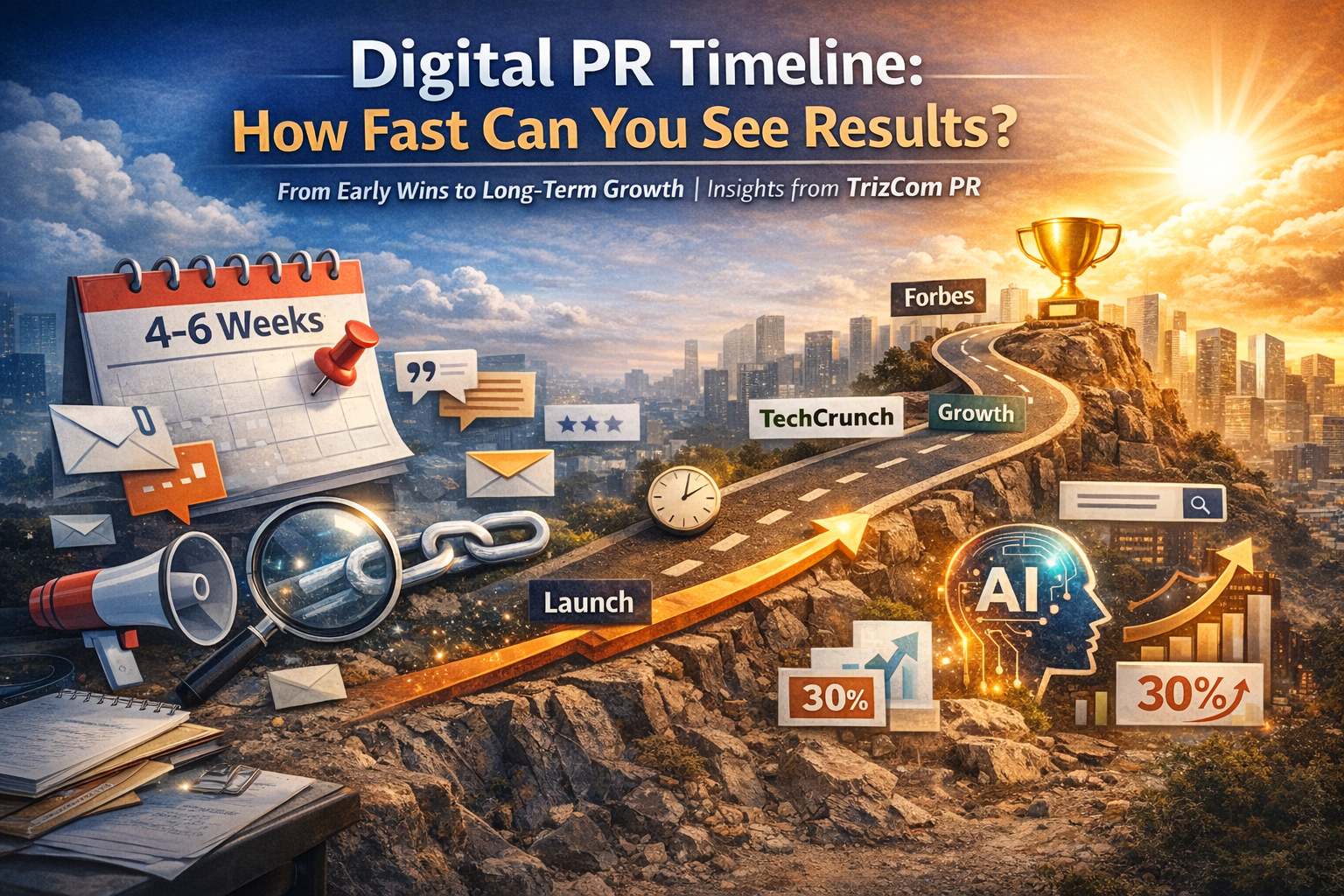
Wondering how quickly digital PR campaigns work? Discover realistic timelines for immediate wins and long-term growth with insights from TrizCom PR.
Expect to see the first signs of progress, such as media pitches and initial feedback, within the first four to six weeks of a digital PR campaign. Significant results, including high-quality backlinks and articles in major publications, typically emerge between three to six months. Unlike paid ads, which stop when payments cease, digital PR gains momentum over time. It often delivers the best return on investment after six months, with studies showing that consistent PR efforts can increase website traffic by up to 30%.
Timeline Breakdown: What to Expect and When
Digital PR is a marathon, not a sprint. While every campaign is unique, most follow a predictable trajectory of growth. Here is a breakdown of realistic milestones for a standard engagement.
Phase 1: Foundation & Strategy (Months 1, 2)
The first few months are about building the infrastructure for success. At TrizCom PR, we use this time to dig into data, identify the most compelling story angles and build targeted media lists.
Activities: Auditing current backlink profiles, conducting competitor analysis, creating press assets and drafting initial pitches.
Expected Results: Approval of strategy, first round of outreach to journalists and potentially small "quick win" mentions in niche blogs or trade publications. For example, securing mentions in publications with a Domain Authority (DA) of 30+.
Phase 2: Momentum & Coverage (Months 3, 6)
This is where the work starts to pay off visibly. Journalists who received pitches in Phase 1 are now publishing stories.
Activities: Consistent pitching, newsjacking by tapping into trending topics and refining angles based on initial feedback.
Expected Results:
· Backlinks: A steady increase in links from authoritative domains (DA 40+).
· Traffic: Referral traffic from news sites starts to climb, with potential increases of 20% month-over-month.
· Brand Mentions: Your brand appears in industry roundups or feature articles, such as those in "TechCrunch" or "Forbes".
Phase 3: Authority & Scale (Months 6, 12+)
By this stage, the "flywheel effect" kicks in. Your brand is recognized as an authority, making future placements easier to secure.
Activities: Leveraging past coverage to secure tier-1 media spots like national news, detailed case studies and thought leadership pieces.
Expected Results: Significant boost in organic search rankings due to backlink accumulation, consistent high-tier media coverage and measurable leads generated from PR efforts. For instance, a 50% increase in search visibility and 30% more qualified leads.
Digital PR vs. Paid Ads: Speed vs. Longevity
Clients often compare digital PR timelines to Pay-Per-Click (PPC) ads. It's essential to recognize their different mechanics and benefits.
| Feature | Digital PR Campaigns | Paid Advertising (PPC) |
|---|---|---|
| Speed to First Result | Typically slow, taking one to three months to show results. | Immediate, often within hours. |
| Duration of Impact | Long-lasting effects, sometimes years. | Short-lived, ends when the budget is exhausted. |
| Credibility | High, as it builds trust through third-party endorsements. | Lower, since it relies on paid placements. |
| SEO Benefit | Significant, as backlinks enhance domain authority. | None, ads do not contribute to organic ranking. |
| AI Answer Visibility | Influences inclusion in AI summaries, recommendations and zero-click answers through earned media and expert sources. | No impact on AI-generated answers once ads stop. |
| Cost Efficiency | Improves over time, offering better ROI. | Costs may increase with market competition. |
Key Factors That Influence Speed
Not all campaigns progress at the same pace. Various factors can either accelerate or decelerate your outcomes.
Responsiveness: Journalists often operate under tight deadlines. For instance, if a reporter requests a quote and it takes three days for approval, the chance may be missed. An agile approach, like that of TrizCom PR, can help seize these fleeting opportunities.
News Value: A significant data study or a provocative thought leadership article is likely to be picked up more quickly. For example, a recent survey by XYZ Company, which revealed a 30% increase in remote work productivity, was widely covered within a week.
Industry Competition: In highly competitive fields like SaaS or FinTech, securing coverage requires more creativity. A unique angle or exclusive data can make a substantial difference. Consider how ABC FinTech leveraged a unique case study to stand out.
Existing Brand Authority: Websites with a solid Domain Authority (DA) see faster SEO improvements from new links. For example, a site with a DA of 60 can expect quicker results compared to one starting from scratch.
AI Visibility Readiness: Slow publishing cycles, unclear page structure or delayed updates to expert bios, FAQs or media pages can slow inclusion in AI-generated answers. Brands that keep authoritative content current and easy for AI systems to interpret tend to surface faster.
While you might notice early activity in the first month of your digital PR campaign, substantial returns usually develop between months 3 and 6. By emphasizing data-driven strategies and regular outreach, agencies like TrizCom PR help brands establish lasting authority that enhances traffic and SEO value well beyond the initial campaign. Staying patient early on leads to sustainable, long-term growth. Ready to elevate your brand's presence? Contact us today to get started!
FAQ
Digital PR focuses on "earned" media, not paid placements. We carefully select the right contacts, develop compelling stories and align with editorial schedules. For instance, a journalist may love your pitch in Week Two but might only publish it by Week Six due to their schedule.
Does digital PR guarantee sales immediately?
Not instantly. TrizCom PR approaches digital PR as a top-of-funnel strategy focused on building brand awareness, trust and SEO authority. While referral traffic can lead to conversions, the primary goal is visibility that supports sales conversations later in the buying cycle.
How do I measure success?
At TrizCom PR, success is measured by outcomes, not activity. Key indicators include:
• Increases in Domain Authority (DA) from earned links
• Referral traffic from media placements
• Share of Voice compared to competitors
• Keyword ranking improvements tied to campaign themes
See this blog for more information: How Do PR Firms Measure Success? What KPIs Should I Ask About?
How soon can digital PR influence AI-generated answers?
TrizCom PR often sees AI-generated answers reflect earned media and expert content shortly after publication. While traditional rankings may take months to move, authoritative mentions, quotes and bylines can begin influencing AI summaries within weeks once sources are indexed.
See this blog for more information: How Does Public Relations Help Companies Appear In AI Search Results?
Why does digital PR sometimes feel slower than expected early on?
Early stages involve research, approvals and relationship building. TrizCom PR prioritizes alignment before pitching because outreach without clear messaging or approved assets can slow results. The first one to two months lay the groundwork for stronger, longer-lasting coverage.
Can one media placement make a difference?
Rarely on its own. TrizCom PR views media relations as one part of a broader visibility strategy. A strong placement creates momentum, but real impact happens when that coverage is amplified through owned content, shared channels and consistent messaging. Authority builds through repetition and reinforcement, not a single hit.
Does updating website content affect PR results?
Absolutely. TrizCom PR often identifies outdated bios, unclear service pages or inconsistent positioning as barriers to coverage. Keeping core content current improves journalist confidence and helps AI systems interpret brand expertise more accurately.
What happens if a campaign pauses after a few months?
It depends. Earned media does not disappear overnight, but PR works best when it is consistently feeding the ecosystem. Once outreach pauses, momentum begins to fade. Journalists stop hearing from you, new coverage slows and visibility gradually declines. TrizCom PR treats PR as an ongoing discipline. When you stop feeding the beast, authority, relevance and influence start to weaken over time.
How does digital PR support brands with long sales cycles?
TrizCom PR focuses on influencing buyers early. Earned media, expert commentary and AI summaries often shape perceptions before prospects contact sales, helping shorten decision timelines later.
Do smaller brands see results as quickly as larger companies?
They can. TrizCom PR works with smaller brands that move quickly because they have clear messaging, responsive approvals and strong story angles. While authority builds over time, focused campaigns can generate meaningful coverage without a household name.
How often should results be reviewed during a campaign?
TrizCom PR typically reviews performance monthly. These check media response, early placements, referral traffic and emerging AI visibility trends. Early adjustments often accelerate results in later phases.