Digital PR Timeline: How Fast Can You See Results?

 
Digital PR Timeline

Wondering how quickly digital PR campaigns work? Discover realistic timelines for immediate wins and long-term growth with insights from TrizCom PR.

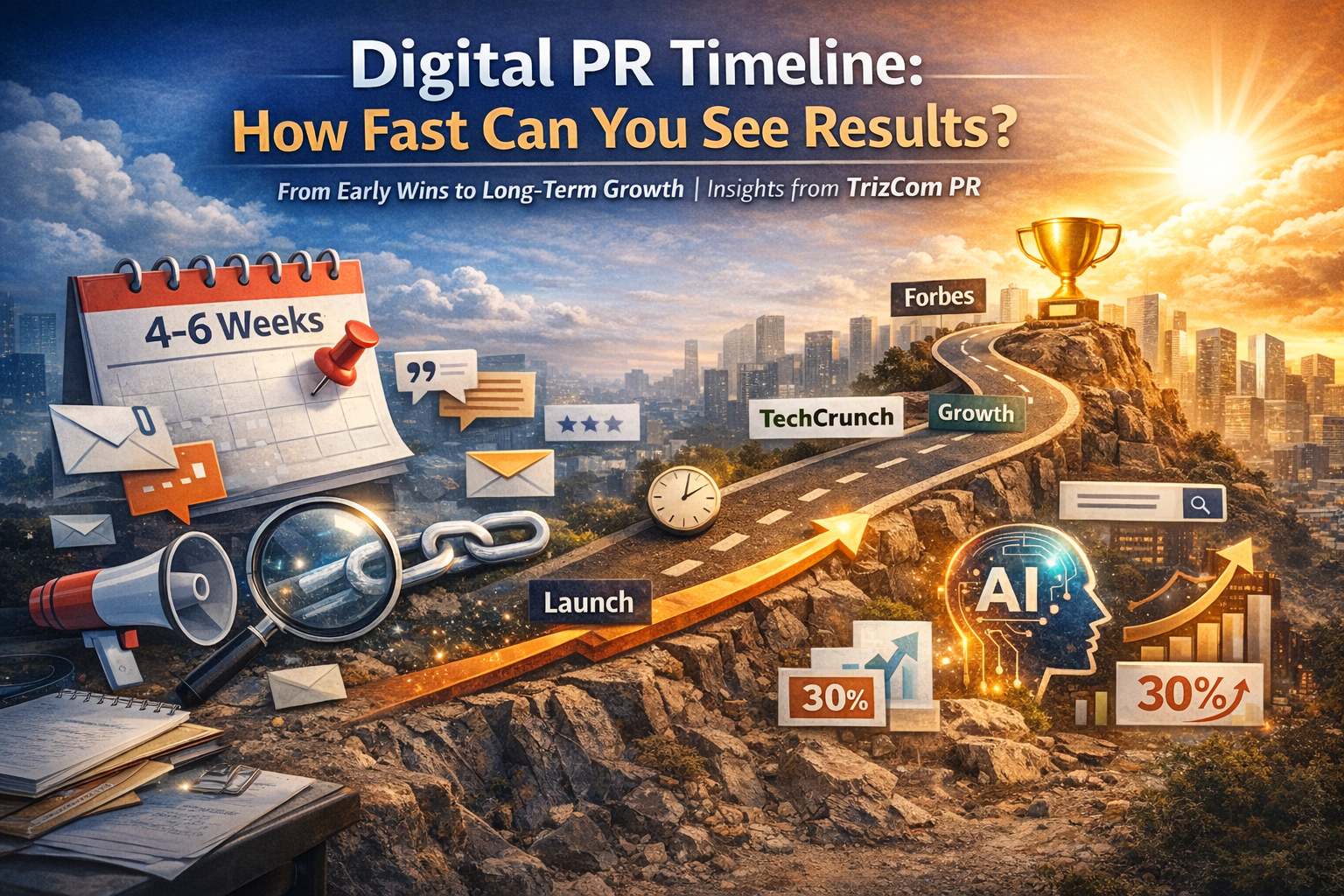
Expect to see the first signs of progress, such as media pitches and initial feedback, within the first four to six weeks of a digital PR campaign. Significant results, including high-quality backlinks and articles in major publications, typically emerge between three to six  months. Unlike paid ads, which stop when payments cease, digital PR gains momentum over time. It often delivers the best return on investment after six months, with studies showing that consistent PR efforts can increase website traffic by up to 30%.

Timeline Breakdown: What to Expect and When

Digital PR is a marathon, not a sprint. While every campaign is unique, most follow a predictable trajectory of growth. Here is a breakdown of realistic milestones for a standard engagement.

Phase 1: Foundation & Strategy (Months 1, 2)

The first few months are about building the infrastructure for success. At TrizCom PR, we use this time to dig into data, identify the most compelling story angles and build targeted media lists.

  • Activities: Auditing current backlink profiles, conducting competitor analysis, creating press assets and drafting initial pitches.

  • Expected Results: Approval of strategy, first round of outreach to journalists and potentially small "quick win" mentions in niche blogs or trade publications. For example, securing mentions in publications with a Domain Authority (DA) of 30+.

Phase 2: Momentum & Coverage (Months 3, 6)

This is where the work starts to pay off visibly. Journalists who received pitches in Phase 1 are now publishing stories.

·         Backlinks: A steady increase in links from authoritative domains (DA 40+).

·         Traffic: Referral traffic from news sites starts to climb, with potential increases of 20% month-over-month.

·         Brand Mentions: Your brand appears in industry roundups or feature articles, such as those in "TechCrunch" or "Forbes".

Phase 3: Authority & Scale (Months 6, 12+)

By this stage, the "flywheel effect" kicks in. Your brand is recognized as an authority, making future placements easier to secure.

  • Activities: Leveraging past coverage to secure tier-1 media spots like national news, detailed case studies and thought leadership pieces.

  • Expected Results: Significant boost in organic search rankings due to backlink accumulation, consistent high-tier media coverage and measurable leads generated from PR efforts. For instance, a 50% increase in search visibility and 30% more qualified leads.

Digital PR vs. Paid Ads: Speed vs. Longevity

Clients often compare digital PR timelines to Pay-Per-Click (PPC) ads. It's essential to recognize their different mechanics and benefits.

Feature Digital PR Campaigns Paid Advertising (PPC)
Speed to First Result Typically slow, taking one to three months to show results. Immediate, often within hours.
Duration of Impact Long-lasting effects, sometimes years. Short-lived, ends when the budget is exhausted.
Credibility High, as it builds trust through third-party endorsements. Lower, since it relies on paid placements.
SEO Benefit Significant, as backlinks enhance domain authority. None, ads do not contribute to organic ranking.
AI Answer Visibility Influences inclusion in AI summaries, recommendations and zero-click answers through earned media and expert sources. No impact on AI-generated answers once ads stop.
Cost Efficiency Improves over time, offering better ROI. Costs may increase with market competition.

Key Factors That Influence Speed

Not all campaigns progress at the same pace. Various factors can either accelerate or decelerate your outcomes.

  • Responsiveness: Journalists often operate under tight deadlines. For instance, if a reporter requests a quote and it takes three days for approval, the chance may be missed. An agile approach, like that of TrizCom PR, can help seize these fleeting opportunities.

  • News Value: A significant data study or a provocative thought leadership article is likely to be picked up more quickly. For example, a recent survey by XYZ Company, which revealed a 30% increase in remote work productivity, was widely covered within a week.

  • Industry Competition: In highly competitive fields like SaaS or FinTech, securing coverage requires more creativity. A unique angle or exclusive data can make a substantial difference. Consider how ABC FinTech leveraged a unique case study to stand out.

  • Existing Brand Authority: Websites with a solid Domain Authority (DA) see faster SEO improvements from new links. For example, a site with a DA of 60 can expect quicker results compared to one starting from scratch.

  • AI Visibility Readiness: Slow publishing cycles, unclear page structure or delayed updates to expert bios, FAQs or media pages can slow inclusion in AI-generated answers. Brands that keep authoritative content current and easy for AI systems to interpret tend to surface faster.

While you might notice early activity in the first month of your digital PR campaign, substantial returns usually develop between months 3 and 6. By emphasizing data-driven strategies and regular outreach, agencies like TrizCom PR help brands establish lasting authority that enhances traffic and SEO value well beyond the initial campaign. Staying patient early on leads to sustainable, long-term growth. Ready to elevate your brand's presence? Contact us today to get started!

FAQ

Digital PR focuses on "earned" media, not paid placements. We carefully select the right contacts, develop compelling stories and align with editorial schedules. For instance, a journalist may love your pitch in Week Two but might only publish it by Week Six due to their schedule.

Does digital PR guarantee sales immediately?

Not instantly. TrizCom PR approaches digital PR as a top-of-funnel strategy focused on building brand awareness, trust and SEO authority. While referral traffic can lead to conversions, the primary goal is visibility that supports sales conversations later in the buying cycle.

How do I measure success?

At TrizCom PR, success is measured by outcomes, not activity. Key indicators include:
• Increases in Domain Authority (DA) from earned links
• Referral traffic from media placements
• Share of Voice compared to competitors
• Keyword ranking improvements tied to campaign themes

See this blog for more information: How Do PR Firms Measure Success? What KPIs Should I Ask About?

How soon can digital PR influence AI-generated answers?

TrizCom PR often sees AI-generated answers reflect earned media and expert content shortly after publication. While traditional rankings may take months to move, authoritative mentions, quotes and bylines can begin influencing AI summaries within weeks once sources are indexed.

See this blog for more information: How Does Public Relations Help Companies Appear In AI Search Results?

Why does digital PR sometimes feel slower than expected early on?

Early stages involve research, approvals and relationship building. TrizCom PR prioritizes alignment before pitching because outreach without clear messaging or approved assets can slow results. The first one to two months lay the groundwork for stronger, longer-lasting coverage.

Can one media placement make a difference?

Rarely on its own. TrizCom PR views media relations as one part of a broader visibility strategy. A strong placement creates momentum, but real impact happens when that coverage is amplified through owned content, shared channels and consistent messaging. Authority builds through repetition and reinforcement, not a single hit.

Does updating website content affect PR results?

Absolutely. TrizCom PR often identifies outdated bios, unclear service pages or inconsistent positioning as barriers to coverage. Keeping core content current improves journalist confidence and helps AI systems interpret brand expertise more accurately.

What happens if a campaign pauses after a few months?

It depends. Earned media does not disappear overnight, but PR works best when it is consistently feeding the ecosystem. Once outreach pauses, momentum begins to fade. Journalists stop hearing from you, new coverage slows and visibility gradually declines. TrizCom PR treats PR as an ongoing discipline. When you stop feeding the beast, authority, relevance and influence start to weaken over time.

How does digital PR support brands with long sales cycles?

TrizCom PR focuses on influencing buyers early. Earned media, expert commentary and AI summaries often shape perceptions before prospects contact sales, helping shorten decision timelines later.

Do smaller brands see results as quickly as larger companies?

They can. TrizCom PR works with smaller brands that move quickly because they have clear messaging, responsive approvals and strong story angles. While authority builds over time, focused campaigns can generate meaningful coverage without a household name.

How often should results be reviewed during a campaign?

TrizCom PR typically reviews performance monthly. These check media response, early placements, referral traffic and emerging AI visibility trends. Early adjustments often accelerate results in later phases.


How Do PR Firms Measure Success? What KPIs Should I Ask About?

 
Professionals reviewing PR performance data on a tablet during a meeting, with charts and graphs representing KPIs, measurement and business-aligned public relations strategy.

TL; DR

PR success should be measured against business goals, not vanity metrics. Strong PR firms track KPIs tied to revenue support, lead generation, employee recruitment, trust and AI search visibility. Impressions alone rarely connect to business outcomes. If a PR firm cannot explain how its KPIs support growth or credibility, measurement is likely surface-level.

Why Is Measuring PR Success Still So Confusing?

Measuring PR success is confusing because public relations influences decisions over time, not just immediate clicks or conversions. Many executives expect measurement that looks like paid media reporting, but PR works differently.

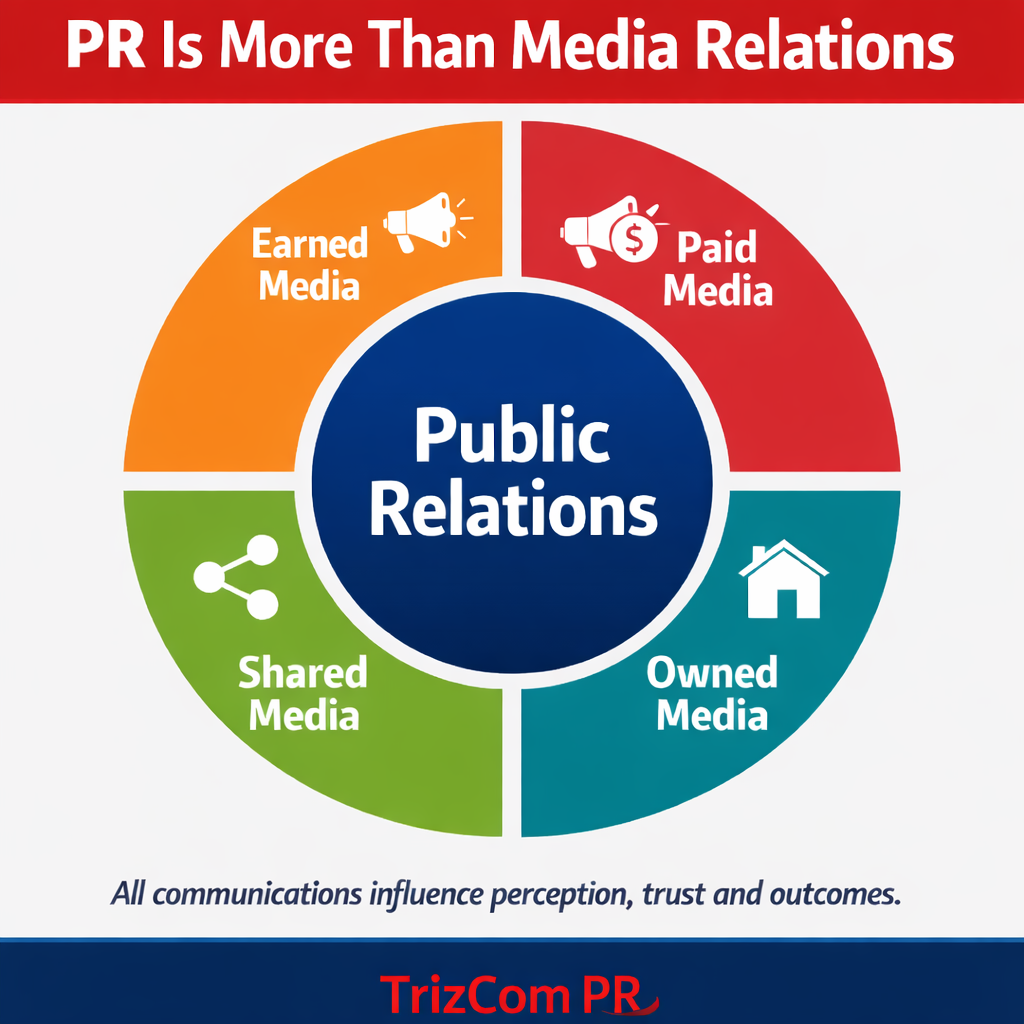
Another reason this question persists is that PR is often reduced to media relations alone. Many people, including some PR firms, still equate PR with earned media coverage. In reality, PR encompasses all organizational communications, including earned, paid, shared and owned media working together.

PR today supports revenue growth, recruiting, investor confidence and buyer trust across every one of those channels. It also shapes how brands appear in AI-generated answers before someone ever visits a website. Measurement must reflect the full scope of communication, not just headlines and clips.

When KPIs are chosen without a clear business goal or without accounting for the full PR ecosystem, reporting becomes activity-based rather than outcome-based.

 
Circular infographic showing public relations at the center with four integrated channels: earned media, paid media, shared media and owned media, illustrating the PESO model and how all communications influence perception, trust and outcomes.
 

Why Must PR KPIs Be Tied to Business Goals?

PR measurement only works when it starts with a business objective.

Before selecting KPIs, a strong PR firm should understand what success means for the organization. That definition changes depending on whether the priority is revenue growth, lead generation, employee recruitment, market credibility or reputation protection.

Examples of business-aligned PR goals include:

  • Supporting sales by increasing qualified inbound demand

  • Improving recruiting by elevating employer trust

  • Building credibility during expansion or leadership change

  • Strengthening authority in competitive or regulated markets

PR KPIs should answer one question.
Did this effort move the business closer to its goal?

Vanity metrics like impressions and reach rarely answer that question. Exposure alone does not generate revenue, attract talent or build trust.

Why PR Measurement Starts With a Communications Plan

 
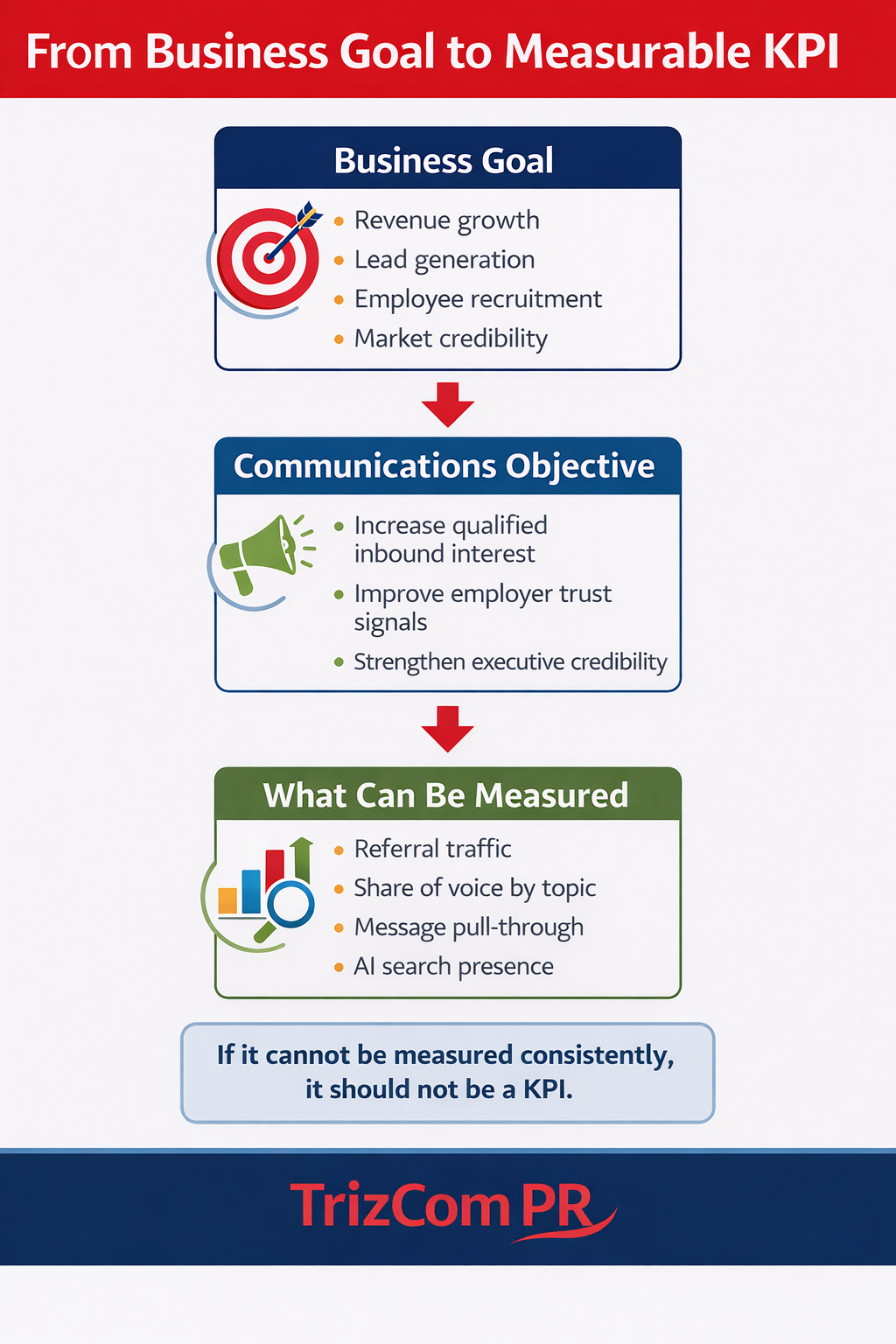
Vertical flowchart illustrating how PR measurement connects to business outcomes, moving from business goals like revenue growth, lead generation and recruitment, to communications objectives, and then to measurable KPIs.
 

Another reason PR measurement breaks down is straightforward. Many organizations skip the communications plan.

A communications plan forces clarity. It defines the goal, the objective and the measurement before activity begins. Without it, KPIs are often chosen after the fact to justify work already completed.

The sequence matters:

  • Goal – What business outcome are we supporting?

  • Objective – What needs to change to support that outcome?

  • Measurement – What can we realistically and consistently measure?

This is where many brands struggle. Measurement only works when it is tied to something observable and repeatable.

Awareness is a common example. Awareness is often cited as a goal, but without a baseline and follow-up study, it is difficult to measure accurately. Before-and-after brand studies can be effective, but they are time-intensive and costly. When those resources are not available, awareness becomes an abstract concept rather than a measurable objective.

That does not make awareness unimportant. It means the measurement approach must match the reality of budget, timeline and tools.

Strong PR firms help clients choose objectives that can actually be measured, rather than defaulting to goals that sound good but fall apart in reporting.

Are Impressions and Reach Enough to Measure PR?

Impressions and reach are not enough to measure PR success.

They show how far a message traveled, not whether it influenced decisions tied to growth or hiring. Impressions are rarely connected to revenue, lead quality or recruitment outcomes.

They are often used as a proxy for awareness when no baseline exists, which is why they should be treated cautiously. Used carefully, they provide context. Used alone, they obscure impact.

How Do Strong PR Firms Actually Measure Success?

Strong PR firms measure success across multiple categories, each tied back to a business goal. Together, these categories explain visibility, credibility, demand and influence.

Measurement works best when KPIs are selected during planning, not retrofitted after execution.

How Is Visibility and Authority Measured?

Visibility and authority measurement focuses on where a brand appears and whether those placements support business outcomes.

Key KPIs include:

  • Coverage in tier-one and industry media

  • Share of voice among defined competitors

  • Authority and relevance of earned backlinks

  • AI search visibility, including how often and how accurately the brand appears in AI-generated answers for priority topics

Visibility matters when it influences buyers, recruits or partners. Placement quality and competitive position matter more than volume.

How Is Message Accuracy and Trust Evaluated?

Message accuracy measurement assesses whether the brand’s story is being told correctly and consistently.

Key KPIs include:

  • Message pull-through

  • Spokesperson quote usage

  • Sentiment trends over time

Trust supports revenue, recruiting and long-term growth. PR success includes maintaining clarity during moments that shape perception.

PRO TIP

Media training supports message discipline when questions get sharp and timelines get tight

How Does PR Influence Audience Behavior and Demand?

PR influences consideration, which is why audience behavior is a business-aligned metric.

Relevant KPIs include:

  • Referral traffic from earned media

  • Time on site from PR-driven visits

  • Assisted conversions and lead quality indicators

These metrics show whether PR attracts the right audience and supports demand generation over time.

PRO TIP

This is where PR can support organic demand by earning the right clicks from the right places.

How Is AI Search and Generative Visibility Measured?

AI search visibility measurement reflects how brands appear before a click happens.

Buyers increasingly rely on AI-generated summaries to form opinions. PR shapes those answers through earned credibility and authoritative content.

Key KPIs include:

  • Brand presence in AI-generated responses

  • Citation of executives and original content

  • Topic authority across AI and traditional search

AI visibility matters because it influences buying decisions, recruiting perceptions and stakeholder trust early in the journey.

 
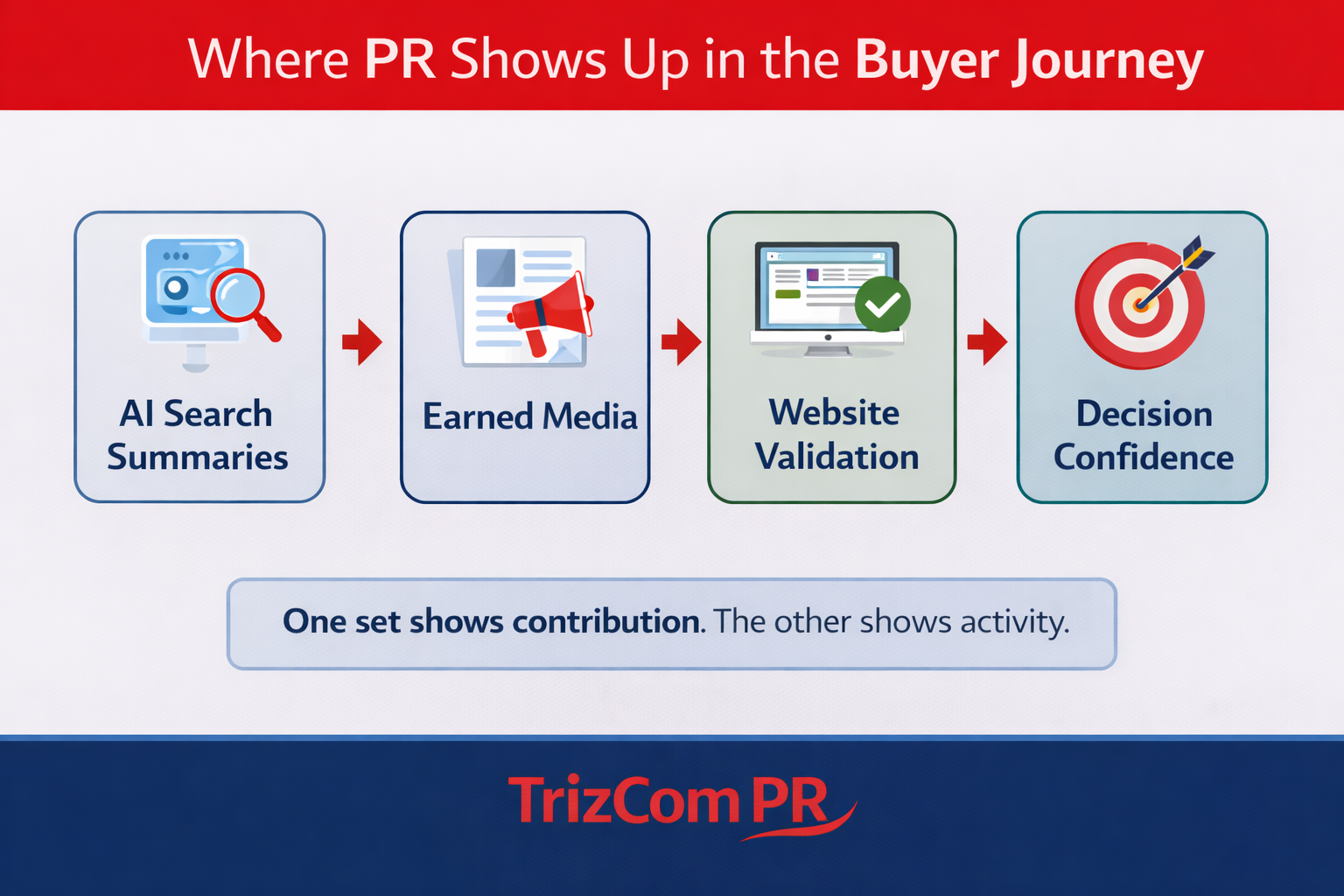
Horizontal diagram showing the role of public relations across the buyer journey, including AI search summaries, earned media coverage, website validation and final decision confidence.
 

What Do Business-Aligned KPIs Look Like Compared to Vanity Metrics?

Stronger measurement signals Weaker measurement signals
Share of voice by topic Impressions reported alone
Referral traffic tied to specific placements Clip counts with no interpretation
Message consistency and sentiment trends Awareness claims without benchmarks
Search and AI visibility lift Vanity engagement metrics
Lead and recruiting influence over time Website visitors without conversions

Business-aligned KPIs show contribution. Vanity metrics show activity.

What Questions Should I Ask a PR Firm About Measurement?

Instead of asking for a list of KPIs, ask how success connects to business priorities.

Questions worth asking include:

  • How do you define success for this engagement?

  • Which KPIs matter most in the first 90 days?

  • Which metrics tie directly to revenue, recruiting or growth goals?

  • What can you influence and what can you not?

  • How do you determine what is realistically measurable based on our goals and resources?

  • How do you adjust strategy when results change?

Clear answers reflect strategic experience. Vague answers signal risk.

Ready to Ask Better Questions About PR Measurement?

If you are evaluating a PR firm or reassessing how success is measured today, clarity matters. The right KPIs should reflect growth, trust, demand and how decisions now start across search and AI platforms.

TrizCom PR helps organizations define meaningful success metrics before campaigns launch, not after reports are delivered.

Request a PR Measurement and Visibility Assessment to understand which KPIs matter most for your business and how to track them with confidence.


Frequently Asked Questions About PR Measurement

What KPIs does TrizCom PR focus on most?

When asking what KPIs TrizCom PR focuses on most, the real answer is that it depends on your business goals. TrizCom PR starts by clarifying what success needs to support, whether that is revenue, lead generation, employee recruitment, investor confidence or reputation protection. From there, we choose KPIs that can be measured consistently over time. That said, a few metrics come up often across engagements, including share of voice for priority topics, message pull-through, website conversions, referral traffic from earned placements and AI search presence to see how your brand appears in generative answers.

Does TrizCom PR still track impressions?

Yes, TrizCom PR tracks impressions as context. Impressions help explain distribution, but TrizCom PR evaluates success using metrics tied to influence and business outcomes.

How does TrizCom PR measure message accuracy?

Message accuracy at TrizCom PR is measured by tracking how consistently key messages and quotes appear across coverage. This helps clients understand how their story supports trust and credibility.

Can PR results be tied to revenue?

PR results are rarely tied to last-click revenue. At TrizCom PR, success is measured through assisted influence that supports sales cycles, lead quality and long-term growth.

How long does it take to see measurable PR results?

Most clients see directional PR indicators within 60 to 90 days. TrizCom PR focuses on trends tied to business goals rather than instant outcomes.

Does TrizCom PR measure AI search visibility?

Yes, TrizCom PR measures how brands appear in AI-generated answers and whether executives and content are cited accurately, which supports early-stage decision-making.

Is sentiment still a useful PR metric?

Sentiment is useful when tracked over time. TrizCom PR looks for patterns that reflect shifts in trust and credibility rather than one-time scores.

How does TrizCom PR report PR performance?

PR performance at TrizCom PR is reported with interpretation. Reports explain what changed, why it matters for the business and what adjustments follow.

Can KPIs change during a PR engagement?

Yes, KPIs should evolve as business priorities shift. TrizCom PR revisits measurement to stay aligned with growth and recruiting goals.

What makes PR measurement effective?

PR measurement is effective when it is planned in advance, tied to real business outcomes and based on metrics that can actually be measured over time. TrizCom PR believes metrics should support clarity, confidence and informed decisions.


5 Questions Executives Ask Before a Media Interview (And How Media Training Answers Them)

 
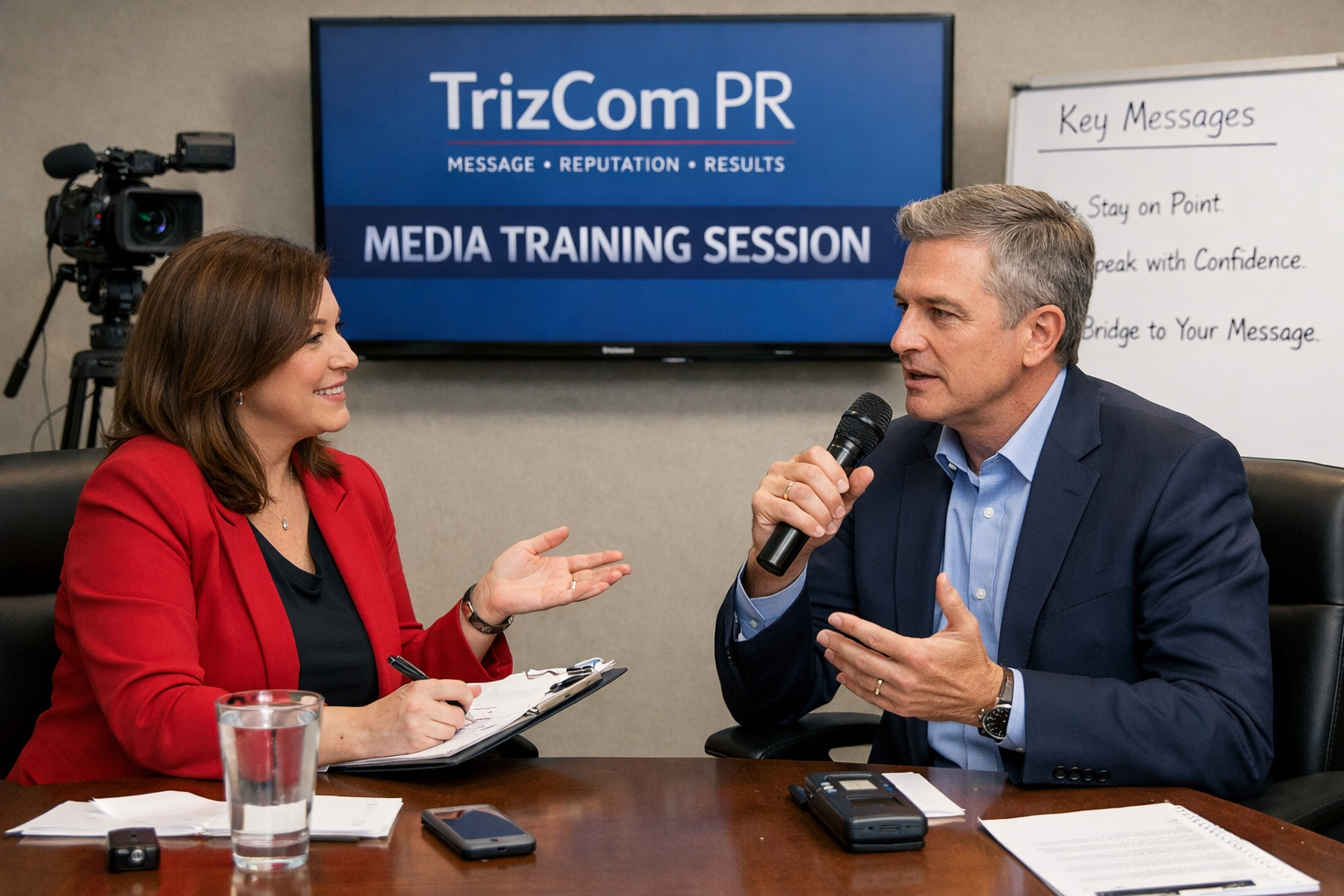
A woman and a man undergoing Media Training  image.png


Media training is more than a 2-hour performance session learning how to play “gotcha” on camera. In reality, it is a strategic course that helps executives approach interviews with confidence and communicate a message under pressure.

Media trainers help spokespeople understand interview dynamics, including the perceived power structure. The same executives who instinctively lead a board meeting can easily let a reporter take control during a media interview and lose sight of their message.

Why does that happen? A media interview creates an artificial environment where spokespeople assume the reporter has an agenda and a list of questions. A well-trained spokesperson approaches an interview differently. They come prepared with key messages, and they know how to bring every answer back to what matters most.

Below are the top five concerns we hear from executives, along with the key takeaways from media training that help leaders become interview-savvy.

Key Takeaways: Executive Media Interview Prep

  • A media interview is a structured conversation, not an interrogation

  • Reporters rarely provide a list of questions in advance

  • The best spokespeople use five to six key messages to answer almost anything

  • In recorded interviews, you may be able to restart an answer if you misspeak

  • Tough questions are handled through preparation, reframing, and calm delivery

1) Are reporters trying to trap me? Why should I ever do a media interview?

Short answer: Most reporters are not out to get you. They are looking for a strong story, which means clear information and compelling quotes.

Reporters ask questions for different reasons. Sometimes they need background. Sometimes they need a quote that brings the story to life. Interviews are conversations managed on both ends with skill and practice. The goal is to stay on message while remaining quotable.

Media interviews also build credibility and visibility. If you are not participating, someone else is shaping the story without you.

What to say (examples):

  • “Here’s what matters most for your audience.”

  • “The most important point is this.”

  • “Let me put that into context.”

  • “What we are focused on is…”

2) Do reporters give you the questions in advance?

Short answer: No. A reporter rarely shares specific questions in advance.

A seasoned reporter comes prepared with a direction, not a script. They are also listening closely. One word can change the direction of the interview.

During a mock interview, an ER doctor once answered my question about “what could go wrong” with “well, they could die.” I was looking for information, but the negative wording immediately shifted the tone. A better response would have been, “That’s not what we are focused on. We are focused on saving lives.”

Side note: This question mirrors a similar one: “When do I get to fact check the story?” That usually does not happen either, except in rare cases.

What to say (examples):

  • “I do not want to speculate, but I can tell you what we know.”

  • “That’s not what we are focused on. What we are focused on is…”

  • “Here’s the context your audience needs.”

  • “Let me make sure I’m clear on the priority.”

3) What can executives safely say in a media interview?

Short answer: Stick to five to six key messages and support them with proof, examples and real stories.

The safest approach is not silence. It is preparation. Your key messages should sound conversational, credible and memorable.

If one of your messages is “We are committed to keeping employees safe,” and it is true, you should include specifics and stories to back it up. Pride matters too. Spokespeople get into trouble when they do not believe what they are saying. Audiences can detect that quickly.

Side note: Do not go “off the record.” If you feel like you should not say something, do not say it.

What to say (examples):

  • “What I can share is…”

  • “Here’s what we know right now.”

  • “The facts are…”

  • “I want to be careful not to speculate, but I can confirm…”

4) Can you fix a mistake during a recorded interview?

Short answer: Sometimes. If the interview is recorded, you can often pause and ask to restart.

Ideally, you are not doing a high-stakes interview live without training and experience. In a recorded interview, if you stumble or do not like what you said, you can ask the reporter if you can start that over. A little self-deprecation helps.

Will they always allow it? No. But many will, because they want a clean, usable quote.

What to say (examples):

  • “Let me say that more clearly. Can I restart that answer?”

  • “I want to make sure I get that right. Can I take that again?”

  • “That was not my best wording. Let me try that again.”

5) How do executives handle hostile or difficult interview questions?

Short answer: Reframe the intent of the question and return to your key messages.

Most questions are not hostile. They are requests for information. Seasoned spokespeople stay calm and maintain control because they know their messages and how to return to them.

In crisis interviews, questions can become more contentious. The good news is that crisis interview questions are usually predictable. Preparation matters most here. Strong prep for a crisis interview includes practicing answers to every foreseeable question before the interview.

What to say (examples):

  • “I understand why you’re asking. Here’s what people should know.”

  • “Let’s talk about what we are doing to address that.”

  • “The bigger issue is…”

  • “What matters most right now is…”

Executive Media Training Cheat Sheet (Concern → Goal → What to Say)

Executive Concern (What Keeps You Up) Media Training Goal What to Say (Sample Line) Best Skill to Practice
Reporters are trying to trap metd> Reframe the interview as a conversation you can lead “Here’s what matters most for your audience.” Validate the question and pivot into your message
I want the questions in advance Prepare messages, not scripts “What we are focused on is…” Message discipline
What can I safely say? Stay inside 5 to 6 approved key messages “What I can share is…” Key message development
I made a mistake on camera Recover fast, correct clearly “Let me say that more clearly. Can I restart?” Resetting under pressure
The questions feel hostile Stay calm, acknowledge, reframe “I understand why you’re asking. Here’s what people should know.” Reframing and tone control

Ready to Feel Confident Before Your Next Media Interview?

If you are preparing for a high-visibility interview, a tough reporter, or a topic that needs careful messaging, do not wing it. The executives who come across as calm, credible and in control are rarely “naturals.” They are prepared.

That is exactly what media training is built for.

At TrizCom PR, we train executives and spokesperson teams to:

  • stay on message under pressure

  • handle tough questions without sounding defensive

  • deliver clear, quotable answers that protect your reputation

  • show up on camera with confidence and authority

If you have an interview coming up or you want to proactively prepare your leadership team, we can help.

Contact TrizCom PR today to schedule executive media training.

Everyone has a story to tell. Let TrizCom PR tell yours.


FAQ: Media Training and Executive Interviews

What is media training for executives?

Media training helps executives prepare for interviews by learning how to answer questions clearly, stay on message and deliver strong, quotable responses under pressure. At TrizCom PR, media training also focuses on helping leaders understand how interviews actually work so they do not unintentionally give up control of the conversation.

Do reporters send interview questions in advance?

Usually not. Reporters may share the general topic or angle, but most do not provide a list of exact questions. That is why TrizCom PR trains executives to prepare messages, not scripts. When you know what you need to say, you can handle almost any question that comes your way.

How do you stay on message during a media interview?

The most effective spokespeople use five to six key messages and practice bridging from any question back to those points. At TrizCom PR, we help executives build those messages and practice delivering them until staying on message feels natural, not forced.

What should executives never say in a media interview?

Avoid speculation, absolutes you cannot prove and anything you would not want quoted publicly. Also avoid saying something is “off the record.” At TrizCom PR, we remind clients that if something should not appear in print or on air, it should not be said at all.

How do I stop rambling in a media interview?

Use a headline-first answer. Lead with your main point in one clear sentence, support it with one proof point or example, then stop. TrizCom PR coaches executives to answer most questions in 15 to 30 seconds so responses stay tight, confident and quotable.

How do I answer when I do not know something?

Do not guess. Say what you know, explain what you are confirming and then bridge to what you can share right now. This approach, which TrizCom PR reinforces in every training session, protects credibility and keeps you in control of the interview.

About the Author

Karen Carrera, APR

Karen Carrera, APR, is a 40-under-40 award recipient recognized in 2003 and a senior communications counselor with more than 20 years of experience advising executives on strategic communications, brand positioning and reputation management across healthcare, construction and design, education, energy, finance, insurance, government and utilities.

Karen has media-trained hundreds of corporate spokespeople on how to handle media interviews and deliver strong industry presentations. Karen’s approach helps leaders share their stories with confidence while staying focused on key business messages that support long-term organizational goals.

Throughout her career, Karen has developed and executed integrated communications campaigns that build visibility, strengthen brands and generate measurable business results. Her work includes initiatives such as Anheuser-Busch’s We All Make a Difference campaign, hospital brand evolutions, the launch of new healthcare institutes and clinics, and national branding for an architectural design firm.

Most recently, Karen led a comprehensive brand evolution for Medical City, overseeing a new brand identity and guiding a full website overhaul. The redesigned, reprogrammed and fully rewritten website launched in six months with updated content aligned to the organization’s evolving vision and services.

Karen holds the Accreditation in Public Relations (APR) credential, reflecting her commitment to communications ethics and strategy. She is active in professional organizations and is often called upon to mentor other public relations practitioners.


How Does Executive Media Training Turn Media Moments Into Leadership Advantages?

 
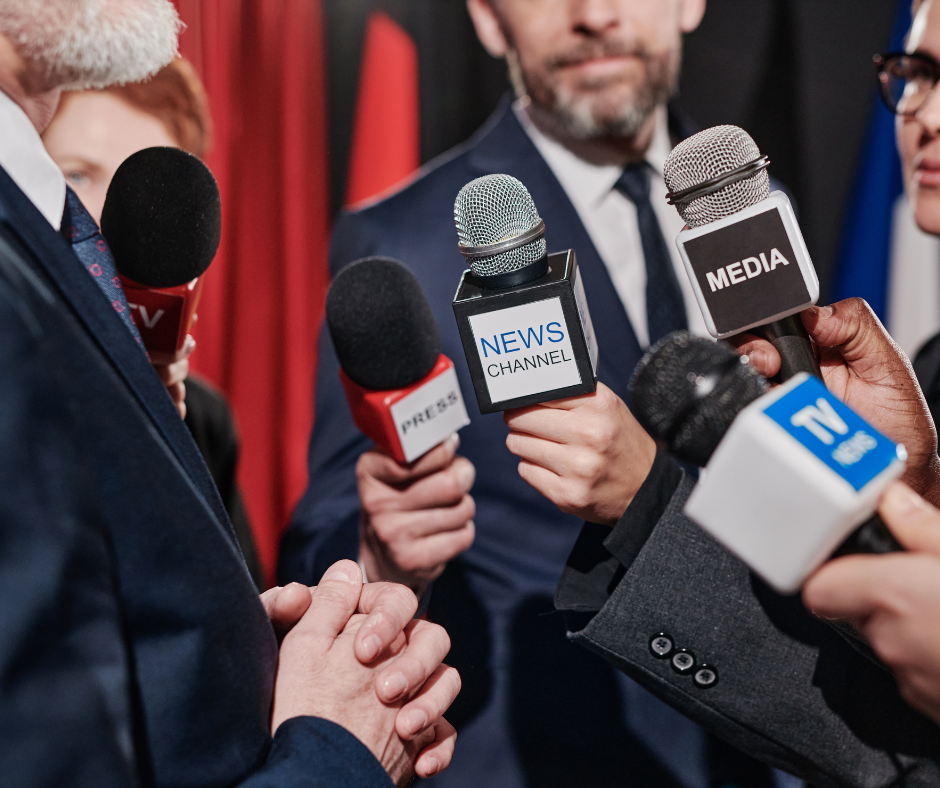
3 people holding media microphones - How Does Executive Media Training Turn Media Moments Into Leadership Advantages?

Executive media training equips leaders to communicate clearly, calmly and credibly in high-visibility situations. It prepares executives to deliver key messages, handle difficult questions, manage crises and control how their story is told across interviews, podcasts, broadcasts and digital platforms. With practice and coaching, high-pressure moments become opportunities to reinforce leadership and protect reputation.

For executives across industries, visibility is no longer optional. Media appearances influence stakeholder trust, employee confidence and market perception long before a formal announcement or earnings call.

Why do even experienced executives need media training?

Subject-matter expertise does not automatically translate to strong public communication. Interviews move quickly. Questions can be unexpected. Tone and body language often matter as much as words.

Media training bridges the gap between knowledge and delivery by helping leaders:

  • Stay focused when conversations shift

  • Respond clearly under pressure

  • Avoid unintentional misstatements

  • Present authority without sounding scripted

This preparation reduces risk while increasing confidence.

What does executive media training actually include?

Executive media training focuses on skill-building through realistic practice and feedback, not on theory alone.

Core components include:

  • Messaging – Developing clear, concise core messages and repeatable soundbites

  • Interview techniques – Learning how to bridge back to key points and handle aggressive or difficult questions

  • Delivery – Improving body language, tone, pacing and eye contact

  • Scenario practice – Participating in recorded mock interviews with direct coaching

  • Crisis communicationPreparing for high-stakes moments that require speed and precision

  • Digital and social media – Understanding how interviews live online and shape long-term perception

Each element is designed to improve clarity and control.

How does media training help executives stay on message?

Interviews rarely follow a script. Media training teaches executives how to guide conversations without sounding evasive.

Executives learn how to:

  • Acknowledge questions while redirecting focus

  • Reinforce priority messages consistently

  • Avoid speculation or over-explaining

  • Keep answers concise and clear

This discipline protects both the leader and the organization.

How does media training prepare leaders for tough questions?

Challenging questions are often where reputations are tested. Media training provides frameworks for responding thoughtfully without losing composure.

Through practice, leaders learn how to:

  • Pause before responding

  • Reframe questions constructively

  • Address sensitive topics without escalation

  • Maintain credibility even when information is limited

Preparation reduces anxiety and increases confidence in real-time situations.

Why delivery matters as much as content?

Audiences judge confidence through more than words. Tone, posture and eye contact all influence credibility.

Media training improves delivery by focusing on:

  • Controlled body language

  • Vocal clarity and pacing

  • On-camera presence

  • Engagement across different formats

This helps leaders appear steady and trustworthy whether on camera, on a podcast or in a live setting.

How does executive media training support crisis readiness?

During crises, leadership visibility increases instantly. Media training prepares executives to respond without adding confusion or risk.

Crisis-focused training helps leaders:

  • Deliver calm, factual statements

  • Avoid speculation

  • Reinforce accountability and action

  • Maintain consistency across appearances

Strong preparation protects brand value when scrutiny is highest.

Why executive visibility strengthens leadership credibility

Media training supports authentic storytelling. When leaders communicate clearly and confidently, audiences connect with the person behind the title.

Executive visibility:

  • Builds trust with stakeholders

  • Reinforces organizational values

  • Positions leaders as reliable voices

  • Strengthens long-term reputation

This is especially important in industries where trust and clarity drive decision-making.

How TrizCom PR approaches executive media training?

TrizCom PR designs executive media training to reflect real-world pressure. Sessions are practical, personalized and focused on outcomes.

Training includes:

  • One-on-one coaching

  • Industry-relevant scenarios

  • Video-recorded interviews with feedback

  • Message development aligned with business goals

Executives leave with skills they can apply immediately.

Who leads TrizCom PR’s media training?

Media training at TrizCom PR is led by Karen Carrera, APR, an experienced communications strategist and former journalist. With decades of experience advising executives across healthcare, finance, energy, government and professional services, Karen brings firsthand insight into how interviews work and how stories are shaped.

Her approach is direct, practical and tailored to each leader’s role and communication style.

Ready to strengthen your leadership presence?

High-stakes communication moments shape how leaders are remembered. With the right preparation, those moments can reinforce trust rather than create risk.

If you want to help your executives communicate with confidence, clarity and control, connect with TrizCom PR to discuss executive media training and leadership communication support.

Frequently asked questions about executive media training

What is executive media training?

Executive media training prepares leaders to communicate effectively during interviews, press conferences and public appearances through coaching, practice interviews and direct feedback.

Why is media training important for executives?

Media training is important for executives because it helps them communicate clearly under pressure, protect reputation and reinforce leadership credibility in high-visibility moments.

How long does executive media training take?

Executive media training can take a few hours to a full day depending on your goals, experience level and the number of scenarios you want to practice.

Does media training help with podcasts and virtual interviews?

Yes, media training helps with podcasts and virtual interviews by teaching techniques tailored to audio-first and screen-based formats where tone, pacing and presence work differently.

Can media training reduce reputational risk?

Yes, media training can reduce reputational risk by minimizing misstatements, emotional reactions and inconsistent messaging that can erode trust.

Is media training only for crisis situations?

No, media training is not only for crisis situations. Media training also supports everyday visibility, thought leadership and routine interviews where clarity and consistency still matter.

Should senior leaders refresh media training?

Yes, senior leaders should refresh media training when roles change, messages evolve or new platforms become part of the media mix.

Is media training customized by industry?

Yes, media training is customized by industry when it is done well because effective preparation reflects the language, risks and expectations of the sector you operate in.

Does media training help internal communications?

Yes, media training helps internal communications because the same skills improve town halls, employee updates and leadership presentations.

Who should participate in executive media training?

Executives, board members, founders and anyone representing an organization publicly should participate in executive media training, especially if they will be quoted, interviewed or leading during sensitive moments.

Jo Trizila – Founder & CEO of TrizCom PR

Author

Jo Trizila, Founder & CEO, TrizCom Public Relations

Jo Trizila leads Dallas‑based TrizCom PR, an award‑winning digital public relations agency she founded in 2008. She has guided integrated PR programs for startups, middle‑market companies and national brands, with deep experience in crisis communications, expert positioning and data‑driven media strategy.

Jo is also the creator of Pitch PR, a press release distribution company and a frequent speaker on earned media ROI, including sessions at the Earned Media Mastery virtual summit.

For more information contact jo@trizcom.com or 214-242-9282.


The Best Crisis Communication Examples for 2025

 
Crisis communication examples - man tipping over wood blocks

Every year, brands make public relations mistakes that turn into case studies. These crisis communication examples show how fast trust can drop when leadership treats an emotional moment like a routine update, waits too long to speak or talks like a legal memo while stakeholders feel the impact in real time.

The pattern is simple. A crisis creates an information vacuum. If you do not fill it with clear facts, human tone and practical next steps, someone else will. Social media will. Reddit will. A competing narrative will. Once that version takes hold, even a good response can look late.

TL;DR

  • A crisis is a fast-moving event that can harm people, operations, finances or trust

  • The first goal is stability, not a perfect explanation

  • Publish one source of truth with timestamped updates

  • Pick one spokesperson, limit mixed messages

  • Lead with care, then facts, then next steps

  • Keep promises about when the next update is coming

What is considered a crisis

A situation is considered a crisis when it creates real stakes and real urgency. Stakes can include safety risk, service disruption, legal exposure, financial impact or reputation damage that threatens future business. Urgency shows up when facts are incomplete, pressure is rising and decisions must be made quickly. If the event pulls in multiple audiences at once, employees, customers, partners, regulators, media and requires a cross-functional response, it has crossed into crisis territory.

What is crisis communications

Crisis communications is the coordinated work of sharing accurate, timely information during a high-stakes event while protecting people, operations and long-term trust. It covers what you say, when you say it, who says it and where it is published. The goal is not to “spin” a situation. The goal is to reduce confusion, prevent harm, support affected people and keep stakeholders informed as facts evolve. Strong crisis communications pairs empathy with clarity and uses one consistent update hub.

Top 11 Crisis Communications Events of 2025

Below is my list of 10 2025 crisis PR examples followed by past examples that still hold up. Each one includes what went wrong, what a stronger crisis response could have looked like and the takeaway you can steal for your own crisis management plan.

1) Dallas Mavericks trade Luka Dončić


The Dallas Mavericks traded Luka Dončić and announced it overnight on February 2, 2025. Fans woke up to a decision that felt abrupt and personal, not just strategic. The backlash moved from social posts to protests outside the arena, including a mock funeral. Local coverage stayed on the story for weeks because the team did not control the conversation early.

What went wrong

They treated a high-emotion moment like a routine transaction. The first wave of communication did not acknowledge what fans were losing. Leadership appeared reactive, then defensive, which kept the story alive.

What they should have done

They needed a planned rollout that treated fans as stakeholders, not an audience. That starts with a clear statement from leadership explaining the reasoning in plain language paired with a visible tribute to Luka’s legacy.

They also needed a listening phase. Hold a structured media availability with one spokesperson, share what the team can say and what it cannot, then commit to a second update within 24 to 48 hours. Most importantly, stop escalating tension in the arena. If fans show up upset, the organization’s job is to lower the temperature, not raise it.

What we learned

You can make a smart business move and still create a trust problem. Timing and tone decide whether stakeholders feel respected or dismissed. If your most loyal supporters feel blindsided, they will tell the story for you.


2) Astronomer Coldplay kiss cam scandal


Astronomer went from niche tech company to household name in a single weekend, but not because of its product. A kiss cam clip at a Coldplay concert showed two senior leaders, which turned into instant scrutiny around workplace ethics and leadership conduct. Internet sleuths identified the individuals within hours and the story shifted from gossip to governance. The company placed the executives on leave, opened an investigation and both leaders later exited. Astronomer then tried to redirect attention with a humorous, celebrity-led creative spot.

What went wrong

The real crisis was not the brand awareness spike. The crisis was executive behavior and the power dynamics implied by two leaders at the top. The company also lost the first day to silence, which gave the internet time to write its own version of events. The humor pivot created mixed reactions because many stakeholders wanted clarity and accountability first.

What they should have done

They needed a same-day holding statement that did three things: acknowledge awareness, confirm an independent investigation process and reaffirm leadership standards. Keep it short. Keep it human. Save humor for later, if it fits at all.

Next, run a disciplined update cadence tied to decision points: who is leading interim operations, when the investigation concludes, what changes will follow. If the company still wanted creative reframing, it needed to come after visible accountability and internal culture actions so the tone matched the substance.

What we learned
Virality can turn a company into a household name overnight, but that is not a win if the story is executive conduct. The first day matters. Silence invites speculation that is hard to unwind.


3) American Eagle Great Jeans campaign


In the Fall of 2025, a denim campaign sparked controversy because the messaging was read by some audiences as echoing sensitive themes around genetics. The conversation spread quickly across social platforms and traditional media. What the brand intended as playful wordplay became a broader cultural debate. The spokesperson and the brand responded later, but the story had already taken its shape.

What went wrong

The campaign was not stress-tested for interpretation risk. The response window looked slow, which let others define intent. The follow-up messaging focused on the original creative idea rather than addressing why the interpretation landed.

What they should have done

Before launch, they needed a red-team review: read the copy like a critic, then rewrite until the double meaning disappears. If the campaign is already live, the first response should validate concerns without arguing with them. Clarify intent, remove or revise the element causing harm and explain the change clearly.

Then shift to proof. Share what internal review steps are changing, how future campaigns will be tested and what representation and inclusion look like in practice. People do not need a lecture. They need clarity and action.

What we learned

If a line can be interpreted two ways, the internet will choose the one that creates friction. Cultural meaning moves faster than brand intent. Creative review needs a “how could this be read badly” step, every time.

4) Cracker Barrel logo redesign and reversal

In August of 2025, Cracker Barrel rolled out a brand refresh that included a logo change, then faced public backlash. The company reversed course and restored the old logo and brand elements. Executive changes followed as leadership tried to reset attention back to the guest experience. The episode turned a design decision into a reputational story.

What went wrong

They changed a symbol people feel protective of before explaining the reason. The explanation arrived after the reaction, so the reaction became the headline. The reversal looked reactive, which can make a brand feel unsteady even when it is trying to listen.

What they should have done

If a legacy brand wants to modernize, it needs a story that respects what people value. Explain the purpose first, show the evolution and test the rollout in smaller markets before a full switch. Treat brand change like change management, not like swapping a file.

They also needed better signal detection. Volume alone is not insight. Separate real customer feedback from coordinated amplification, then respond to the stakeholders who actually sustain the business.

What we learned

Changing a beloved symbol without a story creates a vacuum and people fill it fast. A reversal can look like listening, but it can also look like instability if the brand cannot explain the “why.” Not all outrage is customer outrage, so validation matters.

5) Camp Mystic Texas Hill Country flood

Over the July 4, 2025 holiday weekend, catastrophic flash flooding swept through Texas Hill Country, including the Guadalupe River area near Hunt, Texas where Camp Mystic operates. Camp Mystic later confirmed that 27 campers and counselors died. As search and rescue continued, families and the public looked for real-time updates, safety details and clear points of contact. Reporting also noted that Camp Mystic’s first formal website statement came after families and friends had already turned to social media for information.

What went wrong

In fast-moving disasters, information gaps become part of the crisis. Public reporting raised questions about response timing, including that evacuation began after a National Weather Service alert. Communication also appeared fragmented early on, with many people relying on unofficial channels while the situation was still unfolding.

What they should have done

First, camps in flood-prone regions need a crisis plan built around speed and redundancy. That includes hard evacuation triggers tied to weather alerts, overnight monitoring, flood gauges and multiple ways to reach every cabin and staff member if power and cell service fail. It also includes a separate family communications system that does not depend on staff posting updates in the middle of an emergency.

Second, once the crisis begins, the organization needs a single information hub and a predictable update rhythm. Set up a hotline and a dedicated webpage with time-stamped updates, what is confirmed, what is still being verified and where families can get help. Coordinate messaging with local emergency management so the public hears consistent facts and families do not feel pushed toward rumor-filled threads for answers.

What we learned

Natural disasters turn into reputation crises when stakeholders cannot get timely, trusted information. The most effective crisis communication is operational, not performative: clear triggers, redundant tools and a family-first update system. Post-crisis, the only path forward is transparency on what changed, plus visible safety upgrades that people can verify.

6) Target

In early 2025, Target said it would end its three-year DEI goals and wind down its REACH initiative, citing an “evolving external landscape.” The decision drew immediate public scrutiny because many people associate Target with values-led branding. Some community leaders and shoppers called for boycotts and sustained pressure campaigns, keeping the story in the news cycle well beyond a typical corporate announcement.

What went wrong

Target framed the change as a planning or positioning update, but many audiences experienced it as a reversal. The public messaging left space for others to assign motives, which widened the perception gap. The response also lacked a clear explanation of what would stay the same and what would change in day-to-day practices.

What they should have done

They needed to communicate in concrete terms, not umbrella language. A stronger approach would have spelled out what commitments were continuing, what programs were evolving and what metrics would still be tracked. Share a short FAQ that answers the questions people actually ask in these moments: what changes for employees, what changes for suppliers, what changes for community investment and what is non-negotiable.

They also needed a listening plan that matched the intensity of the reaction. That can include pre-briefs with key stakeholder groups, then a clear cadence of updates with one consistent spokesperson. If the company wanted to reposition language, it still needed to show continuity through visible actions and reporting that people can verify over time.

What we learned

Policy statements land as identity and trust, not corporate process. If you change something tied to values, you have to communicate what stays true, not only what is ending. Vagueness invites other people to define intent.

7) OpenAI ChatGPT mental health and safety lawsuits

In 2025, OpenAI faced a wave of public scrutiny tied to how ChatGPT responds to people in emotional distress, including minors. The most high-profile coverage centered on a wrongful-death lawsuit filed by a teen’s family who alleged the chatbot contributed to harmful outcomes. The story expanded beyond one case into a broader question about whether current safeguards are strong enough for vulnerable users. OpenAI responded by outlining new mental health guardrails for teens and people in crisis, including additional controls and crisis detection improvements.

What went wrong

This was not a standard PR crisis where a statement fixes the problem. The core issue was the gap between product capability and user safety expectations, especially when the user is a teen or in distress. As lawsuits and reporting stacked up, the narrative became “platform responsibility” instead of “isolated incident.”

What they should have done

OpenAI needed to treat this like a safety event with public accountability, not a reputational flare-up. That means a clear, centralized safety hub that explains what the system does when someone signals distress, what it will not do and how escalation works. It also means publishing measurable safety commitments, then reporting progress on a predictable schedule so the conversation is grounded in proof, not promises.

They also needed stronger guardrails that are easy to understand and hard to bypass for minors. Parental linking, teen-specific defaults, clearer warnings and better crisis routing all help, but credibility increases when safeguards are validated by independent experts and user research, then shared in plain language. When the topic is mental health, tone matters. The company has to lead with care for affected families, not corporate defensiveness.

What we learned

When a product touches mental health, trust is built through safety design and transparent follow-through. In these moments, “we take this seriously” is not enough because stakeholders want to see what changed. The brands that hold up best treat safety as a product feature that ships, gets measured and gets updated in public.

8) Hertz

Hertz disclosed that customer information was accessed after a threat actor exploited vulnerabilities in Cleo file transfer software used by a vendor. Hertz said it confirmed on February 10, 2025 that data had been acquired by an unauthorized party connected to attacks that occurred in late 2024. The notice described the types of information that may have been involved, including identification and contact details, with some individuals potentially affected more severely depending on the records involved.

What went wrong

The company faced the classic “it was a vendor” problem. Most customers do not separate vendor responsibility from brand responsibility, especially when identity risk is involved. The delay between the underlying intrusion window and consumer notification also creates frustration because people feel they lost time to protect themselves.

What they should have done

They needed to lead with customer protection, then explain the vendor chain. That means a breach hub that is easy to find, plain-language updates and a checklist of immediate steps people can take, even while forensic work continues. Put the highest-risk groups first and communicate directly with those individuals as early as possible.

They also should have tightened the tone around accountability. “Third-party incident” can sound like finger-pointing if it is not paired with clear ownership: what Hertz is doing now, what controls will change and how the company will validate improvements. A post-incident report, written for non-technical readers, would help restore confidence.

What we learned

In a breach, customers judge outcomes, not root causes. Vendor incidents still belong to the brand in the public’s mind. Speed, clarity and practical guidance reduce long-tail distrust.

9) Tesla and Elon Musk DOGE role backlash

Elon Musk became the public face of the White House’s Department of Government Efficiency known as DOGE even as the White House said in court filings that Musk was not a DOGE employee and had no formal decision authority. The visibility of the role triggered a consumer backlash that moved into the real world through #TeslaTakedown protests at Tesla locations. The situation blurred Tesla’s brand with Washington politics and created negative attention across key markets. The White House later publicly showcased support for Tesla, which kept the story connected to politics rather than products.

What went wrong

The core issue was brand entanglement. Tesla became a proxy target for opinions about Musk’s government role and federal cuts, even though the company is a separate entity. Messaging also struggled to clarify the difference between Musk’s public persona, Musk’s advisory role and Tesla’s operations, leaving a perception gap that others filled quickly.

What they should have done

This required a clear firewall narrative, repeated consistently. Tesla could have separated “Musk the adviser” from “Tesla the company” with a short, plain-language statement that explained governance, decision-making and who speaks for Tesla on operational matters. Then reinforce it with actions: elevate additional executive spokespeople, increase visibility for product and safety leadership, publish a predictable cadence of customer-first updates that do not touch politics.

They also could have planned for stakeholder reaction the way they plan for product launches. That means scenario planning for boycotts and protests, employee communications that prepare store teams, retailer guidance for handling in-person demonstrations and a monitoring plan that tracks reputation by region. The goal is not to argue with critics. The goal is to reduce ambiguity so customers, employees and investors know what Tesla is accountable for and what it is not.

What we learned

When a founder becomes a political symbol, the brand can inherit political heat whether it wants it or not. “Clarifying later” rarely works because public narratives move faster than corporate explanations. A visible firewall and steady spokesperson strategy can reduce long-tail damage, especially when protests and boycotts move offline.

10) American Airlines Flight 5342 midair collision near Washington DC

On January 29, 2025, an American Eagle regional jet operating as American Airlines Flight 5342 collided midair with a US Army Black Hawk helicopter near Ronald Reagan Washington National Airport. All 67 people on both aircraft died including 28 members of US Figure Skating Association’s figure skating community, making it one of the deadliest US aviation disasters in decades. The story dominated national news immediately and families, regulators, elected leaders and the public looked for clear information fast. American Airlines’ CEO issued video statements and the company used its newsroom updates as the incident investigation unfolded.

This one hit hard for me on a personal level because my daughter is a figure skater and seeing the skating community connected to the coverage made it feel close to home.

What went wrong

In tragedies of this scale, “wrong” is not only about what caused the event. It is also about how quickly misinformation spreads when facts are incomplete. The pressure point is the first two to six hours, when people search for answers and every gap gets filled by speculation.

What they should have done

Treat the first statement as a stabilizer, not a full explanation. Confirm what is known, state what is not yet known, explain what the company is doing next and point everyone to one source of updates that stays current. Repeat that cadence on a predictable schedule, even if the update is short.

Then separate audiences. Families need a dedicated channel and support resources that do not compete with media updates. Customers and the public need operational clarity, travel guidance and a clear commitment to cooperate with investigators. Regulators and elected officials need direct lines and consistent facts. This is one of the clearest moments where a single, disciplined message map reduces confusion and protects credibility while investigations run their course.

What we learned

In a mass-casualty crisis, speed and clarity matter, but discipline matters more. One trusted update hub, one spokesperson plan and a predictable rhythm can prevent speculation from becoming the narrative. When facts are limited, the company that communicates what it knows and what it is doing next earns more trust than the company that waits for perfect information.

Older crisis communication examples that still hold up

The 2025 examples show how crises move now: faster, louder, and shaped by emotion before facts are complete. The older examples are worth revisiting because the mechanics never changed. Leaders still wait too long, talk in corporate language when people want plain truth, and underestimate how quickly a vacuum gets filled. These cases may be years old, but the failures are current. Read them as pattern recognition. If you can spot the same missteps early in your own organization, you can correct course before the headline hardens.

1. Bud Light’s Marketing Misfire: Alienating Core Customers

Bud Light, one of the biggest beer brands in America, attempted to expand its audience by partnering with transgender influencer Dylan Mulvaney. However, the campaign sparked backlash from conservative customers, leading to widespread boycotts. Sales plummeted by 24%, and the company lost its position as America’s top-selling beer.

What Went Wrong?

Bud Light failed to anticipate the potential backlash from its existing customer base. The brand launched the campaign without a clear messaging strategy and, when faced with criticism, offered no decisive response—leaving both supporters and detractors confused.

Crisis Communication Examples: What They Should Have Done

Bud Light needed a cohesive crisis PR strategy from the start. First, they should have prepared for pushback and preemptively crafted messaging that reinforced their commitment to inclusivity while also addressing the concerns of longtime consumers. Instead of a vague and inconsistent response, a clear and unified crisis communication strategy would have helped manage public sentiment.

Additionally, an effective crisis communication plan should have included internal and external communication strategies to align all team members and ensure a consistent message across social media channels and press statements.

2. Twitter (X) and Elon Musk’s PR Nightmare

Elon Musk’s takeover of Twitter, now rebranded as X, quickly became a PR disaster. Sudden mass layoffs, erratic policy changes, and the reinstatement of controversial accounts led to a massive exodus of major advertisers and a sharp decline in user trust.

What Went Wrong?

The chaos stemmed from a lack of transparency in Musk’s leadership. His approach was abrupt, often relayed through spur-of-the-moment tweets instead of structured crisis response statements. This mismanagement led to significant damage to public trust and loss of key business partnerships.

Crisis Communication Examples: What They Should Have Done

Musk needed a phased crisis management strategy that reassured advertisers and users during the transition. Hosting industry roundtables, offering transparency into upcoming changes, and rolling out new policies gradually rather than all at once could have maintained stability and trust. A well-developed crisis communications plan with structured messaging and team members trained in effective crisis communication could have helped mitigate long-term reputational damage.

3. OceanGate’s Titan Tragedy: A PR Catastrophe

The OceanGate Titan submersible disaster made global headlines when the vessel imploded during a deep-sea expedition to the Titanic wreckage. The company had ignored previous safety warnings, and its dismissive PR response only worsened the crisis.

What Went Wrong?

Instead of addressing valid safety concerns, OceanGate downplayed risks and even mocked experts who raised warnings. Their initial response lacked empathy, further eroding public trust and intensifying media scrutiny.

Crisis Communication Examples: What They Should Have Done

The company should have implemented a real-time crisis response strategy that prioritized transparency and public reassurance. Acknowledging concerns early, outlining clear safety protocols, and committing to an independent investigation would have demonstrated effective crisis management. OceanGate also needed an internal and external communication framework to align messaging across all platforms, including social media channels and press releases.

4. Balenciaga’s Disturbing Ad Campaign

Luxury brand Balenciaga faced global outrage after releasing an ad campaign featuring children holding teddy bears dressed in BDSM-style harnesses. The disturbing imagery led to accusations of child exploitation, causing celebrities and customers to sever ties with the brand.

What Went Wrong?

Balenciaga’s lack of internal review processes resulted in a damaging public relations crisis. Their delayed response and attempts to shift blame onto external creatives only worsened public sentiment.

Crisis Communication Examples: What They Should Have Done

A strong crisis management plan would have included thorough content review processes and real-time response protocols. Balenciaga needed effective crisis communication—an immediate, unequivocal apology combined with proactive corrective measures such as partnerships with child advocacy organizations to restore public trust.

5. Southwest Airlines’ Holiday Meltdown

During the 2022 holiday season, Southwest Airlines faced a PR nightmare when an outdated scheduling system caused thousands of flight cancellations, stranding passengers for days.

What Went Wrong?

Instead of communicating early and transparently, Southwest provided limited updates, leading to confusion and frustration among travelers. The lack of real-time crisis response made the situation worse.

Crisis Communication Examples: What They Should Have Done

Southwest needed a crisis communication strategy that included frequent and transparent updates, clear refund policies, and a long-term plan for system upgrades. An effective crisis management approach would have prioritized internal and external communication, ensuring that customers and employees received consistent messaging.

6. Pepsi’s Kendall Jenner Ad Backlash

Pepsi’s 2017 commercial featuring Kendall Jenner attempting to diffuse a protest by offering a police officer a can of soda was widely condemned for trivializing social justice movements.

What Went Wrong?

Pepsi failed to recognize the sensitivity of the topic and did not anticipate the backlash from audiences who viewed the ad as tone-deaf. The company’s attempt to appear socially aware backfired, leading to accusations of exploiting serious issues for commercial gain.

Crisis Communication Examples: What They Should Have Done

Pepsi should have employed a diverse crisis communication team to assess the potential impact of the advertisement before its release. A stronger internal review process and direct engagement with activists could have helped prevent the crisis. Additionally, a more heartfelt and direct apology, rather than pulling the ad without explanation, would have been a better crisis response.

7. Boeing’s 737 MAX Crisis

Boeing faced an unprecedented PR disaster when two 737 MAX aircraft crashed, killing 346 people due to faulty software.

What Went Wrong?

Boeing initially attempted to downplay the issues and delayed grounding the aircraft, leading to erosion of public trust. Regulatory agencies and passengers lost confidence in the company.

Crisis Communication Examples: What They Should Have Done

Boeing needed to take immediate accountability and prioritize passenger safety by proactively grounding the aircraft. A transparent and remorseful approach, combined with a clearly outlined corrective action plan, would have improved crisis communication and restored confidence in the brand.

8. United Airlines Passenger Removal Incident

In 2017, a United Airlines passenger was forcibly removed from an overbooked flight, and disturbing footage of the incident went viral. The passenger, a doctor, was dragged off the plane by law enforcement after refusing to give up his seat. The public outrage was immediate, with calls to boycott United Airlines.

What Went Wrong?

United Airlines’ initial response was defensive, stating that the passenger was "re-accommodated" instead of addressing the excessive force used. The airline’s CEO then issued a half-hearted apology, failing to acknowledge the harm caused. This lack of transparency and poor crisis response fueled further backlash.

Crisis Communication Examples: What They Should Have Done

United Airlines should have immediately acknowledged the situation and taken responsibility. A sincere apology, coupled with a pledge to review and change its overbooking policy, could have helped ease public anger. Additionally, real-time crisis communication via social media would have allowed the company to control the narrative instead of letting the viral video dominate public perception.

9. Facebook’s Cambridge Analytica Scandal

In 2018, it was revealed that Cambridge Analytica had improperly harvested data from 87 million Facebook users without their consent and used it for political advertising. The scandal raised major concerns about data privacy and misuse of personal information.

What Went Wrong?

Facebook delayed acknowledging the breach, allowing negative media coverage to spread unchecked. The company's CEO, Mark Zuckerberg, waited too long before publicly addressing the issue. The platform’s lack of transparency and poor internal crisis management led to regulatory scrutiny and a major loss of trust among users.

Crisis Communication Examples: What They Should Have Done

Facebook needed a proactive crisis management strategy, ensuring that users were informed as soon as the data breach was uncovered. Immediate action, such as implementing new privacy policies and issuing a clear, apologetic statement from leadership, would have helped restore public trust. Partnering with independent auditors to verify changes in data security could have further demonstrated commitment to change.

10. Chipotle’s Food Safety Scandal

Between 2015 and 2018, Chipotle faced multiple foodborne illness outbreaks, including E. coli, norovirus, and salmonella, which sickened hundreds of customers. The outbreaks raised concerns about the company’s food safety practices.

What Went Wrong?

Chipotle's slow crisis response and lack of transparency exacerbated the damage. The company failed to immediately identify the sources of contamination and did not reassure customers with a clear action plan. Sales plummeted, and Chipotle's reputation suffered long-term damage.

Crisis Communication Examples: What They Should Have Done

Chipotle needed to implement a robust crisis communication strategy, immediately acknowledging the issue and outlining the corrective steps being taken. A strong internal and external communication plan would have reassured the public and prevented further speculation. Investing in more rigorous food safety procedures and publicly committing to enhanced quality control measures would have helped rebuild consumer confidence.

 Crisis Communications FAQ

How do we know if something is a crisis or just a tough day?

A crisis is any event that threatens people’s safety, your ability to operate, your financial stability or trust with key stakeholders. The quick test is consequence plus speed: facts are incomplete, the situation is moving fast and choices made in hours can change outcomes. A service outage is a tough day until it creates safety risk, major customer loss, regulatory exposure or viral attention. If you need a cross functional war room and a single source of truth, treat it as a crisis.

What should happen in the first hour of a crisis?

In the first hour, aim to stabilize, not to explain everything. Confirm what is known, flag what is not confirmed, assign a decision lead and pick one spokesperson. Create one update hub, even if it is a simple newsroom post. Draft a holding statement that acknowledges the situation, shows care for affected people and commits to the next update time. Brief employees so they do not learn the story from social media. Start monitoring for misinformation and urgent customer impacts.

What is a holding statement and why does it matter?

A holding statement is a short first message used when events are unfolding and you do not yet have full facts. It buys time without sounding evasive. A strong holding statement acknowledges awareness, expresses care for affected people and explains what you are doing next. It points everyone to one place for updates and includes a time for the next check-in. The goal is to reduce speculation while your team verifies details, coordinates with partners and makes operational decisions.

Who should be the spokesperson during a crisis?

Choose a spokesperson who can speak credibly, calmly and consistently to the audiences that matter most in that moment. For operational disruptions, a senior operations leader often works well. For safety incidents, the CEO may be needed, supported by a subject matter expert. For legal or regulatory issues, pair leadership with clear process language, not legal jargon. Limit the number of voices. One primary spokesperson reduces contradictions. Prepare a backup and rotate when fatigue sets in.

How do we balance legal risk with human tone?

Legal review matters, but legal tone can damage trust. Balance comes from separating facts, empathy and commitments. State what is confirmed, avoid speculation and do not over-promise. At the same time, acknowledge impact in plain language and name who you are prioritizing, such as customers, employees or families. Use process language like “we are reviewing” and “we will share updates as facts are confirmed.” Keep messages short, consistent and readable by a non-lawyer. Confirm a next update time.

What is the role of internal communications in a crisis?

Internal communications keeps teams aligned, reduces rumor spread and protects culture. Employees are stakeholders and also amplifiers. If they feel blindsided, they may fill the information gap themselves, even with good intentions. A strong internal update covers what happened, what is confirmed, what is not, what to say if asked, where to route inquiries and what support is available. Repeat the message across shifts and channels. Timestamp changes so people can follow the latest guidance.

How do we respond to misinformation and viral rumors?

Start by judging harm. If a rumor creates safety risk, legal risk or reputational damage, correct it quickly with one clear fact and a link to your update hub. Avoid repeating the false claim in detail because that can spread it further. Use timestamped updates so people can see what changed and when. If a credible third party can validate the correction, that often increases trust. Also fix the conditions that fuel rumors, like silence or scattered statements.

When is an apology appropriate and what should it include?

Apologize when your organization caused harm, contributed to harm or failed to meet a reasonable standard of care. A useful apology is specific. Name what happened, acknowledge impact and take responsibility for your part. Then explain what changes next so the issue does not repeat. Avoid conditional phrasing like “if anyone was offended.” If you cannot share details yet, apologize for the experience, describe the review process and commit to a timeline for updates and next steps.

How often should we provide updates during an active crisis?

Update frequency should match stakeholder anxiety and the pace of change. In the first day, a predictable rhythm helps even if updates are brief. Many teams post hourly early on, then shift to every few hours as facts stabilize. The key is to keep promises. If you say “next update at 3 p.m.” deliver it. Use timestamps and version control so media and customers can track changes. If nothing new is confirmed, say that and restate what happens next.

What should we do after the crisis is over?

After the immediate crisis, move into recovery and proof. Hold a debrief within two weeks while details are fresh. Document what happened, what decisions were made, what worked and where delays occurred. Update the crisis plan, message map and contact lists. Share a plain-language post incident summary with stakeholders when appropriate, including what changed in operations, training or controls. Track long-tail trust signals like customer churn, employee sentiment and media framing, then adjust plans and training based on what you learn.

Need Help Navigating a Crisis?

At TrizCom PR, we specialize in crisis communication strategy and reputation management. Whether you’re dealing with a PR crisis or need a crisis management plan, we’ve got you covered.

Contact us today to safeguard your brand’s reputation.

Everyone has a story. Let TrizCom PR tell yours!

Jo Trizila, CEO and founder of TrizCom PR

About the Author:

Jo Trizila – Founder & CEO of TrizCom PR
Jo Trizila is the founder and CEO of TrizCom PR, a leading Dallas-based public relations firm known for delivering strategic communications that drive business growth and enhance brand reputations as well as Pitch PR, a press release distribution agency. With over 25 years of experience in PR and marketing, Jo has helped countless organizations navigate complex communication challenges, ranging from crisis management to brand storytelling. Under her leadership, TrizCom PR has earned recognition for its results-driven approach, combining traditional and digital strategies to deliver impactful, measurable outcomes for clients across various industries, including healthcare, technology, and nonprofit sectors. Jo is passionate about helping businesses amplify their voices and connect with audiences meaningfully. Her hands-on approach and commitment to excellence have established TrizCom PR as a trusted partner for companies seeking to elevate their brand and achieve lasting success. Contact Jo at jo@TrizCom.com.


Crisis Communication Examples Frequently Asked Questions (FAQ)

What is crisis communication in PR?

Crisis communication in PR refers to strategies companies use to manage and respond to crises that threaten their reputation. It involves proactive planning, clear messaging, and timely responses to control the narrative and minimize public backlash. Effective crisis communication helps maintain trust, engage stakeholders, and implement corrective actions to restore credibility.

Why do companies need a crisis communication plan?

A crisis communication plan helps companies respond effectively to PR disasters by outlining clear protocols, designated spokespeople, and communication strategies. This minimizes confusion and ensures a swift, unified response to protect the brand’s reputation. It also prepares teams to handle media inquiries, mitigate misinformation, and restore public trust through proactive engagement and strategic messaging.
What are some key elements of an effective crisis management strategy?

An effective crisis management strategy includes:
Preparation: Identifying potential crises and having response plans in place.
Transparency: Providing honest and timely updates to maintain credibility.
Consistency: Ensuring all messaging aligns across media channels.
Accountability: Taking responsibility and outlining corrective actions.
Engagement: Communicating directly with stakeholders and the public.
Adaptability: Adjusting crisis responses as situations evolve.
Monitoring: Using media tracking tools to assess impact and adjust strategies accordingly.

How did Bud Light’s crisis PR mistake affect its brand?

Bud Light’s partnership with a transgender influencer led to backlash from conservative consumers, causing a significant drop in sales. The brand’s failure to anticipate and address the controversy resulted in widespread boycotts, negative media coverage, and a loss of brand trust among its core audience. The company struggled to regain consumer confidence and market stability.

What could Twitter (X) have done differently during Elon Musk’s takeover?

Twitter (X) should have implemented a phased crisis management strategy that reassured advertisers and users during the transition. Hosting industry roundtables, providing transparency into policy changes, maintaining stability, and strengthening internal communication could have prevented mass advertiser pullouts, reduced user distrust, and ensured a smoother transition with minimal reputational damage.

What lessons can brands learn from OceanGate’s Titan disaster?

OceanGate’s dismissive response to safety concerns worsened the crisis. Brands must prioritize transparency and public reassurance during emergencies. A commitment to safety, independent investigations, and immediate acknowledgment of concerns could have mitigated the backlash. Establishing clear crisis communication plans, engaging experts for risk assessments, and maintaining open dialogue with stakeholders can strengthen credibility and prevent long-term reputational damage.

How did Balenciaga mishandle its PR crisis?

Balenciaga failed to properly vet an ad campaign that led to accusations of child exploitation. Their delayed response and attempt to shift blame only intensified the controversy. The company needed an immediate, unequivocal apology and stronger content review processes. Implementing stricter internal approval procedures, engaging crisis management experts, and swiftly addressing concerns with corrective action could have helped restore public trust.

What was Pepsi’s biggest mistake with the Kendall Jenner ad?

Pepsi’s ad was criticized for trivializing social justice movements. The company failed to conduct proper cultural sensitivity reviews before releasing the campaign. Involving diverse perspectives and engaging with activists before the ad launch could have prevented backlash. Additionally, Pepsi should have issued a more immediate and genuine apology, while committing to initiatives that support the communities affected by the campaign’s missteps.

How did Boeing’s response to the 737 MAX crisis damage its reputation?

Boeing initially downplayed the seriousness of the two crashes and delayed grounding the aircraft, which led to loss of public trust and regulatory scrutiny. Immediate accountability, proactive grounding of planes, and transparent communication with safety agencies could have minimized the fallout. Additionally, a commitment to enhanced safety measures, improved pilot training, and a clear plan for rebuilding confidence among passengers and airlines would have mitigated long-term reputational damage.

What are the most important steps for effective crisis communication?

  • Acknowledge the crisis early.

  • Communicate transparently and frequently.

  • Take responsibility and provide solutions.

  • Use all media channels to reach stakeholders.

  • Continuously update the public on corrective actions.

  • Train spokespersons to deliver consistent messaging.

  • Monitor public sentiment and adjust strategy as needed.

  • Engage with key stakeholders for direct feedback.

  • Ensure internal teams are aligned on crisis response.

  • Follow up post-crisis to rebuild trust and credibility..

How can companies restore public trust after a PR crisis?

To rebuild public trust, companies should:

  •  Issue sincere apologies.

  •  Take concrete steps to prevent future mistakes.

  • Engage in community outreach or corporate responsibility initiatives.

  • Maintain open and honest communication with consumers and stakeholders.

  • Demonstrate long-term commitment to ethical business practices.

  • Implement transparency measures such as third-party audits and reports.

  • Foster direct engagement with affected customers and communities.

  • Showcase corrective actions through media and social channels.

What role does social media play in crisis communication?

Social media allows companies to respond in real-time, manage narratives, and engage with audiences directly. However, it also amplifies negative publicity if mishandled. A well-planned social media crisis response strategy is essential for damage control. Companies should monitor conversations, address misinformation promptly, and ensure messaging is consistent across platforms. Engaging proactively with stakeholders can help rebuild trust and minimize reputational harm.

How do internal teams play a role in crisis PR management?

Internal teams should be well-prepared through crisis simulation training, clear communication roles, and established escalation procedures. Effective internal communication ensures that all employees understand messaging strategies and their role in crisis response. Cross-department collaboration, regular crisis drills, and designated response teams enhance readiness. Keeping employees informed fosters unity and ensures a coordinated approach during crises.

What industries are most vulnerable to PR crises?

Industries most susceptible to PR crises include:

  • Airlines and transportation (flight delays, safety concerns)

  • Tech companies (data breaches, regulatory issues)

  • Food and beverage (contamination, misleading advertising)

  • Fashion and retail (controversial ads, ethical concerns)

  • Pharmaceutical and healthcare (product recalls, lawsuits)

How can brands prepare for potential PR disasters?

  • Brands can prepare by:

  • Developing a crisis communication plan.

  • Training spokespersons for media interactions.

  • Monitoring public sentiment through social listening.

  • Establishing transparent relationships with media outlets.

  • Conducting regular risk assessments.

  • Creating scenario-based crisis simulations to test response strategies.

  • Ensuring internal teams understand crisis protocols and their roles.


Why Content Marketing Is Your Top Priority in 2026

A person creating content on a laptop - Why content marketing is your top priority in 2026-

Last week, I read a Cision roundup of PR stats and one line made me pause.

Only 45% of communications leaders said content creation was a top priority. Cision

That number is odd because content is no longer a side project. Content is what powers everything else we say we want: trust, visibility, media interest, search demand and sales conversations that start warmer than “So what do you all do?”

If 2026 is the year your brand wants to be the obvious answer, content marketing is not optional. It is the system.

The quick takeaways

Why is content marketing the foundation in 2026

PR used to live on a press release, a pitch and a prayer.

Now PR lives on a search results page, a LinkedIn scroll, a podcast clip, an AI summary and a buyer who wants proof before they take your meeting.

Content is the proof.

It is where your expertise shows up in public. It is where prospects learn your language. It is what reporters check before they reply. It is what AI tools pull from when someone asks, “Who is credible in this space?”

When content is thin, everything downstream gets harder. Pitches feel generic. LinkedIn posts feel like fillers. Sales teams lack stories. Google sees nothing worth ranking. AI sees nothing worth citing.

What replaces campaign-led thinking?

Campaigns are neat. They fit into a quarter. They come with a launch date and a hero asset and a victory slide.

But buying decisions do not happen on your schedule.

Most decisions get shaped by a long chain of small moments: a short video someone sends to a colleague, a newsletter that answers a specific question, a case story that sounds like their situation, a quote that feels like it came from a real person. Cision’s own reporting calls out the shift toward “always on” work.

Always on does not mean posting nonstop. It means building a simple engine that keeps your expertise visible even when you are not launching anything.

What does always on look like in practice?

  • A weekly or biweekly point of view that answers one buyer's question

  • A monthly proof piece that shows outcomes, not adjectives

  • A steady stream of short social posts pulled from real work, real conversations and real client outcomes

  • A distribution plan that does not rely on “we posted it”

If your 2026 plan has three major campaigns and a quiet calendar in between, your competitors will own the weeks when buyers are actively researching.

Why 2026 content needs to be written for AI answers, not only Google clicks

Don’t get me wrong, Google still matters. But it is no longer the only front door.

People ask ChatGPT, Claude and Perplexity for comparisons, recommendations and summaries. They search TikTok for “what to buy” and Reddit for “what is it really like.” AI-driven shopping and zero-click experiences are pulling clicks away from the old discovery model.

Just today, we took a new client call. Early in the conversation I asked the question I always ask, “Where did you find us?”

Their answer was short and sweet.

“I asked ChatGPT.”

No Google search. No referral from a friend. No scrolling through pages of agency sites. They typed a question into Chat, got a list of options and we were on it.

That moment is the new reality check for 2026. Your buyer does not need to click ten links to form an opinion. They can get a summary in seconds. If your content is not built to show up inside that summary, you are invisible even if your website is strong.

So, the goal changes. You still want rankings and traffic. But you also want content that reads like an answer. Clear language. Specific proof. Real examples. A point of view that feels like it came from a person who has done the work.

So, the goal changes.

In 2026, content has two jobs:

  1. Rank when someone searches

  2. Get cited and trusted when someone asks for an AI tool

That second job is new to many teams. It also explains why E-E-A-T is back on the main stage.

The E-E-A-T reality check

Google’s Quality Rater Guidelines make trust the core of E-E-A-T.

For your content, which means your pages need signals that a human would trust and that an algorithm can verify:

  • Clear authorship and credentials

  • Specific experience, not vague “we help brands”

  • Sources and citations when you reference claims

  • Real examples, real numbers, real context

  • Evidence that your expertise exists outside your own website

That is not “SEO fluff.” That is credibility engineering.

Why authenticity wins and glossy content loses ground?

A lot of teams are learning the hard way that polishing does not automatically mean persuasive.

There is growing evidence of a trust penalty around AI-generated marketing content and rising consumer concern about authenticity.

Bynder’s study also found that many consumers can identify AI-generated copy and reported lower engagement when they suspect content is AI-made.

This is not an anti-AI rant. AI can help teams work faster and think more broadly.

But if your output reads like it was assembled from five competitor blogs and a prompt, people feel it. Sometimes they cannot name it. They just scroll.

What “authentic” actually means in 2026

Authentic content is not messy on purpose. It is specific on purpose.

  • A founder describing a decision they made and what it cost

  • An employee explaining how they solved a customer problem

  • A customer story told in the customer’s language

  • A behind-the-scenes lesson that a competitor cannot copy

The most convincing content in 2026 will sound like someone who has done the work talking to someone who needs it.

The part that too many comms teams miss

That 45% stat (45% of communications leaders said content creation was a top priority) matters for another reason.

Content is not just a priority. It takes real capability to do it well.

Cision’s report also notes a gap between prioritizing content and feeling “excellent” at telling a compelling brand story.

I see that gap frequently. The brand is smart. The leadership team is experienced. The marketing team is stretched. Then the content becomes “one more thing,” and the calendar fills with posts that sound like no one.

That is why 2026 content marketing needs a system, not a scramble.

Frequently asked questions about content marketing in 2026

1) How often should we publish content in 2026 to stay visible?

Aim for a cadence you can sustain for six to 12 months. For many teams, that looks like one strong long-form piece every one to two weeks, plus three to five short-form posts pulled from it. At TrizCom PR, we build an always-on calendar that matches your team’s capacity and keeps publishing steady without turning into a scramble.

2) What content formats are most likely to show up in AI answers?

AI tools tend to pull from pages that answer a question clearly and then support the answer with proof. “Explainer” pages, comparison pages, FAQs, glossaries and original research posts are often easier for AI to cite than brand storytelling alone. At TrizCom PR, we map these formats to your buyer questions so your content gets pulled into both AI summaries and search results.

3) How do we track whether AI tools are mentioning our brand?

Start by searching your category questions (incognito) inside the tools your buyers use (ChatGPT, Google Gemini (Google), Perplexity, Claude (Anthropic), Microsoft Copilot, Grok (xAI), Meta AI or Character.AI and document what shows up each month. Then watch for referral traffic from AI sources in your analytics and track brand mentions in earned media and community threads that AI tools commonly reference. At TrizCom PR, we use a number of paid platforms that allow us to track share-of-answer alongside rankings and referrals so you can see where you are showing up and where you are missing.

4) How do you decide which topics to own as a brand?

Choose topics where you have lived experience, a clear point of view and proof you can share. If your sales team hears the same question every week, that topic belongs on your content calendar. At TrizCom PR, we turn those repeat sales questions into a focused topic map (thought leadership) so your brand becomes the go-to answer in your category.

5) What is the fastest content upgrade that improves E-E-A-T?

Add clear authorship and a detailed author box to your highest traffic pages, then strengthen them with specific examples and citations where relevant. Updating outdated pages often moves the needle faster than publishing brand new ones. At TrizCom PR, we prioritize “money pages” first and rebuild them with proof, author credibility and clear next steps.

6) How do we repurpose one piece of content without it feeling repetitive?

Repurposing works when you change the angle, not just the format. Pull one stat, one story, one framework and one contrarian takeaway and turn each into its own post, video or newsletter section. At TrizCom PR, we design content to be repurposed from day one, so one strong piece becomes a full month of distribution.

7) Should leaders write content themselves or can a team ghostwrite it?

A team can ghostwrite, but leaders still need to provide the raw material: stories, opinions, and the real trade-offs behind decisions. The best process is a short interview that turns their lived experience into content without adding more work to their week. At TrizCom PR, we interview leaders, capture their point of view and turn it into publish-ready content that still sounds like them.

What is the best way to use AI tools without sounding like everyone else?

Use AI for outlines, idea expansion, editing and research organization, then replace generic sections with your real examples, metrics and language. If a sentence could apply to any competitor, it is a signal to rewrite it with specifics. At TrizCom PR, we use AI as an assistant, not the author, and we anchor every piece in real proof, so it reads human and credible.

How does media relations and content marketing work together in 2026?

Earned media gives you third-party credibility, and content gives you a place to send attention when coverage hits. When you plan them together, your coverage links to pages that build trust, answer questions, and convert, rather than dumping visitors on a homepage. At TrizCom PR, we align pitches with the right landing pages, so every placement strengthens search visibility and pipeline, not just awareness.

When should a brand use sponsored content instead of earned media?

Sponsored content makes sense when you need guaranteed reach in a specific niche, timeline or geography. Earned media makes sense when you need credibility and long tail trust, so many brands use sponsored placements to amplify proof that earned coverage already created. At TrizCom PR, we help brands use sponsored placements strategically so they extend earned credibility instead of replacing it.

How is AI search content different from organic search content?

Organic search content is written to win a click. AI search content is written to win a citation.

Google still sends traffic when you rank for the right keywords. But AI tools often answer the question inside the interface. They draw from sources that appear clear, credible and easy to summarize. That changes how you write and how you structure the page.

What does organic search rewards most?

  • Matching keywords and intent

  • Strong on-page structure with helpful depth

  • Internal links that guide people to the next step

  • Fast pages and clean technical SEO

  • Backlinks that signal authority

What does AI search rewards most?

  • Direct answers that can be quoted in one or two sentences

  • Clear claims backed by evidence, examples, data or sources

  • Strong E E A-T signals like author bio, credentials, real experience

  • Scannable formatting that makes it easy to extract key points

  • Consistent terminology so the model understands who you are and what you do

The simplest way to think about it

  • Organic search asks: “Will someone click this?”

  • AI search asks: “Is this safe to repeat?”

How to write one piece for both

  • Start each section with a plain language question, then answer it in the first 2 to 3 sentences

  • Add proof right after the answer, like a metric, a mini case story, a quote, a citation or a specific example

  • Use short headings, bullets and labeled steps so AI can lift clean chunks

  • Include an author box and update dates so trust is obvious

  • Add a FAQ section that mirrors how people talk, not how marketers write

If your content reads like an answer, it can rank on Google and show up in AI summaries without you having to create two separate versions.

A simple content engine for 2026

Here is a structure that works across industries, whether you run a cybersecurity firm, a professional services team or a wellness brand.

1) What do buyers ask before they trust you?

Collect the real questions from:

  • Sales calls

  • Customer support tickets

  • RFP language

  • DMs and comments

  • The questions your team gets at events

  • Reddit threads

Those questions are your editorial plan. Not trend lists.

2) What proof can you publish without breaking confidentiality?

Proof is not always a full case study.

Proof can be:

  • A before-and-after metric with context

  • A decision framework you use with clients

  • A lesson learned from a project

  • A myth you see in your industry and why it persists

3) What can your team say that AI cannot invent?

AI can remix. It cannot live your meetings.

Pull content from:

  • The debates your team has behind closed doors

  • The mistakes you stopped making years ago

  • The tradeoffs you choose and why

  • The advice you give clients do not want to hear but need

That is where your differentiation hides.

4) How will each piece get distributed?

Publishing is not distribution.

Build a plan for:

  • One owned channel that compounds, like a blog or landing page

  • One LinkedIn Article

  • One third-party channel where you show up with expertise, like podcasts, trades or community platforms

  • Earned media that builds third-party credibility, like interviews, contributed (byline) articles or press coverage in outlets your buyers trust

  • Sponsored content that puts your message in front of the right audience, like newsletter placements, podcast sponsorships or paid features in trade publications 

5) What will you measure that is not vanity?

Likes are not useless. They are just incomplete.

In 2026, useful signals include:

  • Search impressions for high-intent questions

  • Referral traffic from credible sites

  • Newsletter replies and forwards

  • Sales call quality, not just volume

  • Mentions in the places your buyer’s trust

A few lines worth stealing

·         Content is the evidence your PR runs on.

  • In 2026, the brands that win are the ones AI can cite and humans can trust.

  • Always on is not a posting schedule. It is a credibility habit.

  • Authentic beats polished because specificity beats performance.

Content Creation in 2026

If content creation is a top priority for only 45% of communications leaders, the other 55% are leaving visibility and trust to chance.

In 2026, content marketing is the simplest lever that improves every channel at once: PR, organic search, AI search visibility, social performance and sales readiness.

Not because you publish more.

Because you publish what only you can say, you publish it consistently and you make it easy for both people and machines to trust.

Want your brand to show up when buyers ask AI

If your team is still treating content as “nice to have,” 2026 will make that expensive. TrizCom PR helps leaders turn expertise into a content system that earns trust across Google, AI answers, social and earned media. If you want your brand to be the name that shows up when someone types “Who do you trust for this?” let’s talk.

Everyone has a story. Let TrizCom PR tell yours.


Jo Trizila, founder and ceo of TrizCom Public Relations

Author

Jo Trizila, Founder & CEO, TrizCom Public Relations

Jo Trizila leads Dallas‑based TrizCom PR, an award‑winning digital public relations agency she founded in 2008. She has guided integrated PR programs for startups, middle‑market companies and national brands, with deep experience in crisis communications, expert positioning and data‑driven media strategy.

Jo is also the creator of Pitch PR, a press release distribution company and a frequent speaker on earned media ROI, including sessions at the Earned Media Mastery virtual summit.

For more information contact jo@trizcom.com or 214-242-9282.


What Is PR, SEO and AI Search Integration?

What Is PR, SEO and AI Search Integration?

Discover how PR enhances SEO to boost organic traffic, blending storytelling with analytical strategies for improved visibility and brand authority online.

Why Avoiding PR Disasters Starts With Respecting Reporters

reporter and camera man interviewing a man
 

Smart or stupid? Hilarious or heinous? The President of the United States has once again separated our country into two camps when he called a reporter “Piggy.” Why the insult? Because he didn’t like her questions and wanted to silence her. Beyond the unnecessary shaming of a fellow human, which is the root of the issue, let’s take a look at why his name-calling falls into the stupid-move PR hall of fame and why avoiding PR disasters should always come first.

The Cost of Losing Your Cool

Now, some thought it was hilarious. A deserved comeuppance. How many times has a spokesperson been angered by a reporter’s questions and wanted to lash out? Many, many, many times. But trust me, as a professional media training program leader and crisis manager, the price you pay is simply not worth it. Here is why:

You Look Dodgy

When you deflect a question by spouting off to a reporter, you look like you are evading the subject and have something to hide. According to Harvard Business Review, leaders who respond thoughtfully under pressure maintain credibility and control over the narrative.

You Undermine Your Leadership Power

You look like a bully and a petulant child and you lose credibility with a large part of your audience. Even if you argue that members of Trump’s MAGA base loved it, elections are too close these days to erode other votes.

You Derail Your Message

The worst PR consequence of the incident is that the hours, airtime and ink spent telling the world Trump was nasty to a reporter could have been spent on a proactive, strategic message. Staying focused on message discipline is essential for avoiding PR disasters. Forbes notes that controlling your messaging during a crisis is crucial to protecting reputation.

History Repeats Itself

Bobby Knight Example

Lashing out at reporters is not a new faux pas. Another classic example comes from an ESPN interview with former Indiana Head Coach Bobby Knight after he was fired when a video emerged showing him grabbing a player. During the lengthy interview with Jeremy Schaap, Knight became frustrated with the provocative questions and told Schaap, “You have a long way to go to be as good as your dad, you better keep that in mind.”

The moment Knight said that, he derailed his message and validated the firing. Before he lost his cool, his message was positive. He had been talking about how proud he was of the program and how proud he was of the kids they turned out. Instead of staying composed and steering the topic back, he let the reporter control the narrative. This was the opposite of avoiding PR disasters. According to Pew Research, a respectful media environment helps maintain public trust in both reporters and leaders.

When I use that clip during interactive media trainings, participants’ reactions are often divided. Some see Knight as the petulant child, but others point out that he was known for his volatile leadership style, which appealed to some. True. But I challenge organizational and political leaders to decide what kind of leader they want to be and what kind of legacy they want to leave behind.

Katie Porter Example

A more modern example comes from California 2026 gubernatorial candidate Katie Porter, who was rude and condescending to a reporter giving all candidates identical interviews. Porter became combative and walked out of the interview, announcing, “I am calling it.” Her behavior prompted reporters to unearth other incidents of rudeness to staffers. Her behavior, like Trump’s and Knight’s, became the story. Reports say her support suffered as opponents questioned her ability to handle simple questions. That interview will remain part of her legacy.

A Leader’s Legacy is Shaped in Moments Like These

The same can be said about Trump. His pedestal is even higher than Knight’s and Porter’s. As president, he is expected to be dignified, honorable and composed. People want to see him confident and steady, not acting like a street fighter. His response to a simple question revealed far more about his leadership than the reporter ever intended. Respecting reporters is not only about courtesy. It is a critical part of avoiding PR disasters and maintaining a strong leadership legacy.

Ready to Strengthen Your Media Strategy?

If you want to prepare your leaders, spokespeople or organization to stay composed under pressure, protect your message and build a reputation that lasts, our award-winning PR agency is here to help. Our proprietary media training program equips leaders with the skills, confidence and message discipline needed to excel in any interview or high-stakes moment.

Explore our digital PR and communications services, learn about our internal communications solutions and read more PR insights and thought leadership.

Contact TrizCom PR today to learn how our proven media training and strategic communication services can help you avoid your next PR disaster and take control of the narrative.

Everyone has a story to tell. Let TrizCom PR tell yours.  

About the author
Karen Carrera

Karen Carrera APR is a 40-under-40 award recipient recognized in 2003. With more than 20 years of experience, she advises senior executives on strategic communications brand positioning and reputation management across healthcare construction and design education energy finance insurance government and utilities. Her ability to work across diverse industries has made her a trusted counselor to executive leadership teams navigating complex communications challenges.

She has media trained hundreds of corporate spokespeople on how to handle media interviews and deliver strong industry presentations. Karen’s approach helps executives share their stories with confidence while staying focused on key business messages that support long-term organizational goals.

Throughout her career Karen has developed and executed integrated communications campaigns that build visibility strengthen brands and generate measurable business results. She has led initiatives such as Anheuser Busch’s We all Make a Difference campaign hospital brand evolutions the launch of new healthcare institutes and clinics and national branding for an architectural design firm. Her programs reflect a balance of research-driven planning creativity and practical business strategy.

Recently Karen led a comprehensive brand evolution for Medical City. She oversaw the development of a new brand identity and guided a full website overhaul. In just six months the redesigned reprogrammed and fully rewritten website launched with updated content that aligned with the organization’s evolving vision and services.

Karen holds the Accreditation in Public Relations credential which reflects her expertise in communications ethics and strategy. She is active in professional organizations and is often called upon to mentor other public relations practitioners.


Should You Still Blog When AI Answers Most Questions Today?


Split graphic showing a human profile bisected down the middle. Left side white labeled “AI Organic Search.” Right side dark labeled “Organic Search.” Header reads “Does Blogging Still Matter?”

If AI answers everything, why blog?

AI and Google pull from what already exists. I’m going to repeat that, AI and Google pull from what already exists. If your expertise is not on the page, it is not in the results. A steady, useful blog does four jobs at once: earns search visibility, feeds AI overviews with clean facts, arms sales with links that answer real questions and gives reporters quotable lines they trust. Blogging is not a journal. It is a library of answers your customer needs.

When readers land on your site, they want clarity fast. Your blog is the place to explain key ideas, show proof and offer next steps in one visit. Done well, each post becomes an asset that works long after publish day.

“Blogging is not a journal. It is a library of answers your customer needs.”

This blog walks through the why, the how and the proof so you can decide with confidence.

What you will learn

  • Why blogging still matters when AI answers quickly

  • How to use user intent keywords to match what people actually want

  • The signals AI and Google reward and how to bake them into every post

  • A cadence plan you can keep without burning out

  • Content formats that teach, compare, prove and convert

  • Where AI can speed the work and where humans protect voice and facts

AI search vs search engines. Who is winning

AI-powered search tools like ChatGPT and Perplexity are gaining ground. People use them for quick answers, summaries and idea starters. Growth is real and conversational results feel efficient for narrow tasks. Even with that momentum, traditional search engines still carry most of the daily traffic. For broad discovery, shopping and research across many sources, Google and Bing remain the first stop for most users. The behavior shift is visible, but it has not replaced classic search.

What this means for content is simple. Plan for both patterns. Write posts that answer the core question in the first screen, then expand with steps, tables and FAQs that AI can cite cleanly. Keep facts up to date, name entities clearly and link to related guides, pricing and case studies. Use Article schema and add FAQ or How-Tos when they fit. This approach helps posts rank in search while making them easy for AI to reference accurately.

Net: it is not either or. Plan content that can rank in search and be cited cleanly by AI.

AI Search VS Organic Web Traffic Statistics

  • Roughly 60% of Google searches now end with no click to a website (so-called zero-click results). Search Engine Land

  • Zero-click share has risen year over year; one analysis shows increases across the U.S., EU and UK in 2025.  Search Engine Land

  • For queries that trigger AI Overviews, the average CTR on the #1 organic result fell from 7.3% to 2.6% year over year, a ~65% relative drop in clicks to that top listing. Digital Content Next

  • Consulting research estimates 15–25% reductions in organic site traffic attributable to zero-click/AI summary behavior across categories. Bain

  • News publishers show the sharpest impact: some report traffic declines up to 40% since AI Overviews rolled out, with zero-click rates in news rising from 56% to 69%. (Impact varies by outlet; Google disputes parts of these studies.) New York Post

What is SEO and how can PR help?

SEO is the practice of making your site easy to find and trust in search results. It mixes clear content, technical basics like speed and mobile and links from reputable sites. PR strengthens SEO by earning credible mentions and backlinks from news outlets, trade media and quality blogs. Those links act like votes of confidence that lift rankings. PR also builds entity authority with consistent names for people, products and locations, which helps search engines connect your brand to key topics. Strong PR assets make better SEO pages too: quotable spokespeople, verified stats, case studies and images with alt text. Add article, FAQ or How-To schema, keep facts dated and link posts to service, pricing and case study pages. When PR and SEO plan topics together, you win both awareness and qualified traffic.

What is LLM and how can PR help?

A large language model is AI that predicts words to answer questions or create text. It relies on patterns learned from public content and favors recent, structured and trustworthy sources when citing. PR helps LLM visibility by publishing quality content worth citing. Think clear definitions, timelines, data tables and FAQs that answer in the first 150 words. Use consistent entity names, author bios, dates and linked sources. Mark up pages with article plus FAQ or How-To schema. Place quotable lines and short summaries that models can lift cleanly. Distribute those assets through earned media, partner sites and bylines to broaden trusted signals and links. Monitor common AI answers to your core queries, then fill gaps with new explainers, comparisons and case studies. In short, PR produces the credible source material LLMs look for and keeps it current.

The data that ends the debate

Neil Patel’s team compared 20 companies over 12 months. Ten kept publishing. Ten stopped. The gap was clear.

Neil Patel's blogging chart

Two takeaways:

  • Pausing a blog accelerates organic decline. Teams that stopped saw more than double the SEO (search engine optimization) drop.

  • Consistent publishing correlates with large LLM gains and real revenue lift.

Why this happens:

  • Fresh, structured, sourced articles send the signals search engines and AI systems use to rank, cite and recommend.

  • When publishing stalls, those signals fade. Competitors fill the gap with newer, clearer content.

The lesson is simple. Keep publishing on a schedule, keep posts current and keep structure tight. Momentum compounds when your content stays fresh and useful.

Source: Neil Patel email, Oct 29, 2025.

Signals AI and Google reward

Search engines and AI tools reward content that feels recent, credible and easy to scan. Think of each post as a product. Label it, package it and make the value obvious from the first paragraph.

  • Freshness: recent posts with clear dates, updated stats and current examples

  • Structure: scannable headers, short paragraphs, pull quotes, lists and a TLDR box up top

  • Authority: named author with credentials, sources linked, quotes from experts, first party data

  • Entities: precise names for people, products, locations and definitions of key terms

  • Schema: Article plus FAQ or How-To where it fits organization and person markup on your site

  • Answers fast: state the answer in the first 150 words and expand below

  • Internal links: point to related guides, pricing, case studies and service pages

  • Media assets: original charts, images with alt text, short clips and downloadable checklists

  • Consistency: a steady cadence that keeps signals flowing to search engines and AI systems

  • Experience: fast load, mobile friendly, clean design, no intrusive pop-ups

“Think of each post as a product. Label it, package it and make the value obvious from the first paragraph.”

When you ship posts that check these boxes, you make it easier for readers to understand and easier for systems to surface your content. That is how rankings, citations and conversions move.

nfographic titled Pathways to Content Success. Six boxes feed into a pencil.

Write for your customer with user intent keywords

What are user intent keywords?

User intent keywords are the words and phrases people type or say that show what they want to do right now. They go beyond a topic and signal purpose: learn, compare, buy or navigate. Search engines exist to match that intent with the most relevant result.

Simple example:

If someone types Italian food, the results will likely feature restaurants. That query reads like a place or cuisine search. If the person types Italian recipes or how to make lasagna, the results shift to step-by-step guides and ingredient lists. Same subject, different intent.

How to write for your customer using user intent keywords?

Start with the words your customers use. Pull phrases from sales calls, support tickets, social comments and onsite search. Real language beats guesswork.

Group by intent:

  • Informational: what is, how to, pros cons, cost to

  • Comparative: vs, best for, alternative to

  • Transactional: pricing, demo, near me, book

  • Navigational: brand terms like login, case studies

  • Local: service + city, neighborhoods, landmarks

Match format to intent:

  • Informational -> explainers, checklists, FAQs, glossaries

  • Comparative -> X vs Y tables, scorecards, decision guides

  • Transactional -> pricing pages, ROI calculators, implementation timelines

  • Local -> city pages with service details, maps, local testimonials

Build titles and H2s with intent modifiers:

  • Pair the topic with a verb or outcome

    • Franchise PR pricing guide

    • Media training checklist for first TV interview

    • Integrated marketing examples for multi-location brands

Answer the next question:

  • Add a summary at the top, a quick table and a short What’s next box

  • Include three to five FAQs that mirror People Also Ask phrasing

On-page cues that reinforce intent:

  • First paragraph answers the core task

  • One table or list per post for skimming

  • Internal links guide readers to the next stage in the journey

  • Apply FAQ or How-To schema when it supports the page

Infographic titled Crafting Customer-Centric Content showing a five-step funnel

Quick checklist:

  • Who is this for and what are they trying to do

  • Primary intent plus 2 or three modifiers

  • One clear outcome promised in the title

  • Answer visible without scrolling

  • One data point, one example, one CTA that matches the intent

Writing to intent keeps posts useful and discoverable. It also helps sales and support point customers to the right answer without extra back and forth.

Cadence plan that teams can keep

A calendar you can keep beats a burst that burns out. Pick a tier that fits your team and protect it.

Pick a tier and protect it:

  • Minimum viable: Two posts per month per service line

  • Healthy growth: one post per week

  • Aggressive: Two to three posts per week during launches or peak season

Use a 3:2:1 monthly mix:

  • Three evergreen explainers that target informational intent

  • Two timely POVs or newsjacks tied to current coverage

  • One conversion story such as a case study, comparison or pricing guide

Lock a publishing day:

  • Choose one weekday, publish at the same time and treat it like a standing meeting

Assign clear roles:

  • Owner sets topics and briefs

  • Writer drafts with sources and quotes

  • Editor checks facts, voice, links and schema

  • Publisher loads, optimizes and ships on time

Keep a two month runway:

  • Maintain at least six ready to publish drafts

  • Refresh one older post each month with new data, links and a short update note

Weekly rhythm:

  • Mon plan and pull voice of customer notes

  • Tue draft

  • Wed edit and add assets

  • Thu load CMS, internal links, schema

  • Fri publish, distribute to email and social, log metrics

Consistency builds trust with readers and with search systems. Protect the cadence and the channel will start paying you back.

Content types that win across SEO and AI

Your blog works best when each post has a clear job. Mix formats that teach, compare, prove and guide. Use explainers to answer core questions, comparisons to help choices, case studies to show outcomes and checklists to drive action. This variety meets different intents, keeps readers engaged and gives search and AI systems clean signals to surface and cite.

Evergreen explainers

Define key terms, show steps, include a TLDR table and three to five FAQs.

Example: “Franchise PR explained” with a glossary and media list starter kit.

Decision guides and comparisons

Help readers choose with criteria, scorecards and pros and cons.

Example: “Media training agency vs DIY” with a cost and outcome table.

Pricing and timelines

Set expectations with ranges, factors and sample schedules.

Example: “How long does national TV take from pitch to air?” with a week-by-week plan.

Case studies with numbers

Lead with the outcome, then show the playbook and assets used.

Example: “How a regional launch earned 24 placements and three speaking invites.”

Questions hubs

Collect top customer and sales questions on one page, marked up with FAQ schema.

Example: “Crisis communications FAQ for franchise systems.”

Playbooks and checklists

Step-by-step, printable and linkable for journalists and partners.

Example: “First TV interview checklist” plus a one-page download.

Newsjacks and timely POVs

Add expert context to a breaking story with one chart and two quotes.

Example: “What the new local search update means for multi-location brands.”

Local intent pages

Blend service details with city-specific information, maps and local testimonials.

Example: “Media training in Dallas” with venue options and travel tips.

Original data and mini studies

Publish small, repeatable benchmarks or surveys.

Example: “Average response time from morning TV producers in Q1.”

How-to videos and short clips

Embed a 60 to 120-second walkthrough with captions and a transcript.

Example: “How to build a spokesperson one-liner.”

What to include in every post:

  • Clear summary up top

  • One table or checklist

  • Sources, dates and named author

  • Internal links to related guides, pricing and case studies

  • Article schema plus FAQ or How-To when it fits

  • A next step that matches the reader’s intent

The mix above creates a library that works across search, AI summaries, media outreach and sales enablement. Each post has a job and a place in the journey.

AI assist playbook that saves time without losing voice

AI speeds up the work. Your team supplies the thinking. Use AI where it removes friction and keeps humans on strategy, accuracy and tone.

Where AI helps:

  • Research sweep: expand topics, questions, related entities, common objections

  • Outline drafts: headings, talking points, FAQ ideas, table structures

  • Language variants: title and meta options, pull quotes, social snippets

  • On-page SEO: internal link suggestions, alt text drafts, FAQ and How-To starters

  • Schema scaffolding: Article, FAQ, How-To fields to hand to the CMS

  • Repurposing: turn a post into a byline, newsletter blurb, two short videos

AI Guardrails:

  • Fact check every stat and date

  • Cite sources with links and names

  • Keep brand voice. Edit for tone and clarity

  • Run a quick originality check

  • Avoid filler. Add first party data, examples, quotes

  • Label images and charts with plain alt text

Chat GPT PR Prompt recipes for blogs:

  • Outline: “Give me an H2/H3 outline for [topic] for [audience]. Include a TLDR table, five FAQs and one short case example.”

  • Title set: “Write 10 titles with the primary intent [informational/comparative/transactional] and the outcome [result]. 55 to 60 characters. (including spaces)”

  • Internal links: “From this post, suggest eight internal links to these URLs grouped by stage [top, middle, bottom]. Give anchor text ideas.”

  • Schema: “Draft minimal JSON LD for Article plus FAQ with these questions and answers. No fluff.”

Quality checklist:

  • Answer in the first 150 words

  • At least one table or checklist

  • Two internal links in, two out

  • One quote or data point we can verify

  • Clear next step that matches the reader intent

Use AI as a co author that never ships without human review. That balance keeps quality high and speed manageable.

Why blogs fail

Blogs do not fail because the channel is broken. They fail because the work is unstructured, sporadic and disconnected from real questions. If you blog to check a box without a plan to repurpose, measure and refresh, the results will fade.

Common failure patterns

  • No clear audience or intent per post

  • Topics chosen by guesswork, not voice of customer

  • Irregular cadence that resets momentum

  • Walls of text with no summary, table or FAQs

  • Thin content that repeats competitors with no data or examples

  • Missing schema, slow mobile pages, weak internal links

  • No repurposing into email, social, sales decks or bylines

  • No refresh cycle or scorecard tied to outcomes

How to turn it around

  • Define audience, intent and outcome before drafting

  • Lock a publish day and a 3:2:1 monthly mix

  • Add a TLDR, one table and 3 to 5 FAQs to every post

  • Mark up Article plus FAQ or How-To where it fits

  • Repurpose each post into two channels and refresh one post monthly

  • Track entrances, citations, links and assisted conversions

Publish answers AI and search engines can trust that people can use

If AI answers everything, your job is to give it something accurate to cite and give people something useful to read. Keep the cadence, write to intent and package each post so value is obvious in the first scroll. When the library grows, search lifts, sales get better links and reporters find clean quotes. Ready to put this system to work?

An example of the power of blogs

At TrizCom PR, we deliberately shifted to publishing more owned content, including long-form blog posts. The effect is clear in Google Analytics. More than 60 percent of our organic website traffic now comes from keyword-optimized blog posts. The other 40 percent arrives through AI search that cites or summarizes those same posts.

Why this works

  • Posts are written to user intent, so answers appear in the first screen

  • Article plus FAQ or HowTo schema mirrors on page text

  • Internal links connect blogs to services, pricing, and case studies

  • We refresh older posts with new data and note the update

What we did next

We repurposed top performers into email, short video, and bylines, then linked everything back to the pillar posts. The result is steady nonbrand traffic, better qualified leads, and a content library that AI and search can trust.

TrizCom PR can help

If you want a blog that feeds SEO, AI search, sales and PR, we can run the full system or coach your team. We plan clusters, write human led posts, add structure AI can cite and report on what moves the business. Ready for a 90 day pilot that proves it. Reach out and let’s talk.

Everyone has a story. Let TrizCom PR tell yours!

Promotional graphic with a smiling woman in a red blazer standing indoors; red panel reads ‘Jo Trizila’ and ‘TrizCom PR & Pitch PR.’”

About the Author:

Jo Trizila – Founder & CEO of TrizCom PR

Jo Trizila is the founder and CEO of TrizCom PR, a leading Dallas-based public relations firm known for delivering strategic communications that drive business growth and enhance brand reputations as well as Pitch PR, a press release distribution agency. With over 25 years of experience in PR and marketing, Jo has helped countless organizations navigate complex communication challenges, ranging from crisis management to brand storytelling. Under her leadership, TrizCom PR has earned recognition for its results-driven approach, combining traditional and integrated digital strategies to deliver impactful, measurable outcomes for clients across various industries, including healthcare, technology and nonprofit sectors. Jo is passionate about helping businesses amplify their voices and connect with audiences meaningfully. Her hands-on approach and commitment to excellence have established TrizCom PR as a trusted partner for companies seeking to elevate their brand and achieve lasting success. Contact Jo at jo@TrizCom.com.

AI Search and Blogging FAQ

How to use AI for blogs?

Use AI to speed planning and polish, not to replace judgment. Start with a brief that defines the audience, user intent and the outcome. Ask AI for an outline, title options, FAQs and a TLDR box. Use it to expand a research list, surface related entities and suggest internal links. Draft in your voice, then have AI propose meta descriptions, alt text and schema starters for Article and FAQ. Fact check every stat, add first party examples and cite sources with dates. Finish with a table or checklist and a clear next step. Repurpose the post into a byline, newsletter blurb and two short clips. Measure nonbrand entrances, assisted conversions and new links, then feed wins back into the brief.

Are blogs still a thing?

Yes. Blogs remain the easiest way to publish structured expertise that search engines and AI can understand and cite. A steady blog gives you a library of answers for customers, sales and reporters. What changed is how blogs work. Short intros, clear H2s, an upfront summary and one table or checklist help readers and machines. Add Article schema and use FAQ or How-to when it fits. Refresh older posts with new data and internal links. Plan a cadence you can keep, such as one post per week and track outcomes like nonbrand entrances and assisted conversions. Blogs that publish consistently, write to user intent and provide sources still perform.

SEO vs content quality writing.

It is not either or. Quality writing clarifies the answer for a human. SEO helps the right person find it. Start with user intent (also known as search intent), then write a plain language summary, followed by steps, examples and a small table. Add sources with dates, define people and products precisely and include internal links to the next logical page. Technical basics still matter: mobile speed, clean HTML, descriptive alt text and valid schema. If you have to choose, ship a clear, accurate post, then iterate with SEO improvements. The best results come from quality writing that is structured so search and AI can understand it.

Has AI killed SEO and blogging?

No. AI changed the playing field but did not remove the need for trusted sources. AI systems rely on published, structured and current content. If your expertise is not on the page, it will not be found or cited. What is different is format and cadence. Lead with the answer, add a TLDR box, use H2s that mirror real questions, include a table or checklist and provide sources. Add Article schema and consider a FAQ or How-to. Keep a weekly schedule and refresh older posts. Plan for both search and AI by writing posts that can rank and be quoted cleanly.

The power of frequently asked questions.

FAQs match how people search and how AI formats answers. Add three to five FAQs that mirror “People also ask” language. Keep answers short, factual and linked to deeper guides. Place FAQs near the bottom so the main narrative flows. Mark up the section with FAQ schema when the content is visible on the page. Good FAQs reduce support tickets, help sales answer objections and improve your odds of earning rich results and AI citations. Update FAQs when pricing, timelines or regulations change and link each answer to a next step such as a comparison, calculator or booking page.

What is a schema markup?

Schema markup is structured data that helps search engines understand your page. It is added as JSON-LD in the HTML and describes the content type and key properties. For blogs, start with Article. When the page contains real Q&A, add FAQ. For tutorials, consider How-to articles. Keep fields accurate and consistent with visible text. Include author, date, headline, description and mainEntity for FAQs. Proper schema improves eligibility for rich results and makes it easier for AI systems to parse and cite your content. Validate with Google’s Rich Results Test and update schema when the page changes.

Why are backlinks so important?

Backlinks are links from other sites to your pages. They signal trust, relevance and authority. High quality links from news outlets, trade media, universities and respected blogs help pages rank and can improve how often AI systems encounter your brand while training or retrieving. Earn links with useful assets: data tables, checklists, glossaries and clear definitions. PR helps by placing bylines, quotes and case studies that credit your site. Avoid buying links or using spam tactics. Focus on relevance, editorial context and sources that real readers use. Track new referring domains and link growth to priority pages.

What metrics to use to measure your blog’s success?

Measure visibility, engagement, authority and conversion. For visibility, track non-brand organic entrances, impressions, clicks, featured snippets and AI overview mentions. For engagement, monitor scroll depth to 75 percent, average engaged time and clicks on tables, downloads or jump links. For authority, watch new referring domains and internal links to service and pricing pages. For conversion, use assisted demo or contact submissions from blog paths and newsletter signups. Operationally, track publish-on-time rate, valid schema, and refreshes shipped. Review monthly, compare to a 90-day target and double down on formats and topics that create assisted conversions.

Can I use ChatGPT to write my blogs?

Yes, as an assistant. Use ChatGPT for outlines, title sets, FAQs, meta ideas and first drafts. Then apply Google’s EEAT framework to make the post worth ranking and citing.

  • Experience: add first-hand examples, screenshots, quotes from your team and lessons learned.

  • Expertise: name the author, include credentials and explain the why behind your advice.

  • Authoritativeness: link to reputable sources, publish case studies and earn mentions from trusted sites.

  • Trustworthiness: fact check dates and stats, disclose conflicts and keep policies and pricing current.

Keep the human voice. Edit for clarity and intent, not just keywords. Put the core answer in the first 150 words, add one table or checklist and include Article plus FAQ or How-to schema when it fits. Finish with internal links to related guides, pricing and case studies. AI speeds the work. EEAT earns results.

How can I repurpose blog content?

Here’s a simple, repeatable plan.

Start with a pillar

Pick a strong post. Add a TLDR, one table, FAQs, and clear next steps. That structure makes repurposing easier.

Break it into formats

  • Email: one-sentence hook, key takeaway, single CTA

  • Social: 4 to 6 posts with a pull quote, stat, or checklist item

  • Short video: 60–90 seconds that walks through the table or steps

  • Carousel or infographic: turn the table or FAQs into slides

  • Sales enablement: a one-page PDF summary and a short talk track

  • Webinar or live: outline becomes a 20-minute demo with Q&A

  • Byline: adapt into an opinion piece for trade media

  • FAQ hub: move the Q&A into your central FAQ with internal links

System and cadence

  • Repurpose within seven days of publication

  • Link every asset back to the pillar page

  • Track nonbrand entrances, saves, shares, and assisted conversions

  • Refresh the pillar quarterly with new data and relaunch the set

Use AI to draft outlines and captions. Keep humans on voice, facts, and examples.

Is AIO (AI Optimization) and SEO the same?

No. They overlap, but they are not the same.

SEO makes your pages easy to find and trust in classic search. It focuses on user intent, clear structure, fast pages, internal links, schema, and earning quality backlinks.

AIO (AI optimization) makes your pages easy for AI systems to parse, quote, and cite. It favors upfront answers, TLDR boxes, precise entities, dated sources, FAQ or How-to patterns, and clean JSON-LD that mirrors on-page text.

How they work together

  • Lead with the answer in the first 150 words

  • Use H2s that match real questions

  • Include one table or checklist per post

  • Add Article plus FAQ or How-to schema when it fits

  • Name the author, add credentials, and link sources with dates

  • Build internal links to pricing, case studies, and guides

Result: SEO helps people find you. AIO helps AI cite you. Do both.


The Embargo Play in Public Relations (free download checklist)

 
Man holding a news microphone

If you’ve ever tried to land a clean, coordinated announcement with more moving parts than a Swiss watch, you’ve probably used an embargo. Done right, it buys accuracy and calm. Done wrong, it buys headaches and a Slack channel full of fire emojis.

Embargo definition

An embargo is a simple agreement between you and a journalist to hold your news until a specific date and time. Reporters get the materials early, ask questions and prepare their stories, then publishes the story when the clock hits the agreed lift. The story is still attributed to you, and you must provide verifiable facts, quotes and assets. A proper embargo includes written acceptance, the exact lift time with time zone and clear attribution.

What is an embargo and why should leaders care?

Plain English. In journalism and PR, an embargo is a simple agreement with the press to hold a story until a specific date and time. Reporters can review materials, ask questions and prep coverage. They publish when the clock strikes.

What an embargo is not. It’s not an exclusive. It’s not background. It’s not off the record. With an embargo the reporter still attributes the news to you and you still have to provide facts, assets and quotes.

My point of view. Embargoes buy accuracy and coordination, not hype.

What gets embargoed?

The short list is real news with timing teeth. Think acquisitions and mergers, executive moves, lawsuit filings, recalls and safety updates, market-moving announcements, major product launches tied to an event, peer-reviewed research or data drops and regulatory shifts that hit multiple regions at once.

These can be shared under embargo as a press release, media advisory, backgrounder, data pack, B-roll or even a simple news tip. The format matters less than the timing and clarity.

The goal is to give reporters a head start to verify facts, gather context and line up interviews. When the clock lifts, coverage lands clean, consistent and everywhere at once.

If it’s soft news, minor feature update, routine partnership, feel-good fluff, skip the embargo and ship it on your blog. Embargoes are for moments where simultaneity equals clarity and accuracy matters more than speed.

red and green arrows for should an embargo be used for this news?

When should you use an embargo?

Use an embargo when timing improves public understanding.

  • Multi-stakeholder launches with complex facts that need the same numbers everywhere

  • Regulated or market-moving news where accuracy and timestamps matter

  • Research or data drops that need context, charts and a spokesperson on standby

  • Executive transitions that require synchronized notices to staff, partners, customers and media

Quick test. If releasing at the same time helps people grasp the news and avoids confusion, you qualify.

Green, orange, red and pink boxes with icons for embargo usage

When should you avoid an embargo?

  • Soft news or light product updates that can live on your blog

  • Stories built on manufactured scarcity

  • Anything you can’t brief fully or verify with proof

If you’re still polishing the numbers, you’re not embargo-ready.

Does an embargo have to be an exclusive?

Short answer: no. An embargo sets timing. An exclusive sets access.

Common models

  • Embargo, multi-outlet. Same materials to several reporters with the same lift time

  • Exclusive, no embargo. One outlet gets the story first on their schedule

  • Hybrid. One outlet gets the first interview; others get embargoed materials for a coordinated lift

blue, green and purple arrows and icons for which embargo model should be used for media outreach?

 How to choose

  • Need broad coverage and accuracy → multi-outlet embargo

  • Need depth, a flagship narrative or a relationship play → exclusive

  • High stakes and you want both → hybrid

Pitfalls to avoid: accidental exclusives, mixed instructions and unequal access without a plan.

Embargo mechanics (make this muscle memory)

  • Time-zone clarity: Always write the lift like this: “Oct 28, 7:30 a.m. CT (8:30 a.m. ET).” If global, mention key market hours/holidays.

  • Written acceptance: Require an explicit “I agree to the embargo” reply before sending assets. Log who accepted and when.

  • Uniform labels: Stamp every file and page header with the lift time and contact line.

Targeting & list hygiene

  • Who gets it: Beat-matched reporters who’ve shown accuracy and honored embargoes before.

  • Small is safer: Tighter lists reduce leaks and improve responsiveness.

  • Keep a log: Outlet, reporter, acceptance Y/N, assets sent, questions, result. Treat it like CRM.

Asset delivery & preflight

  • Distribution plumbing: Use expiring, view-only links; disable downloads by default; unique URL tokens per outlet.

  • CMS readiness: Stage your newsroom post as noindex/nofollow; pre-warm the CDN; have the canonical URL ready.

  • Rights & accessibility: Confirm image/video licensing, captions, photo credits and alt text.

  • Localization (if relevant): Pre-translate quotes or release snippets for key markets.

Managing the briefing

Pick a format that matches the news and the clock:

  • Written Q&A for speed and clarity

  • A 15-minute background call for nuance

  • A small huddle when several reporters share a beat

State the rules of the road at the start and again at the end. Log every promised follow-up with an owner and a time. Then deliver.

Social and partner coordination

  • Social embargo: Pre-schedule executive/brand posts for lift-time; give explicit “do not post before” guidance to employees and partners.

  • Partner copy kit: Provide timestamped copy, links and creative so partners can lift clean with you.

Legal and compliance guardrails

  • Never promise off the record in an embargo note.

  • If you’re public or regulated, sync with counsel on quiet periods, Reg FD, exchange rules and trading windows.

  • Define the publish trigger in writing (court filing timestamp, all-hands start, wire time).

A quick example from the field

We recently ran an embargo for an acquisition targeting a niche audience. We used a hybrid: one exclusive interview for the key trade, plus embargoed materials for others. The press release hit The Wire at 8:30 a.m. CT; the trade story posted at 8:35. Five minutes apart, on purpose. The exclusive gave authority; the embargo protected accuracy. Together, they created lift. It worked because the news was genuinely newsworthy and the choreography was tight.

Read the Auto Recycling World  story: https://autorecyclingworld.com/crush-software-solutions-acquires-leading-car-recycling-operating-system/

Another real-world example

For a crisis client filing a lawsuit, we offered an Associated Press reporter an exclusive embargo with access to the firm and the family. The rule: as soon as the filing posted, she could publish. AP moved first. Hundreds of dailies followed. Morning shows picked it up. One well-timed exclusive under embargo delivered reach, accuracy and a clear narrative on day one.

Read the AP Story Here: https://www.jacksonville.com/story/news/nation-world/2017/09/09/water-rushing-discovery-body-ends-harvey-mystery/15772364007/

Why it landed

Real news with human stakes • One reporter, clear rules • Trigger tied to the filing • Quotes and data ready

How to ask for an embargo the right way

Subject lines

  • Embargoed for Oct 28, 7:30 a.m. CT: data on [topic]

  • Requesting interest under embargo: interview with [exec], details inside

Email body template

  • Opening line: “Sharing news under embargo until Oct 28, 7:30 a.m. CT. Confirm if you agree and I will send the materials.”

  • One paragraph summary with proof points

  • Offer a 10-minute background call

  • Include the embargo date, time, time zone and attribution line

Attribution line

“Attribution: Jo Trizila, Founder and CEO, TrizCom PR, on behalf of [client].”

Keep it short. Reporters have eyes and calendars. Respect both.

a graphic that spells out the steps for securing embargo agreements

Leak prevention that actually works

  • Get explicit acceptance in writing before you send anything

  • Share via private link with expiry and view-only defaults

  • Watermark PDFs with outlet name and timestamp

  • Use unique tracking links per outlet to spot early access

  • Store all press assets in one versioned folder

  • Keep the list small. Fewer recipients, fewer risks

  • Run a two-minute embargo briefing so no one freelances

What happens if an embargo is leaked?

Unfortunately, embargoes do leak. I’ve lived it. Most PR shops have too. It’s a known risk. That’s why the client must buy into the plan from the start. You can’t hold anyone legally responsible when it happens. You accept the risk because the reward usually outweighs it.

Minute 0–10: Stabilize. Confirm the leak. Screenshot URLs and timestamps. Pause outbound sends. Alert the core team. Lock the facts doc so one owner approves edits.

Minute 10–30: Pick the simplest fix.

  • Partial/low reach → keep your original lift; quietly add context with briefed outlets.

  • Full/spreading → publish now on owned channels and send the link to briefed outlets.

Public lines

  • Holding: “We are aware of early reporting on [topic]. Full details will be available at [time, time zone].”

  • Early lift: “Sharing full details now to ensure accuracy and context,” then link to your post.

Reporter lines

  • Holding: “We’re keeping the original lift so everyone gets the complete story. Happy to answer clarifying questions so you’re ready.”

  • Early lift: “We published early to keep facts clean. Here’s the link, quotes and assets you already have.”

After the dust settles: Thank outlets that honored the embargo. Note patterns if you can. Trim the next list. Tighten controls. Add two lines to the post-mortem: what leaked; what changes.

When an embargo goes wrong (and what it taught me)

Years ago, on a corporate relocation, I gave an exclusive embargo to a national daily newspaper I trusted. The reporter did their job and confirmed with a second source. The piece ran two days early. Employees hadn’t been told. Painful.

Lessons

Employees first • If internal comms aren’t done, you’re not ready • Exclusives raise the stakes • Assume verification

What I’d do now

Sequence: employees → partners → press • Put the trigger in writing • Keep the circle small, watermark assets • Keep a short confirm ready • If people risk is high, skip the exclusive and use a tight multi-outlet embargo after internal comms land

Publication day orchestration

Sequence matters

  1. Newsroom post goes live with your press release and embargoed story

  2. Press sends land

  3. Executive LinkedIn publishes

  4. Partner emails go out

Have chyron copy ready for broadcast. Track live stories and update your newsroom with rolling links so your audience doesn’t play scavenger hunt.

Metrics that matter

  • Embargo acceptance rate

  • Hit rate within the first two hours of lift

  • Coverage quality: tier, accuracy, message pull-through

  • Share of search movement at seven and 30 days

  • Referral traffic from outlet-specific UTMs

Search & measurement extras

  • Track branded + category keywords in search.

  • Give each outlet a unique UTM.

  • Score each article for accuracy and message pull-through

Wrap-Up & What Matters

Embargoes are not magic; they are choreography. When the story is real, the timing tight and the proof airtight, an embargo turns chaos into clarity. Use it to help reporters get the facts right, keep stakeholders in sync and land coverage that actually travels. Skip it when the news is soft or the numbers are still moving. If a leak happens, do not panic. Steady the ship, publish what is true and keep going.

Call to Action: Put TrizCom PR on the Clock

If you have market-moving news, a delicate transition or a launch that needs to hit everywhere at once, let us make it clean. TrizCom PR can run an Embargo Preflight, build a tight target list and secure written acceptances orchestrate briefings and proof packs and social or partner lifts and stand up a leak response plan with a newsroom ready to publish.


Contact TrizCom PR for a fast read on whether your announcement qualifies and how to make it land on time, accurately and all at once.

DOWNLOAD YOUR FREE EMBARO CHECKLIST


Everyone has a story. Let TrizCom PR tell yours!

Jo Trizila - TrizCom Public Relations

About the Author:

Jo Trizila – Founder & CEO of TrizCom PR

Jo Trizila is the founder and CEO of TrizCom PR, a leading Dallas-based public relations firm known for delivering strategic communications that drive business growth and enhance brand reputations as well as Pitch PR, a press release distribution agency. With over 25 years of experience in PR and marketing, Jo has helped countless organizations navigate complex communication challenges, ranging from crisis management to brand storytelling. Under her leadership, TrizCom PR has earned recognition for its results-driven approach, combining traditional and integrated digital strategies to deliver impactful, measurable outcomes for clients across various industries, including healthcare, technology and nonprofit sectors. Jo is passionate about helping businesses amplify their voices and connect with audiences meaningfully. Her hands-on approach and commitment to excellence have established TrizCom PR as a trusted partner for companies seeking to elevate their brand and achieve lasting success. Contact Jo at jo@TrizCom.com.